Sports Apparel Market Size
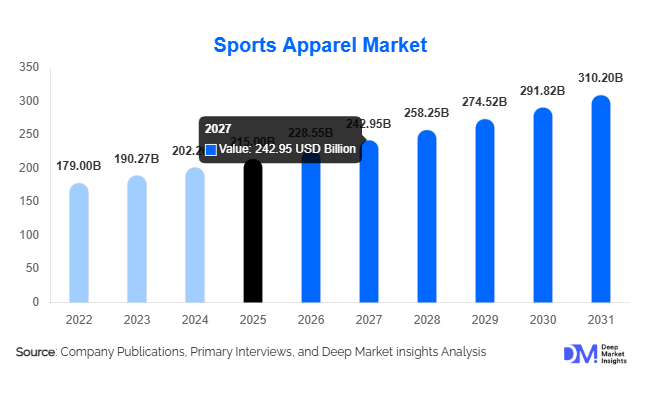
According to Deep Market Insights, the global sports apparel market size was valued at USD 215 billion in 2025 and is projected to grow from USD 228.55 billion in 2026 to reach USD 310.20 billion by 2031, expanding at a CAGR of 6.3% during the forecast period (2026–2031). The sports apparel market growth is primarily driven by increasing health awareness, the rapid adoption of athleisure fashion, and rising participation in fitness and recreational sports globally. The convergence of performance wear and everyday fashion has expanded consumer adoption across demographics, making sports apparel a core component of modern wardrobes.
Key Market Insights
- Athleisure continues to dominate product demand, accounting for nearly 40% of total market consumption globally.
- Polyester-based performance apparel leads fabric adoption, driven by durability and moisture-wicking properties.
- North America dominates the global market, contributing approximately 35% of total revenue in 2025.
- Asia-Pacific is the fastest-growing region, fueled by rising disposable incomes and urban fitness trends.
- Online retail is rapidly expanding, supported by direct-to-consumer strategies and digital engagement.
- Sustainability and eco-friendly materials are emerging as critical purchasing criteria among consumers.
What are the latest trends in the sports apparel market?
Rise of Athleisure as Everyday Wear
The increasing integration of sportswear into daily fashion is one of the most significant trends shaping the market. Athleisure apparel, designed to be worn both during exercise and casual activities, has gained widespread popularity across age groups. Consumers are prioritizing comfort, versatility, and style, driving demand for products such as leggings, hoodies, and performance T-shirts. This trend has enabled brands to expand beyond traditional sports categories and target lifestyle-oriented consumers. Collaborations between sportswear brands and fashion designers are further accelerating this shift, making sports apparel a staple in urban fashion globally.
Technological Advancements in Fabric Innovation
Innovation in fabric technology is redefining product performance and consumer expectations. Advanced materials offering moisture-wicking, anti-microbial, temperature regulation, and stretch capabilities are becoming standard features. Smart textiles embedded with sensors for tracking physical activity and biometric data are also gaining traction. These innovations are enhancing athletic performance while enabling premium pricing strategies for brands. Additionally, lightweight and breathable materials are increasingly preferred, especially in regions with warmer climates, further driving technological advancements in textile manufacturing.
What are the key drivers in the sports apparel market?
Growing Health and Fitness Awareness
The global shift toward healthier lifestyles is a major driver of sports apparel demand. Increasing gym memberships, participation in marathons, and home fitness adoption are fueling the need for performance-oriented clothing. Governments and organizations promoting physical activity are also contributing to sustained market growth. Post-pandemic behavioral changes have further reinforced fitness as a long-term priority, boosting apparel consumption across both developed and emerging markets.
Expansion of E-Commerce and Direct-to-Consumer Channels
The rapid growth of e-commerce platforms has transformed how consumers purchase sports apparel. Brands are increasingly leveraging direct-to-consumer models to enhance customer engagement, improve margins, and control brand positioning. Online channels offer convenience, product variety, and competitive pricing, making them highly attractive to consumers. Personalized recommendations, digital marketing, and seamless logistics are further accelerating online sales growth globally.
What are the restraints for the global market?
Volatility in Raw Material Prices
Fluctuations in the prices of synthetic fibers such as polyester and nylon pose a significant challenge for manufacturers. These materials are closely linked to crude oil prices, making cost structures highly sensitive to market volatility. This impacts pricing strategies and profit margins, particularly for mid-range and economy segments where price sensitivity is high.
Intense Market Competition
The sports apparel market is highly competitive, with global giants and regional players competing aggressively across price segments. This leads to pricing pressure and reduced margins, especially in commoditized product categories. The need for continuous innovation, marketing investments, and brand differentiation further increases operational costs for market participants.
What are the key opportunities in the sports apparel industry?
Expansion in Emerging Markets
Emerging economies such as India, Brazil, and Southeast Asian countries present significant growth opportunities due to rising disposable incomes and increasing urbanization. The growing middle-class population in these regions is driving demand for affordable yet stylish sports apparel. Localization of product offerings and pricing strategies can help companies tap into these high-growth markets effectively.
Integration of Smart Wearables and Apparel
The convergence of apparel and technology is creating new growth avenues. Smart sportswear with embedded sensors for tracking fitness metrics is gaining popularity among tech-savvy consumers. This segment offers premium pricing potential and differentiation for brands investing in research and development. Partnerships with technology companies can further accelerate innovation in this space.
Report Scope
| Report Metric | Details |
|---|---|
| Market Size in 2025 | USD 215 Billion |
| Market Size in 2026 | USD 228.55 Billion |
| Market Size in 2031 | USD 310.20 Billion |
| CAGR | 6.3% (2026-2031) |
| Base Year for Estimation | 2025 |
| Historical Data | 2022-2024 |
| Forecast Period | 2026-2031 |
| Report Coverage | Revenue Forecast, Competitive Landscape, Supply Chain Disruption, Growth Factors, Environment & Regulatory Landscape and Trends |
| Geographies Covered | North America, Europe, APAC, Middle East and Africa, LATAM |
| Countries Covered | U.S., Canada, U.K., Germany, France, Spain, Italy, Russia, Nordic, Benelux, Rest of Europe, China, Korea, Japan, India, Australia, Singapore, Taiwan, South East Asia, Rest of Asia-Pacific, UAE, Turky, Saudi Arabia, South Africa, Egypt, Nigeria, Rest of MEA, Brazil, Mexico, Argentina, Chile, Colombia, Rest of LATAM |
Explore more data points, trends and opportunities Download Free Sample Report
Product Type Insights
Tops continue to dominate the sports apparel market, accounting for approximately 32% of total revenue in 2025, driven by their unmatched versatility across both performance and lifestyle use cases. Products such as T-shirts, jerseys, hoodies, and lightweight jackets are widely adopted across sports, gym activities, and casual wear, resulting in high purchase frequency and shorter replacement cycles. The increasing influence of athleisure has further strengthened demand for tops as everyday essentials. Bottoms, including leggings, joggers, and track pants, represent a substantial and fast-evolving segment, particularly driven by rising female participation in fitness and the global popularity of yoga and training wear. Compression wear is emerging as a high-value niche, supported by growing awareness of muscle recovery, injury prevention, and enhanced athletic performance. Meanwhile, outerwear demand remains regionally influenced, with colder climates and outdoor sports participation driving sales of performance jackets and thermal wear. Innovation in layering systems and weather-adaptive fabrics is further supporting growth across this segment.
Application Insights
Athleisure remains the leading application segment, contributing nearly 40% of the total market in 2025, primarily due to the global shift toward comfort-driven fashion and hybrid lifestyles. The blurring line between activewear and casual wear has significantly expanded the consumer base beyond athletes to include working professionals and younger demographics. The segment’s growth is driven by increasing demand for multifunctional apparel that seamlessly transitions between workouts and daily activities. Team sports apparel continues to maintain stable demand, supported by strong participation in sports such as football, basketball, and cricket, along with institutional purchases from clubs, schools, and leagues. Individual sports apparel, including running, gym, and yoga wear, is witnessing steady growth due to rising health consciousness and the proliferation of fitness centers and home workout routines. Additionally, outdoor and adventure apparel is gaining traction, fueled by increasing interest in recreational activities such as hiking, trekking, and camping, particularly among millennials and Gen Z consumers seeking experiential lifestyles.
Distribution Channel Insights
Offline retail remains the dominant distribution channel, accounting for approximately 60% of total sales in 2025, largely due to the importance of physical product trials, brand experience, and immediate purchase gratification. Brand-exclusive outlets and specialty sports stores continue to attract consumers seeking personalized service, product authenticity, and immersive retail environments. However, online retail is the fastest-growing channel, driven by increasing digital adoption, convenience, and competitive pricing. E-commerce platforms enable brands to reach a wider audience, particularly in emerging markets where physical retail infrastructure may be limited. Direct-to-consumer (DTC) channels are gaining significant momentum, allowing brands to enhance customer engagement, leverage data analytics, and improve profit margins by eliminating intermediaries. The integration of omnichannel strategies, such as click-and-collect and seamless return policies, is further reshaping the distribution landscape.
End-User Insights
The men’s segment leads the sports apparel market with approximately 48% share in 2025, driven by higher participation in organized sports, greater spending on performance-oriented apparel, and strong brand loyalty. However, the women’s segment is the fastest-growing, supported by increasing engagement in fitness activities, expanding product offerings tailored to female consumers, and the rising popularity of athleisure. Brands are actively focusing on inclusivity, design innovation, and comfort to capture this segment. The kids’ segment is also experiencing steady growth, driven by increasing awareness of sports participation, school-level athletic programs, and rising parental expenditure on activewear. Additionally, the growing trend of mini-me fashion and branded children’s apparel is further supporting demand in this category.
Explore more data points, trends and opportunities Download Free Sample Report
Sports Apparel Market Segmentations
By Product Type
- Tops
- Bottoms
- Innerwear & Compression Wear
- Swimwear
- Outerwear
By Application
- Athleisure
- Team Sports Apparel
- Individual Sports Apparel
- Outdoor & Adventure Apparel
By Distribution Channel
- Offline Retail
- Online Retail
By End-User
- Men
- Women
- Kids
By Fabric Type
- Polyester-Based Apparel
- Cotton-Based Apparel
- Nylon-Based Apparel
- Blended/Performance Fabrics
Regional Insights
North America
North America dominates the global sports apparel market with approximately 35% market share in 2025, led by the United States. The region’s growth is primarily driven by high consumer spending power, a deeply ingrained fitness culture, and strong brand presence from global leaders. The increasing popularity of athleisure as everyday wear, coupled with widespread gym memberships and participation in sports leagues, continues to drive demand. Additionally, advanced e-commerce infrastructure and strong direct-to-consumer strategies have enabled brands to scale rapidly. Canada contributes to regional growth through rising interest in outdoor and winter sports, further boosting demand for specialized apparel.
Europe
Europe accounts for around 25% of the global market, with key countries including Germany, the United Kingdom, and France. The region’s growth is strongly influenced by sustainability trends, with consumers increasingly demanding eco-friendly and ethically produced apparel. Stringent environmental regulations and growing awareness around carbon footprints are encouraging brands to adopt recycled materials and circular production models. Additionally, the popularity of football and other organized sports continues to sustain demand for team sports apparel. Premiumization trends and a strong preference for high-quality products further support market expansion in this region.
Asia-Pacific
Asia-Pacific is the fastest-growing region, expanding at a CAGR of approximately 8%, driven by rapid urbanization, rising disposable incomes, and increasing health awareness. China and India are the primary growth engines, supported by large populations and expanding middle-class segments. The region is witnessing a surge in gym memberships, fitness apps, and sports participation, significantly boosting demand for sports apparel. Additionally, the rapid growth of e-commerce platforms and the presence of cost-effective manufacturing hubs are enabling both domestic and international brands to scale operations efficiently. Government initiatives promoting sports and fitness are also playing a key role in accelerating market growth.
Latin America
Latin America is experiencing steady growth, with Brazil and Mexico emerging as key markets. The region’s demand is primarily driven by the strong cultural influence of football and increasing interest in fitness activities. Expanding retail infrastructure and the growing presence of international brands are improving product accessibility. Rising urbanization and a gradually expanding middle-class population are also contributing to increased consumer spending on sports apparel. Additionally, social media influence and celebrity endorsements are playing a growing role in shaping purchasing behavior.
Middle East & Africa
The Middle East & Africa region is witnessing gradual but consistent growth, supported by increasing investments in sports infrastructure and rising health awareness. Countries such as the UAE and Saudi Arabia are leading demand due to high disposable incomes and government-led initiatives aimed at promoting active lifestyles. Large-scale sporting events and infrastructure development projects are further boosting demand for sports apparel. In Africa, improving retail penetration and a growing population are contributing to market expansion, although growth remains uneven across countries due to economic disparities. The increasing adoption of Western fashion trends and the expansion of international brands are expected to further drive demand in the region.