Sports and Athletics Socks Market Size
According to Deep Market Insights, the global sports and athletics socks market size was valued at USD 8,450 million in 2025 and is projected to grow from USD 9,066.85 million in 2026 to reach USD 12,018.64 million by 2031, expanding at a CAGR of 7.3% during the forecast period (2026–2031). The market growth is primarily driven by rising global participation in fitness and sports activities, increasing demand for performance-enhancing apparel, and the growing popularity of athleisure trends across both developed and emerging economies.
Key Market Insights
- Performance-driven product innovation is reshaping the market, with moisture-wicking, compression, and temperature-regulating socks gaining widespread adoption.
- Athleisure trends are expanding usage beyond sports, increasing demand for stylish yet functional socks in everyday wear.
- North America dominates the global market, driven by high sports participation and the strong presence of premium brands.
- Asia-Pacific is the fastest-growing region, supported by rising disposable income, urbanization, and government-led sports initiatives.
- E-commerce and D2C channels are rapidly gaining traction, enabling brands to reach consumers directly and improve margins.
- Sustainability is emerging as a key differentiator, with increasing demand for eco-friendly materials such as organic cotton and recycled polyester.
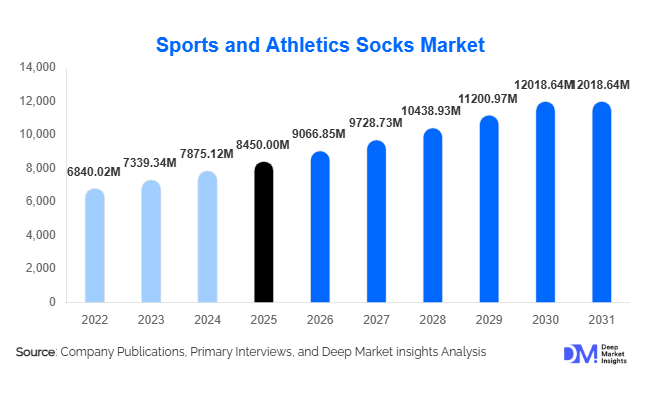
What are the latest trends in the sports and athletics socks market?
Rise of Smart and Functional Textiles
The market is witnessing increasing adoption of advanced textile technologies, including antimicrobial coatings, moisture management systems, and compression-based designs. Smart socks embedded with sensors for performance tracking are emerging as a niche yet high-growth segment. These innovations are particularly appealing to professional athletes and fitness enthusiasts seeking enhanced performance and injury prevention. Manufacturers are also focusing on seamless knitting technologies and ergonomic designs that improve comfort and durability, further driving consumer preference toward premium offerings.
Shift Toward Sustainable and Eco-Friendly Products
Sustainability is becoming a central trend in the sports and athletics socks market. Consumers are increasingly favoring products made from recycled fibers, organic cotton, and biodegradable materials. Brands are adopting circular economy practices, including recycling programs and low-impact manufacturing processes. Regulatory pressures and corporate sustainability goals are also encouraging companies to reduce carbon footprints and adopt environmentally responsible sourcing practices, making sustainability a key competitive differentiator.
What are the key drivers in the sports and athletics socks market?
Growing Global Fitness and Sports Participation
The increasing awareness of health and wellness is significantly boosting demand for sports apparel, including socks. Rising participation in activities such as running, gym workouts, and outdoor sports is driving consistent demand across all demographics. Organized sports events, marathons, and fitness programs are further contributing to market growth.
Technological Advancements in Fabric and Design
Innovations in textile engineering, such as moisture-wicking fibers, compression support, and temperature regulation, are enhancing product functionality. These features improve athletic performance and comfort, encouraging consumers to opt for premium products and increasing repeat purchases.
Expansion of Athleisure and Casual Wear Trends
The blending of sportswear with casual fashion has expanded the use of athletic socks beyond sports activities. Consumers are increasingly incorporating athletic socks into everyday outfits, driving higher sales volumes and broadening the customer base.
What are the restraints for the global market?
High Price Sensitivity in Emerging Markets
The presence of numerous local and unorganized players in developing regions creates intense price competition. Consumers in these markets are highly price-sensitive, limiting the adoption of premium products and impacting overall profit margins for established brands.
Volatility in Raw Material Prices
Fluctuating prices of key raw materials such as cotton and synthetic fibers pose a significant challenge. Variations in input costs can affect manufacturing expenses and force companies to adjust pricing strategies, potentially impacting demand and profitability.
What are the key opportunities in the sports and athletics socks industry?
Expansion in Emerging Markets
Rapid urbanization and increasing disposable incomes in countries such as India, China, and Brazil present significant growth opportunities. Government initiatives promoting sports participation and fitness are further driving demand in these regions. Companies can leverage localized production and pricing strategies to capture these markets.
Growth of Direct-to-Consumer and E-commerce Channels
The expansion of online retail platforms allows brands to directly engage with consumers, reducing dependency on intermediaries. Personalized offerings, subscription models, and targeted digital marketing are enhancing customer retention and improving profit margins.
Integration of Advanced and Smart Technologies
The development of smart socks with embedded sensors and advanced performance features represents a high-growth opportunity. These products cater to professional athletes and tech-savvy consumers, enabling brands to differentiate themselves and capture premium segments.
Report Scope
| Report Metric | Details |
|---|---|
| Market Size in 2025 | USD 8450 Million |
| Market Size in 2026 | USD 9066.85 Million |
| Market Size in 2031 | USD 12018.64 Million |
| CAGR | 7.3% (2026-2031) |
| Base Year for Estimation | 2025 |
| Historical Data | 2022-2024 |
| Forecast Period | 2026-2031 |
| Report Coverage | Revenue Forecast, Competitive Landscape, Supply Chain Disruption, Growth Factors, Environment & Regulatory Landscape and Trends |
| Geographies Covered | North America, Europe, APAC, Middle East and Africa, LATAM |
| Countries Covered | U.S., Canada, U.K., Germany, France, Spain, Italy, Russia, Nordic, Benelux, Rest of Europe, China, Korea, Japan, India, Australia, Singapore, Taiwan, South East Asia, Rest of Asia-Pacific, UAE, Turky, Saudi Arabia, South Africa, Egypt, Nigeria, Rest of MEA, Brazil, Mexico, Argentina, Chile, Colombia, Rest of LATAM |
Explore more data points, trends and opportunities Download Free Sample Report
Product Type Insights
Performance socks dominate the global sports and athletics socks market, accounting for approximately 42% of the total market share in 2025. This leadership is primarily driven by increasing consumer demand for functional and performance-enhancing features such as compression support, moisture-wicking capabilities, arch support, and targeted cushioning. The rising participation in high-intensity fitness activities, including marathon running, gym training, and professional sports, has significantly accelerated the adoption of performance socks. Additionally, technological advancements in knitting techniques and ergonomic designs have further enhanced durability and comfort, encouraging repeat purchases and premiumization trends.
Specialty sports socks, including running, hiking, cycling, and skiing variants, are gaining strong traction as sports participation becomes more activity-specific. Consumers are increasingly opting for sport-specific gear that improves performance and reduces injury risk. Meanwhile, basic athletic socks continue to maintain steady demand, particularly in price-sensitive and mass-market segments, due to their affordability, versatility, and widespread usage in both sports and casual wear. However, their growth rate remains slower compared to performance-driven segments due to limited differentiation.
Material Insights
Synthetic fibers lead the market with around 48% share in 2025, driven by their superior durability, elasticity, and moisture management properties. Materials such as polyester, nylon, and elastane are widely preferred for their ability to withstand intense physical activity while maintaining shape and comfort. The growing demand for high-performance sportswear is further reinforcing the dominance of synthetic materials, particularly in professional and high-end consumer segments.
Blended fabrics are witnessing increasing adoption as they combine the comfort of natural fibers with the functional advantages of synthetics. These blends offer improved breathability, softness, and performance, making them highly attractive in mid-range and premium product categories. Natural fibers such as cotton and wool continue to hold relevance, particularly in casual athletic use and outdoor activities. Wool, especially merino wool, is gaining traction in cold-weather sports due to its thermal insulation and odor-resistant properties. However, the shift toward performance-oriented materials is gradually limiting the growth of pure natural fiber segments.
Distribution Channel Insights
Offline retail channels dominate the market with approximately 55% market share in 2025, as consumers continue to prefer physical evaluation of product quality, fit, and comfort before purchase. Specialty sports stores and branded outlets play a crucial role in influencing buying decisions by offering expert guidance and product trials. Additionally, strong brand visibility and in-store promotions contribute to sustained dominance of offline channels.
However, online retail channels are experiencing rapid growth, driven by increasing digital penetration, convenience, and access to a wider range of products. E-commerce platforms and direct-to-consumer (D2C) brand websites are enabling competitive pricing, personalized recommendations, and seamless shopping experiences. The rise of influencer marketing, social media engagement, and subscription-based models is further accelerating online sales. Over time, the shift toward omnichannel strategies is expected to redefine distribution dynamics in the market.
End-Use Insights
The men’s segment leads the market with approximately 46% share in 2025, driven by higher participation rates in organized sports, fitness activities, and outdoor recreation. Men also tend to have higher purchase frequency for sports apparel, particularly in performance-driven categories, contributing to their dominant market position. The women’s segment is emerging as the fastest-growing category, supported by increasing awareness of health and wellness, rising female participation in sports, and expanding availability of women-specific athletic products. Brands are actively targeting this segment with tailored designs, improved fit, and enhanced comfort features.
The kids segment demonstrates steady demand, primarily driven by school sports programs, youth athletic training, and increasing parental focus on physical fitness for children. Growth in this segment is also supported by the expansion of organized youth sports leagues and rising disposable incomes in emerging markets.
Activity Type Insights
Individual sports account for approximately 45% of the global market, making it the leading segment. This dominance is driven by the global rise in personal fitness activities such as running, gym workouts, yoga, and cycling. The flexibility, convenience, and accessibility of individual sports have significantly contributed to their widespread adoption, particularly among urban populations.
Team sports continue to maintain strong demand, especially in regions with established sports cultures such as North America and Europe, where football, basketball, and cricket drive consistent consumption of athletic gear. Meanwhile, outdoor and adventure activities are emerging as a high-growth segment, fueled by increasing interest in hiking, trekking, and recreational sports. The growing popularity of experiential travel and adventure tourism is further supporting demand for specialized socks designed for rugged environments.
Explore more data points, trends and opportunities Download Free Sample Report
Sports and Athletics Socks Market Segmentations
By Product Type
- Performance Socks
- Specialty Sports Socks
- Basic Athletic Socks
By Material
- Synthetic Fibers
- Natural Fibers
- Blended Fabrics
By End-Use
- Men
- Women
- Kids
By Distribution Channel
- Online Retail
- Specialty Sports Stores
- Supermarkets/Hypermarkets
- Brand Outlets
By Activity Type
- Individual Sports
- Team Sports
- Outdoor & Adventure Activities
By Price Range
- Economy
- Mid-Range
- Premium
Regional Insights
North America
North America holds approximately 32% of the global market share in 2025, with the United States accounting for the majority of regional demand. The region’s dominance is driven by high participation in sports and fitness activities, strong consumer purchasing power, and widespread adoption of premium and technologically advanced products. Additionally, the presence of leading global sportswear brands, well-established retail infrastructure, and high awareness of performance-enhancing apparel further support market growth. Increasing trends in athleisure and wellness lifestyles are also key drivers fueling sustained demand.
Europe
Europe accounts for around 27% of the global market share, led by countries such as Germany, the United Kingdom, and France. The region’s growth is driven by a strong sports culture, particularly in football and outdoor recreational activities such as hiking and cycling. Increasing consumer preference for sustainable and eco-friendly products is also shaping market dynamics, with European consumers showing higher adoption of organic and recycled materials. Government initiatives promoting active lifestyles and sports participation further contribute to steady market expansion.
Asia-Pacific
Asia-Pacific is the fastest-growing region, with a projected CAGR exceeding 9%. China and India are the primary growth engines, supported by rapid urbanization, rising disposable incomes, and expanding middle-class populations. Government-led initiatives promoting sports and fitness, along with increasing investments in sports infrastructure, are significantly boosting demand. Additionally, the growing influence of Western fitness trends, coupled with the expansion of e-commerce platforms, is accelerating market penetration. The region also benefits from strong manufacturing capabilities, enabling cost-effective production and export opportunities.
Latin America
Latin America demonstrates moderate growth, with Brazil and Mexico as key markets. The region’s demand is driven by strong cultural affinity toward sports, particularly football, and increasing participation in fitness activities. Rising urbanization and improving economic conditions are contributing to higher consumer spending on sports apparel. However, price sensitivity remains a challenge, encouraging demand for mid-range and affordable products. Expansion of retail networks and growing online penetration are expected to further support market growth.
Middle East & Africa
The Middle East & Africa region is emerging as a promising growth market, led by countries such as the UAE, Saudi Arabia, and South Africa. Increasing investments in sports infrastructure, including stadiums, fitness centers, and international sporting events, are driving demand for athletic apparel. Rising health awareness and government initiatives promoting active lifestyles are also key growth drivers. In addition, the region’s young population and growing interest in recreational sports are contributing to market expansion. However, market growth remains uneven due to varying economic conditions across countries.