Spice Rack Stand Market Size
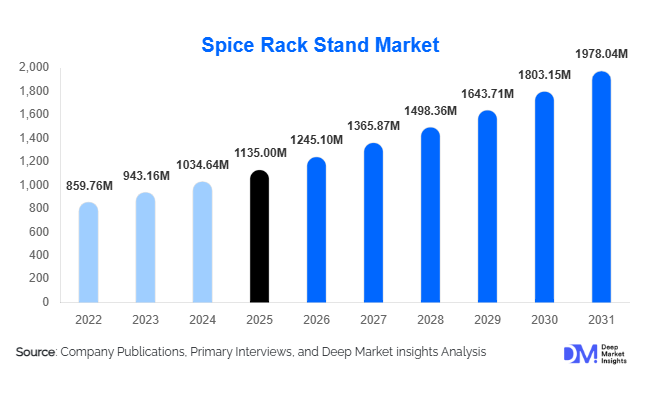
According to Deep Market Insights, the global spice rack stand market size was valued at USD 1,135 million in 2025 and is projected to grow from USD 1,245.10 million in 2026 to reach USD 1,978.04 million by 2031, expanding at a CAGR of 9.7% during the forecast period (2026–2031). Market growth is primarily driven by increasing adoption of modular kitchens, rising consumer focus on kitchen organization and space optimization, and growing demand for aesthetically designed storage accessories across residential and commercial kitchens worldwide.
Key Market Insights
- Kitchen organization trends are reshaping consumer purchasing behavior, with spice rack stands evolving from functional accessories into lifestyle and décor products.
- Urbanization and smaller living spaces are accelerating adoption of compact and multi-functional kitchen storage solutions globally.
- Asia-Pacific dominates production and consumption, supported by expanding middle-class households and rapid modular kitchen installations.
- Online retail channels are transforming distribution, enabling global access to diverse designs and price segments.
- Sustainable materials such as bamboo and recyclable metals are gaining popularity among environmentally conscious consumers.
- Commercial kitchens and cloud kitchens are emerging as new demand centers requiring standardized ingredient organization systems.
What are the latest trends in the spice rack stand market?
Rise of Modular and Space-Saving Kitchen Solutions
Modern urban housing designs increasingly prioritize compact kitchens, driving demand for efficient storage accessories such as spice rack stands. Consumers are shifting toward modular and expandable rack systems that maximize storage within limited countertop or cabinet space. Pull-out cabinet racks, magnetic mounting systems, and adjustable modular units are gaining traction as they offer flexibility and adaptability to evolving kitchen layouts. Interior designers and modular kitchen manufacturers are increasingly integrating spice organization solutions into standard kitchen installations, transforming spice racks into essential kitchen components rather than optional accessories.
Premiumization and Design-Led Innovation
The market is witnessing strong premiumization driven by consumer interest in aesthetically appealing kitchens. Stainless steel finishes, minimalist Scandinavian designs, and eco-friendly bamboo structures are increasingly preferred over traditional plastic racks. Brands are investing in ergonomic layouts, labeled containers, and coordinated kitchen organization systems to enhance usability and visual appeal. Social media platforms and home décor influencers are further accelerating this trend by promoting organized kitchens as lifestyle aspirations, encouraging consumers to upgrade storage accessories alongside appliances and cabinetry.
What are the key drivers in the spice rack stand market?
Growing Home Cooking Culture
Increasing interest in home cooking and culinary experimentation has significantly expanded the number of spices used in households. Consumers preparing diverse cuisines require better ingredient organization, directly boosting demand for spice rack stands. Cooking content across digital platforms has reinforced organized kitchens as functional necessities, encouraging frequent product upgrades.
Expansion of Modular Kitchen Installations
The rapid growth of modular kitchen adoption across Asia-Pacific, North America, and Europe is a major growth driver. New residential construction and renovation activities increasingly include customized storage accessories. Spice racks integrated within cabinets or drawers enhance workflow efficiency and kitchen ergonomics, supporting consistent demand from both new homeowners and renovation projects.
What are the restraints for the global market?
Price Sensitivity in Emerging Economies
In developing markets, consumers often rely on traditional storage containers instead of dedicated racks due to cost considerations. Economy alternatives and DIY storage solutions limit penetration of premium spice rack products, particularly in price-sensitive regions.
Raw Material Price Volatility
Fluctuations in steel, aluminum, and wood prices impact manufacturing costs and profit margins. Since spice racks are considered semi-discretionary purchases, manufacturers face challenges in passing cost increases to consumers without affecting demand.
What are the key opportunities in the spice rack stand industry?
Integration with Smart and Modular Kitchens
Smart kitchen ecosystems present new opportunities for manufacturers to introduce customizable and technology-integrated spice storage systems. Modular racks compatible with smart inventory tracking, labeling systems, and ergonomic layouts are expected to attract premium buyers and commercial kitchens seeking operational efficiency.
Expansion Through Cross-Border E-commerce
E-commerce platforms have lowered market entry barriers, enabling manufacturers to reach international consumers directly. Export-oriented production from Asia to North America and Europe is expanding rapidly, supported by private-label manufacturing and direct-to-consumer strategies that improve margins and customer engagement.
Report Scope
| Report Metric | Details |
|---|---|
| Market Size in 2025 | USD 1135 Million |
| Market Size in 2026 | USD 1245.10 Million |
| Market Size in 2031 | USD 1978.04 Million |
| CAGR | 9.7% (2026-2031) |
| Base Year for Estimation | 2025 |
| Historical Data | 2022-2024 |
| Forecast Period | 2026-2031 |
| Report Coverage | Revenue Forecast, Competitive Landscape, Supply Chain Disruption, Growth Factors, Environment & Regulatory Landscape and Trends |
| Geographies Covered | North America, Europe, APAC, Middle East and Africa, LATAM |
| Countries Covered | U.S., Canada, U.K., Germany, France, Spain, Italy, Russia, Nordic, Benelux, Rest of Europe, China, Korea, Japan, India, Australia, Singapore, Taiwan, South East Asia, Rest of Asia-Pacific, UAE, Turky, Saudi Arabia, South Africa, Egypt, Nigeria, Rest of MEA, Brazil, Mexico, Argentina, Chile, Colombia, Rest of LATAM |
Explore more data points, trends and opportunities Download Free Sample Report
Product Type Insights
The global spice rack stand market demonstrates strong diversification across product types, with countertop spice rack stands maintaining a dominant position and accounting for approximately 34% of total market demand. Their leadership is primarily attributed to ease of installation, portability, and compatibility with both traditional and modern kitchen layouts. Consumers increasingly prefer solutions that require minimal structural modification, making countertop models particularly attractive for rental homes and urban apartments. The growing trend of kitchen organization and visibility of ingredients during cooking further strengthens demand for accessible countertop storage solutions.Wall-mounted and cabinet-integrated spice racks are witnessing steady expansion as modular kitchen adoption accelerates globally. These solutions optimize vertical space utilization and contribute to clutter-free kitchen environments, aligning with contemporary interior design trends focused on minimalism and functionality. Pull-out spice rack systems are gaining strong traction within premium residential developments and high-end renovations, where space optimization and ergonomic convenience are prioritized. Rotating carousel racks continue to appeal to households seeking efficient accessibility within compact storage spaces, especially in smaller kitchens.Emerging formats such as magnetic and expandable spice racks are gaining momentum due to rising urbanization and shrinking living spaces. These innovative designs enable flexible storage arrangements and cater to consumers seeking customizable organization solutions. Manufacturers are increasingly incorporating modular features, adjustable compartments, and aesthetic customization options to enhance product differentiation and address evolving consumer preferences for multifunctional kitchen accessories.
Material Insights
Material selection plays a critical role in shaping consumer purchasing decisions, influencing durability, aesthetics, sustainability, and pricing. Stainless steel spice racks account for nearly 29% of the global market and remain the leading material segment due to their superior durability, corrosion resistance, and compatibility with modern kitchen interiors. The material’s hygienic properties and long product lifespan make it particularly suitable for both residential and commercial kitchen environments. Increasing preference for premium kitchen finishes continues to support stainless steel adoption worldwide.Wooden and bamboo spice racks are experiencing rising popularity, especially among environmentally conscious consumers seeking sustainable home products. European markets in particular are driving demand for eco-friendly materials supported by stringent sustainability regulations and growing awareness of renewable resources. Natural textures and aesthetic warmth also contribute to their appeal in contemporary and rustic kitchen designs.Plastic spice racks maintain strong penetration within the economy segment due to affordability, lightweight construction, and mass-market accessibility. These products remain highly popular in emerging economies where price sensitivity influences purchasing behavior. Meanwhile, hybrid-material designs combining metal structures with glass or acrylic containers are expanding rapidly within premium categories. These designs offer enhanced durability alongside visual transparency, allowing users to easily identify stored spices while maintaining aesthetic appeal.
Distribution Channel Insights
Distribution dynamics within the spice rack stand market are undergoing significant transformation as digital commerce reshapes consumer buying behavior. Online retail accounts for approximately 41% of global sales and represents the fastest-growing distribution channel. The leading driver of this segment is the increasing consumer preference for convenience-driven purchasing supported by detailed product comparisons, user reviews, competitive pricing, and doorstep delivery services. E-commerce platforms enable manufacturers to reach geographically diverse consumers while offering wider product assortments than traditional retail formats.Offline retail channels continue to maintain relevance, particularly among consumers who prefer physical evaluation of product quality, material finish, and size compatibility before purchase. Home improvement stores, hypermarkets, and specialty kitchenware outlets provide experiential purchasing environments that support consumer confidence. Retailers are increasingly integrating omnichannel strategies, allowing customers to research products online while completing purchases in-store.Direct-to-consumer brand websites are expanding steadily as manufacturers invest in digital marketing, customization tools, and personalized product offerings. This channel enables stronger brand engagement, improved margins, and data-driven product development strategies. Subscription-based kitchen organization solutions and bundled accessory offerings are also emerging as companies seek to strengthen long-term customer relationships.
End-Use Insights
Residential households represent the largest end-use segment, accounting for nearly 72% of global demand. The leading driver for this segment is the rising consumer focus on home organization, efficiency in cooking processes, and increased investment in kitchen renovations. The growth of home cooking trends, influenced by lifestyle changes and digital culinary content, has encouraged consumers to adopt structured ingredient storage systems that enhance accessibility and visual organization.The commercial foodservice sector is the fastest-growing end-use segment, supported by expansion of restaurants, quick-service outlets, and cloud kitchens worldwide. Organized spice storage improves operational efficiency, reduces preparation time, and supports standardized food preparation practices. Compliance with hygiene and food safety regulations further encourages adoption of durable and easy-to-clean spice rack solutions within professional kitchens.Institutional kitchens, including hospitals, educational facilities, and corporate cafeterias, are increasingly implementing organized storage systems to meet strict food safety standards and inventory management requirements. Growth in large-scale meal preparation facilities and centralized catering operations continues to create new opportunities for durable, high-capacity spice rack installations.
Explore more data points, trends and opportunities Download Free Sample Report
Spice Rack Stand Market Segmentations
By Product Type
- Countertop Spice Rack Stands
- Wall-Mounted Spice Rack Stands
- Cabinet/Door-Mounted Spice Rack Stands
- Pull-Out & Drawer-Integrated Spice Rack Systems
- Rotating (Carousel) Spice Rack Stands
- Magnetic Spice Rack Stands
- Modular & Expandable Spice Rack Systems
By Material Type
- Stainless Steel
- Wood & Bamboo
- Plastic & Polymer-Based
- Glass-Integrated Structures
- Aluminum & Metal Alloys
- Hybrid Material Designs
By Distribution Channel
- Online Retail
- Hypermarkets & Supermarkets
- Home Improvement Stores
- Specialty Kitchenware Stores
- Furniture Retail Chains
By End User
- Residential Households
- Commercial Foodservice Kitchens
- Institutional Kitchens
Regional Insights
North America
North America accounts for approximately 27% of the global spice rack stand market, supported by strong consumer spending on home improvement and organized living solutions across the United States and Canada. Regional growth is driven by increasing kitchen remodeling activities, high adoption of modular kitchen designs, and strong penetration of premium home organization products. The popularity of open kitchen layouts encourages aesthetically appealing storage solutions that combine functionality with design appeal. Additionally, widespread e-commerce adoption and strong presence of home organization brands accelerate product accessibility. Growing interest in cooking at home and culinary experimentation further strengthens demand for efficient spice organization systems.
Europe
Europe holds nearly 22% of the global market share, with Germany, the United Kingdom, France, and Italy serving as major demand centers. Regional growth is strongly influenced by sustainability-focused consumer behavior and regulatory emphasis on environmentally responsible materials. Increasing adoption of bamboo, recycled materials, and eco-certified products reflects the region’s preference for sustainable household solutions. Mature kitchen renovation culture, compact urban housing, and strong interior design trends emphasizing minimalism and organization continue to drive steady market expansion. The presence of established kitchen furniture manufacturers also supports integration of built-in spice storage solutions.
Asia-Pacific
Asia-Pacific dominates the global market with approximately 38% share and represents the fastest-growing regional segment. Rapid urbanization, rising disposable incomes, and expanding middle-class populations in China and India are primary growth drivers. Increasing adoption of modular kitchens and modern housing developments significantly boosts demand for organized storage accessories. The region’s dense urban living conditions encourage compact and multifunctional storage solutions, supporting growth of magnetic, expandable, and space-saving spice racks. Japan and South Korea contribute through strong demand for premium, space-efficient kitchen products tailored to smaller living environments, while expanding e-commerce ecosystems enhance product availability across emerging markets.
Latin America
Latin America demonstrates moderate yet consistent growth, led by Brazil and Mexico. Regional expansion is supported by rising urbanization, improving household purchasing power, and increasing penetration of organized retail channels. Growth in middle-income households is encouraging adoption of practical kitchen organization products that enhance convenience and efficiency. Expansion of modern retail formats and online marketplaces is improving product visibility and accessibility, particularly for mid-range spice rack solutions. Increasing interest in home improvement and cooking culture also contributes to gradual market development.
Middle East & Africa
The Middle East and Africa region is witnessing growing demand driven by rapid residential construction, luxury housing developments, and expansion of the hospitality sector in countries such as the United Arab Emirates and Saudi Arabia. Rising investments in hotels, restaurants, and large-scale catering facilities significantly contribute to commercial kitchen installations requiring organized storage systems. Increasing urban population growth and adoption of modern kitchen layouts are further supporting residential demand. Premium product adoption is particularly strong in Gulf Cooperation Council countries, where consumers prioritize design aesthetics, durability, and high-quality kitchen accessories.
Key Players in the Spice Rack Stand Market
- IKEA
- Simplehuman
- Rubbermaid Commercial Products
- YouCopia Products Inc.
- Copco (Bradshaw Home)
- Spectrum Diversified Designs
- Joseph Joseph Ltd.
- OXO (Helen of Troy Limited)
- KitchenCraft
- Yamazaki Home
- iDesign
- Home Basics
- Cuisinart
- Rev-A-Shelf
- mDesign