Spice Jars Market Size
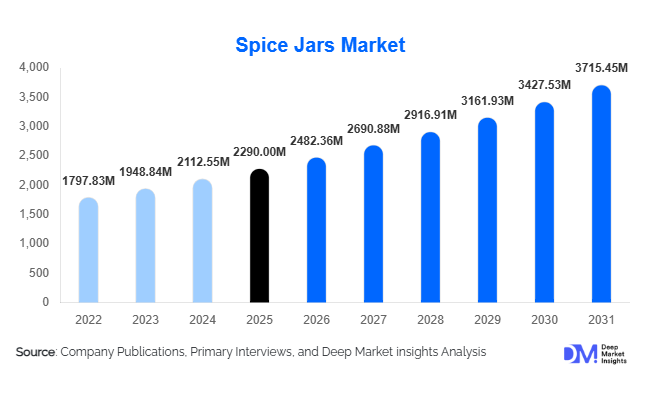
According to Deep Market Insights, the global spice jars market size was valued at USD 2,290 million in 2025 and is projected to grow from USD 2,482.36 million in 2026 to reach USD 3,715.45 million by 2031, expanding at a CAGR of 8.4% during the forecast period (2026–2031). The spice jars market growth is primarily driven by the increasing consumption of packaged spices, rising home cooking trends, and the growing popularity of organized kitchen storage solutions. Consumers worldwide are increasingly prioritizing hygienic food storage, durability, and aesthetic kitchen organization, driving demand for high-quality spice containers.
The market has evolved beyond simple storage containers into a lifestyle-driven kitchen organization category. Rising urbanization, modular kitchen installations, and the increasing influence of interior design trends are encouraging consumers to invest in standardized and visually appealing spice jar sets. Furthermore, the expansion of e-commerce platforms has significantly increased product accessibility, allowing consumers to purchase customized and premium storage solutions online. Glass jars with airtight lids, modular stackable containers, and smart labeling systems are becoming increasingly popular among urban households.
Key Market Insights
- Glass spice jars dominate the market due to durability, chemical stability, and increasing preference for sustainable kitchen storage materials.
- Household kitchens account for the majority of global demand, driven by rising home cooking culture and kitchen organization trends.
- Asia-Pacific holds the largest market share, supported by high spice consumption and expanding packaged spice industries.
- E-commerce channels are growing rapidly, enabling consumers to access premium and modular spice storage systems.
- Sustainable and eco-friendly materials, including recyclable glass and biodegradable composites, are gaining traction globally.
- Integration of modular kitchen systems is increasing demand for uniform spice storage containers compatible with racks and cabinets.
What are the latest trends in the spice jars market?
Rise of Modular Kitchen Storage Systems
Modern kitchens are increasingly adopting modular organization systems, and spice jars are becoming an integral component of these setups. Consumers prefer stackable jars, rotating racks, and uniform labeling systems that enhance both aesthetics and accessibility. Kitchen storage brands are introducing coordinated sets that combine jars with racks, drawers, and magnetic holders, enabling users to create visually organized cooking spaces. This trend is particularly strong in urban apartments where space optimization is crucial. Manufacturers are also focusing on ergonomic dispensing lids, transparent bodies for quick spice identification, and compact shapes designed to fit into standard kitchen cabinets and drawers.
Growing Demand for Sustainable and Reusable Containers
Sustainability concerns are pushing consumers and manufacturers toward eco-friendly spice storage solutions. Glass jars, bamboo lids, recycled plastics, and biodegradable composite materials are gaining popularity across global markets. Many brands are also introducing refillable spice packaging models that encourage consumers to reuse containers rather than discard them. This shift aligns with government regulations aimed at reducing single-use plastics. Retailers and spice brands are increasingly offering refill stations and recyclable packaging formats, which further strengthen demand for reusable spice jars. As sustainability awareness continues to grow, eco-friendly materials are expected to become a defining feature of premium kitchen storage products.
What are the key drivers in the spice jars market?
Increasing Popularity of Home Cooking
Home cooking has experienced a significant resurgence in recent years as consumers seek healthier and more cost-effective meal options. The trend toward experimenting with international cuisines has increased the variety of spices used in everyday cooking, thereby driving demand for organized storage solutions. Households increasingly require multiple containers to store spices separately while maintaining freshness and preventing contamination. Social media cooking trends, recipe platforms, and culinary content creators are also encouraging consumers to maintain well-organized kitchens, indirectly boosting spice jar sales.
Expansion of Packaged Spice Industry
The global spice processing and packaging industry has been expanding rapidly, particularly in emerging economies. Packaged spice brands require standardized containers for retail packaging, labeling, and shelf display. This demand has created strong procurement opportunities for spice jar manufacturers supplying bulk containers to food companies and private label retailers. Countries such as India, Vietnam, Indonesia, and China are major producers and exporters of spices, generating consistent demand for packaging containers used in domestic distribution and export markets.
What are the restraints for the global market?
Raw Material Price Volatility
The production of spice jars depends heavily on raw materials such as glass, stainless steel, and polymer resins. Fluctuations in energy prices and petrochemical supply chains directly impact manufacturing costs. Rising raw material prices can compress margins for manufacturers and lead to frequent price adjustments, particularly in the mid-range and premium segments.
High Competition in the Economy Segment
The low-cost spice jar segment remains highly fragmented, with numerous regional manufacturers producing similar designs. Limited product differentiation in this category intensifies price competition and reduces profitability. As a result, global brands are increasingly focusing on innovation, branding, and design improvements to differentiate their offerings from generic products.
What are the key opportunities in the spice jars industry?
Growth of Premium Kitchen Organization Products
Premium kitchen organization products represent a significant growth opportunity for spice jar manufacturers. Consumers are increasingly willing to invest in coordinated kitchen storage sets that include jars, racks, labels, and drawer organizers. Premium products offer improved sealing technologies, aesthetic designs, and long-lasting materials, allowing companies to achieve higher profit margins. As modular kitchens become more common in urban households, demand for premium spice storage systems is expected to increase significantly.
Expansion of Sustainable Packaging Solutions
Environmental regulations and consumer awareness are creating opportunities for sustainable spice storage products. Manufacturers adopting recyclable materials, biodegradable composites, and refillable packaging solutions can attract environmentally conscious consumers. In addition, sustainable products allow companies to build stronger brand loyalty and access eco-certified retail channels that prioritize environmentally responsible products.
Report Scope
| Report Metric | Details |
|---|---|
| Market Size in 2025 | USD 2290 Million |
| Market Size in 2026 | USD 2482.36 Million |
| Market Size in 2031 | USD 3715.45 Million |
| CAGR | 8.4% (2026-2031) |
| Base Year for Estimation | 2025 |
| Historical Data | 2022-2024 |
| Forecast Period | 2026-2031 |
| Report Coverage | Revenue Forecast, Competitive Landscape, Supply Chain Disruption, Growth Factors, Environment & Regulatory Landscape and Trends |
| Geographies Covered | North America, Europe, APAC, Middle East and Africa, LATAM |
| Countries Covered | U.S., Canada, U.K., Germany, France, Spain, Italy, Russia, Nordic, Benelux, Rest of Europe, China, Korea, Japan, India, Australia, Singapore, Taiwan, South East Asia, Rest of Asia-Pacific, UAE, Turky, Saudi Arabia, South Africa, Egypt, Nigeria, Rest of MEA, Brazil, Mexico, Argentina, Chile, Colombia, Rest of LATAM |
Explore more data points, trends and opportunities Download Free Sample Report
Material Type Insights
Glass spice jars dominate the global market, accounting for nearly 48% of total demand. The segment’s leadership is primarily driven by the material’s non-reactive nature, which prevents chemical interaction with spices and helps preserve their original flavor, aroma, and freshness for longer periods. In addition, the transparency of glass allows consumers to easily identify stored spices without opening the container, improving convenience and kitchen organization. Glass jars are also highly durable and reusable, making them a preferred choice among environmentally conscious consumers seeking sustainable storage solutions.Plastic spice jars represent the second-largest segment, supported by their lightweight construction, cost-effectiveness, and resistance to breakage. These characteristics make plastic containers particularly attractive for budget-conscious households, foodservice operations, and large-scale packaging applications. Manufacturers are also increasingly introducing BPA-free and recycled plastic variants to address growing sustainability concerns.Stainless steel and ceramic spice containers occupy a niche but growing segment, particularly in premium kitchenware categories. These materials are valued for their aesthetic appeal, durability, and compatibility with modern modular kitchen designs. Ceramic jars often feature decorative finishes that complement upscale kitchen interiors, while stainless steel options provide a sleek and professional appearance.Eco-friendly materials such as bamboo-fiber composites, biodegradable polymers, and recycled plastics are gaining traction as sustainability becomes a key purchasing criterion among consumers. Increasing environmental awareness and regulatory pressure on plastic waste are encouraging manufacturers to develop innovative and sustainable alternatives in the spice jar market.
Capacity Insights
The 100–250 ml capacity segment holds the largest share of the global spice jars market, representing approximately 42% of total demand. The dominance of this segment is driven by its optimal balance between storage capacity and usability, making it ideal for commonly used spices in household kitchens. Containers within this size range allow consumers to store sufficient quantities without risking flavor degradation due to prolonged storage.Spice jars with capacities below 100 ml are commonly used for storing rare, premium, or less frequently used spices such as saffron, specialty herbs, and imported seasoning blends. These compact containers are also favored in spice rack systems designed for space-efficient kitchen organization.Larger containers above 500 ml are primarily utilized in commercial kitchens, foodservice establishments, and food processing facilities where spices are used in bulk quantities. Restaurants, catering services, and cloud kitchens rely on these larger containers to ensure consistent availability of frequently used spices during high-volume food preparation.To address diverse consumer needs, manufacturers are increasingly offering multi-size spice jar sets that combine small, medium, and large containers within a single product package. These bundled sets enhance consumer convenience and allow users to organize spices based on usage frequency and storage requirements.
Distribution Channel Insights
Offline retail channels such as supermarkets, hypermarkets, specialty kitchenware stores, and department stores continue to dominate the distribution landscape for spice jars. The leading position of offline retail is driven by consumers’ preference to physically inspect product quality, material durability, lid mechanisms, and design aesthetics before making a purchase decision. In-store displays also enable customers to compare different brands and select storage solutions that match their kitchen organization needs.However, online distribution channels are experiencing rapid growth as e-commerce platforms expand their presence across global markets. Online marketplaces and direct-to-consumer brand websites offer a wider variety of spice jars, including customized labeling systems, modular storage solutions, and premium designer products that may not be widely available in physical retail stores.The convenience of home delivery, competitive pricing, and access to customer reviews are further encouraging consumers to purchase kitchen storage products online. Many manufacturers are also leveraging digital platforms to sell bundled spice storage kits, refill packs, and personalized labeling accessories that enhance the overall kitchen organization experience.
End-Use Insights
Household kitchens represent the largest end-use segment, accounting for more than 60% of total market demand. The segment’s leadership is primarily driven by increasing urbanization, rising adoption of modular kitchen designs, and growing consumer interest in home cooking and culinary experimentation. Consumers are increasingly investing in organized storage solutions to maintain clean, visually appealing kitchen environments, which is significantly boosting demand for spice jars.The foodservice sector, including restaurants, cafes, catering services, and cloud kitchens, represents the fastest-growing end-use segment. Standardized spice containers improve operational efficiency by enabling quick identification, portion control, and consistent flavor preparation across high-volume food production environments.Food processing companies also generate steady demand for spice jars, particularly for packaging and selling spice blends, seasoning mixes, and specialty herbs through retail channels. These companies require durable and airtight containers to ensure product freshness and extend shelf life during storage and distribution.
Explore more data points, trends and opportunities Download Free Sample Report
Spice Jars Market Segmentations
By Material Type
- Glass Spice Jars
- Plastic Spice Jars
- Stainless Steel Spice Jars
- Ceramic Spice Jars
- Eco-Friendly & Composite Material Jars
By Capacity
- Below 100 ml
- 100–250 ml
- 250–500 ml
- Above 500 ml
By Closure Type
- Screw Cap Lids
- Flip-Top Lids
- Shaker Lids
- Airtight Clamp Lids
- Dual Dispensing Lids
By End Use
- Household Kitchens
- Foodservice & Restaurants
- Food Processing & Packaged Spice Manufacturers
- Hospitality & Catering Services
By Distribution Channel
- Online Retail & E-commerce Platforms
- Supermarkets & Hypermarkets
- Specialty Kitchenware Stores
- Wholesale & B2B Distribution
Regional Insights
Asia-Pacific
Asia-Pacific dominates the global spice jars market with approximately 38% share of total demand. The region’s leadership is supported by strong culinary traditions that involve extensive use of spices in everyday cooking. Countries such as India and China represent major demand centers due to their large populations and deeply rooted spice consumption culture.India alone accounts for nearly 14% of global demand, driven by the country’s expansive packaged spice industry and growing adoption of organized kitchen storage solutions in urban households. Rapid urbanization, rising disposable incomes, and increasing penetration of modular kitchens are further supporting the adoption of modern spice storage containers.Additionally, Southeast Asian countries including Indonesia, Thailand, and Vietnam are witnessing strong market growth as modern retail infrastructure expands and consumers increasingly adopt contemporary kitchen organization practices. The rapid expansion of e-commerce platforms across the region is also improving product accessibility and accelerating market penetration.
North America
North America accounts for approximately 24% of the global spice jars market. The United States represents the largest market in the region, supported by high consumer spending on kitchenware products and a strong culture of home cooking and food experimentation.The region has witnessed significant adoption of modular kitchen storage systems, which has increased demand for aesthetically designed spice jar sets. Consumers in North America are particularly drawn to premium storage solutions featuring airtight lids, stackable designs, and customizable labeling systems.Growth in the region is also driven by the expansion of online retail platforms, the rising popularity of meal preparation trends, and increasing consumer preference for sustainable kitchenware products made from recyclable materials such as glass and stainless steel.
Europe
Europe represents approximately 22% of global demand, with Germany, France, and the United Kingdom serving as key markets. European consumers demonstrate strong preference for environmentally sustainable kitchen products, which has significantly increased demand for glass spice jars and recyclable packaging materials.Stringent environmental regulations implemented by the European Union are encouraging manufacturers to adopt eco-friendly production practices and develop sustainable packaging alternatives. This regulatory framework is accelerating innovation in recyclable and biodegradable storage solutions.In addition, the region’s well-established retail infrastructure and strong culture of culinary diversity are contributing to steady demand for organized spice storage products across both household and professional kitchens.
Latin America
Latin America holds roughly 8% of the global spice jars market, with Brazil and Mexico representing the largest regional markets. The growing middle-class population and increasing urbanization across the region are supporting demand for modern kitchen organization products.Expansion of modern retail chains and supermarkets has improved the availability of kitchenware products, including spice jars and modular storage solutions. Consumers are also increasingly adopting contemporary kitchen designs that emphasize organized storage and aesthetic presentation.Additionally, the rapid growth of e-commerce platforms in major Latin American cities is enabling manufacturers and international brands to reach a broader consumer base, further contributing to market expansion.
Middle East & Africa
The Middle East and Africa region is experiencing steady growth in the spice jars market due to strong culinary traditions that rely heavily on spices and herbs in everyday cooking. Countries such as the United Arab Emirates and Saudi Arabia are witnessing increasing demand for premium kitchenware products as consumers invest in modern kitchen designs and high-quality storage solutions.The rapid expansion of the hospitality and tourism sectors across the Gulf region is also contributing to rising demand for commercial spice storage containers used in restaurants, hotels, and catering services.In Africa, South Africa remains a key market supported by growing urbanization, expanding retail infrastructure, and increasing consumer awareness of kitchen organization products. The gradual growth of modern retail formats and online shopping platforms is expected to further strengthen regional market development.
Key Players in the Spice Jars Market
- OXO International
- Tupperware Brands Corporation
- LocknLock Co., Ltd.
- IKEA
- Newell Brands (Rubbermaid)
- Glasslock
- Kilner (Rayware Group)
- Anchor Hocking Company
- Libbey Inc.
- World Kitchen LLC (Pyrex)
- Joseph Joseph Ltd.
- Brabantia
- Chef’n Corporation
- Trudeau Corporation
- Borosil Limited