Spa Hot Tub Covers Market Size
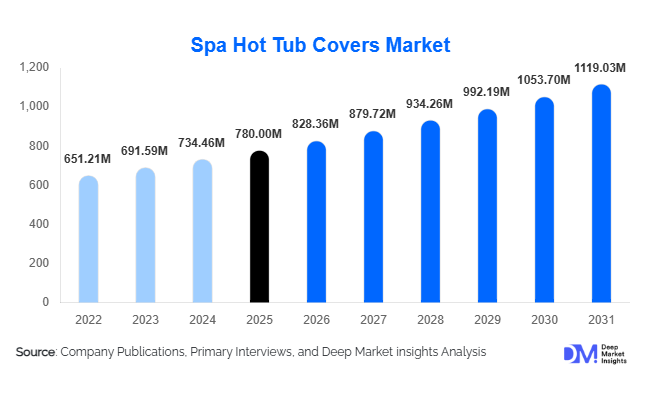
According to Deep Market Insights, the global spa hot tub covers market size was valued at USD 780 million in 2025 and is projected to grow from USD 828.36 million in 2026 to reach USD 1,119.03 million by 2031, expanding at a CAGR of 6.2% during the forecast period (2026–2031). The spa hot tub covers market growth is primarily driven by the rising adoption of residential hot tubs, increasing focus on energy efficiency, and growing demand for premium outdoor lifestyle products. Additionally, expansion in the hospitality and wellness industry, coupled with advancements in durable and insulated materials, is supporting sustained market growth globally.
Key Market Insights
- Residential demand dominates the market, accounting for nearly 65% share due to increased home wellness adoption.
- Energy-efficient insulated covers are gaining traction, driven by rising electricity costs and sustainability concerns.
- North America leads the global market, supported by high hot tub penetration and consumer spending.
- Asia-Pacific is the fastest-growing region, fueled by urbanization and rising disposable incomes.
- E-commerce platforms are expanding rapidly, enabling wider product access and customization options.
- Material innovation, including eco-friendly and UV-resistant covers, is shaping product differentiation.
What are the latest trends in the spa hot tub covers market?
Shift Toward Energy-Efficient and Smart Covers
The market is witnessing a growing shift toward energy-efficient and technologically advanced covers. High-density foam insulation, multi-layer thermal protection, and improved sealing mechanisms are becoming standard features. Manufacturers are increasingly exploring smart cover technologies that integrate with home automation systems, allowing users to monitor temperature and energy consumption. Automated lifting systems and lightweight materials are also improving user convenience. These innovations are particularly attractive in regions with extreme climates, where maintaining water temperature efficiently is essential.
Rising Demand for Sustainable and Customizable Products
Sustainability has emerged as a key trend, with manufacturers introducing covers made from recycled and eco-friendly materials. Consumers are increasingly prioritizing environmentally responsible products, especially in Europe and North America. Additionally, customization is gaining popularity, with buyers seeking tailored sizes, colors, and designs to match outdoor aesthetics. This trend is driving premium product demand and enabling companies to differentiate themselves in a competitive market. Digital platforms are further facilitating customization by offering interactive product design tools.
What are the key drivers in the spa hot tub covers market?
Growth in Residential Spa Installations
The increasing adoption of hot tubs in residential settings is a major growth driver. Consumers are investing in home wellness solutions, particularly after the pandemic, leading to higher demand for essential accessories such as covers. Backyard renovations and outdoor living enhancements are further supporting this trend, especially in North America and Europe.
Rising Focus on Energy Efficiency
Energy efficiency is a critical factor influencing purchasing decisions. Hot tub covers help reduce heat loss and lower electricity consumption, making them an essential component for cost-conscious consumers. With rising global energy prices, demand for high-performance insulated covers is increasing significantly.
Expansion of the Hospitality and Wellness Industry
The growth of luxury hotels, resorts, and wellness centers is driving commercial demand for spa hot tub covers. These establishments require durable and high-quality covers to maintain hygiene and operational efficiency. The global wellness tourism industry continues to expand, creating sustained demand for spa-related products.
What are the restraints for the global market?
High Replacement and Maintenance Costs
Spa hot tub covers are exposed to harsh environmental conditions, including UV radiation, moisture, and chemicals, leading to wear and tear over time. Frequent replacement requirements can increase overall ownership costs, particularly for price-sensitive consumers, limiting adoption in emerging markets.
Intense Price Competition in Lower Segments
The presence of numerous manufacturers offering similar products in the economy segment leads to intense price competition. Limited product differentiation in this category reduces profit margins and makes it challenging for companies to maintain brand loyalty without continuous innovation.
What are the key opportunities in the spa hot tub covers industry?
Integration of Smart and Automated Cover Solutions
The integration of IoT-enabled features and automated cover systems presents a significant growth opportunity. Smart covers that offer remote operation, energy monitoring, and enhanced safety features are expected to attract tech-savvy consumers and premium buyers, particularly in developed markets.
Expansion into Emerging Markets
Emerging economies in the Asia-Pacific and Latin America offer substantial growth potential due to rising disposable incomes and increasing adoption of luxury home amenities. Local manufacturing and distribution strategies can help companies penetrate these markets effectively and reduce costs.
Eco-Friendly Product Innovation
The development of sustainable and recyclable covers aligns with global environmental trends and regulatory requirements. Companies focusing on green certifications and low-impact manufacturing processes can gain a competitive advantage, especially in environmentally conscious regions.
Report Scope
| Report Metric | Details |
|---|---|
| Market Size in 2025 | USD 780 Million |
| Market Size in 2026 | USD 828.36 Million |
| Market Size in 2031 | USD 1119.03 Million |
| CAGR | 6.2% (2026-2031) |
| Base Year for Estimation | 2025 |
| Historical Data | 2022-2024 |
| Forecast Period | 2026-2031 |
| Report Coverage | Revenue Forecast, Competitive Landscape, Supply Chain Disruption, Growth Factors, Environment & Regulatory Landscape and Trends |
| Geographies Covered | North America, Europe, APAC, Middle East and Africa, LATAM |
| Countries Covered | U.S., Canada, U.K., Germany, France, Spain, Italy, Russia, Nordic, Benelux, Rest of Europe, China, Korea, Japan, India, Australia, Singapore, Taiwan, South East Asia, Rest of Asia-Pacific, UAE, Turky, Saudi Arabia, South Africa, Egypt, Nigeria, Rest of MEA, Brazil, Mexico, Argentina, Chile, Colombia, Rest of LATAM |
Explore more data points, trends and opportunities Download Free Sample Report
Material Type Insights
Vinyl covers dominate the spa hot tub covers market, accounting for approximately 38% of the total share in 2025, primarily due to their superior durability, water resistance, UV protection, and cost-effectiveness. Vinyl remains the preferred material across both residential and commercial segments as it offers an optimal balance between performance and affordability. A key driver behind vinyl’s leadership is its ability to withstand harsh outdoor conditions, including prolonged sun exposure, moisture, and chemical contact, which significantly extends product lifespan and reduces replacement frequency.
Foam core covers are also widely used, particularly due to their strong insulation properties that enhance energy efficiency by minimizing heat loss. This makes them highly attractive in colder regions where maintaining water temperature is critical. Meanwhile, composite and eco-friendly materials are gaining traction as sustainability becomes a key purchasing criterion. Manufacturers are increasingly adopting recycled plastics, biodegradable components, and multi-layer composite structures. The growing adoption of these advanced materials is driven by regulatory pressure and consumer demand for environmentally responsible products. Multi-layer construction technologies are further enhancing thermal efficiency and structural strength, making them suitable for premium residential applications and high-usage commercial environments.
Cover Type Insights
Tapered covers lead the market with approximately 32% share, driven by their functional advantage in facilitating water runoff and preventing debris accumulation. This design significantly reduces water pooling, which can otherwise lead to structural damage and reduced insulation efficiency. The increasing frequency of extreme weather conditions, including heavy rainfall and snowfall in North America and Europe, is a major driver supporting the dominance of tapered covers. Hard covers and walk-on covers are gaining strong traction in commercial applications such as hotels, resorts, and wellness centers. Their reinforced structure provides enhanced safety, durability, and load-bearing capacity, making them ideal for high-traffic environments. These covers also align with safety regulations in commercial settings, further driving their adoption.
Soft covers continue to maintain relevance in residential applications due to their lightweight design, ease of handling, and affordability. They are particularly popular among first-time buyers and price-sensitive consumers. However, ongoing innovation is leading to hybrid designs that combine the flexibility of soft covers with the durability of hard materials, expanding their application scope.
Insulation Type Insights
High-density foam insulation dominates the market, accounting for approximately 45% share, due to its superior thermal retention capabilities. The primary driver for this segment is the increasing emphasis on energy efficiency, as well-insulated covers significantly reduce heating costs for hot tubs. This is particularly important in regions with high energy prices, such as North America and Europe. Multi-layer insulation systems are gaining momentum as they offer enhanced performance by combining different insulating materials to reduce heat transfer more effectively. These systems are increasingly being adopted in mid-range and premium products, where consumers are willing to pay more for long-term energy savings.
Hybrid insulation solutions are emerging as a high-growth segment, driven by technological innovation. These systems integrate foam cores with air pockets or reflective layers to optimize insulation while reducing weight. The demand for such solutions is particularly strong in premium residential and commercial applications where performance and durability are critical.
Distribution Channel Insights
E-commerce platforms account for approximately 28% of the market and represent the fastest-growing distribution channel. The primary driver is the increasing digitalization of consumer purchasing behavior, with buyers preferring online platforms for product comparison, customization, and competitive pricing. The availability of detailed product specifications, customer reviews, and direct-to-consumer pricing models is accelerating online sales growth. Specialty retail stores continue to play a crucial role, particularly for customers seeking expert advice, installation services, and product demonstrations. These stores are especially relevant in mature markets where consumers prioritize quality and after-sales support. Direct sales channels dominate the commercial segment, where bulk purchasing, customization, and long-term supplier relationships are critical. Manufacturers are increasingly forming partnerships with spa installers, hospitality chains, and wellness centers to secure large-volume contracts, further strengthening this channel.
End-Use Insights
The residential segment dominates the market, contributing approximately 65% of total demand, driven by the rapid adoption of home wellness solutions and outdoor lifestyle enhancements. A key driver is the growing consumer preference for private relaxation spaces, particularly in developed markets where backyard renovations and luxury home improvements are increasing. The commercial segment, including hotels, resorts, and wellness centers, is the fastest-growing, with a CAGR of 7–8%. This growth is primarily driven by the expansion of global wellness tourism and increasing investments in luxury hospitality infrastructure. Commercial users require durable, high-performance covers that can withstand frequent use, creating demand for premium products.
Emerging applications in healthcare and rehabilitation centers are also contributing to market growth. Hydrotherapy treatments are becoming more prevalent, particularly in physiotherapy and senior care, driving demand for specialized covers that ensure hygiene and temperature control. This niche segment is expected to expand steadily as healthcare infrastructure improves globally.
Explore more data points, trends and opportunities Download Free Sample Report
Spa Hot Tub Covers Market Segmentations
By Material Type
- Vinyl Covers
- Polyethylene Covers
- Foam Core Covers
- Composite Covers
- Eco-friendly/Recycled Material Covers
By Cover Type
- Standard Flat Covers
- Tapered Covers
- Walk-on Covers
- Hard Covers
- Soft Covers
By Insulation Type
- High-Density Foam Insulation
- Multi-Layer Thermal Insulation
- Air-Bladder Insulation
- Hybrid Insulation Systems
By End-Use Application
- Residential
- Hotels & Resorts
- Wellness & Spa Centers
- Fitness Centers
- Healthcare Facilities
By Distribution Channel
- Direct Sales
- Specialty Retail Stores
- E-commerce Platforms
- Distributors & Dealers
Regional Insights
North America
North America holds the largest market share of approximately 42% in 2025, with the United States accounting for over 75% of regional demand. The region’s dominance is driven by high penetration of residential hot tubs, strong consumer purchasing power, and a well-established outdoor living culture. Additionally, harsh winter conditions in many parts of the U.S. and Canada create a strong need for high-quality insulated covers to maintain water temperature and reduce energy costs. The presence of leading manufacturers and advanced distribution networks further supports market growth in this region.
Europe
Europe accounts for approximately 28% of the global market, with key countries including Germany, the UK, France, and Italy. Growth in this region is driven by increasing demand for sustainable and energy-efficient products, supported by stringent environmental regulations. The rising popularity of wellness tourism and spa culture is also contributing to demand, particularly in countries with strong tourism industries. Additionally, consumer preference for high-quality and durable products is encouraging the adoption of premium covers.
Asia-Pacific
Asia-Pacific is the fastest-growing region, with a CAGR exceeding 8%. China leads both production and consumption due to its strong manufacturing base and growing middle-class population. Australia and Japan exhibit strong residential demand driven by outdoor lifestyle trends and high living standards. India is an emerging market, where rapid urbanization, increasing disposable income, and growing awareness of wellness products are driving demand. The expansion of e-commerce platforms and improving distribution networks are further accelerating market growth in the region.
Latin America
Latin America is experiencing gradual growth, led by Brazil and Mexico. The primary drivers include rising middle-class income levels, increasing urbanization, and growing adoption of outdoor lifestyle products. The expansion of hospitality and tourism sectors in these countries is also contributing to demand, particularly for commercial applications. However, price sensitivity remains a key challenge, influencing the dominance of mid-range and economy products in the region.
Middle East & Africa
The Middle East & Africa region is witnessing steady growth, particularly in the UAE and Saudi Arabia. This growth is driven by significant investments in luxury hospitality, tourism infrastructure, and high-end residential projects. The increasing number of luxury hotels and resorts incorporating spa facilities is a major driver for commercial demand. Additionally, rising disposable income and a growing preference for premium lifestyle products are supporting market expansion. In Africa, the market is still in a nascent stage but shows potential due to the gradual development of tourism infrastructure.
Key Players in the Spa Hot Tub Covers Market
- Cover-Pools Incorporated
- Leisure Concepts
- Canadian Spa Company
- MySpaCover
- BeyondNice
- The Cover Guy
- Arctic Spas
- Sundance Spas
- Jacuzzi Brands LLC
- Bullfrog Spas
- Marquis Spas
- Viking Spas
- Wellis
- Master Spas
- Hydropool