Soccer Shoes & Cleats Market Size
According to Deep Market Insights, the global soccer shoes & cleats market size was valued at USD 8,900 million in 2025 and is projected to grow from USD 9,460.70 million in 2026 to reach USD 12,840.73 million by 2031, expanding at a CAGR of 6.3% during the forecast period (2026–2031). The soccer shoes & cleats market growth is primarily driven by the rising global participation in football, increasing investments in sports infrastructure, and continuous innovation in performance-enhancing footwear technologies.
Key Market Insights
- Firm ground cleats dominate globally, accounting for the largest share due to their versatility across natural grass surfaces.
- Synthetic materials are increasingly replacing leather, driven by durability, lightweight properties, and cost efficiency.
- Europe dominates the global market, supported by a strong football culture and premium product adoption.
- Asia-Pacific is the fastest-growing region, fueled by rising grassroots participation and government sports initiatives.
- E-commerce channels are expanding rapidly, enabling brands to reach underserved markets and younger consumers.
- Technological innovation, including smart cleats and advanced soleplate designs, is reshaping performance and consumer preferences.
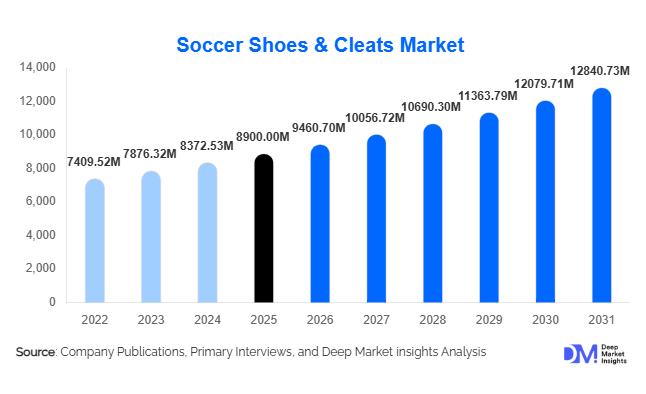
What are the latest trends in the soccer shoes & cleats market?
Shift Toward Lightweight and Synthetic Materials
Manufacturers are increasingly adopting advanced synthetic materials such as knit fabrics, TPU, and engineered mesh to enhance performance. These materials offer improved flexibility, reduced weight, and better durability compared to traditional leather. The shift is particularly evident in mid-range and premium segments, where players demand speed, agility, and comfort. Additionally, synthetic uppers allow for better water resistance and consistent performance across varying weather conditions, making them highly suitable for diverse playing environments.
Growth of Customization and Smart Footwear
Customization is emerging as a key trend, with brands offering personalized fit, color schemes, and stud configurations. At the same time, smart cleats embedded with sensors are gaining traction, enabling players to track performance metrics such as speed, distance, and movement patterns. These innovations are appealing to both professional athletes and tech-savvy amateur players, opening new revenue streams for manufacturers. Digital integration, including mobile apps linked to footwear performance, is further enhancing user engagement.
What are the key drivers in the soccer shoes & cleats market?
Rising Global Football Participation
The increasing number of football players across all age groups is a major growth driver. Grassroots programs, school-level participation, and amateur leagues are expanding globally, particularly in the Asia-Pacific and Africa. This has significantly increased demand for affordable and mid-range soccer footwear, supporting overall market growth.
Technological Advancements in Footwear Design
Continuous innovation in soleplate technology, stud configurations, and material engineering is enhancing player performance. Features such as improved traction, shock absorption, and injury prevention are encouraging frequent product upgrades. These advancements are particularly influential in premium segments, where consumers are willing to pay higher prices for performance benefits.
What are the restraints for the global market?
Price Sensitivity in Emerging Markets
Despite growing demand, affordability remains a challenge in developing regions. High-quality cleats are often priced beyond the reach of many consumers, limiting penetration of premium products and slowing overall market expansion.
Proliferation of Counterfeit Products
The presence of counterfeit and low-quality products in the market poses a significant challenge. These products not only impact brand revenues but also reduce consumer trust and compromise performance and safety standards.
What are the key opportunities in the soccer shoes & cleats industry?
Expansion in Emerging Markets
Countries such as India, China, and Brazil are witnessing increased investments in football infrastructure and youth development programs. This creates opportunities for manufacturers to introduce affordable and durable products tailored to local conditions, significantly expanding their customer base.
Sustainable and Eco-friendly Footwear
Growing environmental awareness is driving demand for sustainable products. Companies investing in recycled materials, biodegradable components, and low-carbon manufacturing processes can capture environmentally conscious consumers and differentiate their offerings in the market.
Report Scope
| Report Metric | Details |
|---|---|
| Market Size in 2025 | USD 8900 Million |
| Market Size in 2026 | USD 9460.70 Million |
| Market Size in 2031 | USD 12840.73 Million |
| CAGR | 6.3% (2026-2031) |
| Base Year for Estimation | 2025 |
| Historical Data | 2022-2024 |
| Forecast Period | 2026-2031 |
| Report Coverage | Revenue Forecast, Competitive Landscape, Supply Chain Disruption, Growth Factors, Environment & Regulatory Landscape and Trends |
| Geographies Covered | North America, Europe, APAC, Middle East and Africa, LATAM |
| Countries Covered | U.S., Canada, U.K., Germany, France, Spain, Italy, Russia, Nordic, Benelux, Rest of Europe, China, Korea, Japan, India, Australia, Singapore, Taiwan, South East Asia, Rest of Asia-Pacific, UAE, Turky, Saudi Arabia, South Africa, Egypt, Nigeria, Rest of MEA, Brazil, Mexico, Argentina, Chile, Colombia, Rest of LATAM |
Explore more data points, trends and opportunities Download Free Sample Report
Product Type Insights
Firm ground (FG) cleats dominate the soccer shoes & cleats market with approximately 38% share in 2025, primarily due to their widespread compatibility with natural grass surfaces, which remain the most commonly used playing fields globally. The leading position of FG cleats is further driven by their versatility, durability, and adoption across both professional and amateur levels. Major leagues and tournaments are predominantly played on firm natural pitches, reinforcing consistent demand for this segment. Additionally, continuous innovation in stud configuration and lightweight materials has enhanced traction and speed, further strengthening their market leadership.
Artificial ground (AG) and turf shoes are witnessing accelerated growth, supported by the rapid development of synthetic playing fields, especially in urban and semi-urban areas where maintaining natural grass is cost-intensive. Governments and private academies are increasingly investing in artificial turfs, directly boosting demand for AG-specific footwear. Indoor and futsal shoes are also gaining momentum, particularly in densely populated cities, where space constraints and lifestyle shifts favor smaller-format games. This diversification of playing environments is expanding the overall product mix and enabling manufacturers to target niche use cases, thereby enhancing revenue streams.
Application Insights
Amateur and club-level players represent the largest application segment, accounting for nearly 44% of total demand. This dominance is driven by the expanding global base of grassroots football participation, supported by school programs, local leagues, and community initiatives. Increasing accessibility to training facilities and organized competitions has significantly boosted footwear consumption in this segment. The relatively higher replacement frequency among amateur players, compared to professionals, further contributes to sustained demand.
Professional players, while smaller in volume, play a critical role in shaping market trends and driving premium product sales. Their preference for technologically advanced and customized cleats influences product innovation and brand positioning. Recreational users are increasingly contributing to market expansion, particularly in urban regions where football is played casually through formats such as futsal and five-a-side games. Additionally, the youth segment is emerging as a high-growth category, driven by rising investments in sports academies and talent development programs, ensuring long-term demand sustainability.
Distribution Channel Insights
Offline retail channels continue to dominate the market with around 60% share, largely due to consumer preference for physical trials to ensure proper fit, comfort, and performance suitability. Specialty sports stores and brand-exclusive outlets remain critical in influencing purchase decisions, particularly for mid-range and premium products. In-store expert guidance, product demonstrations, and immediate availability provide a competitive advantage to offline channels.
However, online retail is the fastest-growing segment, driven by the rapid expansion of e-commerce platforms, improved logistics, and increasing digital adoption among consumers. Online channels offer price transparency, broader product availability, and convenience, making them particularly attractive to younger demographics. The rise of direct-to-consumer (D2C) strategies is enabling brands to enhance customer engagement, collect valuable consumer data, and improve margins by bypassing intermediaries. Omnichannel strategies, integrating online and offline experiences, are becoming increasingly important for sustained growth.
End-User Insights
The amateur and youth segments collectively account for over 60% of market demand, making them the primary growth drivers of the soccer shoes & cleats market. The increasing emphasis on sports participation at school and community levels, along with government-backed initiatives promoting physical activity, is significantly boosting demand in these segments. Affordable and mid-range products are particularly popular among these users, ensuring high volume sales.
Professional players contribute disproportionately to revenue in the premium segment, as they demand high-performance, technologically advanced footwear. Their influence extends beyond direct consumption, as endorsements and visibility drive aspirational purchases among amateur players. Recreational users are also emerging as a key segment, especially in urban areas where football is played for fitness and leisure. The growing popularity of small-sided formats and indoor football is further expanding this user base, contributing to overall market diversification.
Explore more data points, trends and opportunities Download Free Sample Report
Soccer Shoes & Cleats Market Segmentations
By Product Type
- Firm Ground (FG) Soccer Cleats
- Soft Ground (SG) Soccer Cleats
- Artificial Ground (AG) Soccer Cleats
- Indoor Soccer Shoes (IC)
- Turf Soccer Shoes (TF)
By Application
- Professional Players
- Amateur/Club Players
- Recreational Players
- Youth/Junior Players
By Distribution Channel
- Online Retail
- Specialty Sports Stores
- Multi-brand Retail Stores
- Brand-Owned Stores
By Material Type
- Synthetic Materials
- Leather
- Hybrid Materials
By Price Range
- Economy
- Mid-Range
- Premium
Regional Insights
North America
North America holds approximately 22% of the global market share, with the United States being the primary contributor. The region’s growth is driven by the increasing popularity of soccer among youth and women, supported by strong participation in school and collegiate programs. The expansion of professional leagues such as Major League Soccer (MLS) and the National Women’s Soccer League (NWSL) is further boosting market demand. Additionally, rising disposable incomes and a strong preference for premium sportswear are encouraging higher spending on advanced cleats. The region also benefits from well-developed retail infrastructure and high e-commerce penetration, facilitating product accessibility.
Europe
Europe dominates the global market with around 34% share in 2025, supported by its deeply rooted football culture and high participation rates across all age groups. Countries such as the UK, Germany, France, and Spain are major demand centers, driven by established domestic leagues and international competitions. The presence of leading manufacturers and strong brand loyalty further strengthens the region’s position. High consumer purchasing power and a preference for premium, performance-oriented products contribute significantly to revenue generation. Additionally, continuous investments in grassroots development and youth academies ensure sustained long-term demand.
Asia-Pacific
Asia-Pacific is the fastest-growing region, expanding at a CAGR of approximately 7.5%. Key markets such as China, India, and Japan are witnessing rapid growth due to rising disposable incomes, urbanization, and increasing awareness of football as a professional sport. Government initiatives promoting sports participation, including school-level programs and infrastructure development, are major growth drivers. The region’s large population base and growing middle class present significant opportunities for both affordable and premium product segments. Additionally, the expansion of international leagues’ fan bases in Asia is further stimulating demand for branded soccer footwear.
Latin America
Latin America accounts for around 18% of the global market, with Brazil and Argentina leading demand due to their strong football heritage. The sport is deeply embedded in the region’s culture, ensuring consistent consumption across all income groups. Growth is supported by high participation rates and the presence of local leagues and community tournaments. However, economic volatility and income disparities can impact purchasing power, leading to higher demand for mid-range and economy products. Despite these challenges, the region remains a key market due to its passion for football and strong export-oriented manufacturing capabilities.
Middle East & Africa
The Middle East and Africa region is witnessing steady growth, driven by increasing investments in sports infrastructure and rising interest in football. Countries such as the UAE, Saudi Arabia, and South Africa are emerging as key markets, supported by government initiatives to promote sports and host international events. In Africa, grassroots participation and youth engagement programs are expanding rapidly, creating demand for affordable soccer footwear. The Middle East, on the other hand, is characterized by higher spending on premium products due to strong purchasing power. Additionally, international tournaments and partnerships with global football organizations are enhancing market visibility and driving regional growth.