Smart Tracker Market Size
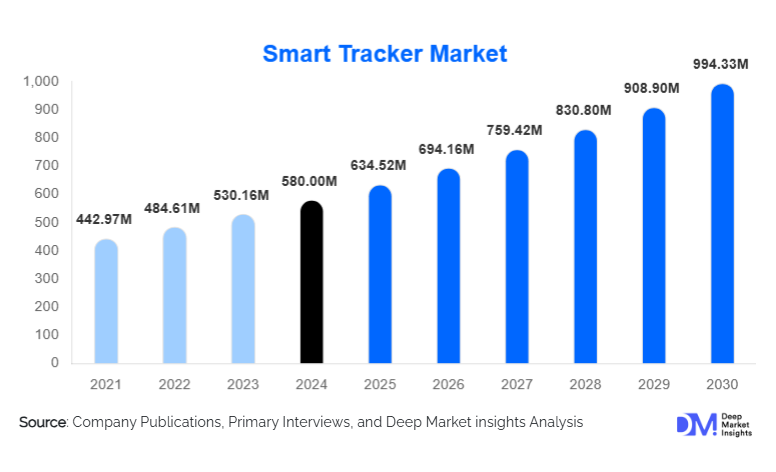
According to Deep Market Insights, the global smart tracker market size was valued at USD 580.00 million in 2025 and is projected to grow from USD 634.52 million in 2026 to reach USD 994.33 million by 2031, expanding at a CAGR of 9.40% during the forecast period (2026–2031). The smart tracker market growth is driven by expanding fleet digitisation, rising consumer adoption of wearable and personal trackers, and the rapid deployment of IoT-enabled tracking systems across logistics, industrial, and public-sector applications.
Key Market Insights
- GPS-based smart trackers dominate the market, supported by widespread fleet, automotive, and asset-tracking applications across commercial and industrial sectors.
- APAC leads global demand, driven by rapid industrialisation, large logistics networks, and the expansion of e-commerce in China, India, and Southeast Asia.
- Cellular and NB-IoT connectivity-based trackers represent the fastest-growing technology cluster, enabling real-time, long-range monitoring for enterprise and government use.
- Commercial users contribute nearly half of global revenues, with logistics companies, supply-chain operators, and fleet managers accelerating adoption.
- Wearable and personal safety trackers are gaining traction as consumers increasingly prioritise security, health monitoring, and asset protection.
- Technological integration, including AI-driven analytics, geofencing automation, and multi-mode connectivity (GPS + cellular + BLE), is reshaping product innovation and customer expectations.
Smart Tracker Market Trends
AI-Driven and IoT-Integrated Tracking Systems
Smart tracker manufacturers are increasingly embedding AI, predictive analytics, and IoT platform connectivity into their devices. AI-enabled insights such as predictive maintenance alerts, route optimisation, and real-time anomaly detection offer high value to logistics operators and enterprises. Integration with cloud platforms enables large-scale asset monitoring, multi-device management, and automated workflow triggers. In the consumer segment, AI-driven geofence alerts, fall detection, real-time motion insights, and personalised behavioural data are improving user experience and retention. Enterprises are deploying IoT-integrated trackers across warehouses, production lines, and supply-chain nodes to achieve end-to-end digital visibility.
Hybrid Connectivity Trackers Gaining Dominance
The industry is shifting toward hybrid devices combining GPS, cellular (LTE/NB-IoT), Bluetooth, Wi-Fi, and satellite connectivity. These trackers provide seamless coverage across remote, indoor, and urban environments, reducing data blind spots. Adoption is particularly strong in cross-border logistics, mining, construction, and emergency response operations. Falling connectivity module costs and growing NB-IoT network availability are enabling large-scale deployments. Hybrid trackers are also penetrating consumer markets, where users demand reliable performance for pet tracking, personal safety, vehicle monitoring, and luggage tracking.
Smart Tracker Market Drivers
Expansion of Global Logistics, E-Commerce, and Fleet Operations
Rapid growth in e-commerce and global supply-chain activity has increased the need for real-time asset visibility, efficient last-mile delivery, and fleet optimisation. Logistics firms rely on smart trackers to reduce theft, monitor delivery progress, optimise routes, and ensure cargo integrity. Governments in multiple regions now require digital fleet monitoring for safety, emissions, and compliance, further accelerating market growth. As businesses scale cross-border logistics and high-value cargo movement, tracker adoption is surging across freight, trucking, courier services, and delivery networks.
Growing Consumer Demand for Personal Safety, Wearables, and Asset Protection
Consumers are increasingly adopting smart trackers for monitoring children, elderly family members, pets, vehicles, and valuables. Urban lifestyles, rising safety concerns, and increasing affordability of compact, multi-feature personal trackers contribute to widespread adoption. Wearable trackers integrated with GPS, BLE, and health-monitoring sensors are gaining popularity among fitness users, seniors, and outdoor enthusiasts. Advancements in battery life, form factor miniaturisation, and smartphone integration further improve adoption.
Technological Advancements in IoT, Connectivity, and Device Miniaturisation
Modern smart trackers benefit from advanced GNSS chips, multi-band connectivity, longer battery life, and ruggedised designs. The availability of 4G/5G, NB-IoT, and satellite connectivity enables reliable real-time tracking even in geographically challenging environments. IoT ecosystems allow enterprises to link trackers with automation systems, ERP platforms, and data analytics tools. These innovations have lowered deployment barriers, reduced device costs, and opened new use-cases across industries, from manufacturing to healthcare to public safety.
Smart Tracker Market Restraints
Privacy, Data Security, and Regulatory Restrictions
Continuous location tracking raises data security and privacy concerns, especially in consumer and workforce monitoring applications. Stringent regulations in the EU, North America, and parts of APAC require compliance with data handling, user consent, and storage protocols. Misuse of tracking devices for unauthorised surveillance also creates public scepticism, limiting adoption in sensitive sectors.
Fragmented Connectivity Standards and Interoperability Challenges
Smart tracker adoption is hindered by differing connectivity technologies (GPS, LTE-M, NB-IoT, BLE, satellite), inconsistent network availability, and limited interoperability across platforms. Fragmentation creates integration complexity for enterprises, especially in multinational operations. Variations in performance, device reliability, and battery life across manufacturers further slow down large-scale deployments.
Smart Tracker Market Opportunities
Emerging Market Expansion and Public Sector Adoption
Developing regions such as Asia-Pacific, Africa, and Latin America present significant untapped potential due to rapid growth in logistics, mobility services, and urban infrastructure. Governments are deploying trackers across public transport fleets, emergency response units, waste management systems, and public asset inventories. Smart city initiatives increasingly rely on GPS and IoT trackers for traffic management, surveillance, and urban asset monitoring. These large-scale projects offer multi-year procurement opportunities for global and regional device manufacturers.
Advanced IoT Platform Integration and Value-Added Analytics Services
Manufacturers are expanding beyond hardware to offer SaaS-based fleet dashboards, predictive analytics, geofencing automation, temperature and motion alerts, and compliance reporting tools. This shift from device sales to subscription revenue significantly boosts profitability. Enterprises seeking digital transformation increasingly prefer integrated solutions, creating opportunities for ecosystem partnerships with cloud providers, telecom operators, and IoT engineering firms.
Report Scope
| Report Metric | Details |
|---|---|
| Market Size in 2025 | USD 580 Million |
| Market Size in 2026 | USD 634.52 Million |
| Market Size in 2031 | USD 994.33 Million |
| CAGR | 9.40% (2026-2031) |
| Base Year for Estimation | 2025 |
| Historical Data | 2022-2024 |
| Forecast Period | 2026-2031 |
| Report Coverage | Revenue Forecast, Competitive Landscape, Supply Chain Disruption, Growth Factors, Environment & Regulatory Landscape and Trends |
| Geographies Covered | North America, Europe, APAC, Middle East and Africa, LATAM |
| Countries Covered | U.S., Canada, U.K., Germany, France, Spain, Italy, Russia, Nordic, Benelux, Rest of Europe, China, Korea, Japan, India, Australia, Singapore, Taiwan, South East Asia, Rest of Asia-Pacific, UAE, Turky, Saudi Arabia, South Africa, Egypt, Nigeria, Rest of MEA, Brazil, Mexico, Argentina, Chile, Colombia, Rest of LATAM |
Explore more data points, trends and opportunities Download Free Sample Report
Product Type Insights
GPS trackers dominate the market, accounting for nearly 55% of global revenues in 2025. These devices are widely used in fleet management, logistics, vehicle monitoring, and industrial asset tracking. Bluetooth/BLE trackers serve the consumer segment, pet tracking, keys, bags, and personal belongings, while wearable trackers offer safety and health monitoring features, particularly for children, elderly individuals, and fitness users. Hybrid trackers combining GPS, BLE, Wi-Fi, and cellular connectivity are growing rapidly due to their reliability across difficult environments, making them increasingly preferred in enterprise operations.
Application Insights
Vehicle and Fleet Tracking is the largest application segment, contributing nearly 40% of the total market in 2025. Logistics companies rely heavily on real-time tracking for route optimisation, fuel monitoring, theft prevention, and delivery accuracy. Asset tracking across warehouses, supply chains, and industrial sites is expanding due to IoT integration. Consumer applications, including personal safety trackers, pet trackers, and luggage tags, are steadily growing as devices become more affordable and compact. Healthcare and eldercare applications are emerging, leveraging wearables with GPS and health monitoring sensors.
Distribution Channel Insights
Online platforms, including e-commerce marketplaces and OEM-direct websites, dominate consumer sales of smart trackers. These channels benefit from transparent pricing, detailed reviews, and rapid delivery options. Enterprise customers typically procure through direct sales teams, system integrators, and IoT solution providers offering bundled hardware and software services. Subscription-based sales models are expanding, especially in fleet, logistics, and industrial asset-tracking contracts, creating recurring revenue streams for vendors.
End-User Insights
Commercial users dominate the market with approximately 48% share, including logistics firms, transportation fleets, rental car companies, and supply-chain operators. Industrial customers in manufacturing, construction, and mining increasingly deploy trackers for equipment utilisation, security, and predictive maintenance. Consumer adoption is driven by wearable safety devices, personal item trackers, and vehicle monitoring. Government and public-sector deployments are growing due to smart city programs and mandatory fleet monitoring requirements.
Explore more data points, trends and opportunities Download Free Sample Report
Smart Tracker Market Segmentations
By Product / Device Type
- GPS Trackers
- Bluetooth/BLE Trackers
- Wearable Trackers
- Hybrid Multi-Mode Trackers (GPS + Cellular + BLE)
By Application
- Vehicle & Fleet Tracking
- Asset & Equipment Tracking
- Personal & Pet Tracking
- Logistics & Supply Chain Tracking
- Industrial & Enterprise Tracking
By Connectivity Technology
- GPS / GNSS
- Cellular (2G/3G/4G/5G/NB-IoT/LTE-M)
- Bluetooth / BLE
- Satellite-Enabled Trackers
By Distribution Channel
- Online Retail & E-commerce
- Direct OEM Sales
- Enterprise/B2B System Integrators
- Retail Electronics & Speciality Stores
Regional Insights
North America
North America accounts for about 28% of global demand, driven by advanced fleet management adoption, strong consumer awareness, and regulatory requirements for telematics in commercial vehicles. The U.S. leads in enterprise deployments, especially in trucking, courier services, waste management, and public fleets. High disposable income supports strong sales of personal trackers and wearable safety devices.
Europe
Europe represents around 22% of the market, with demand driven by industrial automation, cross-border logistics, and strict regulatory frameworks requiring digital tracking and emissions reporting. Countries such as Germany, the U.K., France, and the Netherlands are major adopters. Public-sector initiatives for transportation and smart cities further support growth.
Asia-Pacific
APAC leads the global market with a 36% share. China and India dominate due to massive logistics networks, manufacturing expansion, and growing e-commerce. Southeast Asia, Singapore, Indonesia, and Vietnam are rapidly adopting trackers for cross-border logistics. Rising middle-class populations drive consumer demand for wearable trackers and vehicle monitoring devices.
Latin America
LATAM holds roughly 9% of global demand. Brazil and Mexico lead adoption due to expanding e-commerce, high cargo theft risk, and growth in transportation fleets. Enterprises increasingly invest in GPS fleet management to reduce operational losses.
Middle East & Africa
MEA contributes about a 5–6% share, with growth driven by construction, oil & gas logistics, mining, and public infrastructure projects. The UAE and Saudi Arabia are early adopters, investing heavily in smart city technologies. African markets such as South Africa, Kenya, and Nigeria use trackers for fleet safety and cargo protection.
Key Players in the Smart Tracker Market
- CalAmp
- Queclink Wireless Solutions
- Teltonika
- Meitrack
- ORBCOMM
- Eelink
- Sierra Wireless
- Ruptela
- Suntech
- Coban
- Shenzhen Jimi IoT
- Shenzhen Thinkrace Technology
- Tile
- Samsung Electronics
- Apple Inc.
Recent Developments
- In 2025, Queclink launched a next-generation hybrid tracker integrating GPS, NB-IoT, and Bluetooth for global fleet operators seeking unified connectivity.
- In March 2025, Teltonika expanded its manufacturing facility in Lithuania to increase production of IoT-enabled tracking modules for European fleets.
- In 2025, CalAmp introduced a cloud-based analytics suite offering predictive fleet maintenance, geofencing automation, and compliance reporting for enterprise customers.