Smart Mattress Market Size
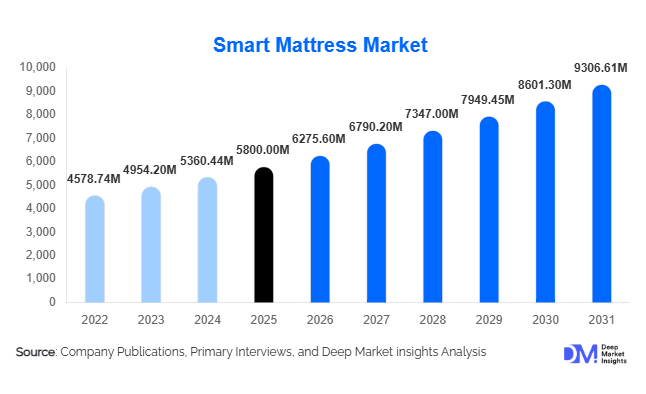
According to Deep Market Insights, the global smart mattress market size was valued at USD 5,800 million in 2025 and is projected to grow from USD 6,275.60 million in 2026 to reach USD 9,306.61 million by 2031, expanding at a CAGR of 8.2% during the forecast period (2026–2031). The market growth is primarily driven by rising consumer awareness around sleep health, growing adoption of IoT-enabled home products, and increasing demand for personalized sleep solutions across residential, hospitality, and healthcare sectors.
Key Market Insights
- Smart mattresses are evolving from comfort products to health-tech solutions, integrating AI-based sleep tracking, pressure sensing, and temperature regulation features.
- Premium and hybrid smart mattresses dominate residential demand, offering personalized sleep adjustments, app-controlled features, and luxury comfort.
- Hospitality and healthcare sectors are increasingly adopting smart mattresses for patient monitoring and enhanced guest experiences, driving stable B2B demand.
- North America remains a leading market, led by high disposable incomes, strong smart home adoption, and growing awareness of sleep wellness.
- Asia-Pacific is the fastest-growing region, fueled by urbanization, rising middle-class wealth in China and India, and increased technology adoption.
- Technological integration, including IoT connectivity, AI-based analytics, and app-controlled adjustments, is redefining the user experience in the smart mattress market.
What are the latest trends in the smart mattress market?
AI-Driven Sleep Monitoring and Personalization
Smart mattress manufacturers are increasingly embedding AI and machine learning algorithms to provide personalized sleep insights. These systems analyze sleep patterns, heart rate, breathing, and pressure distribution to recommend adjustments in firmness, temperature, or sleep schedules. Integration with health apps and wearables allows consumers to track sleep quality and detect early symptoms of sleep disorders. Premium smart mattresses now leverage cloud-based analytics, enabling continuous improvement of sleep recommendations over time. This trend has boosted consumer willingness to pay for high-tech mattresses and reinforced the positioning of smart mattresses as health-enhancing products rather than just comfort solutions.
IoT and Connected Home Integration
IoT-enabled smart mattresses are increasingly compatible with smart home ecosystems. Wi-Fi and Bluetooth connectivity allow users to control mattress settings via mobile apps or voice commands through smart speakers. Integration with other devices, such as bedroom lighting, climate control, and wearable health trackers, creates a holistic sleep management experience. Remote monitoring capabilities appeal to families, elderly consumers, and healthcare facilities, providing real-time insights into sleep quality and potential health risks. Connectivity-driven innovation is positioning smart mattresses as essential components of next-generation smart homes, further driving adoption.
What are the key drivers in the smart mattress market?
Increasing Awareness of Sleep Health
Rising awareness of sleep disorders, insomnia, and lifestyle-related health issues is a primary driver of smart mattress adoption. Consumers are seeking solutions that not only improve comfort but also monitor sleep patterns and promote restorative sleep. The proliferation of health-conscious lifestyles, wellness apps, and fitness wearables complements the adoption of smart mattresses, particularly in urban regions with high-stress populations. Increasing research linking quality sleep to productivity, mental health, and overall well-being further accelerates demand.
Technological Advancements in Mattress Design
Advancements in memory foam, hybrid designs, pressure sensors, temperature regulation, and adjustable firmness technology are enhancing mattress performance. Manufacturers are offering differentiated features such as dual-zone adjustments, AI-driven sleep coaching, and eco-friendly materials to appeal to premium consumers. Continuous innovation enables companies to cater to diverse preferences, encouraging upgrades and repeat purchases, thereby contributing to market growth.
Growth in Residential and Institutional Adoption
The residential segment remains the largest end-use market, supported by urban consumers seeking smart home solutions. Meanwhile, the hospitality industry and healthcare facilities are increasingly deploying smart mattresses to improve guest comfort and patient monitoring. Hospitals are adopting smart mattresses for pressure ulcer prevention, sleep monitoring, and elderly care, creating B2B growth opportunities. The convergence of health benefits and convenience is strengthening adoption across multiple sectors.
What are the restraints for the global market?
High Product Costs
Smart mattresses, particularly premium models with advanced features, are expensive compared to traditional mattresses. The high upfront cost limits accessibility for middle-income consumers in emerging markets, restricting market penetration. Additionally, ongoing technological support, maintenance, and replacement of sensor components add to total ownership costs, which may hinder widespread adoption.
Technological Complexity and Data Privacy Concerns
While IoT-enabled mattresses provide advanced features, they may pose usability challenges for older consumers or those less comfortable with technology. Furthermore, the collection of personal sleep and health data raises privacy and cybersecurity concerns. Companies need to address these challenges through user-friendly interfaces, secure data storage, and transparent privacy policies to sustain consumer confidence and market growth.
What are the key opportunities in the smart mattress market?
Expansion in Emerging Markets
Emerging regions such as Asia-Pacific, Latin America, and the Middle East present significant growth opportunities due to rising disposable incomes, urbanization, and increasing smart home adoption. Countries like China, India, and the UAE are witnessing growing demand for premium and mid-range smart mattresses, driven by awareness of sleep health and digital lifestyle adoption. Localized manufacturing and distribution strategies can reduce costs and accelerate penetration in these markets.
Integration with Healthcare and Wellness Services
Smart mattresses integrated with healthcare applications for hospitals, clinics, and elderly care facilities offer opportunities to provide patient monitoring, fall detection, and pressure ulcer prevention. Wellness-focused features, including temperature regulation, sleep coaching, and relaxation programs, appeal to premium consumers seeking holistic sleep solutions. This convergence of technology, health, and wellness creates differentiated value propositions for manufacturers.
Eco-Friendly and Sustainable Product Development
Rising consumer preference for sustainable products opens opportunities to develop smart mattresses using organic latex, recycled foams, and low-impact manufacturing processes. Combining eco-friendly materials with technological innovation allows companies to cater to environmentally conscious consumers and capitalize on premium pricing. Sustainable smart mattresses are also appealing to institutional buyers seeking green certifications for hospitality and healthcare facilities.
Report Scope
| Report Metric | Details |
|---|---|
| Market Size in 2025 | USD 5800 Million |
| Market Size in 2026 | USD 6275.60 Million |
| Market Size in 2031 | USD 9306.61 Million |
| CAGR | 8.2% (2026-2031) |
| Base Year for Estimation | 2025 |
| Historical Data | 2022-2024 |
| Forecast Period | 2026-2031 |
| Report Coverage | Revenue Forecast, Competitive Landscape, Supply Chain Disruption, Growth Factors, Environment & Regulatory Landscape and Trends |
| Geographies Covered | North America, Europe, APAC, Middle East and Africa, LATAM |
| Countries Covered | U.S., Canada, U.K., Germany, France, Spain, Italy, Russia, Nordic, Benelux, Rest of Europe, China, Korea, Japan, India, Australia, Singapore, Taiwan, South East Asia, Rest of Asia-Pacific, UAE, Turky, Saudi Arabia, South Africa, Egypt, Nigeria, Rest of MEA, Brazil, Mexico, Argentina, Chile, Colombia, Rest of LATAM |
Explore more data points, trends and opportunities Download Free Sample Report
Product Type Insights
Memory foam smart mattresses dominate the market, accounting for approximately 38% of the global market in 2025. The segment’s leadership is largely driven by the widespread adoption of memory foam technology due to its superior pressure-relief properties, body-contouring capability, and compatibility with embedded sensor technologies used for sleep monitoring. Memory foam materials allow seamless integration of smart features such as sleep tracking, heart-rate monitoring, and temperature regulation systems without compromising comfort or mattress flexibility. In addition, memory foam smart mattresses are comparatively more affordable than hybrid or latex alternatives, making them accessible to a broader consumer base in residential applications.
Hybrid smart mattresses are gaining traction in the premium segment as they combine the structural support of innerspring coils with the comfort of memory foam layers and integrated smart technologies. These products are particularly popular among consumers who prefer enhanced spinal support alongside advanced sleep analytics. Meanwhile, latex and airbed smart mattresses remain niche segments, often appealing to eco-conscious buyers and consumers seeking adjustable firmness settings. Despite their niche positioning, innovations in sustainable latex materials and app-controlled air pressure adjustments are expected to gradually expand these segments over the forecast period.
Application Insights
The residential segment dominates the smart mattress market, accounting for approximately 52% of the global market value in 2025. The dominance of this segment is primarily driven by rising consumer awareness regarding sleep health, increasing adoption of smart home technologies, and growing disposable incomes among urban households. Consumers are increasingly prioritizing wellness-oriented products that enhance sleep quality, making smart mattresses a popular upgrade from conventional bedding solutions. Additionally, the growing penetration of IoT-enabled home devices has encouraged the integration of smart mattresses within broader connected home ecosystems, where they can interact with lighting systems, climate control devices, and wearable health trackers.
Healthcare and medical applications are also emerging as a promising growth segment. Hospitals, rehabilitation centers, and elderly care facilities are deploying smart mattresses to monitor patient movement, detect pressure points, and reduce the risk of pressure ulcers. These mattresses can also provide real-time data to healthcare providers, improving patient monitoring and enabling preventive care. Emerging applications include wellness centers, sleep clinics, and integrated smart home systems, which are increasingly incorporating smart mattresses as part of broader health and lifestyle management solutions.
Distribution Channel Insights
Online retail channels dominate the smart mattress market, supported by the rapid growth of e-commerce platforms and direct-to-consumer (D2C) business models. Online platforms allow manufacturers to showcase advanced product features through interactive digital content, customer reviews, and virtual demonstrations. The convenience of home delivery, flexible return policies, and competitive pricing has further encouraged consumers to purchase smart mattresses through online channels. Additionally, digital marketing strategies, including influencer promotions and targeted advertising, have significantly improved brand visibility and consumer engagement.
Increasingly, companies are adopting an omnichannel distribution strategy that combines the advantages of both online and offline retail. Consumers frequently research products online and then visit physical stores for hands-on experience before completing their purchase. Hybrid retail models, including showroom-based experience centers and online ordering with in-store trials, are becoming a key strategy for leading manufacturers seeking to enhance customer engagement and improve conversion rates.
Explore more data points, trends and opportunities Download Free Sample Report
Smart Mattress Market Segmentations
By Product Type
- Memory Foam Smart Mattresses
- Hybrid Smart Mattresses
- Latex Smart Mattresses
- Airbed Smart Mattresses
By Application
- Residential
- Hospitality
- Healthcare & Medical Facilities
- Wellness Centers and Sleep Clinics
By Distribution Channel
- Online Retail
- Specialty Mattress Stores
- Furniture and Home Retail Chains
- Department Stores
- Direct-to-Consumer Brand Stores
By Connectivity Technology
- Wi-Fi Enabled Smart Mattresses
- Bluetooth-Enabled Smart Mattresses
- Offline Sensor-Based Smart Mattresses
By Price Range
- Premium Smart Mattresses
- Mid-Range Smart Mattresses
- Budget Smart Mattresses
Regional Insights
North America
North America accounts for approximately 32% of the global smart mattress market in 2025, making it the largest regional market. The United States dominates regional demand due to high disposable incomes, widespread adoption of smart home technologies, and strong consumer awareness regarding sleep health and wellness. The presence of major market players and continuous technological innovation in bedding solutions further strengthens the region’s leadership.
Another major driver of regional growth is the increasing prevalence of sleep-related disorders such as insomnia and sleep apnea, which has encouraged consumers to adopt advanced sleep monitoring solutions. The healthcare sector in the United States and Canada is also increasingly incorporating smart mattresses for patient monitoring and elderly care. Additionally, strong e-commerce infrastructure and the rapid expansion of direct-to-consumer mattress brands have significantly boosted market penetration across the region.
Europe
Europe represents around 28% of the global smart mattress market, with Germany, the United Kingdom, and France emerging as key contributors. The region’s demand is largely driven by consumer preference for technologically advanced home products and the growing emphasis on wellness-oriented lifestyles. European consumers are increasingly investing in high-quality sleep solutions that combine comfort, sustainability, and technology.
Sustainability is a particularly important driver in the European market. Manufacturers are introducing eco-friendly smart mattresses made from organic latex, recycled materials, and low-emission manufacturing processes to meet stringent environmental standards. Government regulations related to product safety and environmental impact are also encouraging innovation in sustainable mattress design. Furthermore, the growing popularity of smart homes and IoT-enabled devices across Western Europe is accelerating the adoption of connected bedding solutions.
Asia-Pacific
The Asia-Pacific region is the fastest-growing market, with a projected CAGR of 10.1% between 2026 and 2031. Rapid urbanization, rising middle-class incomes, and increasing awareness of sleep health are key factors driving growth across the region. China and India represent the largest growth markets due to their large populations, expanding middle-class consumer base, and growing adoption of smart home technologies.
In China, the growing popularity of premium home products and advanced consumer electronics is encouraging adoption of smart mattresses. In India, increasing digital penetration, expanding e-commerce platforms, and rising awareness about sleep-related health issues are fueling demand. Meanwhile, mature markets such as Japan and Australia contribute to regional growth through high demand for technologically advanced and premium bedding solutions. The expansion of online retail channels and the presence of domestic smart mattress startups are further strengthening market growth in the region.
Latin America
Latin America is experiencing gradual adoption of smart mattresses, with Brazil, Mexico, and Argentina emerging as the primary demand centers. Rising disposable incomes among urban populations and growing exposure to international consumer trends are encouraging interest in advanced sleep products. Although the market remains relatively small compared to North America and Europe, increasing e-commerce penetration is improving accessibility to premium bedding products.
Another key driver of growth in the region is the expansion of the hospitality industry, particularly luxury hotels and resorts seeking to differentiate their guest experience through high-end bedding solutions. Additionally, younger consumers in metropolitan areas are increasingly adopting smart home technologies, which is expected to gradually increase demand for smart mattresses.
Middle East & Africa
The Middle East market, particularly the United Arab Emirates and Saudi Arabia, is witnessing steady growth driven by high disposable incomes, strong luxury residential development, and rising adoption of smart home technologies. Consumers in these markets are increasingly investing in premium lifestyle products, including technologically advanced mattresses designed to enhance comfort and wellness.
Another important growth driver is the expansion of the luxury hospitality sector across the region, where hotels and resorts are incorporating smart mattresses to provide personalized guest experiences. In Africa, adoption remains relatively limited and concentrated in major urban centers. However, growing healthcare infrastructure and increasing awareness about sleep-related health issues are expected to gradually drive demand for smart mattresses, particularly in private hospitals and wellness facilities.
Key Players in the Smart Mattress Market
- Sleep Number Corporation
- Eight Sleep
- Tempur Sealy International
- Casper Sleep Inc.
- Beautyrest
- King Koil
- Slumberland
- Koala Sleep
- Leesa Sleep
- Nectar Sleep
- Tomorrow Sleep
- Restonic
- Hästens
- Vispring
- Emma Sleep