Smart Doorbells Market Size
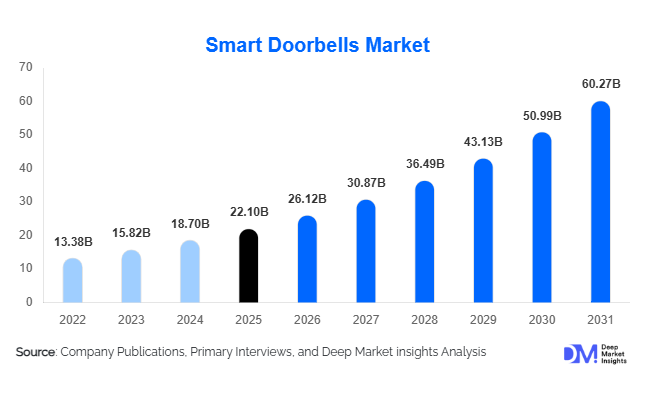
According to Deep Market Insights,the global smart doorbells market size was valued at USD 22.1 billion in 2025 and is projected to grow from USD 26.12 billion in 2026 to reach USD 60.27 billion by 2031, expanding at a CAGR of 18.2% during the forecast period (2026–2031). The smart doorbells market growth is primarily driven by the rapid adoption of smart home ecosystems, rising consumer demand for advanced home security technologies, and increasing integration of artificial intelligence and cloud-based monitoring capabilities in residential surveillance devices.
Key Market Insights
- Video-enabled smart doorbells dominate the market, accounting for more than 75% of total demand due to growing consumer preference for real-time monitoring and remote communication.
- North America leads the global market, driven by strong adoption of smart home devices and high consumer spending on residential security technologies.
- Asia-Pacific is the fastest-growing region, supported by rapid urbanization, expanding middle-class populations, and rising internet penetration.
- Wireless and battery-powered smart doorbells are gaining strong traction due to easier installation and flexibility in residential properties.
- E-commerce platforms dominate distribution, enabling consumers to easily compare features, pricing, and compatibility with smart home ecosystems.
- AI-powered features, including facial recognition, package detection, and intelligent motion alerts, are transforming the capabilities of smart doorbell systems.
What are the latest trends in the smart doorbells market?
AI-Enabled Security and Smart Analytics
Artificial intelligence is increasingly transforming the smart doorbells market by enhancing security capabilities and improving user experience. Modern devices now incorporate advanced analytics such as facial recognition, person detection, and package detection. These technologies enable smart doorbells to distinguish between visitors, delivery personnel, and potential intruders, reducing false alerts and improving overall functionality. AI-powered alerts can notify homeowners when packages arrive or when unknown individuals approach their property. In addition, cloud-based analytics platforms allow users to store and review recorded footage while leveraging machine learning algorithms that continuously improve detection accuracy. As AI technology evolves, manufacturers are expected to integrate more sophisticated predictive security features into smart doorbell devices.
Integration with Smart Home Ecosystems
The integration of smart doorbells with broader smart home ecosystems is another key market trend. Consumers increasingly expect connected devices to function seamlessly with voice assistants, smart locks, security cameras, and home automation systems. Smart doorbells now integrate with platforms such as Alexa, Google Assistant, and Apple HomeKit, allowing homeowners to control doorbell functions using voice commands or centralized mobile applications. This ecosystem compatibility allows users to unlock doors remotely, monitor security feeds, and automate lighting or alarm systems when visitors arrive. As the global smart home market expands, smart doorbells are becoming a core component of connected home security infrastructure.
What are the key drivers in the smart doorbells market?
Growing Adoption of Smart Home Technologies
The rapid adoption of smart home devices is one of the most important drivers of the smart doorbells market. Consumers worldwide are increasingly adopting IoT-enabled technologies to enhance convenience, security, and energy efficiency within residential environments. Smart doorbells serve as an entry-level smart home device due to their practicality and relatively simple installation. As households expand their smart home ecosystems with connected locks, cameras, and lighting systems, demand for integrated doorbell solutions continues to rise. The proliferation of high-speed internet connectivity and smartphone usage further supports this trend, enabling seamless device operation and remote monitoring capabilities.
Rising Demand for Residential Security Solutions
Concerns regarding home security and property protection are driving strong demand for advanced surveillance technologies. Smart doorbells provide homeowners with real-time visibility of visitors and allow remote communication through mobile applications. These devices act as effective deterrents against burglary and unauthorized access while offering the convenience of monitoring deliveries and visitors from any location. With rising urbanization and increasing awareness of security risks, households are investing more heavily in connected security devices, boosting demand for smart doorbells worldwide.
What are the restraints for the global market?
Privacy and Data Security Concerns
Despite strong adoption, privacy concerns remain a significant challenge for the smart doorbells market. These devices capture and store video footage of visitors, delivery personnel, and surrounding areas, raising concerns regarding surveillance and data misuse. Consumers are increasingly cautious about how their personal data is stored and shared by manufacturers. Regulatory frameworks such as data protection laws in Europe and other regions are placing stricter compliance requirements on companies operating within the market.
Connectivity and Installation Limitations
Smart doorbells rely heavily on stable internet connectivity and wireless infrastructure. In regions where broadband networks remain unreliable, the functionality of these devices may be limited. Some smart doorbells also require existing wiring infrastructure or professional installation, which can discourage adoption among certain consumers. Addressing connectivity and installation challenges will be essential for expanding market penetration in developing regions.
What are the key opportunities in the smart doorbells industry?
Growth in E-Commerce and Package Delivery Monitoring
The expansion of global e-commerce has created a growing need for secure package delivery monitoring. Smart doorbells equipped with motion detection, video recording, and package recognition features enable homeowners to track deliveries and prevent theft. As online shopping volumes increase worldwide, these devices are becoming valuable tools for monitoring front-door deliveries and interacting with delivery personnel remotely.
Smart City and Residential Infrastructure Development
Government-led smart city initiatives and large-scale residential infrastructure projects present significant growth opportunities for smart doorbell manufacturers. Modern housing developments are increasingly incorporating smart security infrastructure as standard features. Apartment complexes, gated communities, and luxury residential developments are adopting integrated smart doorbell systems to enhance security and convenience. Emerging markets in Asia-Pacific and the Middle East are witnessing strong demand for smart home technologies as part of urban modernization initiatives.
Report Scope
| Report Metric | Details |
|---|---|
| Market Size in 2025 | USD 22.10 Billion |
| Market Size in 2026 | USD 26.12 Billion |
| Market Size in 2031 | USD 60.27 Billion |
| CAGR | 18.2% (2026-2031) |
| Base Year for Estimation | 2025 |
| Historical Data | 2022-2024 |
| Forecast Period | 2026-2031 |
| Report Coverage | Revenue Forecast, Competitive Landscape, Supply Chain Disruption, Growth Factors, Environment & Regulatory Landscape and Trends |
| Geographies Covered | North America, Europe, APAC, Middle East and Africa, LATAM |
| Countries Covered | U.S., Canada, U.K., Germany, France, Spain, Italy, Russia, Nordic, Benelux, Rest of Europe, China, Korea, Japan, India, Australia, Singapore, Taiwan, South East Asia, Rest of Asia-Pacific, UAE, Turky, Saudi Arabia, South Africa, Egypt, Nigeria, Rest of MEA, Brazil, Mexico, Argentina, Chile, Colombia, Rest of LATAM |
Explore more data points, trends and opportunities Download Free Sample Report
Product Type Insights
Video smart doorbells dominate the global market, accounting for nearly 78% of total demand. These devices provide real-time video streaming, motion detection alerts, and two-way communication, allowing homeowners to interact with visitors remotely through mobile applications. Audio-only smart doorbells, while representing a smaller market share, remain relevant for cost-conscious consumers seeking basic security solutions. Advances in camera resolution, night vision capabilities, and AI-driven analytics have significantly enhanced video doorbell performance, reinforcing their market dominance. High-definition and 2K camera-equipped devices are increasingly becoming standard offerings as consumers prioritize superior video quality, detailed monitoring, and enhanced safety features.
Application Insights
Residential applications account for the largest share of the smart doorbells market, representing over 80% of total demand. Homeowners are increasingly incorporating smart doorbells as integral components of broader smart home security systems. Within residential applications, single-family homes dominate, particularly in North America and Europe, where suburban housing is prevalent. Apartment complexes and multi-family residential buildings are also increasingly integrating smart doorbells to enhance security, visitor management, and access control. Commercial applications are gradually expanding as offices, retail stores, and warehouses adopt smart doorbells for visitor monitoring, delivery management, and operational efficiency. The growing emphasis on safety, convenience, and integration with smart building systems continues to drive demand across both segments.
Distribution Channel Insights
Online retail platforms dominate global smart doorbell sales, accounting for nearly 58% of total revenue. E-commerce marketplaces offer consumers the ability to compare product specifications, pricing, and compatibility with existing smart home ecosystems, driving purchase confidence. Direct-to-consumer brand websites are gaining traction as manufacturers expand digital marketing and personalized sales strategies. Offline retail channels, including consumer electronics stores and professional security system integrators, continue to play a key role, particularly for premium smart doorbell models and professionally installed security solutions where in-person consultations and service assurances are valued.
Installation Type Insights
Wireless and battery-powered smart doorbells represent the fastest-growing installation segment, primarily due to their ease of installation and flexible placement. These devices eliminate the need for complex wiring, making them ideal for renters and apartment dwellers. Wired smart doorbells remain preferred in permanent residential setups, offering a reliable and stable power source. Emerging solar-assisted smart doorbells are gaining popularity in regions with high solar exposure, appealing to environmentally conscious consumers seeking energy-efficient smart home solutions.
Explore more data points, trends and opportunities Download Free Sample Report
Smart Doorbells Market Segmentations
By Product Type
- Video Smart Doorbells
- Audio Smart Doorbells
- AI-Enabled Smart Doorbells
- Integrated Smart Doorbell Security Systems
By Application
- Residential Homes
- Multi-Family Housing & Apartments
- Commercial Buildings
- Retail & Warehouses
- Hospitality & Short-Term Rental Properties
By Connectivity Technology
- Wi-Fi Enabled Smart Doorbells
- Bluetooth Enabled Doorbells
- Z-Wave / Zigbee Smart Doorbells
- Hybrid Connectivity Smart Doorbells
By Installation Type
- Wired Smart Doorbells
- Battery Powered Smart Doorbells
- Solar Assisted Smart Doorbells
By Distribution Channel
- Online Retail / E-commerce Platforms
- Consumer Electronics Stores
- Home Improvement Retail Chains
- Security System Integrators
- Telecom and Smart Home Service Providers
Regional Insights
North America
North America is the largest regional market, accounting for approximately 42% of global smart doorbell demand in 2025. The United States leads due to strong adoption of smart home technologies, high consumer spending on connected security devices, and well-established e-commerce infrastructure. Canada contributes significantly, driven by growing interest in residential automation and smart home ecosystems. Key growth drivers in the region include increasing home security concerns, rising adoption of IoT-enabled devices, and the presence of leading technology companies developing advanced smart doorbell solutions. High-speed internet penetration and widespread smartphone usage further facilitate market expansion.
Europe
Europe represents nearly 26% of the global market, with the United Kingdom, Germany, France, and the Netherlands emerging as key contributors. The region’s growth is driven by rising consumer awareness around privacy, data security, and connected home systems. Manufacturers are responding with devices featuring advanced encryption, secure cloud storage, and seamless smart home integration. Increasing investments in smart building technologies, government incentives for energy-efficient homes, and the expansion of residential security services are further supporting regional adoption of smart doorbells.
Asia-Pacific
Asia-Pacific is poised to be the fastest-growing regional market, fueled by rapid urbanization, expanding middle-class populations, and surging smartphone adoption. China, Japan, South Korea, and India are leading contributors. Key drivers include rising internet penetration, government initiatives to enhance digital infrastructure, and growing awareness of residential and commercial security needs. China’s position as a major IoT manufacturing hub and increasing investment in smart city projects also stimulate market growth, while consumers increasingly demand feature-rich devices such as AI-enabled motion detection and cloud storage capabilities.
Latin America
Latin America accounts for approximately 6–7% of global demand, with Brazil and Mexico emerging as primary markets. Growth is propelled by increasing urbanization, heightened awareness of residential security, and improving internet and mobile connectivity. Rising adoption of smart home technologies in middle-income households, coupled with government efforts to enhance public safety, is encouraging consumers to invest in smart doorbells. E-commerce penetration and the availability of competitively priced devices further drive regional expansion.
Middle East & Africa
The Middle East and Africa represent a smaller but rapidly expanding market. Countries such as the United Arab Emirates, Saudi Arabia, and South Africa are witnessing increased adoption of smart home technologies as part of broader smart city initiatives. Drivers include luxury residential developments, growing disposable incomes, rising interest in advanced home security, and government-led smart infrastructure projects. The region’s adoption is also fueled by the preference for wireless and solar-powered smart doorbells in areas where grid power may be limited or variable.
Key Players in the Smart Doorbells Market
- Amazon (Ring)
- Arlo Technologies
- ADT Inc.
- Anker Innovations (Eufy Security)
- Vivint Inc.
- SkyBell Technologies
- Wyze Labs
- Netatmo
- Remo+
- August Home
- Zmodo Technology
- Aeotec
- Shenzhen VStarcam Technology
- Intelligent Technology Co., Ltd.