Smart Badge Market Size
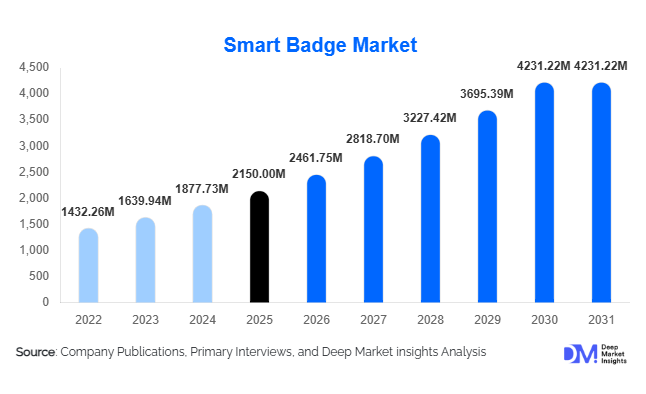
According to Deep Market Insights, the global smart badge market size was valued at USD 2,150 million in 2025 and is projected to grow from USD 2,461.75 million in 2026 to reach USD 4,231.22 million by 2031, expanding at a CAGR of 14.5% during the forecast period (2026–2031). The smart badge market growth is primarily driven by the increasing adoption of IoT-enabled workplace solutions, rising demand for secure identity and access management systems, and the growing emphasis on real-time workforce analytics across industries.
Key Market Insights
- Smart badges are evolving into multifunctional IoT devices, integrating analytics, proximity sensing, and cloud connectivity for real-time workforce insights.
- Corporate enterprises dominate demand, driven by large-scale deployment for access control, attendance tracking, and productivity monitoring.
- North America leads the market, supported by high adoption of advanced security and workplace automation technologies.
- Asia-Pacific is the fastest-growing region, fueled by industrialization, smart city initiatives, and digital infrastructure investments.
- Healthcare and manufacturing sectors are rapidly expanding, leveraging smart badges for safety compliance and operational efficiency.
- Cloud-based deployment models are gaining traction, offering scalability, cost efficiency, and enhanced data analytics capabilities.
What are the latest trends in the smart badge market?
IoT and AI-Driven Smart Badge Ecosystems
Smart badges are increasingly becoming integral components of IoT ecosystems within enterprises. Organizations are integrating badges with AI-powered analytics platforms to derive actionable insights on workforce productivity, movement patterns, and safety compliance. These systems enable predictive analytics, such as identifying operational bottlenecks and improving workforce allocation. The transition from standalone hardware to connected ecosystems is also driving recurring revenue models through SaaS-based analytics platforms, transforming the market from a product-centric to a service-oriented landscape.
Contactless and Health Monitoring Capabilities
Post-pandemic workplace transformation has accelerated the adoption of smart badges with contactless and health monitoring features. Proximity sensors, contact tracing functionalities, and real-time alerts are now standard features in many deployments. Industries such as healthcare, manufacturing, and large-scale events are leveraging these capabilities to ensure compliance with safety regulations and enhance employee well-being. The integration of wearable health monitoring sensors is further expanding the role of smart badges beyond identification into preventive safety management tools.
What are the key drivers in the smart badge market?
Rising Demand for Workplace Security
Organizations across industries are prioritizing advanced security systems to safeguard assets and personnel. Smart badges provide encrypted authentication, multi-factor access control, and real-time monitoring, making them a preferred solution over traditional ID cards. The increasing frequency of security breaches and regulatory requirements for secure access systems is driving widespread adoption of smart badge technologies globally.
Growth of IoT-Enabled Workforce Management
The adoption of IoT in enterprise environments is a major driver of smart badge demand. Companies are leveraging these devices to track employee attendance, monitor movements, and optimize operational workflows. This is particularly significant in manufacturing plants and large corporate campuses, where real-time visibility into workforce activities improves productivity and reduces inefficiencies.
Increasing Focus on Health and Safety Compliance
Industries such as healthcare and manufacturing are placing greater emphasis on employee safety and regulatory compliance. Smart badges equipped with proximity sensors and real-time alerts enable organizations to monitor social distancing, track interactions, and respond quickly to safety incidents. This has become a critical requirement in post-pandemic workplace environments, further boosting market growth.
What are the restraints for the global market?
High Initial Deployment Costs
The implementation of smart badge systems requires significant investment in hardware, software integration, and supporting infrastructure. This can be a barrier for small and medium enterprises, limiting market penetration in cost-sensitive segments. Ongoing maintenance and upgrade costs further add to the financial burden, making adoption slower among smaller organizations.
Data Privacy and Security Concerns
Smart badges collect sensitive data such as employee location and interaction patterns, raising concerns around data privacy and security. Compliance with stringent regulations such as GDPR and other regional data protection laws increases complexity for organizations. These concerns can hinder adoption, particularly in regions with strict regulatory frameworks.
What are the key opportunities in the smart badge industry?
Integration with Smart City and Digital Infrastructure Initiatives
Government-led initiatives such as smart cities and digital identity programs are creating new opportunities for smart badge adoption. These projects require secure and scalable identification systems, providing a strong growth avenue for market players. Emerging economies are particularly attractive due to large-scale infrastructure investments and increasing digitalization.
Expansion into Healthcare and Event Management
Healthcare facilities are adopting smart badges for patient tracking, staff coordination, and infection control. Similarly, the events industry is leveraging smart badges for attendee engagement, networking, and cashless transactions. These sector-specific applications are expanding the market beyond traditional enterprise use cases, creating new revenue streams for solution providers.
Report Scope
| Report Metric | Details |
|---|---|
| Market Size in 2025 | USD 2150 Million |
| Market Size in 2026 | USD 2461.75 Million |
| Market Size in 2031 | USD 4231.22 Million |
| CAGR | 14.5% (2026-2031) |
| Base Year for Estimation | 2025 |
| Historical Data | 2022-2024 |
| Forecast Period | 2026-2031 |
| Report Coverage | Revenue Forecast, Competitive Landscape, Supply Chain Disruption, Growth Factors, Environment & Regulatory Landscape and Trends |
| Geographies Covered | North America, Europe, APAC, Middle East and Africa, LATAM |
| Countries Covered | U.S., Canada, U.K., Germany, France, Spain, Italy, Russia, Nordic, Benelux, Rest of Europe, China, Korea, Japan, India, Australia, Singapore, Taiwan, South East Asia, Rest of Asia-Pacific, UAE, Turky, Saudi Arabia, South Africa, Egypt, Nigeria, Rest of MEA, Brazil, Mexico, Argentina, Chile, Colombia, Rest of LATAM |
Explore more data points, trends and opportunities Download Free Sample Report
Component Insights
Hardware continues to dominate the smart badge market, accounting for approximately 52% of the total market share in 2025, primarily due to sustained innovation in embedded electronics and miniaturized components. The rapid evolution of RFID, BLE, and UWB chipsets, along with improvements in sensor accuracy and battery efficiency, has strengthened the value proposition of hardware offerings. The leading driver for this segment is the continuous demand for advanced, multi-functional badge devices capable of supporting real-time tracking, authentication, and environmental sensing. Enterprises are prioritizing durable and high-performance hardware to ensure reliability in mission-critical environments such as manufacturing plants and healthcare facilities. Meanwhile, software is emerging as a high-growth segment as organizations increasingly invest in analytics platforms to extract actionable insights from badge-generated data. Services, including system integration, customization, and lifecycle management, are also expanding rapidly as enterprises require end-to-end deployment support, particularly for large-scale and multi-location implementations.
Technology Insights
BLE-based smart badges lead the market with around 34% share, driven by their low power consumption, scalability, and seamless integration with IoT ecosystems. The primary growth driver for this segment is the rising adoption of IoT-enabled workplace solutions, where BLE technology enables continuous connectivity without significant energy drain. This makes it ideal for enterprise environments requiring long battery life and real-time communication. RFID and NFC technologies continue to maintain strong adoption, particularly in access control and payment applications, due to their cost-effectiveness and established infrastructure. UWB technology is gaining traction as a niche but rapidly expanding segment, especially in industrial and healthcare settings where high-precision location tracking is critical. The growing need for centimeter-level accuracy in tracking assets and personnel is expected to further accelerate UWB adoption over the forecast period.
Application Insights
Access control and identity management remain the dominant application, contributing nearly 38% of the market share. The key driver for this segment is the increasing emphasis on enterprise security and regulatory compliance, as organizations seek robust solutions to prevent unauthorized access and ensure data protection. Smart badges equipped with encryption and multi-factor authentication capabilities are becoming essential in sectors such as finance, government, and healthcare. Workforce tracking and attendance management are also witnessing strong growth, particularly in large enterprises aiming to optimize productivity and operational efficiency. Emerging applications such as contact tracing, health monitoring, and event engagement are expanding the market scope, driven by the need for safer workplaces and enhanced user experiences. These new use cases are transforming smart badges into versatile tools that go beyond traditional identification functions.
End-Use Industry Insights
Corporate enterprises represent the largest end-use segment, accounting for approximately 30% of the global market. The leading driver for this segment is the growing adoption of smart workplace solutions, where organizations are integrating digital identity systems with broader enterprise IT infrastructure. Large corporate campuses and IT hubs are deploying smart badges to streamline access control, monitor employee movements, and improve operational transparency. Healthcare is the fastest-growing segment, with a CAGR exceeding 16%, driven by the increasing adoption of digital health technologies and the need for patient safety and staff coordination. Manufacturing and industrial facilities are also experiencing strong growth, supported by Industry 4.0 initiatives that require real-time workforce tracking and safety compliance. The integration of smart badges with industrial IoT platforms is further enhancing their adoption in this segment.
Connectivity & Deployment Insights
Connected smart badges dominate with around 65% market share, reflecting the growing importance of real-time data exchange and centralized monitoring systems. The primary driver for this segment is the increasing reliance on cloud-based and IoT-enabled enterprise ecosystems, where continuous connectivity is essential for data-driven decision-making. These badges enable organizations to monitor workforce activities in real time, improving efficiency and safety. Cloud-based deployment models lead with approximately 58% share, driven by their scalability, flexibility, and cost-effectiveness. Enterprises are increasingly shifting away from on-premise systems to cloud platforms that offer seamless updates, remote accessibility, and integration with advanced analytics tools. This trend is particularly strong among large organizations with distributed operations, where centralized data management is critical.
Explore more data points, trends and opportunities Download Free Sample Report
Smart Badge Market Segmentations
By Component
- Hardware
- Software
- Services
By Technology
- RFID-Based Smart Badges
- NFC-Based Smart Badges
- BLE-Based Smart Badges
- UWB-Based Smart Badges
- Hybrid Smart Badges
By Application
- Access Control & Identity Management
- Workforce Tracking & Attendance
- Contact Tracing & Health Monitoring
- Cashless Payments & Transactions
- Event Networking & Engagement
By End-Use Industry
- Corporate Enterprises
- Healthcare Facilities
- Manufacturing & Industrial
- Events & Conferences
- Government & Defense
- Education Institutions
By Connectivity & Deployment
- Connected (IoT-Enabled) Smart Badges
- Standalone Smart Badges
- Cloud-Based Deployment
- On-Premise Deployment
Regional Insights
North America
North America accounts for approximately 35% of the global smart badge market in 2025, with the United States representing the largest contributor. The region’s dominance is driven by early adoption of advanced technologies, strong presence of key market players, and high enterprise spending on security infrastructure. The widespread implementation of IoT, AI, and cloud computing in corporate environments has accelerated the adoption of smart badges. Additionally, stringent regulatory requirements related to workplace safety and data security are compelling organizations to invest in advanced identification systems. The healthcare sector in the U.S. is also a major growth driver, leveraging smart badges for patient tracking and staff coordination.
Europe
Europe holds around 25% market share, with Germany, the United Kingdom, and France leading demand. The region’s growth is primarily driven by strict data protection regulations, such as GDPR, and increasing investments in workplace automation. European enterprises are focusing on secure and compliant identity management solutions, which is boosting the adoption of smart badges. Additionally, the region’s strong industrial base is supporting demand in the manufacturing and logistics sectors. The push toward digital transformation and smart factory initiatives is further enhancing market growth across key European economies.
Asia-Pacific
Asia-Pacific is the fastest-growing region, with a CAGR exceeding 16%. China dominates the region, contributing nearly 18% of global demand, supported by large-scale industrial deployments and government initiatives such as “Made in China 2026.” India and Japan are also significant contributors, driven by rapid industrialization, expanding IT infrastructure, and increasing adoption of smart workplace technologies. The region benefits from a large workforce base and rising investments in digital transformation, making it a key growth hub. Additionally, the expansion of smart city projects and manufacturing automation is further accelerating demand for smart badge solutions.
Latin America
Latin America is experiencing gradual growth, led by Brazil and Mexico. The market is driven by improving digital infrastructure, increasing awareness of workplace security, and growing investments in the corporate and healthcare sectors. While adoption levels remain lower compared to developed regions, the rising need for efficient workforce management and security solutions is creating new opportunities. Government initiatives aimed at digital transformation are also supporting market expansion in the region.
Middle East & Africa
The Middle East & Africa region is witnessing steady growth, primarily driven by smart city initiatives, government investments in digital infrastructure, and increasing adoption of advanced security systems. Countries such as the UAE and Saudi Arabia are leading the market, supported by large-scale infrastructure projects and high adoption of IoT technologies. The region’s focus on diversifying economies and enhancing public sector efficiency is driving demand for smart badge solutions in government and enterprise sectors. Additionally, the growing hospitality and events industry in the Middle East is contributing to increased adoption of smart badges for access control and attendee management.
Key Players in the Smart Badge Market
- HID Global
- Zebra Technologies
- Honeywell International
- Identiv Inc.
- Stanley Black & Decker
- Siemens AG
- Bosch Security Systems
- Giesecke+Devrient
- ASSA ABLOY
- NEC Corporation
- Panasonic Corporation
- Fujitsu Limited
- Thales Group
- Brady Corporation
- Savi Technology