Skin Care Set Market Size
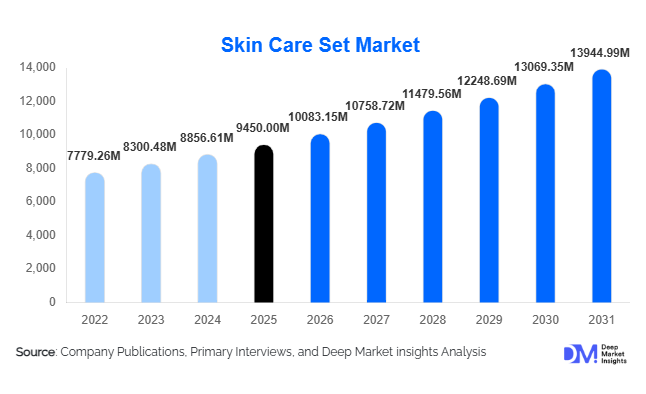
According to Deep Market Insights, the global Skin Care Set Market was valued at approximately USD 9,450 million in 2025 and is projected to grow from USD 10,083.15 million in 2026 to reach nearly USD 13,944.99 million by 2031, expanding at a CAGR of 6.7% during the forecast period (2026–2031). The market growth is primarily driven by rising consumer preference for complete skincare routines, increasing demand for premium and clean beauty products, expansion of e-commerce beauty channels, and growing influence of multi-step skincare regimens inspired by K-beauty and J-beauty trends.
Skin care sets are increasingly preferred by consumers due to their convenience, product compatibility, and cost-effectiveness compared to individual product purchases. These sets typically include cleansers, toners, serums, moisturizers, sunscreens, exfoliators, and masks designed for specific concerns such as anti-aging, hydration, acne control, pigmentation, and skin brightening. Rising awareness regarding preventive skincare, coupled with growing disposable incomes and urbanization, has significantly strengthened global demand.
The market is also benefiting from rapid digital transformation in the beauty industry, with AI-driven personalization, influencer-led marketing, and subscription-based skincare models reshaping consumer purchasing behavior. Additionally, sustainability trends such as vegan formulations, refillable packaging, and clean-label ingredients are further accelerating market adoption across developed and emerging economies.
Key Market Insights
- Anti-aging skincare sets dominate global demand, driven by a rising aging population and preventive skincare adoption among younger consumers.
- Asia-Pacific leads the global market due to a strong skincare culture in China, South Korea, Japan, and India.
- E-commerce is the fastest-growing distribution channel, supported by influencer marketing and direct-to-consumer strategies.
- Premium skincare sets are witnessing strong growth, reflecting global premiumization trends in beauty and personal care.
- Natural and organic skincare sets are expanding rapidly, driven by clean beauty and sustainability preferences.
- Male grooming skincare sets are emerging as a high-growth segment due to increasing awareness of personal care among men.
Skin Care Set Market Trends
Clean Beauty and Sustainable Formulations
Consumers are increasingly shifting toward clean-label, vegan, and cruelty-free skincare products. Brands are focusing on eliminating harmful chemicals, adopting plant-based formulations, and introducing biodegradable packaging solutions. Sustainability has become a key purchase driver, particularly among Millennials and Gen Z consumers, pushing companies to invest in eco-friendly innovation and carbon-neutral production practices.
AI-Driven Personalization and Digital Skincare
The integration of artificial intelligence and digital skin diagnostics is transforming how consumers select skincare sets. Brands are using AI tools to analyze skin type, environmental conditions, and user behavior to recommend customized skincare routines. Virtual consultations, AR-based try-ons, and subscription-based personalized kits are enhancing customer engagement and boosting retention rates.
Skin Care Set Market Drivers
Rising Skincare Awareness and Preventive Beauty Culture
Global consumers are increasingly adopting structured skincare routines focused on prevention rather than correction. Social media education, dermatology content, and influencer-driven awareness have significantly increased understanding of skincare ingredients and routines, driving demand for complete skincare sets rather than individual products.
Expansion of E-commerce and Direct-to-Consumer Channels
The rapid growth of online beauty platforms has significantly expanded access to skincare sets. Consumers benefit from product reviews, influencer recommendations, personalized suggestions, and competitive pricing. Subscription boxes and recurring skincare kits are also strengthening long-term consumer engagement.
Premiumization of Beauty and Personal Care Products
Rising disposable incomes and evolving consumer preferences are driving demand for premium and luxury skincare sets. Products featuring active ingredients such as retinol, peptides, ceramides, and niacinamide are gaining strong traction, particularly in urban markets across North America, Europe, and Asia-Pacific.
Skin Care Set Market Restraints
High Market Saturation and Intense Competition
The market is highly competitive, with global beauty giants, regional brands, and digital-native startups competing across all price segments. High advertising costs, influencer marketing expenses, and constant product innovation requirements create barriers for smaller players.
Regulatory Complexity and Ingredient Compliance
Different regulatory standards across regions such as the US, EU, China, and Japan create compliance challenges for manufacturers. Restrictions on ingredients, labeling requirements, and sustainability claims increase operational complexity and compliance costs.
Skin Care Set Market Opportunities
Personalized and Subscription-Based Skincare Solutions
The growing demand for personalized skincare routines presents a major opportunity for market expansion. AI-driven diagnostics and subscription-based skincare kits allow brands to offer customized solutions, improving customer loyalty and lifetime value.
Expansion in Emerging Markets
Rapid urbanization, rising disposable incomes, and social media influence in countries such as India, Brazil, Indonesia, and Vietnam are creating strong demand for affordable and premium skincare sets. Localization of formulations for diverse skin types and climates is further supporting growth.
Sustainable and Clean Beauty Innovation
Increasing demand for environmentally responsible skincare products is driving innovation in biodegradable packaging, waterless formulations, and ethically sourced ingredients. Companies adopting sustainable practices are gaining a competitive advantage in global markets.
Report Scope
| Report Metric | Details |
|---|---|
| Market Size in 2025 | USD 9450 Million |
| Market Size in 2026 | USD 10083.15 Million |
| Market Size in 2031 | USD 13944.99 Million |
| CAGR | 6.7% (2026-2031) |
| Base Year for Estimation | 2025 |
| Historical Data | 2022-2024 |
| Forecast Period | 2026-2031 |
| Report Coverage | Revenue Forecast, Competitive Landscape, Supply Chain Disruption, Growth Factors, Environment & Regulatory Landscape and Trends |
| Geographies Covered | North America, Europe, APAC, Middle East and Africa, LATAM |
| Countries Covered | U.S., Canada, U.K., Germany, France, Spain, Italy, Russia, Nordic, Benelux, Rest of Europe, China, Korea, Japan, India, Australia, Singapore, Taiwan, South East Asia, Rest of Asia-Pacific, UAE, Turky, Saudi Arabia, South Africa, Egypt, Nigeria, Rest of MEA, Brazil, Mexico, Argentina, Chile, Colombia, Rest of LATAM |
Explore more data points, trends and opportunities Download Free Sample Report
Product Type Insights
Anti-aging skincare sets dominate the global Skin Care Set Market, accounting for approximately 28% of the total market value in 2025. This leadership is primarily driven by the accelerating global aging population, rising concerns around premature skin aging among younger consumers due to pollution, UV exposure, and lifestyle stress, and increasing adoption of preventive skincare routines. Consumers are increasingly shifting from corrective treatments to long-term anti-aging maintenance, boosting demand for multi-step kits combining retinol, peptides, hyaluronic acid, and collagen-boosting formulations.
Hydration and moisturization sets represent the second most influential category, supported by growing incidences of skin barrier damage caused by environmental pollution, climate variability, and indoor air conditioning exposure. Acne and oil-control sets are experiencing strong traction among Gen Z and young adults, particularly in urban regions where hormonal acne, stress-related breakouts, and pollution exposure are prevalent. Brightening and pigmentation correction sets are especially dominant in Asia-Pacific markets due to strong cultural preference for even skin tone, fueled by niacinamide, vitamin C, and plant-based lightening agents.
Application Insights
Personal and home-use applications continue to dominate the Skin Care Set Market, accounting for nearly 79% of global demand in 2025. This dominance is driven by the rising consumer preference for at-home beauty routines, increased awareness of skincare layering systems, and the convenience of complete bundled regimens. The affordability of at-home skincare compared to professional treatments further reinforces this segment’s leadership.
Professional salon and spa applications are expanding steadily, particularly in luxury wellness centers, where skincare sets are integrated into facial therapies and premium treatment packages. Dermatology clinics are emerging as one of the fastest-growing application areas due to increasing reliance on clinically validated skincare regimens for acne, pigmentation disorders, rosacea, and aging-related concerns. Hospitality and wellness tourism sectors are also adopting premium skincare kits as part of guest experience enhancement strategies in luxury hotels and resorts.
Distribution Channel Insights
E-commerce platforms lead the global distribution landscape, contributing approximately 38% of skincare set sales in 2025. This dominance is fueled by influencer-led marketing, product discovery via social media, subscription-based skincare models, and AI-driven personalization tools that enhance consumer decision-making. The transparency of online reviews and ability to compare ingredient-based formulations has further strengthened digital dominance.
Specialty beauty stores and pharmacies continue to play a critical role in premium product sales, particularly for dermatologist-recommended and clinically tested skincare sets. Brand-owned retail stores are expanding through omnichannel integration, offering immersive customer experiences such as skin analysis kiosks and personalized consultations. Social commerce platforms are rapidly emerging as a powerful channel, especially among Gen Z consumers, driven by short-form video content and influencer-driven purchase decisions.
Explore more data points, trends and opportunities Download Free Sample Report
Skin Care Set Market Segmentations
By Product Type
- Anti-Aging Skincare Sets
- Hydration & Moisturization Sets
- Acne & Oil-Control Sets
- Brightening & Pigmentation Correction Sets
- Sensitive Skin Care Sets
- Sun Protection & UV Defense Sets
- Premium & Luxury Multi-Step Skincare Sets
- Organic & Natural Skincare Sets
By Application
- Personal / Home Use
- Professional Salon & Spa Use
- Dermatology Clinics
- Hospitality & Wellness Tourism
- Corporate Gifting & Promotional Use
By Distribution Channel
- E-commerce Platforms
- Specialty Beauty Stores
- Pharmacies & Drugstores
- Brand-Owned Retail Stores
- Department Stores
- Social Commerce Platforms
- Subscription-Based Beauty Boxe
Regional Insights
Asia-Pacific
Asia-Pacific leads the global market with approximately 41% share in 2025. The region’s dominance is driven by strong skincare culture, early adoption of multi-step skincare routines, and innovation leadership from South Korea and Japan. China remains a major demand hub supported by rapid premiumization and livestream commerce, while India is emerging as the fastest-growing market due to rising disposable incomes and increasing digital beauty adoption.
The region is primarily driven by high product innovation in K-beauty and J-beauty, strong influence of beauty influencers, rapid urbanization, and increasing consumer preference for natural and functional skincare ingredients such as niacinamide, fermented extracts, and herbal actives.
North America
North America accounts for nearly 27% of the global market, led by the United States. The region exhibits strong demand for premium skincare sets, dermatologist-developed formulations, and clean beauty products. Consumers are highly ingredient-conscious and increasingly prefer scientifically validated skincare routines supported by clinical research.
Growth is driven by rising demand for anti-aging solutions among aging millennials, rapid expansion of AI-based skincare personalization platforms, strong penetration of subscription skincare services, and increasing adoption of sustainability-focused beauty brands.
Europe
Europe holds around 24% share of the global market, with France, Germany, and the United Kingdom as key contributors. The region is strongly influenced by luxury beauty consumption, dermatological skincare adoption, and strict regulatory frameworks that reinforce consumer trust in product safety and sustainability.
The European market is driven by rising demand for eco-certified and organic skincare, increasing consumer focus on ingredient transparency, strong luxury skincare heritage in France and Italy, and growing preference for clinically tested dermatology-grade skincare systems.
Latin America
Brazil leads regional demand, followed by Mexico and Argentina, driven by rising beauty awareness and strong influence of social media trends. Demand for skincare sets is increasing across urban populations, particularly for brightening, hydration, and anti-aging solutions tailored to diverse skin tones.
Growth is supported by an expanding middle-class population, increasing internet and social media penetration, rising adoption of global beauty standards, and growing preference for affordable bundled skincare solutions offering high value.
Middle East & Africa
The UAE and Saudi Arabia dominate premium skincare demand in the region, supported by high-income consumers and strong luxury retail expansion. Climate conditions characterized by heat, dryness, and high UV exposure further drive demand for hydration and sun protection skincare sets.
The region’s growth is driven by luxury beauty consumption among high-net-worth individuals, rising influence of international beauty brands, increasing demand for climate-adaptive skincare solutions, and the expansion of premium retail infrastructure in Gulf countries.
Key Players in the Skin Care Set Market
- L'Oréal
- Estée Lauder Companies
- Shiseido
- Procter & Gamble
- Unilever
- Amorepacific
- Beiersdorf
- Johnson & Johnson
- Coty
- LG Household & Health Care
- Kao Corporation
- Chanel
- Clarins
- Natura & Co
- Mary Kay