Ski Pole Market Size
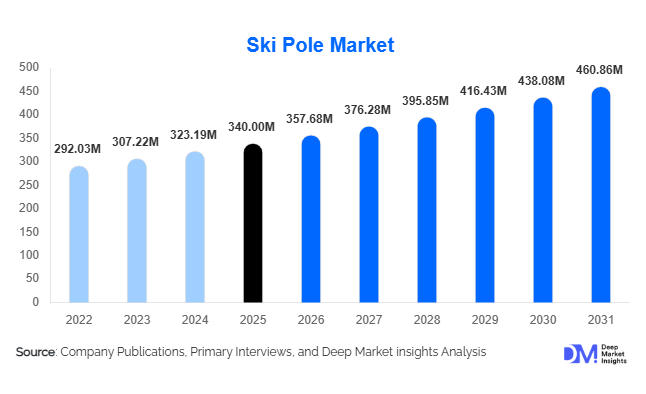
According to Deep Market Insights, the global ski pole market size was valued at USD 340 million in 2025 and is projected to grow from USD 357.68 million in 2026 to reach USD 460.86 million by 2031, expanding at a CAGR of 5.2% during the forecast period (2026–2031). The ski pole market growth is primarily driven by the rising participation in winter sports activities, expansion of ski tourism infrastructure across emerging destinations, and increasing demand for lightweight, high-performance equipment made from advanced materials such as carbon fiber and reinforced aluminum alloys. Growing consumer interest in adventure tourism and recreational skiing is also strengthening global demand for ski poles across both premium and mid-range segments.
Key Market Insights
- Alpine skiing dominates global demand, driven by strong ski resort infrastructure across Europe and North America.
- Carbon fiber and hybrid material ski poles are gaining traction due to their lightweight structure and performance advantages.
- Europe leads the global market, supported by high participation rates in skiing sports and an established alpine tourism culture.
- Asia-Pacific is the fastest-growing region, fueled by ski infrastructure development in China, Japan, and South Korea.
- Rental and ski school demand is increasing, supporting steady institutional purchases of durable and adjustable ski poles.
- E-commerce platforms are rapidly expanding distribution, improving accessibility of mid-range and premium ski equipment globally.
What are the latest trends in the ski pole market?
Lightweight Material Innovation and Performance Enhancement
The ski pole market is witnessing a strong shift toward advanced materials such as carbon fiber composites and aerospace-grade aluminum alloys. These materials significantly reduce weight while improving durability and vibration control, enhancing skier performance and reducing fatigue. Manufacturers are increasingly investing in R&D to develop hybrid structures that balance cost efficiency and high performance. This trend is particularly strong in the premium ski segment, where professional athletes and advanced recreational users demand equipment optimized for precision and endurance.
Rising Demand for Rental-Optimized Equipment
Ski resorts and ski schools are increasingly driving demand for durable, adjustable ski poles designed for high-frequency usage. This is leading to increased adoption of telescopic and fixed-length hybrid models that can withstand repeated use across different user groups. The growth of ski tourism packages and resort-based rental ecosystems is reinforcing this trend, especially in Europe and North America, where organized ski tourism is highly developed.
What are the key drivers in the ski pole market?
Expansion of Global Ski Tourism
The steady rise in international ski tourism is one of the strongest drivers of the ski pole market. Increasing disposable income, improved air connectivity to alpine destinations, and the popularity of winter sports vacations are encouraging more consumers to participate in skiing activities. Countries such as Switzerland, Austria, the United States, and Japan continue to attract millions of ski tourists annually, directly boosting demand for ski equipment, including poles.
Technological Advancements in Equipment Design
Continuous innovation in ski pole design, including ergonomic grips, vibration-dampening systems, and lightweight composite materials, is significantly enhancing user experience. These advancements improve safety, comfort, and performance, making skiing more accessible to beginners while also meeting the expectations of professional athletes. This technological evolution is increasing replacement cycles and driving premium product adoption globally.
Growth in Recreational and Adventure Sports Participation
A rising global interest in adventure and outdoor sports is expanding the consumer base for ski equipment. Younger demographics are increasingly engaging in skiing as a recreational activity, supported by social media influence and experiential travel trends. This is broadening demand beyond traditional skiing regions and contributing to consistent market expansion.
What are the restraints for the global market?
Seasonal Demand Dependency
The ski pole market is highly dependent on winter seasons, leading to fluctuating demand cycles throughout the year. This seasonality creates revenue instability for manufacturers and retailers, particularly in regions with shorter ski seasons. Off-season demand remains limited, affecting inventory management and production planning.
High Penetration of Low-Cost Alternatives
Price-sensitive markets, especially in emerging economies, prefer low-cost ski poles or rental options, which restricts the growth of premium product segments. This limits revenue expansion for high-end manufacturers and intensifies price competition in the economy segment of the market.
What are the key opportunities in the ski pole industry?
Expansion in Emerging Ski Tourism Destinations
Countries such as China and South Korea are investing heavily in ski resort infrastructure, creating new demand centers for ski equipment. Government-backed winter sports initiatives are encouraging participation and expanding the consumer base. This presents significant opportunities for global manufacturers to enter emerging markets through localized distribution and affordable product offerings.
Smart and Sensor-Enabled Ski Equipment
The integration of digital technologies into ski equipment presents a future growth opportunity. Smart ski poles equipped with motion sensors, performance tracking, and GPS capabilities are expected to gain traction among professional athletes and tech-savvy users. This aligns with broader trends in sports analytics and wearable technology integration.
Growth of Rental and Institutional Procurement Models
The increasing dominance of ski resorts and rental-based tourism models is creating stable institutional demand. Manufacturers can secure long-term contracts by offering durable, low-maintenance, and adjustable ski poles designed specifically for rental ecosystems. This shift is expected to ensure consistent volume-based demand across major ski destinations.
Report Scope
| Report Metric | Details |
|---|---|
| Market Size in 2025 | USD 340 Million |
| Market Size in 2026 | USD 357.68 Million |
| Market Size in 2031 | USD 460.86 Million |
| CAGR | 5.2% (2026-2031) |
| Base Year for Estimation | 2025 |
| Historical Data | 2022-2024 |
| Forecast Period | 2026-2031 |
| Report Coverage | Revenue Forecast, Competitive Landscape, Supply Chain Disruption, Growth Factors, Environment & Regulatory Landscape and Trends |
| Geographies Covered | North America, Europe, APAC, Middle East and Africa, LATAM |
| Countries Covered | U.S., Canada, U.K., Germany, France, Spain, Italy, Russia, Nordic, Benelux, Rest of Europe, China, Korea, Japan, India, Australia, Singapore, Taiwan, South East Asia, Rest of Asia-Pacific, UAE, Turky, Saudi Arabia, South Africa, Egypt, Nigeria, Rest of MEA, Brazil, Mexico, Argentina, Chile, Colombia, Rest of LATAM |
Explore more data points, trends and opportunities Download Free Sample Report
Product Type Insights
Aluminum ski poles continue to dominate the global ski pole market, accounting for approximately 55% of total market share in 2025. Their leadership is primarily driven by cost efficiency, high durability, and suitability for mass usage in rental fleets and ski schools. Aluminum poles offer a strong balance between performance and affordability, making them the preferred choice for beginner and intermediate skiers as well as institutional buyers. The segment’s dominance is further reinforced by the growing rental ecosystem across ski resorts, where durability and low replacement cost are critical procurement factors. Carbon fiber ski poles represent the fastest-growing premium segment, driven by increasing demand from professional athletes and performance-oriented consumers. These poles offer a superior strength-to-weight ratio, vibration dampening, and enhanced control, which significantly improve skiing performance. As consumer preferences shift toward high-performance equipment, especially in North America and Europe, carbon fiber adoption is expected to accelerate further. Meanwhile, composite and hybrid ski poles are gaining traction due to their ability to combine affordability with improved performance characteristics, making them attractive in the mid-range segment.
From a design perspective, fixed-length ski poles hold a dominant share of approximately 65%, largely due to their structural simplicity, reliability, and widespread adoption in rental and recreational applications. However, adjustable or telescopic ski poles are witnessing strong growth, particularly in tourism-driven markets and multi-user environments, where flexibility and convenience are key purchase drivers.
Application Insights
Alpine skiing remains the leading application segment in the global ski pole market, contributing nearly 60% of total demand in 2025. This dominance is primarily driven by the widespread popularity of downhill skiing across Europe and North America, supported by well-developed ski resort infrastructure and a strong culture of winter sports participation. Alpine skiing also drives higher equipment replacement rates, as performance-oriented users frequently upgrade gear to match evolving skill levels. Cross-country skiing holds a significant share, particularly in Nordic countries such as Norway, Sweden, and Finland, where it is deeply integrated into both recreational and professional sports culture. This segment benefits from consistent participation levels and government support for winter sports activities. Freestyle and park skiing are emerging niche segments, driven by younger demographics and increasing interest in extreme sports and snow parks.
Recreational skiing is the fastest-growing application segment, supported by rising global tourism and increased participation in winter holiday activities. The expansion of ski schools and beginner-friendly programs is further accelerating demand, as new entrants to the sport require entry-level equipment. Additionally, ski rental services contribute significantly to overall demand, creating a stable institutional procurement channel for durable and cost-effective ski poles.
Distribution Channel Insights
Specialty sports retail stores remain the dominant distribution channel, accounting for approximately 40% of global ski pole sales. This dominance is driven by consumer preference for in-store product testing, expert guidance, and personalized fitting, particularly for performance-oriented equipment. These stores play a crucial role in influencing purchasing decisions, especially among intermediate and professional skiers. However, online retail platforms are experiencing rapid growth, driven by increasing digital adoption, competitive pricing, and wider product availability. E-commerce channels are particularly appealing to younger consumers and recreational users who prioritize convenience and price transparency. Manufacturers are also increasingly leveraging direct-to-consumer (D2C) platforms to improve margins and strengthen brand engagement.
Ski resorts and rental operators represent a stable and high-volume institutional channel, driving bulk procurement of ski poles designed for durability and ease of use. OEM bundled sales, where ski poles are sold as part of complete ski equipment kits, also contribute significantly to market revenue, particularly in premium and professional segments where brand bundling enhances value perception.
Explore more data points, trends and opportunities Download Free Sample Report
Ski Pole Market Segmentations
By Material
- Aluminum Ski Poles
- Carbon Fiber Ski Poles
- Composite / Hybrid Ski Poles
- Advanced Alloy Ski Poles
By End Use
- Alpine Skiing
- Nordic / Cross-Country Skiing
- Freestyle & Park Skiing
- Recreational & Casual Skiing
- Rental & Ski School Use
By Distribution Channel
- Specialty Sports Retail Stores
- Online Retail Platforms
- Ski Resorts & Rental Shops
- OEM Bundled Sales
By Price Segment
- Economy Segment
- Mid-Range Segment
- Premium Segment
By Product Type
- Fixed-Length Ski Poles
- Adjustable / Telescopic Ski Poles
Regional Insights
Europe
Europe leads the global ski pole market with approximately 45% market share in 2025, driven by its deeply rooted skiing culture and well-established alpine tourism infrastructure. Countries such as Austria, Switzerland, France, Germany, and Italy serve as major demand centers due to their extensive ski resort networks and high participation rates. Key growth drivers in the region include strong domestic and international ski tourism, frequent equipment replacement cycles, and high consumer spending on premium sports gear. Additionally, Europe benefits from being a manufacturing hub for leading ski equipment brands, further strengthening regional market dominance.
North America
North America accounts for around 35% of the global ski pole market, led by the United States and Canada. The region’s growth is driven by a combination of high disposable income, well-developed ski resort infrastructure, and strong participation in winter sports tourism. Demand is particularly strong for premium and technologically advanced ski poles, as consumers in this region show a higher willingness to invest in high-performance equipment. The presence of major ski destinations such as Colorado and British Columbia further supports consistent demand, while growing interest in adventure sports among younger demographics is expanding the consumer base.
Asia-Pacific
Asia-Pacific is the fastest-growing region in the ski pole market, driven by the rapid expansion of ski infrastructure in countries such as China, Japan, and South Korea. Government initiatives promoting winter sports participation, particularly in China following major international sporting events, are significantly boosting market growth. Rising middle-class income, increasing outbound and domestic tourism, and growing awareness of skiing as a recreational activity are key drivers in this region. Additionally, investments in indoor ski facilities and artificial snow parks are helping to overcome seasonal limitations and expand year-round demand.
Latin America
Latin America represents an emerging market for ski poles, with growing demand concentrated in countries such as Chile and Argentina. The region’s growth is driven by increasing adventure tourism and the development of ski resorts in the Andes mountain range. While the market remains relatively small compared to Europe and North America, rising disposable income among urban populations and growing interest in winter sports are gradually supporting demand. Seasonal tourism from international visitors also contributes to equipment rental demand, providing opportunities for institutional sales.
Middle East & Africa
The Middle East & Africa region exhibits limited but steadily growing demand for ski poles. Growth is primarily driven by outbound tourism from high-income Gulf countries such as the UAE and Saudi Arabia, where consumers frequently travel to European ski destinations. Additionally, niche ski tourism activities in select mountainous regions of Africa are contributing to localized demand. Increasing interest in luxury adventure tourism and rising disposable income in the Middle East are key growth drivers, while the development of indoor ski facilities in the region is expected to create new demand avenues in the long term.