Single-Function Printers Market Size
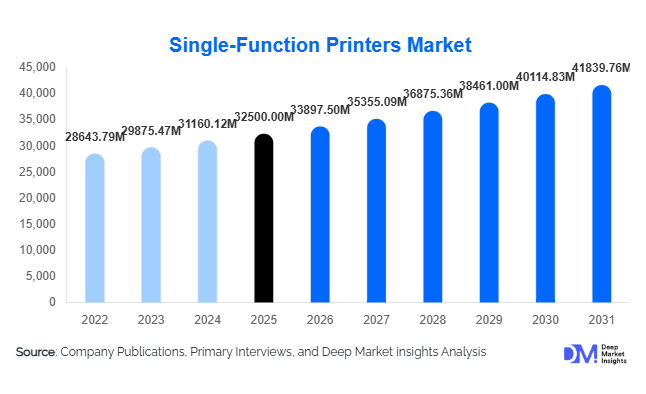
According to Deep Market Insights, the global single-function printers market size was valued at USD 32,500 million in 2025 and is projected to grow from USD 33,897.50 million in 2026 to reach USD 41,839.76 million by 2031, expanding at a CAGR of 4.3% during the forecast period (2026–2031). The market growth is primarily driven by steady demand for dedicated printing solutions across commercial offices, educational institutions, and industrial applications, along with increasing adoption of cost-efficient and high-performance printing devices in emerging economies.
Key Market Insights
- Laser printers dominate the market, accounting for nearly 48% share due to their efficiency in high-volume printing environments.
- Wireless-enabled printers are gaining rapid adoption, contributing over 55% of total sales driven by mobile and cloud-based workflows.
- Asia-Pacific leads the global market, with approximately 38% share, supported by strong demand from China and India.
- Commercial offices remain the largest end-use segment, contributing around 40% of total demand.
- Mid-range printers (USD 150–500) dominate pricing segments, offering a balance between affordability and advanced features.
- Sustainability and energy-efficient printing solutions are becoming critical decision factors among enterprises globally.
What are the latest trends in the single-function printers market?
Shift Toward Wireless and Cloud Printing
The increasing adoption of wireless and cloud-based technologies is transforming the single-function printers market. Businesses and consumers are prioritizing printers that support Wi-Fi, mobile printing, and integration with cloud platforms. This trend is particularly prominent in hybrid work environments, where remote printing capabilities are essential. Cloud-enabled printers allow seamless document access, remote monitoring, and improved workflow efficiency, making them a preferred choice for SMEs and enterprises alike.
Growing Demand for Eco-Friendly Printing Solutions
Sustainability is emerging as a critical trend, with manufacturers focusing on energy-efficient printers, refillable ink systems, and recyclable materials. Regulatory pressures in Europe and North America are pushing companies to adopt environmentally compliant products. Eco-conscious consumers are increasingly favoring printers with lower energy consumption and reduced waste generation, encouraging innovation in green printing technologies.
What are the key drivers in the single-function printers market?
Rising Demand from SMEs and Home Offices
The expansion of small and medium enterprises and the rise of hybrid work models are driving demand for compact and cost-effective single-function printers. These devices offer reliability and simplicity, making them ideal for home offices and small business environments where multifunction capabilities are not essential.
Growth in Emerging Economies
Rapid economic development in countries such as India, China, and Brazil is significantly boosting demand for printing infrastructure. Increasing office setups, educational institutions, and government initiatives are contributing to sustained growth in these regions.
Technological Advancements in Printing Efficiency
Innovations such as high-speed laser printing, wireless connectivity, and smart maintenance features are enhancing productivity and user experience. These advancements are encouraging businesses to upgrade existing systems, driving replacement demand globally.
What are the restraints for the global market?
Shift Toward Digital Documentation
The growing adoption of paperless workflows and digital documentation systems is limiting the demand for printing devices. Organizations are increasingly reducing paper usage to cut costs and meet sustainability goals.
Competition from Multifunction Printers
Multifunction printers offering printing, scanning, and copying capabilities in a single device are gaining popularity, posing a challenge to single-function printers, especially in office environments seeking space and cost efficiency.
What are the key opportunities in the single-function printers industry?
Expansion in Emerging Markets
Emerging economies present significant growth opportunities due to increasing literacy rates, expanding SMEs, and rising office infrastructure. Government initiatives in education and digitalization are further supporting demand for printing devices.
Integration with IoT and Cloud Ecosystems
The integration of printers with IoT platforms and cloud-based systems is creating new growth avenues. Features such as remote diagnostics, predictive maintenance, and enhanced cybersecurity are becoming key differentiators for manufacturers.
Sustainability-Driven Product Innovation
Eco-friendly product development, including energy-efficient printers and refillable ink systems, is opening new market opportunities. Companies focusing on green certifications and sustainable manufacturing are gaining competitive advantages.
Report Scope
| Report Metric | Details |
|---|---|
| Market Size in 2025 | USD 32500 Million |
| Market Size in 2026 | USD 33897.50 Million |
| Market Size in 2031 | USD 41839.76 Million |
| CAGR | 4.3% (2026-2031) |
| Base Year for Estimation | 2025 |
| Historical Data | 2022-2024 |
| Forecast Period | 2026-2031 |
| Report Coverage | Revenue Forecast, Competitive Landscape, Supply Chain Disruption, Growth Factors, Environment & Regulatory Landscape and Trends |
| Geographies Covered | North America, Europe, APAC, Middle East and Africa, LATAM |
| Countries Covered | U.S., Canada, U.K., Germany, France, Spain, Italy, Russia, Nordic, Benelux, Rest of Europe, China, Korea, Japan, India, Australia, Singapore, Taiwan, South East Asia, Rest of Asia-Pacific, UAE, Turky, Saudi Arabia, South Africa, Egypt, Nigeria, Rest of MEA, Brazil, Mexico, Argentina, Chile, Colombia, Rest of LATAM |
Explore more data points, trends and opportunities Download Free Sample Report
Technology Insights
Laser printers lead the technology segment, accounting for approximately 48% of the global market share in 2025, primarily driven by their superior speed, durability, and cost efficiency in high-volume printing environments. These printers are widely adopted across enterprises, government institutions, and large-scale organizations where bulk document processing is essential. Their lower cost per page and longer lifecycle compared to inkjet printers further strengthen their dominance. Additionally, advancements such as energy-efficient laser engines and enhanced toner technologies are supporting sustained adoption.
Inkjet printers continue to hold a significant share, particularly in residential and small office settings, due to their low upfront cost, compact design, and versatility in color printing. The rising demand for home-based work setups and small businesses has boosted inkjet adoption, especially in emerging economies. Continuous ink supply systems (CISS) and refillable ink tank models are further improving cost efficiency, making them increasingly competitive. Impact printers, including dot matrix printers, cater to niche but critical applications such as industrial documentation, invoicing, logistics, and government records. Their ability to produce multi-copy prints and operate in rugged environments ensures continued relevance, particularly in sectors where durability and reliability outweigh speed and print quality.
Print Output Insights
Monochrome printers dominate the market with approximately 62% share in 2025, driven by their extensive use in commercial offices, financial institutions, and administrative operations where high-volume text printing is required. Their lower operational costs, faster output speeds, and reduced maintenance requirements make them the preferred choice for businesses focused on efficiency and cost control. The increasing adoption of digital workflows has not significantly impacted this segment due to the continued need for physical documentation in regulatory and operational processes.
Color printers, although accounting for a smaller share, are witnessing steady growth driven by rising demand for marketing materials, presentations, packaging labels, and creative applications. Industries such as retail, advertising, and education are increasingly investing in color printing to enhance communication and visual appeal. Technological advancements in color accuracy and cost optimization are expected to further accelerate growth in this segment.
Connectivity Insights
Wireless printers account for over 55% of the global market share, making them the leading connectivity segment. This dominance is driven by the growing need for mobility, flexibility, and seamless integration with digital workflows. The widespread adoption of remote and hybrid work models has significantly increased demand for printers that support Wi-Fi, mobile printing, and cloud-based access.
Cloud-enabled printing solutions are further transforming the market by enabling remote device management, real-time document access, and enhanced security features. Enterprises are increasingly adopting these solutions to streamline operations and reduce IT overhead. Additionally, the integration of printers with enterprise resource planning (ERP) systems and document management platforms is driving further adoption. Wired printers, including USB and Ethernet-based devices, continue to serve traditional office environments where stable and secure connections are critical, particularly in government and financial sectors.
End-Use Insights
Commercial offices represent the largest end-use segment, contributing approximately 40% of total market demand in 2025. This dominance is driven by the continuous need for document printing, reporting, billing, and administrative functions. Despite digital transformation efforts, physical documentation remains essential in many business operations, sustaining demand in this segment. The education sector is one of the fastest-growing segments, supported by expanding school and university infrastructure, particularly in emerging economies. Hybrid learning models and examination requirements continue to drive demand for printing solutions.
The healthcare sector is also witnessing increasing adoption, driven by the need for patient records, prescriptions, and compliance documentation. Additionally, industrial and manufacturing sectors are emerging as important end-users, particularly for labeling, packaging, and logistics documentation, fueled by the growth of e-commerce and global trade.
Explore more data points, trends and opportunities Download Free Sample Report
Single-Function Printers Market Segmentations
By Technology
- Inkjet Printers
- Laser Printers
- Impact Printers
By Print Output Type
- Monochrome Printers
- Color Printers
By Connectivity
- Wired Printers
- Wireless Printers
By Distribution Channel
- Online Retail
- Offline Retail
By End-Use Industry
- Residential
- Commercial Offices
- Educational Institutions
- Government & Public Sector
- Healthcare
- Industrial & Manufacturing
Regional Insights
Asia-Pacific
Asia-Pacific dominates the global market with approximately 38% share in 2025, making it the largest regional market. China accounts for nearly 18% of global demand, driven by its strong manufacturing base, extensive export activities, and large-scale enterprise operations. The demand for single-function printers in China is further supported by industrial documentation requirements and government administrative needs. India is emerging as one of the fastest-growing markets in the region, driven by rapid SME expansion, increasing digitalization initiatives, and government programs such as “Digital India” and “Make in India”. The growing education sector and rising number of startups are also contributing significantly to demand. Japan and South Korea represent mature markets characterized by high adoption of advanced printing technologies, automation, and energy-efficient devices. Overall regional growth is driven by urbanization, expanding office infrastructure, and increasing literacy rates.
North America
North America holds approximately 26% of the global market share, with the United States being the dominant contributor. The region’s growth is driven by high enterprise adoption, advanced IT infrastructure, and strong demand for high-performance printing solutions. The increasing adoption of cloud-based printing, managed print services (MPS), and secure printing technologies is a key growth driver in this region. Additionally, the presence of major market players and continuous technological innovation further support market expansion. Demand is also sustained by regulatory requirements in sectors such as healthcare, legal, and finance, where physical documentation remains critical.
Europe
Europe accounts for approximately 22% of the global market, with Germany, the United Kingdom, and France as major contributors. The region is characterized by a strong focus on sustainability and energy efficiency, which is driving the adoption of eco-friendly printing solutions. Strict environmental regulations and corporate sustainability goals are encouraging businesses to invest in low-energy printers, recyclable materials, and reduced-emission technologies. Additionally, the well-established corporate sector and high adoption of advanced technologies support steady demand. Growth is further driven by the increasing demand for secure printing solutions in industries such as banking, government, and healthcare.
Latin America
Latin America represents around 8% of the global market, with Brazil and Mexico leading demand. Market growth in this region is driven by expanding education systems, growing retail sectors, and increasing business activities. The rising number of SMEs and improving economic conditions are contributing to increased adoption of cost-effective printing solutions. Additionally, government initiatives aimed at improving literacy and education infrastructure are supporting demand. However, price sensitivity remains a key factor, leading to higher demand for entry-level and mid-range printers.
Middle East & Africa
The Middle East & Africa region holds approximately 6% of the global market share and is the fastest-growing region, with growth rates exceeding 5.5% annually. The United Arab Emirates and South Africa are the primary markets, driven by infrastructure development, increasing business activity, and government investments. Growth in this region is supported by expanding corporate sectors, rising educational investments, and increasing adoption of digital infrastructure. Additionally, the growth of logistics and trade activities is driving demand for printing solutions in documentation and labeling applications. Government-led initiatives to diversify economies and improve public sector efficiency are further accelerating adoption across the region.
Key Players in the Single-Function Printers Market
- HP Inc.
- Canon Inc.
- Epson Corporation
- Brother Industries Ltd.
- Xerox Holdings Corporation
- Ricoh Company Ltd.
- Lexmark International Inc.
- Kyocera Corporation
- Konica Minolta Inc.
- Toshiba Tec Corporation
- Sharp Corporation
- Dell Technologies
- Pantum (Zhuhai Seine Technology)
- Oki Electric Industry Co. Ltd.
- Samsung Electronics (Printing Business)