Silk Pillowcase Market Size
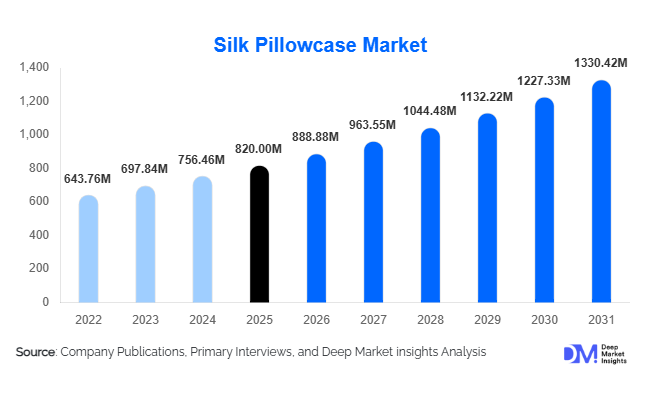
According to Deep Market Insights, the global silk pillowcase market size was valued at USD 820 million in 2025 and is projected to grow from USD 888.88 million in 2026 to reach USD 1,330.42 million by 2031, expanding at a CAGR of 8.4% during the forecast period (2026–2031). The silk pillowcase market growth is primarily driven by increasing consumer awareness regarding hair and skin health, rising demand for premium home textiles, and the growing influence of beauty and wellness trends across global markets.
Key Market Insights
- Silk pillowcases are increasingly positioned as beauty and wellness products, driven by their benefits in reducing hair damage and skin irritation.
- Online retail dominates global sales, supported by strong digital marketing, influencer promotions, and direct-to-consumer brand strategies.
- North America leads the market, fueled by high disposable income and strong awareness of premium bedding products.
- Asia-Pacific is the fastest-growing region, driven by rising middle-class income and strong domestic silk production.
- Mid-range pricing segments are expanding rapidly, making silk pillowcases more accessible to a broader consumer base.
- Sustainability and natural fiber demand are influencing purchasing decisions, favoring silk over synthetic alternatives.
What are the latest trends in the silk pillowcase market?
Wellness and Beauty Integration Driving Demand
Silk pillowcases are increasingly being marketed as an extension of skincare and haircare routines. Consumers are adopting these products for their anti-aging and hair protection benefits, supported by dermatological recommendations and social media influence. This trend has transformed silk pillowcases from luxury bedding items into essential wellness products. Brands are expanding into bundled offerings, combining pillowcases with sleep masks and hair accessories to create holistic beauty solutions. This integration is particularly appealing to younger consumers who prioritize multifunctional lifestyle products.
Expansion of Direct-to-Consumer and Digital Channels
The rise of e-commerce and direct-to-consumer (D2C) brands has significantly reshaped the silk pillowcase market. Companies are leveraging social media platforms, influencer partnerships, and subscription models to build brand loyalty and reach global audiences. Personalized marketing strategies, including targeted ads and customer reviews, are driving conversion rates. Additionally, advancements in logistics and cross-border e-commerce are enabling smaller brands to compete internationally, expanding market accessibility and intensifying competition.
What are the key drivers in the silk pillowcase market?
Growing Awareness of Hair and Skin Benefits
One of the primary drivers of the silk pillowcase market is the increasing awareness of its benefits for hair and skin health. Silk reduces friction compared to traditional fabrics, minimizing hair breakage, frizz, and skin creases. This functional advantage has been widely promoted through beauty influencers and dermatologists, significantly boosting consumer adoption. The trend is particularly strong among urban populations with higher exposure to beauty and wellness content.
Premiumization of Home Textiles
The global shift toward premium home furnishings is another major driver. Consumers are increasingly investing in high-quality bedding products that enhance comfort and lifestyle. Silk pillowcases, positioned as luxury items, are benefiting from this trend. Rising disposable incomes and changing consumer preferences toward aesthetic and functional home products are supporting sustained demand growth.
What are the restraints for the global market?
High Product Cost Compared to Alternatives
Silk pillowcases are significantly more expensive than cotton or synthetic alternatives, which limits their adoption among price-sensitive consumers. While mid-range products are emerging, the perception of silk as a luxury product continues to restrict mass-market penetration. Price sensitivity is particularly evident in developing regions where consumers prioritize affordability over premium features.
Raw Material and Supply Chain Constraints
The silk pillowcase market is dependent on the availability of raw silk, which is subject to fluctuations due to climatic conditions and regional production limitations. The concentration of silk production in specific countries increases supply chain risks. Variations in raw material costs can impact pricing strategies and profit margins for manufacturers, posing challenges for market stability.
What are the key opportunities in the silk pillowcase industry?
Expansion into Emerging Markets
Emerging economies such as India, Brazil, and the UAE present significant growth opportunities for silk pillowcase manufacturers. Rising disposable incomes, urbanization, and increasing awareness of premium lifestyle products are driving demand in these regions. Localized marketing strategies and competitive pricing can help companies tap into these high-growth markets and expand their global footprint.
Product Innovation and Customization
Innovation in product design and functionality is creating new growth avenues. Customizable pillowcases with personalized embroidery, varied sizes, and enhanced features such as antimicrobial treatments are gaining popularity. Companies investing in sustainable production methods and advanced textile technologies can differentiate themselves in a competitive market. Additionally, expanding product lines into complementary accessories can increase revenue streams.
Report Scope
| Report Metric | Details |
|---|---|
| Market Size in 2025 | USD 820 Million |
| Market Size in 2026 | USD 888.88 Million |
| Market Size in 2031 | USD 1330.42 Million |
| CAGR | 8.4% (2026-2031) |
| Base Year for Estimation | 2025 |
| Historical Data | 2022-2024 |
| Forecast Period | 2026-2031 |
| Report Coverage | Revenue Forecast, Competitive Landscape, Supply Chain Disruption, Growth Factors, Environment & Regulatory Landscape and Trends |
| Geographies Covered | North America, Europe, APAC, Middle East and Africa, LATAM |
| Countries Covered | U.S., Canada, U.K., Germany, France, Spain, Italy, Russia, Nordic, Benelux, Rest of Europe, China, Korea, Japan, India, Australia, Singapore, Taiwan, South East Asia, Rest of Asia-Pacific, UAE, Turky, Saudi Arabia, South Africa, Egypt, Nigeria, Rest of MEA, Brazil, Mexico, Argentina, Chile, Colombia, Rest of LATAM |
Explore more data points, trends and opportunities Download Free Sample Report
Product Type Insights
Mulberry silk pillowcases dominate the global market, accounting for approximately 52% of the total market share in 2025. This dominance is primarily driven by their superior fiber quality, longer strand length, and smoother texture compared to other silk types. Mulberry silk is produced under controlled conditions, resulting in consistent quality, enhanced durability, and strong hypoallergenic properties, making it highly preferred among consumers seeking premium bedding solutions. Additionally, its proven benefits for reducing hair frizz, preventing skin creases, and maintaining moisture balance have strengthened its position as the leading product type.
Other silk variants, such as charmeuse and habotai, serve niche segments, particularly in the fashion-forward and lightweight bedding categories. These variants are often priced lower and cater to consumers experimenting with silk products for the first time. Meanwhile, blended silk pillowcases (silk combined with cotton or polyester) are gaining traction in price-sensitive markets due to their affordability and ease of maintenance. However, despite their growing presence, these alternatives have not matched the performance or consumer trust associated with pure mulberry silk, ensuring its continued leadership in the global market.
Application Insights
The residential segment remains the dominant application area, contributing nearly 68% of total demand in 2025. This leadership is driven by increasing consumer awareness of the personal care benefits associated with silk pillowcases, particularly among urban populations. Rising disposable incomes, coupled with the growing trend of self-care and home wellness routines, have significantly boosted household adoption. Consumers are increasingly willing to invest in premium bedding products that offer both comfort and functional benefits.
The hospitality sector is emerging as a strong growth driver, particularly within the luxury and boutique hotel segments. High-end hotels are incorporating silk pillowcases to differentiate their offerings and enhance guest experiences, aligning with broader premiumization trends in the global hospitality industry. Additionally, the beauty and wellness industry is witnessing the fastest growth, with salons, spas, and dermatology clinics recommending silk pillowcases as part of holistic skincare and haircare regimens. This segment is benefiting from strong endorsements by beauty professionals and increasing consumer trust in wellness-integrated products.
Distribution Channel Insights
Online retail channels dominate the silk pillowcase market, accounting for approximately 57% of total sales in 2025. The leading position of this segment is driven by the rapid expansion of e-commerce platforms, increasing internet penetration, and the effectiveness of digital marketing strategies. Direct-to-consumer (D2C) brands are leveraging social media, influencer collaborations, and targeted advertising to build strong brand visibility and customer engagement. The convenience of online shopping, coupled with access to a wide variety of products and competitive pricing, has significantly accelerated consumer adoption.
Offline channels, including specialty stores, department stores, and home furnishing outlets, continue to play a critical role in premium product positioning. These channels allow consumers to physically assess product quality, texture, and craftsmanship, which is particularly important for high-value purchases such as silk pillowcases. The integration of omnichannel strategies, combining online convenience with offline experience, is further enhancing market reach and customer retention, especially among premium brands.
Price Range Insights
The mid-range segment (USD 25–60) leads the global market, capturing around 41% of the total share in 2025. This segment’s dominance is driven by its ability to balance affordability with quality, making silk pillowcases accessible to a broader consumer base. As awareness of silk’s benefits increases, consumers are increasingly opting for mid-range products as an entry point into the premium bedding category. This trend is particularly evident among younger consumers and middle-income households.
Premium segments continue to cater to high-income consumers who prioritize luxury, brand value, and superior product quality. These products often feature higher momme weights, enhanced durability, and advanced finishing techniques. On the other hand, the economy segments are gradually expanding in emerging markets, supported by the introduction of blended silk products and competitive pricing strategies. The growing availability of mid-range options is effectively bridging the gap between luxury and mass-market adoption, driving overall market expansion.
Explore more data points, trends and opportunities Download Free Sample Report
Silk Pillowcase Market Segmentations
By Product Type
- Mulberry Silk Pillowcases
- Tussar Silk Pillowcases
- Charmeuse Silk Pillowcases
- Habotai Silk Pillowcases
- Blended Silk Pillowcases
By Application
- Residential / Household
- Hospitality
- Beauty & Wellness
By Distribution Channel
- Online Retail
- Specialty Stores
- Department Stores
- Home Furnishing Retail Chains
By Price Range
- Economy
- Mid-Range
- Premium
Regional Insights
North America
North America holds approximately 34% of the global market share in 2025, making it the largest regional market. The United States alone accounts for nearly 26% of global demand, driven by high consumer awareness, strong purchasing power, and a well-established premium home textiles market. The region benefits from widespread adoption of wellness-oriented products, with silk pillowcases increasingly positioned as essential components of skincare and haircare routines. Additionally, the presence of leading brands, advanced e-commerce infrastructure, and strong influencer marketing ecosystems are key growth driver. The trend of premiumization in home décor and increasing consumer willingness to invest in high-quality bedding further support market expansion in this region.
Europe
Europe accounts for around 23% of the global market, with major demand centers in the UK, Germany, and France. The region’s growth is driven by a strong preference for sustainable and ethically sourced products. European consumers are highly conscious of environmental impact, leading to increased demand for natural fibers such as silk. Regulatory frameworks supporting sustainable textiles and transparency in sourcing further reinforce market growth. Additionally, the region’s mature retail infrastructure, combined with rising online penetration, is enabling broader product accessibility. The increasing popularity of premium and eco-friendly home furnishings is expected to sustain steady growth across European markets.
Asia-Pacific
Asia-Pacific represents approximately 29% of the global market and is the fastest-growing region, with a CAGR exceeding 9%. China and India are the primary contributors, driven by rising disposable incomes, rapid urbanization, and strong domestic silk production capabilities. China’s dominance in silk manufacturing provides cost advantages and ensures supply chain stability, while India’s expanding middle class is fueling demand for premium lifestyle products. Additionally, increasing awareness of beauty and wellness benefits, supported by social media influence, is accelerating adoption across the region. Government initiatives promoting textile manufacturing and exports further strengthen the growth outlook for the Asia-Pacific.
Latin America
Latin America is an emerging market, with countries such as Brazil and Mexico showing increasing adoption of silk pillowcases. Growth in this region is driven by rising middle-class income levels, urbanization, and growing exposure to global beauty and wellness trends. Increasing penetration of e-commerce platforms is also enabling consumers to access premium products that were previously limited to developed markets. While the region currently holds a smaller share of the global market, improving economic conditions and expanding retail networks are expected to drive future growth. The growing influence of social media and beauty influencers is also playing a significant role in shaping consumer preferences.
Middle East & Africa
The Middle East & Africa region is witnessing steady growth, particularly in the UAE and Saudi Arabia, where luxury hospitality and premium lifestyle segments are expanding rapidly. High disposable incomes, coupled with a strong preference for luxury goods, are key drivers of demand in the Middle East. The region’s thriving tourism and hospitality industry is also contributing to increased adoption of silk pillowcases in high-end hotels and resorts. In Africa, the market is supported by its role in silk production and raw material supply, although consumer demand remains relatively nascent. Increasing investments in retail infrastructure and rising awareness of premium bedding products are expected to drive gradual growth across the region.