Shoe Insert Market Size
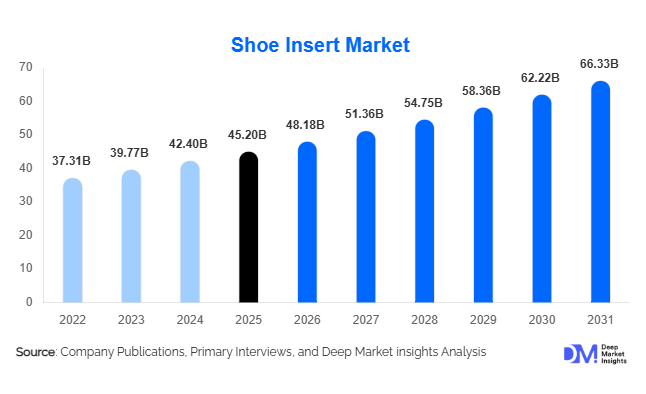
According to Deep Market Insights, the global shoe insert market size was valued at USD 45.2 billion in 2025 and is projected to grow from USD 48.18 billion in 2026 to reach USD 66.33 billion by 2031, expanding at a CAGR of 6.6% during the forecast period (2026–2031). The shoe insert market growth is primarily driven by increasing awareness of foot health, rising prevalence of orthopedic disorders such as plantar fasciitis and diabetic neuropathy, and growing demand for comfort-enhancing footwear solutions across athletic, medical, and lifestyle segments.
Key Market Insights
- Orthopedic and medical shoe inserts are witnessing strong demand due to the rising prevalence of foot-related conditions, including flat feet, plantar fasciitis, and diabetic foot complications.
- Sports and athletic footwear applications are expanding rapidly, with athletes and fitness enthusiasts adopting performance insoles to enhance shock absorption and injury prevention.
- Asia-Pacific dominates the global market, supported by large-scale footwear manufacturing hubs in China, India, and Vietnam.
- North America represents a major revenue-generating region due to high consumer awareness and advanced orthopedic healthcare infrastructure.
- Technological innovation is reshaping the industry, with 3D foot scanning, digital pressure mapping, and additive manufacturing enabling personalized orthotics.
- E-commerce channels are rapidly transforming distribution, allowing direct-to-consumer orthotic brands to reach a wider global customer base.
What are the latest trends in the shoe insert market?
Rise of Personalized Orthotics and 3D Manufacturing
One of the most transformative trends in the shoe insert market is the increasing adoption of personalized orthotics supported by digital technologies such as 3D scanning and additive manufacturing. Custom orthotic inserts can now be designed using digital foot mapping and pressure analysis, enabling precise alignment and support tailored to individual biomechanics. This technological evolution significantly improves treatment outcomes for individuals suffering from conditions such as overpronation, plantar fasciitis, and arch instability. Many podiatry clinics and specialty retailers are incorporating in-store scanning technologies that generate personalized orthotic designs within minutes. These solutions are then produced using advanced 3D printing processes that ensure superior structural support and durability compared with conventional insoles.
Smart Insoles and Wearable Health Integration
Smart insoles embedded with sensors are emerging as an innovative product category within the shoe insert market. These insoles can track gait patterns, monitor foot pressure distribution, and detect early signs of mobility issues. Healthcare providers increasingly use these devices to monitor rehabilitation progress and prevent fall risks among elderly populations. In the sports industry, athletes use sensor-enabled insoles to optimize performance by analyzing running mechanics and stride efficiency. The integration of smart footwear technology with mobile applications and cloud-based analytics platforms is creating a new ecosystem where shoe inserts function as wearable health monitoring devices.
What are the key drivers in the shoe insert market?
Rising Prevalence of Foot Disorders and Musculoskeletal Conditions
The increasing global prevalence of orthopedic and foot-related disorders is one of the most significant drivers of the shoe insert market. Conditions such as plantar fasciitis, arthritis, flat feet, and diabetic neuropathy have become increasingly common due to aging populations, sedentary lifestyles, and obesity-related health issues. Orthotic shoe inserts help improve foot alignment, distribute pressure evenly, and reduce pain, making them widely recommended by podiatrists and orthopedic specialists. Additionally, the growing incidence of diabetes worldwide has increased demand for specialized diabetic insoles designed to prevent ulcers and reduce pressure points.
Expansion of Sports and Fitness Activities
The rapid expansion of global sports participation and fitness culture is another major driver supporting market growth. Athletes and recreational runners often rely on performance insoles to improve stability, reduce fatigue, and prevent injuries during high-impact activities. The increasing popularity of marathon events, trail running, hiking, and gym-based fitness programs has significantly increased demand for shock-absorbing and arch-supporting shoe inserts. Sports footwear brands are also partnering with orthotic manufacturers to integrate performance insoles into their product offerings, further expanding the market.
What are the restraints for the global market?
High Cost of Custom Orthotic Solutions
Despite strong growth potential, the shoe insert market faces challenges due to the relatively high cost of customized orthotics. Personalized orthotic inserts require professional foot analysis, digital scanning, and specialized manufacturing processes, which increase product costs significantly compared with prefabricated insoles. For price-sensitive consumers, particularly in developing economies, these costs can limit adoption and restrict market penetration.
Limited Consumer Awareness in Emerging Economies
In many developing regions, consumer awareness regarding foot health and orthopedic insoles remains relatively low. Shoe inserts are often perceived as optional accessories rather than preventive healthcare solutions. This lack of awareness restricts market expansion in emerging economies where healthcare education and preventive wellness adoption are still developing.
What are the key opportunities in the shoe insert industry?
Growing Demand for Affordable Orthotics in Emerging Markets
Emerging economies such as India, Brazil, Indonesia, and Vietnam present significant growth opportunities for shoe insert manufacturers. Rising disposable incomes and increasing awareness of foot health are driving demand for affordable orthopedic and comfort-oriented insoles. Manufacturers that introduce cost-effective prefabricated inserts tailored to regional footwear preferences can capture large untapped consumer segments in these markets.
Integration with Digital Health Ecosystems
The integration of shoe inserts with digital health monitoring systems represents another promising opportunity. Smart insoles equipped with motion sensors and pressure mapping technology can monitor gait patterns and detect early signs of mobility disorders. These products can be integrated with telemedicine platforms and wearable health devices, enabling continuous patient monitoring and remote healthcare diagnostics. As digital health adoption expands globally, such technologies are expected to create new revenue streams within the shoe insert industry.
Report Scope
| Report Metric | Details |
|---|---|
| Market Size in 2025 | USD 45.2 Billion |
| Market Size in 2026 | USD 48.18 Billion |
| Market Size in 2031 | USD 66.33 Billion |
| CAGR | 6.6% (2026-2031) |
| Base Year for Estimation | 2025 |
| Historical Data | 2022-2024 |
| Forecast Period | 2026-2031 |
| Report Coverage | Revenue Forecast, Competitive Landscape, Supply Chain Disruption, Growth Factors, Environment & Regulatory Landscape and Trends |
| Geographies Covered | North America, Europe, APAC, Middle East and Africa, LATAM |
| Countries Covered | U.S., Canada, U.K., Germany, France, Spain, Italy, Russia, Nordic, Benelux, Rest of Europe, China, Korea, Japan, India, Australia, Singapore, Taiwan, South East Asia, Rest of Asia-Pacific, UAE, Turky, Saudi Arabia, South Africa, Egypt, Nigeria, Rest of MEA, Brazil, Mexico, Argentina, Chile, Colombia, Rest of LATAM |
Explore more data points, trends and opportunities Download Free Sample Report
Product Type Insights
Full-length insoles dominate the global shoe insert market, accounting for nearly 64% of the total market share in 2025. Their leadership is largely attributed to their ability to provide comprehensive support across the entire foot, from heel to toe, ensuring improved weight distribution, shock absorption, and enhanced comfort. These inserts are widely used across multiple applications, including sports footwear, orthopedic treatments, occupational footwear, and daily lifestyle shoes. The growing prevalence of foot disorders such as plantar fasciitis, flat feet, and overpronation has significantly increased demand for full-length insoles, particularly in orthopedic and medical segments where full-foot biomechanical correction is required. Additionally, sports footwear brands increasingly integrate full-length cushioning insoles to improve athletic performance and reduce injury risks during high-impact activities.
Heel cups and heel inserts represent another important product category designed primarily to alleviate heel pain, reduce pressure on the heel bone, and improve shock absorption during walking or running. These products are commonly recommended for individuals suffering from plantar fasciitis, Achilles tendonitis, and heel spurs. Metatarsal pads and arch supports are frequently used for corrective orthopedic treatments and help redistribute pressure away from the forefoot region, particularly for individuals with metatarsalgia or collapsed arches. Toe inserts and separators are typically used in specialized medical applications such as bunion correction, toe alignment, and pressure relief between toes. These inserts are gaining traction among elderly consumers and individuals with chronic foot deformities, further contributing to the diversification of product offerings within the shoe insert market.
Application Insights
Medical and orthopedic applications represent the largest segment in the shoe insert market, contributing approximately 42% of total global revenue in 2025. The dominance of this segment is primarily driven by the increasing prevalence of foot disorders, musculoskeletal conditions, and diabetes-related foot complications worldwide. Orthotic insoles are frequently recommended by podiatrists and orthopedic specialists to improve foot alignment, reduce pressure points, and alleviate pain associated with conditions such as plantar fasciitis, arthritis, and diabetic neuropathy. The rising global elderly population and increasing healthcare awareness have also strengthened demand for clinically prescribed orthotic shoe inserts.
Sports and athletic applications are experiencing strong growth as fitness participation and recreational sports activities expand globally. Athletes and runners widely adopt performance-enhancing insoles to improve stability, shock absorption, and biomechanical alignment during physical activities. The growing popularity of marathon events, gym workouts, hiking, and outdoor sports is significantly contributing to demand in this segment. Daily comfort and lifestyle applications form another substantial portion of the market as consumers increasingly adopt shoe inserts to enhance comfort during extended walking or long working hours. In addition, industrial applications are emerging as an important demand driver, particularly among workers in construction, manufacturing, logistics, and healthcare sectors who spend prolonged periods standing or walking while wearing safety footwear.
Distribution Channel Insights
Footwear retail stores remain the leading distribution channel in the global shoe insert market, accounting for nearly 36% of total sales. These physical retail outlets allow consumers to evaluate different insole products in person and test them within footwear before purchasing, which significantly improves consumer confidence and adoption rates. Retailers specializing in athletic footwear and orthopedic shoes often provide trained staff or foot assessment services to help customers select appropriate inserts based on foot type and comfort requirements.
Pharmacies and drug stores also represent a major distribution channel, particularly for orthopedic and medical insoles recommended by healthcare professionals. Consumers frequently purchase these inserts as over-the-counter solutions for common foot problems such as heel pain or arch discomfort. Meanwhile, online distribution channels are experiencing rapid expansion as consumers increasingly turn to e-commerce platforms for convenience, product variety, and competitive pricing. Digital-first orthotic brands are leveraging direct-to-consumer sales models and advanced technologies such as online foot scanning, AI-driven size recommendations, and mobile apps to deliver personalized orthotics directly to customers. The rise of online marketplaces and digital health platforms is expected to further accelerate growth in this channel over the coming years.
End User Insights
Adults represent the largest consumer group in the global shoe insert market. This segment’s dominance is driven by high participation in sports activities, increasing workplace mobility, and growing awareness of foot health and posture correction. Many working professionals adopt shoe inserts to enhance comfort and reduce fatigue during long hours of standing or walking. The geriatric population represents another major end-user segment due to the higher incidence of foot-related conditions such as arthritis, diabetic neuropathy, joint stiffness, and balance issues. Orthotic insoles play a crucial role in improving mobility and preventing injuries among elderly individuals. With the global population aged 60 years and above growing rapidly, this segment is expected to contribute significantly to long-term market growth.
Athletes and sports professionals constitute one of the fastest-growing end-user segments as demand for performance-enhancing insoles continues to increase. These insoles help optimize running mechanics, reduce stress on joints, and prevent injuries during high-impact sports. Industrial workers represent an additional important user group, particularly in industries such as construction, manufacturing, warehousing, and healthcare, where employees spend extended periods standing or walking while wearing heavy safety footwear. Employers in many regions are increasingly adopting ergonomic workplace practices, including providing shock-absorbing shoe inserts to improve worker comfort and productivity.
Explore more data points, trends and opportunities Download Free Sample Report
Shoe Insert Market Segmentations
By Product Type
- Full-Length Insoles
- 3/4 Length Insoles
- Heel Cups & Heel Inserts
- Metatarsal Pads
- Arch Supports
- Toe Inserts & Toe Separators
By Application
- Medical & Orthopedic
- Sports & Athletic Performance
- Daily Comfort & Lifestyle
- Industrial & Occupational Safety
By Distribution Channel
- Footwear Retail Stores
- Pharmacies & Drug Stores
- Sports Equipment Retailers
- Hospitals & Orthopedic Clinics
- Online / E-commerce Platforms
By End User
- Adults
- Geriatric Population
- Athletes & Sports Professionals
- Industrial Workforce
- Pediatric / Children
Regional Insights
North America
North America accounts for approximately 32% of the global shoe insert market, making it one of the most significant regional markets. The United States dominates regional demand due to high awareness of orthopedic healthcare solutions, widespread sports participation, and strong purchasing power among consumers. The region also benefits from an advanced healthcare infrastructure, including a large network of podiatrists, orthopedic clinics, and rehabilitation centers that frequently recommend orthotic shoe inserts for various medical conditions.
The presence of leading orthotic manufacturers and specialized research institutions further strengthens regional innovation in materials and custom orthotic technologies. In addition, rising health concerns related to obesity, diabetes, and musculoskeletal disorders are contributing to increased demand for orthopedic footwear solutions. Canada also demonstrates steady market growth due to growing adoption of comfort-enhancing footwear accessories, increasing participation in outdoor recreational activities such as hiking and running, and rising demand for preventive healthcare products.
Asia-Pacific
Asia-Pacific dominates the global shoe insert market with nearly 38% market share in 2025 and is also the fastest-growing region globally. The region’s growth is strongly supported by the presence of major footwear manufacturing hubs in countries such as China, India, and Vietnam, which supply footwear products to global markets. China represents the largest production base for footwear accessories, enabling cost-efficient manufacturing of insoles and orthotic inserts.
India is emerging as one of the fastest-growing consumer markets for shoe inserts due to rising disposable incomes, expanding urban populations, and increasing awareness of foot health and fitness. The rapid growth of sports participation and fitness culture among younger populations is further stimulating demand for performance insoles. Japan and South Korea also represent significant markets due to aging populations and increasing healthcare spending. In these countries, orthopedic and medical-grade insoles are widely used to improve mobility and reduce foot-related discomfort among elderly consumers.
Europe
Europe accounts for approximately 22% of the global shoe insert market. Countries such as Germany, the United Kingdom, France, and Italy represent major demand centers due to high consumer awareness regarding preventive healthcare and orthopedic products. Germany plays a particularly important role in the regional market due to its strong orthopedic medical device manufacturing industry and advanced podiatry practices.
European consumers are increasingly adopting shoe inserts as part of preventive healthcare routines, particularly among athletes and aging populations. The region also benefits from strict occupational safety regulations in several countries, encouraging the use of ergonomic footwear accessories among industrial workers. In addition, the growing popularity of outdoor recreational activities such as hiking, trekking, and cycling across Europe is further driving demand for high-performance insoles.
Latin America
Latin America accounts for approximately 3% of the global shoe insert market, with Brazil and Mexico representing the largest markets in the region. Market growth is primarily supported by expanding footwear manufacturing industries and increasing consumer spending on health and wellness products. Brazil, in particular, has a strong domestic footwear industry that supports demand for footwear accessories, including insoles.
Rising awareness of sports fitness, increasing urbanization, and improving retail infrastructure are also contributing to market expansion across the region. However, limited consumer awareness of orthopedic solutions and price sensitivity remain key challenges for market penetration.
Middle East & Africa
The Middle East and Africa region represents approximately 5% of global demand. Growth in this region is primarily driven by increasing healthcare investments and expanding retail markets in Gulf Cooperation Council countries such as Saudi Arabia, the United Arab Emirates, and Qatar. Governments in these countries are investing heavily in healthcare infrastructure and preventive health initiatives, which indirectly support demand for orthopedic products, including shoe inserts.
The growing popularity of fitness activities and sports events in the region is also contributing to increased adoption of performance insoles. In Africa, expanding urban populations and rising awareness of foot health are gradually driving demand for affordable shoe insert solutions, although the market remains in a relatively early stage of development compared to other regions.
Key Players in the Shoe Insert Market
- Superfeet Worldwide
- Bauerfeind AG
- Ottobock SE & Co. KGaA
- Aetrex Worldwide Inc.
- Implus Footcare LLC
- Hanger Inc.
- Sidas Group
- Footbalance System Ltd.
- Birkenstock Orthopädie GmbH
- PowerStep (Stable Step LLC)
- Spenco Medical Corporation
- Foot Levelers Inc.
- Pedag International
- ComfortFit Orthotic Labs
- SOLO Laboratories Inc.