Shoe Cover Market Size
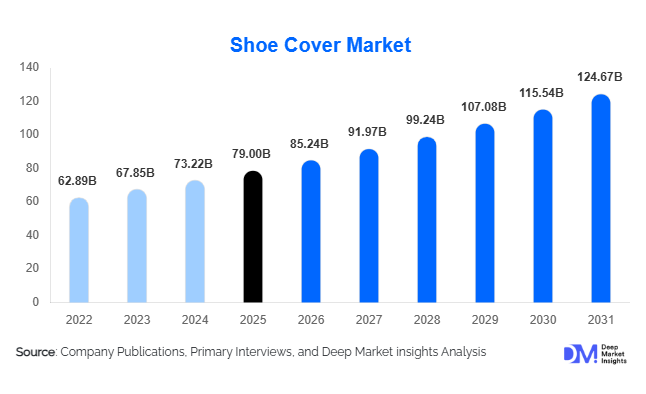
According to Deep Market Insights, the global shoe cover market size was valued at USD 79.0 billion in 2025 and is projected to grow from USD 85.24 billion in 2026 to reach USD 124.67 billion by 2031, expanding at a CAGR of 7.9% during the forecast period (2026–2031). The shoe cover market growth is primarily driven by rising global hygiene standards, increasing demand for personal protective equipment (PPE) across healthcare and industrial environments, and the rapid expansion of contamination-controlled manufacturing sectors such as pharmaceuticals, biotechnology, and semiconductor production.
Shoe covers are widely used across healthcare facilities, cleanrooms, food processing plants, laboratories, and industrial manufacturing environments to prevent contamination and ensure compliance with strict hygiene regulations. Disposable shoe covers remain the most widely adopted product type due to convenience, cost efficiency, and infection-control benefits. However, reusable waterproof and anti-slip shoe covers are gaining traction in construction, industrial, and outdoor applications due to sustainability considerations and improved durability.
Key Market Insights
- Disposable shoe covers dominate the market, accounting for nearly 67% of global demand due to their widespread use in hospitals, pharmaceutical plants, and food processing facilities.
- Polypropylene-based non-woven materials represent the leading material segment, driven by their breathability, affordability, and durability in high-volume applications.
- Asia-Pacific leads the global market, supported by strong manufacturing capacity, expanding healthcare infrastructure, and increasing industrial safety regulations.
- Healthcare remains the largest end-use industry, accounting for nearly 40% of total shoe cover consumption globally.
- Cleanroom manufacturing industries are rapidly increasing in demand, particularly semiconductor fabrication plants and pharmaceutical production facilities.
- Sustainability-driven innovation is emerging, with manufacturers investing in biodegradable materials and reusable protective footwear covers.
What are the latest trends in the shoe cover market?
Shift Toward Sustainable and Biodegradable Protective Equipment
Environmental sustainability is becoming a major trend shaping the shoe cover market. The increasing use of disposable protective equipment during the COVID-19 pandemic highlighted the environmental impact of single-use plastic products, prompting healthcare institutions and industrial facilities to explore eco-friendly alternatives. Manufacturers are developing biodegradable shoe covers made from plant-based polymers and compostable non-woven materials that maintain durability and barrier protection while reducing environmental impact.
Hospitals and food manufacturing companies are also adopting sustainability policies that prioritize environmentally responsible procurement. As a result, suppliers offering recyclable or biodegradable shoe covers are gaining competitive advantages. Governments in Europe and North America are implementing stricter regulations on single-use plastics, further accelerating innovation in sustainable protective equipment.
Growing Adoption in Cleanroom Manufacturing Industries
The expansion of contamination-sensitive industries such as semiconductor manufacturing, biotechnology, and pharmaceutical production is significantly increasing demand for cleanroom protective equipment. In these industries, even microscopic dust particles can compromise product quality and lead to expensive manufacturing defects. As a result, strict cleanroom protocols require workers to wear protective garments, including shoe covers, gloves, masks, and specialized suits.
Shoe covers designed specifically for cleanroom environments are now being engineered with anti-static properties, lint-free materials, and enhanced durability. With semiconductor investments rising globally, particularly in the United States, China, Taiwan, and South Korea, the demand for specialized cleanroom shoe covers is expected to increase significantly over the next decade.
What are the key drivers in the shoe cover market?
Rising Demand for Infection Control in Healthcare Facilities
Healthcare institutions represent the largest demand center for shoe covers globally. Hospitals, surgical centers, diagnostic laboratories, and pharmaceutical production environments must maintain sterile conditions to prevent contamination and reduce the risk of hospital-acquired infections. Disposable protective equipment, including gloves, gowns, masks, and shoe covers, has become essential in modern healthcare environments.
The global expansion of healthcare infrastructure, particularly in emerging economies such as India, Brazil, and Southeast Asian countries, is increasing the procurement of protective medical supplies. Growing awareness of infection control protocols and stricter healthcare regulations is expected to sustain demand for disposable shoe covers across hospitals and laboratories worldwide.
Expansion of Industrial Safety Regulations
Industrial workplaces are increasingly adopting stricter occupational safety standards to protect workers and maintain product quality. Manufacturing facilities in industries such as electronics, automotive, and chemicals require protective equipment to prevent contamination and ensure safe working conditions. Shoe covers help prevent the transfer of dirt, dust, and hazardous substances within manufacturing environments.
Rapid industrialization in the Asia-Pacific and the Middle East has accelerated the adoption of personal protective equipment across factories and construction sites. As workplace safety regulations continue to strengthen globally, shoe covers are becoming standard protective gear in multiple industrial sectors.
What are the restraints for the global market?
Environmental Concerns Related to Disposable PPE Waste
One of the primary challenges facing the shoe cover market is the environmental impact associated with disposable plastic products. Many disposable shoe covers are manufactured from polypropylene or polyethylene materials that are difficult to recycle. Large-scale use of these products generates significant waste, particularly in hospitals and manufacturing facilities.
Growing pressure from environmental regulators and sustainability initiatives may limit the long-term growth of traditional disposable shoe covers unless manufacturers adopt biodegradable or reusable alternatives.
Volatility in Raw Material Prices
The production of shoe covers relies heavily on petrochemical-based raw materials such as polypropylene and polyethylene. Fluctuations in crude oil prices directly influence the cost of these materials, creating price instability for manufacturers. Sudden increases in raw material prices can compress profit margins and force manufacturers to increase product prices, which may impact demand in cost-sensitive markets.
What are the key opportunities in the shoe cover industry?
Expansion of Healthcare Infrastructure in Emerging Economies
Emerging economies represent one of the largest opportunities for shoe cover manufacturers. Countries across Asia, Latin America, and the Middle East are investing heavily in healthcare infrastructure to meet the needs of growing populations. New hospitals, diagnostic laboratories, and pharmaceutical production facilities require large volumes of disposable protective equipment.
Governments are increasing healthcare spending to improve infection control standards, creating strong demand for medical-grade shoe covers. Manufacturers capable of supplying certified sterile products compliant with international healthcare standards can benefit significantly from these investments.
Rapid Growth of Cleanroom and Semiconductor Manufacturing
Global investments in semiconductor manufacturing are creating new opportunities for suppliers of cleanroom protective equipment. Semiconductor fabrication plants require extremely clean production environments, where workers must wear protective gear, including shoe covers. Government initiatives such as domestic semiconductor manufacturing programs in the United States, China, and India are accelerating the construction of advanced manufacturing facilities.
These investments are expected to increase demand for specialized shoe covers with anti-static properties and lint-free materials designed specifically for contamination-sensitive environments.
Report Scope
| Report Metric | Details |
|---|---|
| Market Size in 2025 | USD 79.0 Billion |
| Market Size in 2026 | USD 85.24 Billion |
| Market Size in 2031 | USD 124.67 Billion |
| CAGR | 7.9% (2026-2031) |
| Base Year for Estimation | 2025 |
| Historical Data | 2022-2024 |
| Forecast Period | 2026-2031 |
| Report Coverage | Revenue Forecast, Competitive Landscape, Supply Chain Disruption, Growth Factors, Environment & Regulatory Landscape and Trends |
| Geographies Covered | North America, Europe, APAC, Middle East and Africa, LATAM |
| Countries Covered | U.S., Canada, U.K., Germany, France, Spain, Italy, Russia, Nordic, Benelux, Rest of Europe, China, Korea, Japan, India, Australia, Singapore, Taiwan, South East Asia, Rest of Asia-Pacific, UAE, Turky, Saudi Arabia, South Africa, Egypt, Nigeria, Rest of MEA, Brazil, Mexico, Argentina, Chile, Colombia, Rest of LATAM |
Explore more data points, trends and opportunities Download Free Sample Report
Product Type Insights
Disposable shoe covers dominate the global market, accounting for nearly 67% of total revenue in 2025. Their widespread adoption across hospitals, laboratories, and food processing facilities is primarily driven by convenience and infection-control benefits. Disposable covers eliminate the need for washing or sterilization, making them ideal for environments with strict hygiene requirements. Reusable shoe covers, including rubber and fabric-based products, are gaining traction in construction and industrial applications where durability and cost efficiency are prioritized. These reusable variants often include waterproof coatings and anti-slip soles designed for outdoor and heavy-duty environments. The increasing focus on sustainability is also encouraging the development of biodegradable disposable shoe covers that combine hygiene protection with environmental responsibility.
Application Insights
Healthcare remains the largest application segment for shoe covers globally, representing approximately 40% of market demand. Hospitals and surgical centers require protective equipment to maintain sterile environments and prevent contamination during medical procedures. Pharmaceutical manufacturing and biotechnology laboratories also represent significant application segments due to strict cleanroom requirements. Food processing plants are another key consumer group, as workers must wear protective footwear covers to prevent contamination during food preparation and packaging. Industrial manufacturing facilities, including electronics, automotive, and chemical plants, use shoe covers to maintain production cleanliness and protect workers from hazardous substances. Construction sites and infrastructure projects are emerging application areas, particularly for waterproof and anti-slip reusable shoe covers.
Distribution Channel Insights
Direct institutional procurement dominates the shoe cover market, accounting for more than 50% of total global sales. Hospitals, pharmaceutical manufacturers, and industrial facilities typically purchase shoe covers through bulk procurement contracts with manufacturers or authorized distributors. Medical supply wholesalers also play a major role in distributing disposable protective equipment to healthcare providers and laboratories. Industrial safety equipment distributors supply shoe covers to manufacturing plants and construction companies as part of broader workplace safety solutions. Online sales channels are growing rapidly as hospitals and businesses increasingly purchase PPE products through digital procurement platforms. E-commerce platforms and manufacturer-owned websites are expanding accessibility for small businesses and individual consumers purchasing protective footwear covers.
End-Use Industry Insights
The healthcare industry is the largest consumer of shoe covers, driven by the need to maintain sterile environments in hospitals and surgical centers. Pharmaceutical manufacturing facilities represent another significant end-use industry due to strict contamination-control standards. The food processing industry also generates substantial demand as hygiene regulations require workers to wear protective gear during food preparation and packaging processes. Electronics and semiconductor manufacturing is the fastest-growing end-use segment, driven by increasing investments in cleanroom production facilities worldwide. Industrial manufacturing and construction sectors also contribute to market demand, particularly for heavy-duty waterproof shoe covers designed to protect workers in challenging environments.
Explore more data points, trends and opportunities Download Free Sample Report
Shoe Cover Market Segmentations
By Product Type
- Disposable Shoe Covers
- Reusable / Non-Disposable Shoe Covers
- Waterproof Shoe Covers
- Anti-Slip Industrial Shoe Covers
- Sterile Cleanroom Shoe Covers
By Material Type
- Polypropylene (PP) Non-woven
- Polyethylene (PE)
- Chlorinated Polyethylene (CPE)
- Rubber / Silicone
- Nylon / Polyester Fabric
- Biodegradable Polymers
By End-Use Industry
- Healthcare & Hospitals
- Pharmaceutical & Biotechnology Manufacturing
- Food Processing Industry
- Electronics & Semiconductor Cleanrooms
- Industrial Manufacturing
- Construction & Infrastructure
- Laboratories & Research Institutions
By Distribution Channel
- Direct Institutional Procurement
- Industrial Safety Equipment Distributors
- Medical Supply Wholesalers
- Retail Stores
- Online / E-commerce Platforms
Regional Insights
Asia-Pacific
Asia-Pacific represents the largest regional market, accounting for approximately 38% of global shoe cover demand in 2025. China dominates regional production and consumption due to its large manufacturing base and extensive healthcare infrastructure. India is emerging as one of the fastest-growing markets in the region as hospital construction and pharmaceutical manufacturing expand rapidly. Japan and South Korea also contribute significantly to demand, particularly within electronics and semiconductor manufacturing industries that require strict cleanroom protocols.
North America
North America holds approximately 26% of the global shoe cover market, with the United States representing the largest country market. Strong healthcare infrastructure, strict occupational safety regulations, and high adoption of disposable protective equipment drive demand across the region. The presence of major pharmaceutical companies and advanced semiconductor manufacturing facilities also contributes to sustained growth.
Europe
Europe accounts for roughly 22% of global shoe cover demand. Germany, France, the United Kingdom, and Italy are the largest consumers due to strong healthcare systems and well-established pharmaceutical and food manufacturing industries. European environmental regulations are encouraging the adoption of biodegradable and reusable shoe covers, driving innovation within the regional market.
Latin America
Latin America represents a smaller but steadily growing market for shoe covers, accounting for around 7% of global demand. Brazil and Mexico are the largest markets in the region due to expanding healthcare systems and industrial manufacturing sectors. Increasing awareness of workplace safety and hygiene standards is supporting gradual market expansion.
Middle East & Africa
The Middle East and Africa region accounts for nearly 7% of the global market. Rapid investments in healthcare infrastructure in countries such as Saudi Arabia, the United Arab Emirates, and Qatar are driving demand for protective medical supplies. Industrial diversification strategies across Gulf countries are also increasing demand for industrial safety equipment, including protective shoe covers.
Key Players in the Shoe Cover Market
- DuPont
- Honeywell International
- 3M Company
- Kimberly-Clark Corporation
- Lakeland Industries
- Ansell Limited
- Alpha Pro Tech
- Cardinal Health
- McKesson Corporation
- Cordova Safety Products
- AMMEX Corporation
- Safety Zone
- Medline Industries
- Protexer Corporation
- Royal Shoe Covers