Sexual Wellness Products Market Size
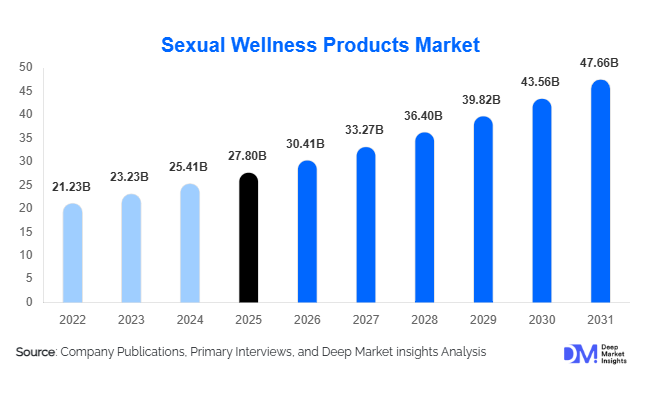
According to Deep Market Insights, the global sexual wellness products market size was valued at USD 27.8 billion in 2025 and is projected to grow from USD 30.41 billion in 2026 to reach USD 47.66 billion by 2031, expanding at a CAGR of 9.4% during the forecast period (2026–2031). The sexual wellness products market growth is primarily driven by increasing awareness regarding sexual health, rising acceptance of intimacy-focused wellness products, expanding e-commerce penetration, and rapid innovation in smart and premium sexual wellness solutions. Growing emphasis on preventive healthcare, self-care culture, and relationship wellness is further accelerating consumer adoption across both developed and emerging economies.
Key Market Insights
- Sexual wellness products are increasingly transitioning from taboo categories into mainstream wellness and healthcare products, supported by rising social acceptance and digital awareness campaigns.
- Women-centric sexual wellness products are witnessing rapid growth globally, driven by rising female spending power, reproductive health awareness, and demand for intimate self-care solutions.
- Asia-Pacific dominates the global sexual wellness products market, led by China, India, Japan, and South Korea, due to strong manufacturing capabilities and expanding consumer demand.
- North America remains the leading premium market, supported by high adoption of smart intimacy devices, subscription wellness services, and technologically advanced products.
- E-commerce and direct-to-consumer platforms are reshaping industry distribution, offering privacy, discreet purchasing, and wider access to premium global brands.
- Technological innovation, including AI-enabled sex-tech devices, app-controlled products, Bluetooth integration, and connected wellness platforms, is significantly transforming consumer experiences.
Sexual Wellness Products Market Trends
Growing Adoption of Smart Intimacy Devices
The integration of advanced technologies into sexual wellness products is emerging as one of the most influential trends in the market. Consumers are increasingly adopting app-connected vibrators, Bluetooth-enabled devices, wearable intimacy products, and AI-powered wellness solutions that offer personalized experiences and remote connectivity. This trend is particularly strong among millennials and Gen Z consumers who prioritize customization, digital integration, and interactive wellness experiences. Manufacturers are investing heavily in ergonomic product design, cybersecurity, rechargeable battery technologies, and discreet connectivity systems to improve user convenience and privacy. Smart intimacy devices are also benefiting from the broader expansion of connected healthcare and digital wellness ecosystems, positioning sexual wellness products as part of mainstream self-care and health monitoring solutions.
Rise of Women-Focused and Inclusive Wellness Products
The market is witnessing a strong shift toward women-centric and gender-inclusive sexual wellness products. Historically dominated by male-oriented contraceptives and performance enhancers, the industry is now rapidly expanding into female sexual wellness, menopause care, pelvic therapy, fertility wellness, and intimate hygiene products. Consumers increasingly seek hormone-free, body-safe, dermatologically tested, and organic formulations that support overall wellness rather than purely functional intimacy needs. Brands are also emphasizing LGBTQ+ inclusivity and gender-neutral marketing strategies to appeal to broader consumer demographics. Social media awareness, influencer marketing, and healthcare-driven educational campaigns are helping normalize discussions surrounding female sexual health, contributing significantly to premium product demand globally.
Sexual Wellness Products Market Drivers
Increasing Sexual Health Awareness and Preventive Healthcare Adoption
Growing awareness regarding sexually transmitted infections (STIs), reproductive health, and safe-sex practices is one of the primary drivers supporting the sexual wellness products market growth. Governments, NGOs, healthcare organizations, and educational institutions are increasingly conducting awareness campaigns focused on contraception, intimate hygiene, and preventive healthcare. Rising urbanization and expanding access to healthcare information through digital platforms are further strengthening consumer understanding of sexual wellness products. Condoms, lubricants, and intimate hygiene products continue to witness strong recurring demand due to their role in preventive healthcare and reproductive wellness. In emerging economies such as India, Brazil, Indonesia, and South Africa, public awareness programs and improving healthcare access are significantly accelerating adoption rates.
Expansion of E-Commerce and Direct-to-Consumer Channels
The rapid growth of online retail and direct-to-consumer platforms has transformed the accessibility and purchasing behavior associated with sexual wellness products. Consumers increasingly prefer discreet shopping experiences, private home delivery, broader product selection, and subscription-based wellness services offered through digital channels. E-commerce platforms enable brands to bypass traditional retail limitations and directly engage with consumers through personalized marketing, influencer collaborations, and AI-driven product recommendations. Online channels have also facilitated market penetration in conservative regions where physical retail visibility for sexual wellness products remains limited. The convenience and anonymity offered by digital commerce continue to significantly support global market expansion.
Sexual Wellness Products Market Restraints
Regulatory and Compliance Challenges
The sexual wellness products industry faces complex regulatory frameworks across different countries and product categories. Depending on regional regulations, products may be classified as medical devices, personal care products, pharmaceuticals, or consumer electronics, resulting in varying compliance requirements and certification standards. Advertising restrictions, product testing obligations, and import regulations increase operational complexity and costs for manufacturers operating internationally. These regulatory inconsistencies often slow product launches and limit expansion opportunities in certain markets.
Cultural Stigma and Social Sensitivities
Despite increasing global acceptance, sexual wellness products continue to face social stigma and conservative cultural attitudes in several developing regions. Public discussions surrounding intimacy and sexual health remain restricted across parts of the Middle East, Africa, and South Asia, limiting product visibility and consumer willingness to purchase such products openly. Advertising limitations, retail restrictions, and religious sensitivities continue to constrain market penetration in these regions. Consumer hesitation and social embarrassment associated with purchasing intimate wellness products remain significant barriers to broader adoption.
Sexual Wellness Products Market Opportunities
Medical and Therapeutic Applications Expanding
The growing integration of sexual wellness products into healthcare and therapeutic applications presents significant opportunities for industry participants. Healthcare professionals increasingly recommend lubricants, pelvic wellness devices, menopause care products, erectile dysfunction support solutions, and fertility wellness products as part of broader treatment plans. Hospitals, gynecology clinics, fertility centers, and sexual health clinics are expanding their focus on sexual wellness as an important component of holistic healthcare. This medicalization of the industry is expected to support premium pricing opportunities and strengthen long-term market credibility. Collaborations between healthcare providers, wellness brands, and pharmaceutical companies are likely to create new revenue streams across therapeutic and clinical applications.
Premiumization and Sustainable Product Innovation
Consumers are increasingly willing to spend on premium sexual wellness products that emphasize safety, sustainability, wellness, and superior user experiences. Demand for organic lubricants, body-safe silicone devices, biodegradable condoms, eco-friendly packaging, and luxury intimacy products is rising globally. Sustainability-conscious consumers are driving brands to invest in recyclable materials, clean-label formulations, and ethical sourcing practices. Premium wellness products also benefit from significantly higher profit margins compared to commoditized product categories such as standard condoms and lubricants. This shift toward premiumization is expected to create substantial opportunities for both established players and emerging startups focused on innovation and wellness-oriented branding.
Report Scope
| Report Metric | Details |
|---|---|
| Market Size in 2025 | USD 27.8 Billion |
| Market Size in 2026 | USD 30.41 Billion |
| Market Size in 2031 | USD 47.66 Billion |
| CAGR | 9.4% (2026-2031) |
| Base Year for Estimation | 2025 |
| Historical Data | 2022-2024 |
| Forecast Period | 2026-2031 |
| Report Coverage | Revenue Forecast, Competitive Landscape, Supply Chain Disruption, Growth Factors, Environment & Regulatory Landscape and Trends |
| Geographies Covered | North America, Europe, APAC, Middle East and Africa, LATAM |
| Countries Covered | U.S., Canada, U.K., Germany, France, Spain, Italy, Russia, Nordic, Benelux, Rest of Europe, China, Korea, Japan, India, Australia, Singapore, Taiwan, South East Asia, Rest of Asia-Pacific, UAE, Turky, Saudi Arabia, South Africa, Egypt, Nigeria, Rest of MEA, Brazil, Mexico, Argentina, Chile, Colombia, Rest of LATAM |
Explore more data points, trends and opportunities Download Free Sample Report
Product Type Insights
Condoms remain the dominant product category within the sexual wellness products market, accounting for nearly one-third of global revenues in 2025. Strong government-supported safe-sex campaigns, affordability, and high purchase frequency continue to support segment dominance. Premium condom categories, including ultra-thin, textured, flavored, and non-latex variants, are witnessing increasing demand among younger consumers seeking enhanced experiences. Personal lubricants are also expanding rapidly, particularly water-based and organic lubricants due to their compatibility, safety, and growing female consumer adoption. Sex toys and smart intimacy devices represent one of the fastest-growing product categories, supported by increasing social acceptance and technological innovation. App-controlled devices, wearable intimacy products, and AI-enabled wellness technologies are reshaping consumer engagement and driving premium product sales globally.
Application Insights
Personal and individual wellness applications dominate the market, driven by growing self-care culture, rising awareness surrounding intimate health, and increasing single-person households globally. Couples wellness applications are expanding rapidly as consumers seek products that enhance emotional connection, relationship wellness, and shared experiences. Therapeutic and healthcare-related applications are also gaining traction, particularly for menopause management, fertility support, pelvic therapy, and erectile dysfunction treatment. Sexual wellness products are increasingly integrated into broader healthcare and mental wellness frameworks, creating opportunities across hospitals, sexual health clinics, and reproductive healthcare centers. Luxury wellness resorts and hospitality providers are also introducing premium intimacy products and wellness kits as part of personalized guest experiences.
Distribution Channel Insights
Online retail and direct-to-consumer platforms dominate the distribution landscape due to the privacy, convenience, and broad product accessibility they offer consumers. E-commerce platforms enable users to compare products, access reviews, and purchase discreetly, making online channels particularly attractive in conservative markets. Subscription-based wellness services and D2C brands are further strengthening digital engagement through personalized product recommendations and recurring delivery models. Pharmacies and drug stores continue to maintain strong demand for condoms, lubricants, and healthcare-related intimacy products due to consumer trust and product accessibility. Specialty wellness stores and premium boutiques are increasingly focusing on luxury and smart sex-tech products targeting affluent consumers seeking high-end wellness experiences.
Consumer Group Insights
Women-focused products represent one of the fastest-growing consumer segments within the sexual wellness products market. Rising female financial independence, increasing awareness regarding reproductive health, and growing discussions surrounding self-care and intimacy wellness are significantly boosting demand. Male consumers continue to drive stable demand for condoms, performance enhancement products, and erectile wellness solutions. Couples represent an important premium consumer segment, particularly for app-connected devices, relationship wellness products, and intimacy-enhancing accessories. LGBTQ+ consumers are also contributing significantly to market expansion, encouraging brands to adopt inclusive product development and gender-neutral marketing strategies that better align with evolving consumer preferences globally.
Age Group Insights
Consumers aged 25–44 years account for the largest share of the sexual wellness products market due to higher disposable incomes, digital engagement, and strong adoption of premium wellness products. This demographic demonstrates significant spending on smart intimacy devices, premium lubricants, and technologically integrated wellness solutions. Younger consumers aged 18–24 years are driving rapid growth in online purchasing and subscription-based wellness services, supported by increasing openness toward sexual health discussions and digital commerce adoption. Older demographics aged above 45 years are contributing to the growing demand for therapeutic wellness products focused on menopause care, fertility support, and sexual health management, particularly across North America, Europe, and Japan.
Explore more data points, trends and opportunities Download Free Sample Report
Sexual Wellness Products Market Segmentations
By Product Type
- Condoms
- Personal Lubricants
- Sex Toys & Smart Intimacy Devices
- Intimate Hygiene Products
- Sexual Enhancement Supplements
- Delay & Performance Products
- Reproductive Wellness Products
- Erotic Accessories & Wellness Products
By Consumer Group
- Men
- Women
- Couples
- LGBTQ+ Consumers
By Age Group
- 18–24 Years
- 25–34 Years
- 35–44 Years
- 45–54 Years
- 55+ Years
By Distribution Channel
- Online Retail & E-commerce
- Pharmacies & Drug Stores
- Supermarkets & Hypermarkets
- Specialty Stores
- Direct-to-Consumer (D2C) Platforms
- Subscription Wellness Services
By End Use
- Personal Use
- Couples Wellness
- Medical & Therapeutic Applications
- Sexual Health Clinics
- Hospitality & Wellness Spas
Regional Insights
North America
North America remains one of the largest and most technologically advanced sexual wellness product markets globally, accounting for nearly 29% of total market revenues in 2025. The United States dominates regional demand due to strong consumer purchasing power, broad social acceptance, and rapid adoption of smart intimacy devices and premium wellness solutions. Consumers increasingly prioritize body-safe materials, personalized wellness products, and subscription-based intimacy services. Canada is also witnessing rising demand for sustainable and inclusive wellness products, supported by progressive healthcare awareness and strong online retail penetration.
Europe
Europe represents a highly mature and innovation-driven market, led by Germany, the United Kingdom, France, and the Netherlands. Strong sexual health awareness, favorable regulatory frameworks, and widespread acceptance of wellness-oriented intimacy products continue to support regional growth. European consumers show strong preference for eco-friendly, sustainable, and medically certified products, driving demand for organic lubricants, biodegradable condoms, and premium wellness devices. Germany remains a leading manufacturing hub for premium condoms and technologically advanced intimacy products, while the U.K. continues to witness strong growth in online wellness retail.
Asia-Pacific
Asia-Pacific dominates the global sexual wellness products market with approximately 38% market share in 2025. China remains the largest manufacturing and export hub for condoms, lubricants, and electronic intimacy devices due to strong production capabilities and cost competitiveness. India is emerging as one of the fastest-growing consumer markets globally, driven by expanding internet penetration, rising youth population, and increasing awareness regarding sexual health and wellness. Japan and South Korea lead adoption of smart sex-tech products and AI-enabled intimacy devices, supported by high technological sophistication and consumer willingness to adopt innovative wellness solutions.
Latin America
Latin America is witnessing steady growth led by Brazil and Mexico, supported by increasing urbanization, rising disposable incomes, and improving retail accessibility. Brazilian consumers are increasingly adopting premium lubricants, intimacy products, and wellness-oriented personal care solutions. Online retail channels are significantly supporting regional expansion by improving product accessibility and consumer privacy. Growing awareness regarding reproductive health and STI prevention is further accelerating demand across urban populations.
Middle East & Africa
The Middle East & Africa region currently represents a smaller but rapidly emerging market opportunity for sexual wellness products. The UAE and South Africa are among the leading regional markets due to rising wellness awareness, improving retail infrastructure, and increasing exposure to global lifestyle trends. However, regulatory restrictions and conservative social attitudes continue to moderate overall market penetration across several countries. Despite these challenges, increasing e-commerce penetration and growing younger populations are expected to support long-term growth opportunities within the region.
Key Players in the Sexual Wellness Products Market
- Reckitt Benckiser Group
- Church & Dwight
- LELO
- LifeStyles Healthcare
- Okamoto Industries
- Doc Johnson Enterprises
- Lovehoney Group
- TENGA
- Bijoux Indiscrets
- Fun Factory
- We-Vibe
- Dame Products
- Cupid Limited
- Karex Berhad
- PHE Inc.