Self Defense Products Market Size
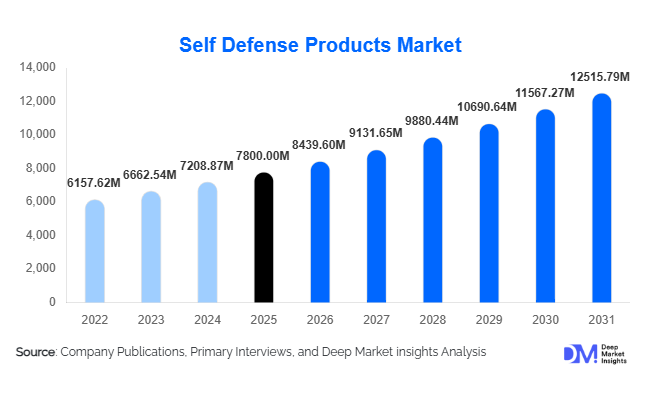
According to Deep Market Insights, the global self-defense products market size was valued at USD 7,800 million in 2025 and is projected to grow from USD 8,439.60 million in 2026 to reach USD 12,515.79 million by 2031, expanding at a CAGR of 8.2% during the forecast period (2026–2031). The market growth is primarily driven by rising personal safety concerns, increasing urban crime rates, expanding adoption of non-lethal defense tools, and rapid penetration of smart safety devices integrated with IoT and mobile technologies.
Key Market Insights
- Pepper sprays and personal alarms dominate adoption due to affordability, legality, and ease of use across global markets.
- Smart wearable safety devices are emerging as a high-growth category, integrating GPS tracking and mobile connectivity for real-time emergency response.
- North America holds the largest market share, driven by high consumer awareness and advanced product availability.
- Asia-Pacific is the fastest-growing region due to rapid urbanization, rising safety concerns, and an expanding middle-class population.
- E-commerce channels dominate distribution, accounting for nearly half of global sales due to privacy-driven purchases and wide product access.
- Women represent the most significant end-user group, driven by workforce participation and safety awareness initiatives.
What are the latest trends in the self-defense products market?
Shift Toward Smart and Connected Safety Devices
The market is experiencing a strong transition from traditional tools to smart safety ecosystems. IoT-enabled wearables, GPS-linked personal alarms, and smartphone-integrated emergency alert systems are gaining traction. These devices offer real-time tracking, emergency communication, and location sharing features, significantly enhancing user safety. Manufacturers are focusing on multi-functional devices that combine personal defense with communication and monitoring capabilities, especially for women, students, and elderly users.
Growth of Discreet and Portable Defense Tools
Consumers are increasingly preferring compact, discreet, and easy-to-carry defense tools such as keychain alarms, lipstick pepper sprays, and wearable safety jewelry. This trend is driven by urban lifestyles and demand for non-threatening self-defense solutions. Product design innovation focuses on aesthetics and portability without compromising effectiveness, expanding adoption among younger demographics and first-time users.
What are the key drivers in the self-defense products market?
Rising Urban Crime and Safety Concerns
Increasing global urbanization has led to a rise in personal safety concerns, particularly in densely populated cities. This has significantly increased demand for non-lethal defense tools such as pepper sprays, alarms, and stun devices. Growing awareness campaigns and safety education programs are further encouraging adoption across residential and institutional users.
Expansion of E-Commerce Distribution
The rapid growth of online retail platforms has made self-defense products widely accessible. Consumers prefer online channels due to privacy, variety, and ease of comparison. E-commerce platforms also support cross-border sales, allowing manufacturers to reach emerging markets efficiently, driving global demand expansion.
Technological Innovation in Smart Safety Devices
Integration of IoT, GPS tracking, and mobile applications is transforming traditional self-defense products into intelligent safety systems. These innovations are increasing product value and creating premium segments, particularly in developed markets such as North America and Europe.
What are the restraints for the global market?
Regulatory Restrictions on Defense Tools
Strict government regulations on stun guns, tasers, and certain defensive weapons limit market penetration in several countries. Legal restrictions vary widely, creating compliance complexity for manufacturers and restricting global product standardization.
Safety and Misuse Concerns
Potential misuse of self-defense products and safety risks associated with improper handling act as a restraint. In some regions, this leads to negative perception and tighter regulatory scrutiny, limiting the adoption of high-impact defense tools.
What are the key opportunities in the self-defense products industry?
Expansion of Smart Wearable Safety Ecosystems
Integration of wearable technology with self-defense systems presents a major opportunity. Devices such as smart rings, pendants, and GPS-enabled wearables are creating new revenue streams. This segment is expected to grow rapidly as consumers prioritize connected safety solutions.
Growth in Women's Safety and Institutional Demand
Increasing focus on women safety programs and institutional procurement from universities and corporates is driving bulk demand. Governments and organizations are adopting personal safety devices for students and employees, creating stable, long-term demand channels.
Emergence of Emerging Market Demand
Asia-Pacific, Latin America, and parts of Africa present strong growth opportunities due to urbanization, rising income levels, and increasing safety awareness. Affordable product lines targeting these regions are expected to drive volume-based expansion.
Report Scope
| Report Metric | Details |
|---|---|
| Market Size in 2025 | USD 7800 Million |
| Market Size in 2026 | USD 8439.60 Million |
| Market Size in 2031 | USD 12515.79 Million |
| CAGR | 8.2% (2026-2031) |
| Base Year for Estimation | 2025 |
| Historical Data | 2022-2024 |
| Forecast Period | 2026-2031 |
| Report Coverage | Revenue Forecast, Competitive Landscape, Supply Chain Disruption, Growth Factors, Environment & Regulatory Landscape and Trends |
| Geographies Covered | North America, Europe, APAC, Middle East and Africa, LATAM |
| Countries Covered | U.S., Canada, U.K., Germany, France, Spain, Italy, Russia, Nordic, Benelux, Rest of Europe, China, Korea, Japan, India, Australia, Singapore, Taiwan, South East Asia, Rest of Asia-Pacific, UAE, Turky, Saudi Arabia, South Africa, Egypt, Nigeria, Rest of MEA, Brazil, Mexico, Argentina, Chile, Colombia, Rest of LATAM |
Explore more data points, trends and opportunities Download Free Sample Report
Product Type Insights
Pepper sprays continue to dominate the global self-defense products market, accounting for approximately 28% share in 2025. This leadership is primarily driven by their affordability, ease of use, compact form factor, and broad legal acceptance across most countries compared to other defensive tools. Additionally, increasing awareness campaigns around women’s safety and self-protection have further accelerated adoption, particularly in urban environments. Personal safety alarms follow as a high-volume segment, especially among students, elderly populations, and first-time users, due to their non-invasive nature and minimal regulatory barriers. Stun guns and tasers maintain a stable but comparatively smaller share, as their adoption is restricted by stringent regulations in several regions, limiting mass-market penetration.
Smart wearable safety devices represent the fastest-growing product category, fueled by advancements in IoT, GPS tracking, and smartphone integration. These devices offer multi-functional capabilities such as real-time location sharing, emergency alerts, and remote monitoring, making them highly attractive in developed markets. Tactical flashlights, batons, and other traditional defense tools cater primarily to professional users such as security personnel and law enforcement, sustaining a niche but consistent demand. Overall, innovation in compact design, multi-functionality, and smart connectivity is reshaping product preferences globally.
Application Insights
Women's safety applications account for the largest share of demand globally, driven by rising concerns around personal security, increasing workforce participation, and government-led safety initiatives. Products tailored for women, such as discreet pepper sprays, wearable alarms, and smart safety jewelry, are witnessing significant uptake. Student safety and urban commuter protection represent the next major application segments, particularly in densely populated cities where daily travel risks are higher. The growing trend of independent living among young populations is further strengthening demand in this segment.
Security personnel applications continue to generate steady demand through institutional procurement by law enforcement agencies, private security firms, and corporate organizations. Emerging applications are expanding the market scope, including corporate workplace safety programs, campus-wide emergency alert systems, and integration with smart city infrastructure. These systems are increasingly linked with centralized monitoring platforms, enhancing response efficiency. Additionally, export-driven demand is rising, with Asian manufacturers supplying cost-effective products to North American and European markets, further strengthening global trade dynamics.
Distribution Channel Insights
Online retail dominates the distribution landscape, accounting for approximately 48% of the global market share in 2025. The primary driver for this dominance is the privacy and discretion offered by e-commerce platforms, which is particularly important for personal safety products. Consumers also benefit from a wider range of options, competitive pricing, and access to customer reviews, influencing purchase decisions. The rise of direct-to-consumer (D2C) brands and digital marketing strategies has further strengthened online sales channels.
Specialty tactical stores continue to play a critical role in selling professional-grade equipment, especially to security personnel and enthusiasts seeking high-performance products. Hypermarkets and supermarkets cater to mass-market consumers by offering affordable and accessible self-defense tools. Meanwhile, institutional and direct sales channels are gaining traction through bulk procurement by corporates, educational institutions, and government organizations. The growing influence of social media, influencer marketing, and targeted advertising is significantly shaping consumer awareness and driving online conversions.
End-Use Insights
Women remain the largest end-user group in the global self-defense products market, driven by increasing awareness, targeted product innovation, and supportive government initiatives promoting personal safety. This segment accounts for a significant share of overall demand, particularly in urban regions where safety concerns are more pronounced. Students and young professionals form the second-largest segment, as rising mobility, independent lifestyles, and increased exposure to urban environments necessitate personal safety solutions.
Security personnel represent a stable and consistent end-use segment, supported by ongoing demand from private security agencies, law enforcement, and corporate security departments. Emerging end-use applications are further expanding market potential, including adoption among ride-sharing drivers, delivery personnel, and gig economy workers who face heightened safety risks. Additionally, corporate organizations and educational institutions are increasingly incorporating self-defense products into safety protocols, creating new avenues for institutional demand and long-term growth.
Explore more data points, trends and opportunities Download Free Sample Report
Self Defense Products Market Segmentations
By Product Type
- Pepper Sprays & Gels
- Stun Guns & Tasers
- Personal Safety Alarms
- Tactical Flashlights
- Self-Defense Weapons
- Wearable Safety Devices
By Technology
- Non-Electronic Devices
- Electronic Devices
- Smart Connected Devices
By End User
- Women
- Men
- Students & Teenagers
- Senior Citizens
- Security Personnel
By Distribution Channel
- Online Retail / E-commerce Platforms
- Specialty Tactical Stores
- Hypermarkets & Supermarkets
- Direct Institutional Sales
By Material Type
- Plastic-Based Devices
- Metal-Based Devices
- Composite Hybrid Materials
Regional Insights
North America
North America accounts for approximately 34% of the global self-defense products market in 2025, with the United States being the dominant contributor. Regional growth is primarily driven by high consumer awareness regarding personal safety, favorable regulatory frameworks for non-lethal defense tools, and strong retail and e-commerce infrastructure. The region also leads in technological adoption, with high demand for smart wearable safety devices and connected defense systems. Increasing urban crime concerns and proactive personal safety measures among women and elderly populations further support market expansion. Additionally, the presence of key manufacturers and continuous product innovation contribute to North America’s leadership position.
Europe
Europe holds nearly 25% share of the global market, led by countries such as the UK, Germany, and France. Growth in this region is influenced by stringent regulations on weapon-based products, which have shifted demand toward non-lethal and smart safety devices. Rising emphasis on personal safety, particularly among women and elderly populations, is driving the adoption of alarms and wearable safety solutions. Furthermore, increasing focus on sustainability and ethical product design is encouraging manufacturers to develop eco-friendly and discreet products. Urbanization and rising public awareness campaigns around safety also act as key growth drivers across major European economies.
Asia-Pacific
Asia-Pacific is the fastest-growing region in the global market, driven by countries such as India, China, Japan, and South Korea. Rapid urbanization, increasing population density, and rising crime awareness are major growth drivers. Expanding middle-class income levels and growing digital penetration have significantly boosted demand for affordable self-defense products through e-commerce platforms. Government-led initiatives focusing on women’s safety, particularly in India, are further accelerating adoption. Additionally, the region serves as a major manufacturing hub, enabling cost advantages and strong export capabilities, which contribute to both domestic and international market growth.
Latin America
Latin America, led by Brazil and Mexico, is witnessing steady growth driven by rising urban crime rates and increasing awareness of personal safety solutions. Demand is primarily concentrated in urban centers where safety concerns are more pronounced. Growing middle-class populations and improving access to online retail platforms are enabling wider adoption of self-defense products. Additionally, local governments and community programs promoting personal safety awareness are gradually supporting market expansion. However, economic fluctuations and regulatory variations continue to influence growth dynamics in the region.
Middle East & Africa
The Middle East & Africa region is experiencing moderate but steadily increasing demand, with key markets including the UAE and South Africa. Growth drivers include rapid urbanization, increasing expatriate population, and rising demand for personal security solutions in metropolitan areas. Government initiatives aimed at enhancing public safety and security infrastructure are also supporting market development. In addition, the growth of tourism and hospitality sectors in the Middle East is contributing to demand for personal safety products among travelers and service providers. In Africa, improving awareness and gradual economic development are expected to drive long-term market growth.
Key Players in the Self-Defense Products Market
- SABRE Security Equipment Corporation
- Axon Enterprise Inc.
- Guard Dog Security
- Streetwise Security Products
- Mace Security International
- Byrna Technologies Inc.
- Fox Labs International
- Vipertek Security
- Police Magnum
- First Defense International
- Vigilant Personal Protection Systems
- Zarc International
- Self Defense Products LLC
- Sabre Red
- Street Smart Safety Technology