Secondhand Camera and Lens Market Size
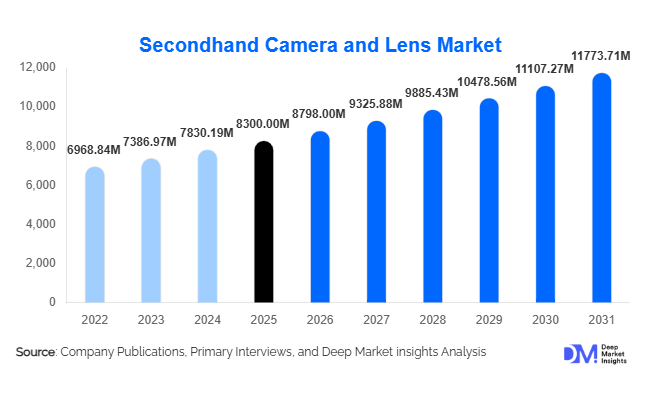
According to Deep Market Insights, the global secondhand camera and lens market size was valued at USD 8,300 million in 2025 and is projected to grow from USD 8798.00 million in 2026 to reach USD 11,773.71 million by 2031, expanding at a CAGR of 6.0% during the forecast period (2026–2031). The market growth is primarily driven by the rising popularity of digital content creation, the increasing cost of new professional photography equipment, and the growing consumer acceptance of refurbished and pre-owned electronics. In addition, sustainability trends and circular economy initiatives are encouraging both individuals and businesses to extend the lifecycle of imaging equipment through resale and refurbishment.
High-quality cameras and lenses typically retain strong functional value for many years, making them well-suited for secondary markets. As professional photographers upgrade to newer mirrorless systems, large volumes of DSLR cameras and lenses enter the resale ecosystem. This steady supply, combined with rising demand from hobbyists, students, and emerging content creators, is expanding the market significantly. Digital resale platforms, certified refurbishment programs, and improved logistics infrastructure are further enhancing buyer confidence and enabling global cross-border trade of used photography equipment.
Key Market Insights
- Online resale platforms dominate the market, accounting for more than 60% of global secondhand camera and lens transactions due to convenience and global inventory availability.
- Mirrorless camera upgrades are increasing resale supply, with many professionals selling DSLR gear to transition to newer systems.
- North America remains the largest market, supported by a strong base of professional photographers and digital creators.
- Asia-Pacific is the fastest-growing region, driven by rising content creation industries in India, China, and Southeast Asia.
- Certified refurbished equipment is gaining popularity, as consumers prefer inspected products with warranties and quality grading.
- Sustainability and circular economy initiatives are encouraging consumers to purchase refurbished electronics rather than new equipment.
What are the latest trends in the secondhand camera and lens market?
Growth of Creator Economy Driving Equipment Demand
The rapid expansion of the global creator economy is significantly influencing demand in the secondhand camera and lens market. Platforms such as YouTube, Instagram, and TikTok have enabled millions of individuals to become content creators, requiring high-quality imaging equipment to produce professional videos and photographs. However, new cameras and lenses can be expensive, often exceeding several thousand dollars for professional-grade equipment. As a result, many emerging creators prefer purchasing used cameras and lenses as a cost-effective alternative.
This trend has led to a surge in demand for used mirrorless cameras, prime lenses, and telephoto lenses among independent filmmakers and vloggers. In addition, social media-driven photography trends have increased interest in specialized lenses for cinematic shots, macro photography, and wildlife photography. As digital media continues to grow globally, the secondhand market is expected to benefit from a steady influx of new creators entering the industry.
Digital Marketplaces Transforming Used Equipment Trade
Another major trend shaping the market is the rapid digitization of secondhand equipment trading platforms. Modern resale platforms now provide standardized grading systems, product inspection reports, transparent pricing tools, and global shipping options. These features have significantly improved trust and reliability in the used equipment ecosystem.
Artificial intelligence-based pricing tools are increasingly being used to analyze historical sales data and determine fair market values for cameras and lenses. Online platforms are also introducing automated inspection processes and certified refurbishment programs to guarantee product quality. These technological innovations have made it easier for buyers to access high-quality used equipment while enabling sellers to reach global audiences.
What are the key drivers in the secondhand camera and lens market?
High Cost of New Professional Photography Equipment
The rising cost of new cameras and lenses is one of the primary factors driving the secondhand market. Professional mirrorless cameras and premium lenses often cost thousands of dollars, making them inaccessible to many aspiring photographers and hobbyists. Used equipment offers a cost-effective alternative, allowing consumers to purchase high-performance gear at discounts of 30% to 60% compared to retail prices.
This affordability enables new photographers to enter the market without significant financial investment. It also allows professionals to expand their equipment portfolios by purchasing backup camera bodies or additional lenses at lower costs.
Expansion of Social Media and Digital Content Creation
The growing popularity of digital media platforms has significantly increased demand for professional imaging equipment. Content creators, vloggers, filmmakers, and online educators require high-quality cameras to produce engaging visual content. Secondhand cameras and lenses provide an accessible entry point for these users, enabling them to produce professional-grade content without the high cost associated with new equipment.
What are the restraints for the global market?
Quality Assurance and Product Authenticity Concerns
Despite significant improvements in refurbishment standards, some consumers remain hesitant to purchase used cameras due to concerns about product condition and authenticity. Issues such as shutter wear, sensor damage, or counterfeit accessories can discourage buyers from entering the secondhand market. Although certified refurbishment programs and inspection services are addressing these challenges, maintaining trust remains a critical factor for market participants.
Competition from Smartphone Photography
Advancements in smartphone camera technology are also impacting demand for entry-level cameras. Modern smartphones offer high-resolution sensors, AI-driven photography features, and advanced video capabilities, reducing the need for standalone cameras among casual users. This trend primarily affects the lower price segments of the secondhand camera market.
What are the key opportunities in the secondhand camera and lens industry?
Expansion of Circular Economy and Sustainable Consumption
The global push toward sustainable consumption presents a major opportunity for the secondhand camera and lens market. Cameras and lenses are durable products with long lifespans, making them ideal for resale and refurbishment. Governments and organizations promoting circular economy initiatives are encouraging consumers to extend the lifecycle of electronic devices by purchasing refurbished products.
Manufacturers and retailers are increasingly launching official trade-in programs that allow customers to exchange old equipment for discounts on new products. These programs not only reduce electronic waste but also create structured supply chains for secondhand equipment.
Emerging Demand from Developing Photography Markets
Emerging markets such as India, Southeast Asia, and Latin America represent significant growth opportunities for the secondhand camera industry. In these regions, rising interest in photography, filmmaking, and social media content creation is increasing demand for professional imaging equipment. However, high prices of new cameras often limit adoption.
Secondhand equipment provides an affordable alternative for consumers in these markets. International resale platforms are increasingly exporting used cameras from developed markets to emerging economies, expanding the global reach of the secondhand camera ecosystem.
Report Scope
| Report Metric | Details |
|---|---|
| Market Size in 2025 | USD 8300 Million |
| Market Size in 2026 | USD 8798 Million |
| Market Size in 2031 | USD 11773.71 Million |
| CAGR | 6.0% (2026-2031) |
| Base Year for Estimation | 2025 |
| Historical Data | 2022-2024 |
| Forecast Period | 2026-2031 |
| Report Coverage | Revenue Forecast, Competitive Landscape, Supply Chain Disruption, Growth Factors, Environment & Regulatory Landscape and Trends |
| Geographies Covered | North America, Europe, APAC, Middle East and Africa, LATAM |
| Countries Covered | U.S., Canada, U.K., Germany, France, Spain, Italy, Russia, Nordic, Benelux, Rest of Europe, China, Korea, Japan, India, Australia, Singapore, Taiwan, South East Asia, Rest of Asia-Pacific, UAE, Turky, Saudi Arabia, South Africa, Egypt, Nigeria, Rest of MEA, Brazil, Mexico, Argentina, Chile, Colombia, Rest of LATAM |
Explore more data points, trends and opportunities Download Free Sample Report
Product Type Insights
Cameras represent the largest product segment in the secondhand camera and lens market, accounting for approximately 58% of total revenue in 2025. DSLR cameras continue to dominate the resale market due to their durability, extensive lens compatibility, and strong availability from professional upgrades. Mirrorless cameras are emerging as the fastest-growing segment within this category, as professionals increasingly adopt mirrorless systems and resell their older equipment. Lenses account for a significant portion of the remaining market share, particularly high-value telephoto and prime lenses used in wildlife, sports, and portrait photography. Accessories such as flashes, battery grips, and stabilizers form a smaller but steadily growing segment, driven by content creators seeking complete equipment setups at affordable prices.
Application Insights
Professional photography remains a major application segment for secondhand cameras and lenses, particularly in industries such as weddings, journalism, and commercial photography. Many professionals purchase used equipment as backup gear or to expand their lens collections without significant investment. Digital content creation represents the fastest-growing application segment, driven by influencers, vloggers, and filmmakers producing content for social media platforms. Educational institutions and photography schools also contribute to demand by purchasing used cameras for training programs. Collectors and hobbyists form another niche segment, particularly in the vintage camera market where film cameras and classic lenses are gaining renewed popularity.
Distribution Channel Insights
Online marketplaces dominate the secondhand camera and lens market, accounting for nearly 62% of global transactions. These platforms allow buyers to browse large inventories, compare prices, and access detailed product descriptions with condition grading. Dedicated resale platforms specializing in photography equipment provide additional services such as professional inspections, warranties, and trade-in programs. Offline retail channels, including specialty camera stores and photography trade shows, continue to play an important role in certain markets where consumers prefer to physically inspect equipment before purchasing. Manufacturer-led refurbishment programs are also emerging as an important distribution channel, providing certified used products directly from original brands.
End-User Insights
Amateur photographers represent the largest end-user group in the secondhand camera and lens market. These consumers often seek affordable equipment to develop their photography skills without investing in expensive new gear. Professional photographers remain a key segment, particularly for high-end lenses and backup camera bodies used in commercial photography projects. Content creators and videographers are the fastest-growing end-user segment, driven by the rapid expansion of digital media platforms. Students and learners also represent a growing customer base as photography courses and media training programs increasingly incorporate practical equipment training using refurbished cameras.
Explore more data points, trends and opportunities Download Free Sample Report
Secondhand Camera and Lens Market Segmentations
By Product Type
- Cameras
- Lenses
- Photography Accessories
By Camera Type
- DSLR Cameras
- Mirrorless Cameras
- Compact / Point-and-Shoot Cameras
- Medium Format Cameras
- Film / Analog Cameras
By Lens Type
- Prime Lenses
- Zoom Lenses
- Telephoto Lenses
- Wide-Angle Lenses
- Macro Lenses
- Specialty Lenses (Tilt-Shift, Fisheye, Cinema)
By Distribution Channel
- Online Marketplaces
- Dedicated Camera Resale Platforms
- Specialty Camera Stores
- Photography Trade Shows and Auctions
- Manufacturer Refurbishment Programs
By End User
- Professional Photographers
- Content Creators and Videographers
- Amateur Photographers
- Students and Learners
- Collectors and Hobbyists
Regional Insights
North America
North America accounts for approximately 34% of the global secondhand camera and lens market in 2025, making it the largest regional market. The United States dominates regional demand due to its large base of professional photographers, filmmakers, and content creators. Strong e-commerce infrastructure and well-established resale platforms further support market growth. Canada also contributes significantly to the market, particularly in professional photography and filmmaking industries.
Europe
Europe represents around 28% of the global market, with strong demand in countries such as the United Kingdom, Germany, and France. The region benefits from a well-developed photography culture and strong consumer acceptance of refurbished electronics. Sustainability initiatives and circular economy policies are encouraging the reuse of electronic products, further supporting the growth of the secondhand camera market.
Asia-Pacific
Asia-Pacific is the fastest-growing regional market, driven by rising demand in China, Japan, India, and South Korea. Japan plays a major role in the global market as both a supplier and consumer of used cameras due to its strong domestic photography culture. India and Southeast Asia are emerging markets where younger consumers are increasingly purchasing secondhand equipment to pursue photography and content creation.
Latin America
Latin America accounts for nearly 7% of global market demand. Brazil and Mexico represent the largest markets in the region, with growing interest in photography and digital media production. Improving e-commerce infrastructure and rising adoption of online resale platforms are supporting market expansion.
Middle East & Africa
The Middle East and Africa region is witnessing gradual growth in demand for secondhand cameras, particularly in the United Arab Emirates, Saudi Arabia, and South Africa. Rising tourism industries, expanding media production sectors, and increasing interest in photography are driving equipment demand in these markets.
Key Players in the Secondhand Camera and Lens Market
- Canon Inc.
- Nikon Corporation
- Sony Group Corporation
- Fujifilm Holdings Corporation
- Panasonic Holdings Corporation
- Leica Camera AG
- OM Digital Solutions Corporation
- Ricoh Imaging Company
- DJI
- GoPro Inc.
- Hasselblad
- Phase One A/S
- Sigma Corporation
- Tamron Co., Ltd.
- Tokina Co., Ltd.