Sanitary Ware Retail Market Size
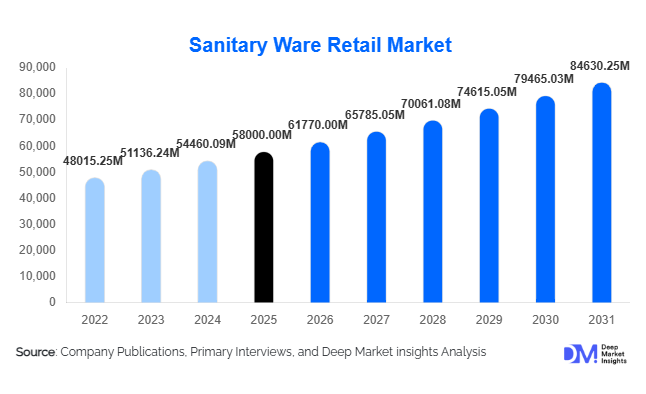
According to Deep Market Insights, the global sanitary ware retail market size was valued at USD 58,000 million in 2025 and is projected to grow from USD 61,770.00 million in 2026 to reach USD 84,630.25 million by 2031, expanding at a CAGR of 6.5% during the forecast period (2026–2031). The sanitary ware retail market growth is primarily driven by rapid urbanization, rising construction activities, increasing consumer awareness regarding hygiene, and the growing demand for modern and aesthetically appealing bathroom solutions. Additionally, the integration of smart technologies and water-efficient products is further accelerating market expansion across both developed and emerging economies.
Key Market Insights
- Residential construction and renovation activities remain the primary growth drivers, accounting for the majority of sanitary ware demand globally.
- Asia-Pacific dominates the market, supported by strong infrastructure development and population growth in countries such as China and India.
- Premiumization trends are gaining traction, with increasing demand for designer and smart sanitary ware products.
- Offline retail channels continue to lead, though e-commerce platforms are rapidly expanding their presence.
- Water-efficient and eco-friendly products are becoming industry standards, driven by regulatory policies and sustainability concerns.
- Technological innovations, including sensor-based fixtures and smart toilets, are transforming consumer preferences.
What are the latest trends in the sanitary ware retail market?
Smart and Water-Efficient Sanitary Solutions
The adoption of smart sanitary ware products is increasing significantly, driven by the need for water conservation and enhanced hygiene. Products such as sensor-based faucets, smart toilets with automated flushing, and water-saving fixtures are gaining popularity across residential and commercial applications. Governments and regulatory bodies are encouraging the use of low-flow and eco-friendly products, leading manufacturers to innovate with advanced technologies. These solutions not only reduce water consumption but also improve user convenience and hygiene standards. The integration of IoT-enabled monitoring systems in high-end sanitary ware is also emerging, allowing users to track water usage and maintenance requirements, further enhancing product value.
Shift Toward Premium and Designer Bathroom Spaces
Bathrooms are increasingly being viewed as lifestyle spaces rather than purely functional areas. This has led to growing demand for premium sanitary ware products such as freestanding bathtubs, designer basins, and luxury fittings. Urban consumers, particularly in developed markets, are investing in aesthetically appealing and customized bathroom solutions. Manufacturers are focusing on design innovation, offering products in various finishes, colors, and materials to cater to evolving consumer preferences. This trend is also supported by rising disposable incomes and the influence of global interior design trends, making premium sanitary ware a key growth segment in the retail market.
What are the key drivers in the sanitary ware retail market?
Expansion of the Global Construction and Housing Sector
The rapid growth of residential and commercial construction activities is a major driver of the sanitary ware retail market. Urbanization and population growth are leading to increased demand for housing, particularly in emerging economies. Government initiatives promoting affordable housing and infrastructure development are further boosting demand for sanitary fixtures. New construction projects account for a significant portion of sanitary ware sales, especially in Asia-Pacific and the Middle East, where large-scale urban development projects are ongoing.
Rising Hygiene Awareness and Health Standards
Increasing awareness regarding hygiene and sanitation is driving the adoption of modern sanitary ware products. Consumers and institutions are prioritizing hygienic solutions such as touchless fixtures, anti-bacterial surfaces, and easy-to-clean materials. This trend has been reinforced by global health concerns, leading to higher demand across residential, healthcare, and public infrastructure sectors. As a result, manufacturers are investing in technologies that enhance hygiene and reduce the risk of contamination.
What are the restraints for the global market?
High Cost of Premium Products
The relatively high cost of advanced and premium sanitary ware products remains a key restraint, particularly in price-sensitive markets. While demand for luxury and smart solutions is growing, affordability continues to limit widespread adoption in developing regions. Consumers in these markets often prefer economy or mid-range products, restricting the growth of high-end segments.
Volatility in Raw Material Prices
Fluctuations in the prices of raw materials such as ceramics, metals, and energy inputs pose challenges for manufacturers and retailers. Rising production costs can lead to increased product prices, impacting demand and profit margins. This volatility also creates uncertainty in pricing strategies and supply chain management, potentially slowing market growth.
What are the key opportunities in the sanitary ware retail industry?
Emerging Market Expansion and Urbanization
Rapid urbanization in emerging economies presents significant growth opportunities for the sanitary ware retail market. Countries such as India, China, and Brazil are witnessing increased demand for residential housing and infrastructure development, driving the need for sanitary products. Government initiatives focused on improving sanitation and housing conditions are further supporting market growth. Companies that expand their presence in these regions can benefit from large-scale demand and growing consumer bases.
Growth of E-commerce and Omnichannel Retail
The increasing adoption of online retail channels is transforming the sanitary ware market. E-commerce platforms provide consumers with convenience, product variety, and competitive pricing, making them an attractive option for purchasing sanitary products. Retailers are adopting omnichannel strategies, integrating online and offline platforms to enhance customer experience. This trend is particularly significant in urban areas, where digital adoption is high, and consumers prefer seamless shopping experiences.
Report Scope
| Report Metric | Details |
|---|---|
| Market Size in 2025 | USD 58000 Million |
| Market Size in 2026 | USD 61770 Million |
| Market Size in 2031 | USD 84630.25 Million |
| CAGR | 6.5% (2026-2031) |
| Base Year for Estimation | 2025 |
| Historical Data | 2022-2024 |
| Forecast Period | 2026-2031 |
| Report Coverage | Revenue Forecast, Competitive Landscape, Supply Chain Disruption, Growth Factors, Environment & Regulatory Landscape and Trends |
| Geographies Covered | North America, Europe, APAC, Middle East and Africa, LATAM |
| Countries Covered | U.S., Canada, U.K., Germany, France, Spain, Italy, Russia, Nordic, Benelux, Rest of Europe, China, Korea, Japan, India, Australia, Singapore, Taiwan, South East Asia, Rest of Asia-Pacific, UAE, Turky, Saudi Arabia, South Africa, Egypt, Nigeria, Rest of MEA, Brazil, Mexico, Argentina, Chile, Colombia, Rest of LATAM |
Explore more data points, trends and opportunities Download Free Sample Report
Product Type Insights
Toilets and water closets continue to dominate the sanitary ware retail market, accounting for approximately 35% of the global market share in 2025. The leadership of this segment is primarily driven by its indispensable role across all types of construction—residential, commercial, and institutional—making it a non-discretionary purchase. Additionally, increasing global sanitation standards and government-led initiatives promoting hygienic living conditions are further accelerating demand. The segment is also benefiting from rapid innovation, particularly in smart toilets equipped with features such as automated flushing, bidet functions, and touchless operation, which are gaining traction in premium and urban markets. Wash basins and bathtubs represent the next significant segments, supported by rising consumer preference for modern bathroom aesthetics and space-optimized designs. Meanwhile, urinals and bidets, though smaller in share, are witnessing steady growth due to increasing awareness of water conservation and hygiene, particularly in commercial and institutional settings. The shift toward multifunctional and design-centric products is expected to further enhance the value contribution of all product categories.
Application Insights
The residential segment remains the dominant application area, contributing approximately 65% of total market demand in 2025. This dominance is driven by strong growth in global housing construction, urban expansion, and increasing renovation activities, particularly in developed economies. Rising disposable incomes and evolving consumer preferences toward aesthetically appealing and technologically advanced bathrooms are further strengthening this segment. The commercial segment, including hospitality, office spaces, and retail establishments, is emerging as the fastest-growing application area, supported by increasing investments in tourism infrastructure, corporate expansion, and smart building development. Institutional applications, particularly in healthcare and education sectors, are also gaining momentum due to stringent hygiene regulations and increased public infrastructure spending. Additionally, new applications such as smart bathrooms in luxury real estate and high-end residential projects are creating niche demand segments, contributing to overall market diversification and value growth.
Distribution Channel Insights
Offline retail channels continue to dominate the sanitary ware retail market, accounting for nearly 70% of total sales in 2025. The leading position of offline channels is driven by the consumer preference for physical inspection of products, particularly for assessing quality, durability, design compatibility, and installation requirements. Specialty stores, multi-brand showrooms, and home improvement outlets play a critical role in influencing purchase decisions through personalized customer service and product demonstrations. However, online retail is rapidly gaining traction, driven by increasing digital adoption, urbanization, and the growing availability of diverse product offerings. E-commerce platforms are providing competitive pricing, transparent product comparisons, and convenient delivery options, making them particularly attractive to younger and tech-savvy consumers. The emergence of omnichannel strategies, where retailers integrate digital platforms with physical stores, is further enhancing customer engagement and expanding market reach, positioning online channels as a key growth driver in the coming years.
End-Use Insights
New construction accounts for approximately 60% of the sanitary ware retail market, maintaining its position as the leading end-use segment. This is primarily driven by large-scale urban development, population growth, and increasing investments in residential and commercial infrastructure, particularly in emerging economies. Government initiatives focused on affordable housing and smart city development are further reinforcing demand for sanitary ware products in new construction projects. Renovation and replacement activities also represent a significant share, especially in developed regions such as North America and Europe, where aging infrastructure and rising consumer interest in home improvement are driving upgrades to modern and water-efficient sanitary solutions. The hospitality sector is emerging as a key growth contributor, supported by increasing global tourism and investments in hotels, resorts, and luxury accommodations. Additionally, the growing emphasis on sustainable and smart building solutions is influencing end-use demand patterns, encouraging the adoption of advanced sanitary ware products across all segments.
Explore more data points, trends and opportunities Download Free Sample Report
Sanitary Ware Retail Market Segmentations
By Product Type
- Toilets/Water Closets
- Wash Basins
- Bathtubs
- Urinals
- Bidets
By Application
- Residential
- Commercial
- Institutional
By Distribution Channel
- Offline Retail
- Online Retail
By End-Use
- New Construction
- Renovation & Replacement
Regional Insights
Asia-Pacific
Asia-Pacific leads the global sanitary ware retail market, accounting for approximately 45% of total demand in 2025. The region’s dominance is driven by rapid urbanization, large-scale residential construction, and strong government initiatives focused on improving sanitation infrastructure. China remains the largest market due to its extensive construction sector, robust manufacturing base, and export capabilities. India is among the fastest-growing markets, supported by government-led sanitation programs, rising middle-class income, and increasing housing demand. Southeast Asian countries such as Indonesia, Vietnam, and Thailand are also contributing significantly, driven by infrastructure development and expanding urban populations. The availability of cost-effective manufacturing and strong domestic consumption further strengthens regional growth.
North America
North America holds around 18% of the global market share, with the United States accounting for the majority of regional demand. Growth in this region is primarily driven by renovation and remodeling activities, as well as high consumer spending on premium and smart sanitary ware products. The increasing adoption of water-efficient and technologically advanced fixtures, supported by stringent environmental regulations, is a key growth driver. Additionally, the presence of well-established retail networks and high awareness of hygiene standards contribute to sustained market expansion. The trend toward luxury bathroom upgrades and smart home integration is further boosting demand in this region.
Europe
Europe accounts for approximately 20% of the global market, with strong demand from key countries such as Germany, the UK, and France. The region is characterized by a high preference for premium, designer, and eco-friendly sanitary ware products. Stringent environmental regulations and water conservation policies are major drivers, encouraging the adoption of sustainable and low-flow fixtures. Additionally, the mature construction market in Europe is supported by significant renovation activities, particularly in older buildings. The growing trend of smart homes and increasing consumer focus on aesthetics and sustainability are further driving market growth across the region.
Middle East & Africa
The Middle East & Africa region contributes approximately 10% of the global market, with growth largely concentrated in countries such as the UAE and Saudi Arabia. The region’s expansion is driven by large-scale infrastructure projects, including smart cities, commercial complexes, and luxury hospitality developments. Increasing investments in tourism and real estate are key growth drivers, particularly in the Gulf Cooperation Council (GCC) countries. In Africa, improving sanitation infrastructure and rising urbanization are gradually boosting demand for sanitary ware products. Government initiatives aimed at enhancing public hygiene and access to sanitation facilities are also supporting long-term market growth.
Latin America
Latin America holds approximately 7% of the global sanitary ware retail market, with Brazil and Mexico leading regional demand. Growth in this region is driven by urbanization, increasing residential construction, and government investments in infrastructure development. The rising middle-class population and improving living standards are contributing to higher demand for modern sanitary ware products. Additionally, renovation activities in urban areas and the expansion of retail distribution networks are supporting market growth. However, economic fluctuations and price sensitivity remain key challenges, influencing the adoption of premium products in the region.
Key Players in the Sanitary Ware Retail Market
- LIXIL Corporation
- Kohler Co.
- Roca Group
- TOTO Ltd.
- Geberit AG
- Duravit AG
- Villeroy & Boch
- Ideal Standard International
- HSIL Limited
- Jaquar Group
- Cersanit Group
- RAK Ceramics
- American Standard Brands
- VitrA (Eczacıbaşı Group)
- Roca Sanitario