Sanitary Ware Market Size
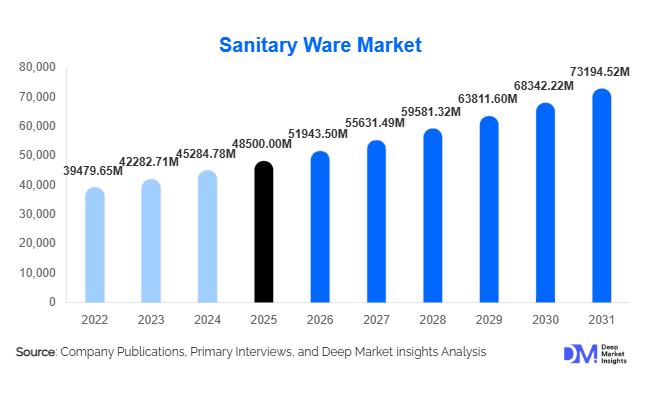
According to Deep Market Insights, the global sanitary ware market size was valued at USD 48,500 million in 2025 and is projected to grow from USD 51,943.50 million in 2026 to reach USD 73,194.52 million by 2031, expanding at a CAGR of 7.1% during the forecast period (2026–2031). The sanitary ware market growth is primarily driven by rapid urbanization, increasing construction activities, rising hygiene awareness, and growing demand for modern and aesthetically designed bathroom solutions across residential and commercial sectors.
Key Market Insights
- Asia-Pacific dominates the global sanitary ware market, accounting for over 40% of demand, driven by large-scale construction activities in China and India.
- Residential applications lead the market, contributing nearly 65% of total demand due to housing expansion and renovation trends.
- Ceramic sanitary ware remains the most widely used material, holding over 60% market share due to durability and cost-effectiveness.
- Smart and touchless sanitary products are gaining rapid adoption, especially in developed markets and commercial spaces.
- Mid-range products dominate globally, balancing affordability and design appeal, particularly in emerging economies.
- Offline distribution channels continue to lead, though online platforms are witnessing accelerated growth with digital transformation.
What are the latest trends in the sanitary ware market?
Rise of Smart and Touchless Sanitary Solutions
The sanitary ware market is increasingly witnessing the integration of smart technologies, including sensor-based faucets, automatic flushing systems, and IoT-enabled smart toilets. These innovations are driven by heightened hygiene awareness and the need for water conservation. Commercial establishments such as airports, malls, and hospitals are rapidly adopting touchless solutions to enhance sanitation standards. Additionally, smart toilets with features such as heated seats, self-cleaning mechanisms, and water-saving functions are gaining traction in premium residential segments. Manufacturers are investing in digital features and automation to differentiate their offerings and meet evolving consumer expectations.
Growing Focus on Sustainable and Water-Efficient Products
Sustainability has emerged as a key trend shaping the sanitary ware industry. Governments and regulatory bodies are promoting water-efficient products to address water scarcity concerns. Low-flow toilets, dual-flush systems, and eco-friendly materials are becoming standard offerings. Manufacturers are also adopting energy-efficient production processes and recyclable materials to reduce environmental impact. Certifications related to water conservation and sustainability are influencing purchasing decisions, especially in developed markets. This trend is expected to strengthen as global sustainability goals become more stringent.
What are the key drivers in the sanitary ware market?
Expansion of Construction and Real Estate Activities
The growth of the global construction industry is a major driver for the sanitary ware market. Increasing urbanization, rising population, and government-led housing initiatives are fueling demand for residential units, thereby boosting sanitary ware installations. Commercial construction, including offices, hotels, and healthcare facilities, further contributes to market growth. Emerging economies are particularly witnessing strong growth due to infrastructure development and urban migration.
Increasing Hygiene Awareness and Sanitation Initiatives
Rising awareness regarding hygiene and sanitation is significantly influencing the demand for modern sanitary ware products. Government programs aimed at improving sanitation infrastructure, especially in developing countries, are accelerating product adoption. Public and institutional sectors are investing in better sanitation facilities, leading to increased demand for durable and hygienic sanitary solutions.
What are the restraints for the global market?
Volatility in Raw Material and Energy Costs
The production of sanitary ware, particularly ceramic products, is energy-intensive and dependent on raw materials such as clay and minerals. Fluctuations in energy prices and raw material costs can impact manufacturing expenses and profit margins. This creates pricing challenges for manufacturers, especially in highly competitive markets.
High Costs of Premium and Smart Products
While premium and smart sanitary ware products offer advanced features, their high cost of purchase and installation limits adoption in price-sensitive markets. Developing regions, where affordability remains a key concern, often prefer basic and mid-range products, restricting the penetration of high-end offerings.
What are the key opportunities in the sanitary ware industry?
Emerging Market Demand and Urban Housing Growth
Rapid urbanization in countries such as India, Indonesia, and Vietnam presents significant growth opportunities. Government-led housing and sanitation programs are driving large-scale demand for sanitary ware products. Manufacturers can capitalize on this opportunity by offering cost-effective and durable solutions tailored to local market needs while expanding their distribution networks.
Premiumization and Bathroom Aesthetic Trends
Consumers are increasingly focusing on bathroom aesthetics and design, transforming bathrooms into lifestyle spaces. This trend is driving demand for premium products such as designer basins, luxury bathtubs, and customized sanitary solutions. Companies that invest in innovative designs and high-quality finishes can capture higher margins and strengthen brand positioning in the premium segment.
Report Scope
| Report Metric | Details |
|---|---|
| Market Size in 2025 | USD 48500 Million |
| Market Size in 2026 | USD 51943.50 Million |
| Market Size in 2031 | USD 73194.52 Million |
| CAGR | 7.1% (2026-2031) |
| Base Year for Estimation | 2025 |
| Historical Data | 2022-2024 |
| Forecast Period | 2026-2031 |
| Report Coverage | Revenue Forecast, Competitive Landscape, Supply Chain Disruption, Growth Factors, Environment & Regulatory Landscape and Trends |
| Geographies Covered | North America, Europe, APAC, Middle East and Africa, LATAM |
| Countries Covered | U.S., Canada, U.K., Germany, France, Spain, Italy, Russia, Nordic, Benelux, Rest of Europe, China, Korea, Japan, India, Australia, Singapore, Taiwan, South East Asia, Rest of Asia-Pacific, UAE, Turky, Saudi Arabia, South Africa, Egypt, Nigeria, Rest of MEA, Brazil, Mexico, Argentina, Chile, Colombia, Rest of LATAM |
Explore more data points, trends and opportunities Download Free Sample Report
Product Type Insights
Toilets and water closets dominate the sanitary ware market, accounting for approximately 38% of total market share in 2025. This leadership is primarily driven by their indispensable role in both residential and commercial infrastructure, along with high replacement frequency compared to other sanitary products. The increasing adoption of dual-flush and water-saving toilet systems, particularly in water-scarce regions, further strengthens this segment’s dominance. Additionally, the rapid penetration of smart toilets, featuring automated flushing, bidet functions, and touchless controls, is accelerating growth, especially in developed markets and premium urban housing.
Wash basins represent the second-largest segment, supported by rising consumer preference for bathroom aesthetics and customization. Demand for countertop and designer basins is increasing in urban residential projects and luxury hospitality spaces. Bathtubs and bidets, while smaller in share, are witnessing robust growth in premium and luxury segments, particularly in North America and Europe, where consumers are investing in spa-like bathroom experiences. Overall, product innovation, water efficiency, and smart integration remain key drivers shaping product-level demand.
Application Insights
Residential applications account for the largest share of the sanitary ware market, contributing nearly 65% of total demand in 2025. This dominance is driven by rapid urban housing expansion, increasing home ownership rates, and a growing trend toward bathroom remodeling and renovation in developed economies. The shift toward nuclear families and rising disposable incomes in emerging markets is also accelerating demand for modern sanitary solutions.
The commercial segment is the fastest-growing application area, supported by expansion in hospitality, retail, and healthcare infrastructure. Hotels, airports, malls, and hospitals require high-durability and hygienic sanitary solutions, leading to increased adoption of sensor-based and touchless products. Institutional applications, including schools, government buildings, and public sanitation facilities, are also expanding steadily due to government-led sanitation programs and infrastructure development initiatives. The combination of regulatory pressure and hygiene standards is further boosting demand across non-residential applications.
Distribution Channel Insights
Offline distribution channels dominate the sanitary ware market, accounting for approximately 72% of total sales. This is largely due to the consumer preference for physical inspection of products, especially for high-value and design-sensitive purchases such as sanitary ware. Dealer networks, specialty stores, and direct project sales remain critical in influencing buyer decisions, particularly in developing markets where contractor recommendations play a key role.
However, online channels are witnessing rapid growth, driven by increasing digital adoption, competitive pricing, and convenience. E-commerce platforms and brand-owned websites are expanding their reach, offering detailed product catalogs, virtual visualization tools, and customization options. The integration of augmented reality (AR) and 3D visualization technologies is enabling customers to simulate bathroom designs, significantly enhancing online buying confidence. This shift is expected to gradually increase the online share, particularly among younger, tech-savvy consumers.
End-Use Industry Insights
The residential sector remains the primary driver of sanitary ware demand, supported by strong growth in global housing construction and renovation activities. In 2025, the residential segment is estimated to account for over USD 31,000 million in market value. Increasing consumer focus on home improvement and interior aesthetics is further driving demand for premium and customized sanitary products.
The commercial sector, particularly hospitality and healthcare, is emerging as the fastest-growing end-use industry, with growth rates exceeding 8% CAGR. The resurgence of global tourism and expansion of healthcare infrastructure are key contributors. Hospitals and hotels are increasingly adopting advanced sanitary solutions to meet hygiene and durability standards. Institutional demand is also rising steadily, supported by government sanitation initiatives, public infrastructure development, and educational facility expansion. Additionally, export-driven demand from manufacturing hubs such as China and India is strengthening global supply chains, enabling cost-effective production and large-scale distribution across international markets.
Explore more data points, trends and opportunities Download Free Sample Report
Sanitary Ware Market Segmentations
By Product Type
- Toilets/Water Closets
- Wash Basins
- Urinals
- Bathtubs
- Bidets
By Application
- Residential
- Commercial
- Institutional
By Distribaution Channel
- Offline
- Online
By Material Type
- Ceramic
- Porcelain
- Stainless Steel
- Acrylic
- Composite Materials
By Price Range
- Economy
- Mid-range
- Premium/Luxury
Regional Insights
Asia-Pacific
Asia-Pacific leads the global sanitary ware market with approximately 42% market share in 2025, making it the largest and most dynamic region. China dominates both production and consumption due to its massive construction sector, strong manufacturing base, and export capabilities. India is among the fastest-growing markets globally, supported by government-led housing and sanitation initiatives, rapid urbanization, and increasing middle-class income levels.
Key drivers for regional growth include large-scale infrastructure development, rising population, increasing urban housing demand, and strong government support for sanitation programs. Southeast Asian countries such as Indonesia and Vietnam are also witnessing accelerated demand due to industrialization and urban expansion. Additionally, the presence of low-cost manufacturing and export-oriented production further strengthens the region’s leadership.
North America
North America accounts for around 18% of the global sanitary ware market, with the United States as the primary contributor. The market is driven by strong demand for premium, smart, and technologically advanced sanitary products. Renovation and replacement activities dominate demand, as most buildings already have established infrastructure. Key growth drivers include high disposable incomes, increasing adoption of smart home technologies, and strong consumer preference for luxury bathroom solutions. The growing trend of bathroom remodeling and sustainability-focused products, such as water-efficient fixtures, is also contributing to market expansion. Regulatory standards related to water conservation further encourage the adoption of advanced sanitary ware solutions.
Europe
Europe holds approximately 22% market share, with major demand coming from Germany, the United Kingdom, and France. The region is characterized by a mature market with strong emphasis on sustainability, design, and product quality. Growth in Europe is primarily driven by stringent environmental regulations, high adoption of water-efficient products, and consumer preference for premium and designer sanitary ware. Renovation activities in aging infrastructure across Western Europe also contribute significantly to demand. Additionally, the region is a hub for high-end sanitary ware innovation, with a strong presence of leading global brands focusing on aesthetics and sustainability.
Middle East & Africa
The Middle East & Africa region is emerging as a high-growth market, with a projected CAGR exceeding 8.5%. Countries such as Saudi Arabia and the UAE are leading demand due to large-scale infrastructure projects, tourism development, and urban expansion. Key growth drivers include government investments in mega construction projects, expansion of hospitality and tourism sectors, and increasing focus on smart city developments. In Africa, improving sanitation infrastructure and rising urbanization are driving demand for basic sanitary ware products. The region’s growth is further supported by increasing foreign investments and infrastructure modernization initiatives.
Latin America
Latin America accounts for approximately 8% of the global market, with Brazil and Mexico as the key contributors. The region is experiencing steady growth, supported by urbanization and improving economic conditions. Growth drivers include increasing investments in residential construction, a rising middle-class population, and government initiatives to improve sanitation infrastructure. While the market remains price-sensitive, demand for mid-range sanitary products is increasing. Additionally, gradual improvements in distribution networks and retail infrastructure are enhancing market accessibility across the region.
Key Players in the Sanitary Ware Market
- LIXIL Group
- Kohler Co.
- TOTO Ltd.
- Roca Sanitario S.A.
- Geberit AG
- Duravit AG
- Villeroy & Boch
- HSIL Ltd.
- Jaquar Group
- RAK Ceramics
- Ideal Standard
- American Standard Brands
- Cersanit S.A.
- Lecico Egypt
- Parryware