Safety Vest Market Size
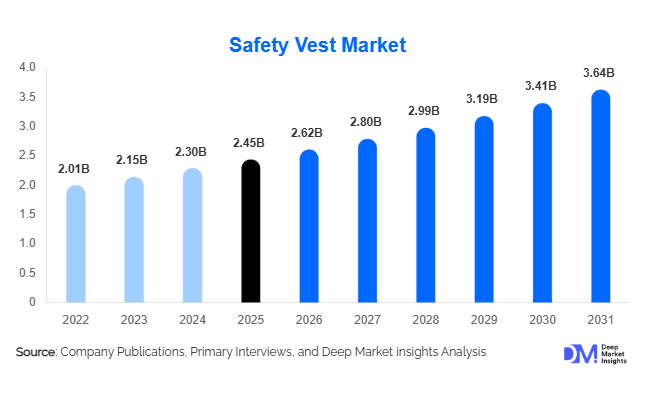
According to Deep Market Insights, the global safety vest market size was valued at USD 2.45 billion in 2025 and is projected to grow from USD 2.62 billion in 2026 to reach USD 3.64 billion by 2031, expanding at a CAGR of 6.8% during the forecast period (2026–2031). The safety vest market growth is primarily driven by increasingly stringent occupational safety regulations, rising infrastructure development activities, expansion of industrial manufacturing, and growing awareness regarding worker visibility protection across hazardous work environments.
Safety vests have become an essential component of personal protective equipment (PPE) across industries such as construction, transportation, mining, oil & gas, warehousing, utilities, and emergency response. Regulatory authorities worldwide are mandating the use of high-visibility garments to reduce workplace accidents and improve worker safety in low-light and high-risk operational environments. ANSI-compliant and EN ISO-certified safety vests are increasingly being adopted as standard protective apparel in developed as well as emerging industrial economies.
The market is also witnessing rapid innovation through the integration of smart technologies, including LED illumination, GPS tracking, IoT-enabled worker monitoring, and heat-stress management systems. Demand for flame-resistant (FR) safety vests and sustainable recycled-fabric variants is also increasing as industrial buyers focus on both operational safety and ESG compliance. Asia-Pacific currently dominates global demand due to rapid industrialization and infrastructure expansion in China and India, while North America remains a premium-value market driven by stringent workplace safety standards and advanced PPE adoption.
Key Market Insights
- Construction and infrastructure development remain the largest demand drivers, accounting for nearly one-third of global safety vest consumption.
- Asia-Pacific dominates the global market, supported by large-scale industrialization, highway expansion, and manufacturing growth across China and India.
- Smart safety vests with IoT, GPS, and LED integration are gaining strong momentum, particularly in mining, logistics, and oil & gas sectors.
- Transportation and warehousing industries are emerging as high-growth end-use sectors, fueled by e-commerce expansion and logistics modernization.
- Sustainable and recycled-material safety apparel is increasingly influencing procurement decisions, especially across Europe and North America.
- Direct B2B procurement channels dominate global sales, as governments and large industrial corporations increasingly centralize PPE sourcing contracts.
Safety Vest Market Trends
Smart Safety Vest Adoption Accelerating Across Industrial Worksites
The safety vest market is increasingly shifting toward technologically integrated wearable protection systems. Smart safety vests equipped with GPS tracking, RFID sensors, LED illumination systems, fatigue monitoring devices, and environmental hazard detection technologies are gaining significant traction across mining, oil & gas, logistics, and utilities industries. Industrial employers are prioritizing connected worker ecosystems that improve operational safety, workforce monitoring, and emergency response efficiency.
IoT-enabled safety vests allow supervisors to track worker locations in real time, monitor body temperature, detect hazardous gas exposure, and issue emergency alerts during operational incidents. LED-integrated safety vests are also becoming increasingly popular for nighttime construction, warehouse logistics, airport operations, and roadside maintenance activities where enhanced visibility is critical. Growing adoption of industrial automation and digital workplace management systems is expected to further strengthen demand for intelligent PPE solutions globally.
Sustainable and Recycled Safety Apparel Gaining Momentum
Sustainability has emerged as a key trend within the safety vest market as industrial buyers and government agencies increasingly prioritize environmentally compliant procurement practices. Manufacturers are introducing safety vests produced using recycled polyester fabrics, eco-friendly reflective tapes, low-emission dyeing technologies, and sustainable textile manufacturing processes.
Large multinational corporations are integrating ESG-focused sourcing policies into PPE procurement strategies, particularly across Europe and North America. Construction firms, logistics companies, and utilities operators are increasingly selecting suppliers capable of offering certified sustainable safety apparel solutions. Some manufacturers are also investing in circular textile programs and biodegradable packaging initiatives to strengthen environmental compliance and brand differentiation. This trend is expected to accelerate further as workplace sustainability targets become more stringent globally.
Safety Vest Market Drivers
Increasing Workplace Safety Regulations
One of the primary drivers of the safety vest market is the tightening of workplace safety regulations across industrial economies. Governments and labor safety authorities worldwide are mandating the use of high-visibility garments in hazardous work environments such as construction zones, road maintenance projects, logistics yards, mining sites, and manufacturing facilities. Regulatory frameworks, including ANSI/ISEA standards in North America and EN ISO 20471 standards in Europe have significantly increased adoption of certified safety apparel.
Employers are under growing pressure to minimize workplace accidents, improve employee visibility, and comply with occupational safety laws to avoid legal liabilities and financial penalties. The increasing focus on workforce safety management is expected to continue supporting long-term demand for safety vests globally.
Rapid Infrastructure and Industrial Expansion
Large-scale infrastructure development and industrialization are significantly contributing to the safety vest market growth. Governments across Asia-Pacific, the Middle East, and Latin America are investing heavily in transportation infrastructure, industrial parks, metro rail systems, airports, ports, and energy projects. These activities require extensive deployment of workers operating in hazardous and low-visibility environments.
Countries such as China, India, Saudi Arabia, Indonesia, and Vietnam are witnessing particularly strong growth in construction and industrial activities, resulting in substantial procurement demand for reflective safety apparel. The expansion of renewable energy projects, smart city initiatives, and logistics infrastructure is also supporting market growth.
Safety Vest Market Restraints
Pricing Pressure from Low-Cost Manufacturers
The global safety vest market remains highly fragmented, with numerous regional and low-cost manufacturers competing aggressively on price. Standard reflective safety vest categories are particularly vulnerable to pricing competition from manufacturers operating in low-cost production hubs across Asia. This intense competition creates margin pressure for established international PPE brands and limits premium product penetration in cost-sensitive markets.
Government contracts and large-volume industrial procurement tenders often prioritize low pricing over product differentiation, creating additional profitability challenges for manufacturers focused on premium-quality or technologically advanced safety apparel.
Raw Material Price Volatility
Fluctuations in the prices of polyester fibers, reflective tapes, flame-resistant coatings, and electronic components used in smart safety vests represent a major restraint for the industry. Since many safety vest materials are petroleum-derived, volatility in crude oil prices directly impacts manufacturing costs.
Supply chain disruptions, logistics bottlenecks, and increasing transportation costs have also affected material procurement globally. Manufacturers operating under long-term fixed-price industrial contracts often face profitability pressures when raw material prices rise sharply. Maintaining stable supply chains and cost-efficient sourcing strategies remains a key challenge for market participants.
Safety Vest Market Opportunities
Growth in Smart PPE and Connected Worker Solutions
The increasing adoption of Industry 4.0 technologies presents major growth opportunities for smart safety vest manufacturers. Industrial companies are investing heavily in connected worker ecosystems that improve workforce visibility, operational efficiency, and workplace safety management. Smart safety vests equipped with communication systems, environmental monitoring sensors, fatigue detection technologies, and GPS tracking capabilities are expected to witness strong demand growth.
Mining, logistics, utilities, aviation, and oil & gas industries are particularly adopting wearable safety technologies to improve emergency response and worker monitoring capabilities. Manufacturers capable of integrating advanced electronics into lightweight, durable, and ergonomic safety apparel are expected to secure strong competitive advantages over the coming years.
Expansion of Warehousing and E-Commerce Logistics
The rapid expansion of e-commerce fulfillment centers, logistics parks, and warehouse automation projects globally is creating substantial new demand for safety vests. Warehouse employees, loading dock operators, delivery personnel, forklift operators, and distribution center workers require high-visibility protective apparel to operate safely within high-traffic industrial environments.
Countries such as the United States, China, India, Germany, and Japan are witnessing rapid growth in logistics infrastructure investments driven by rising online retail penetration. This trend is expected to create long-term procurement opportunities for manufacturers specializing in lightweight, ergonomic, and highly durable safety apparel solutions designed specifically for warehousing and transportation operations.
Report Scope
| Report Metric | Details |
|---|---|
| Market Size in 2025 | USD 2.45 Billion |
| Market Size in 2026 | USD 2.62 Billion |
| Market Size in 2031 | USD 3.64 Billion |
| CAGR | 6.8% (2026-2031) |
| Base Year for Estimation | 2025 |
| Historical Data | 2022-2024 |
| Forecast Period | 2026-2031 |
| Report Coverage | Revenue Forecast, Competitive Landscape, Supply Chain Disruption, Growth Factors, Environment & Regulatory Landscape and Trends |
| Geographies Covered | North America, Europe, APAC, Middle East and Africa, LATAM |
| Countries Covered | U.S., Canada, U.K., Germany, France, Spain, Italy, Russia, Nordic, Benelux, Rest of Europe, China, Korea, Japan, India, Australia, Singapore, Taiwan, South East Asia, Rest of Asia-Pacific, UAE, Turky, Saudi Arabia, South Africa, Egypt, Nigeria, Rest of MEA, Brazil, Mexico, Argentina, Chile, Colombia, Rest of LATAM |
Explore more data points, trends and opportunities Download Free Sample Report
Product Type Insights
Standard reflective safety vests remain the dominant product category globally, particularly Class 2 safety vests, which account for nearly 41% of total market revenue in 2025. These products are extensively used across construction, roadway maintenance, industrial manufacturing, and logistics operations due to their balance of affordability, compliance, and visibility performance. Class 2 safety vests provide adequate reflective coverage for workers operating in moderate-risk environments while remaining lightweight and comfortable for long-duration use.
Flame-resistant (FR) safety vests are gaining traction in oil & gas, utilities, mining, and heavy industrial operations where workers are exposed to electrical arcs, fire hazards, and high-temperature environments. Smart safety vests integrated with LED illumination systems, GPS tracking, and IoT-enabled monitoring technologies are emerging as premium high-growth segments, particularly across North America and developed Asian markets.
Material Insights
Polyester-based safety vests dominate the global market, accounting for nearly 58% of overall material demand due to their durability, low production cost, moisture resistance, and compatibility with reflective coatings and fluorescent dyes. Polyester fabrics are widely preferred in industrial applications because they maintain structural integrity under harsh environmental conditions and support mass-volume manufacturing.
Flame-resistant treated fabrics are witnessing growing adoption within energy, utilities, and industrial processing sectors due to increasing workplace safety compliance requirements. Meanwhile, sustainable recycled-fabric safety vests are emerging as an important niche category as large corporations increasingly prioritize ESG-focused procurement and environmentally responsible PPE sourcing strategies.
Visibility Technology Insights
Retroreflective tape-based safety vests dominate the market with nearly 64% share of global revenue in 2025. These products remain the industry standard across transportation, mining, infrastructure, and logistics sectors due to their high nighttime visibility and regulatory compliance performance. Fluorescent high-visibility garments continue to experience strong demand for daytime industrial applications where worker visibility under bright environmental conditions is critical.
LED-integrated and hybrid reflective safety vests are emerging rapidly as premium categories, particularly for workers operating in low-light environments such as airports, tunnels, warehouses, rail operations, and emergency response applications. Technological advancements in lightweight battery systems and wearable electronics are expected to further accelerate growth in this segment.
End-Use Industry Insights
Construction and infrastructure development remain the largest end-use industries for safety vests globally, accounting for approximately 32% of total market demand in 2025. Large-scale transportation projects, commercial building developments, industrial facility construction, and urban infrastructure expansion continue to generate strong PPE procurement requirements.
Transportation and logistics represent the fastest-growing end-use segment due to rapid expansion of e-commerce warehousing, airport logistics operations, transportation fleet management, and distribution center automation. Oil & gas, mining, and utilities industries continue to drive demand for premium flame-resistant and smart safety vest solutions due to elevated operational risks and stringent industrial safety requirements.
Distribution Channel Insights
Direct B2B procurement dominates the global safety vest market, accounting for nearly 46% of overall revenue share. Large industrial corporations, government agencies, infrastructure contractors, and utilities operators increasingly prefer centralized procurement contracts to ensure regulatory compliance, cost optimization, and supply consistency.
Industrial safety equipment distributors continue to play an important role in regional product distribution, particularly among small and medium-sized industrial enterprises. Online and e-commerce channels are expanding rapidly as businesses increasingly adopt digital procurement systems for PPE sourcing. Direct manufacturer websites, industrial marketplaces, and digital B2B procurement platforms are becoming increasingly important sales channels globally.
Explore more data points, trends and opportunities Download Free Sample Report
Safety Vest Market Segmentations
By Product Type
- Standard Reflective Safety Vests
- Flame-Resistant (FR) Safety Vests
- Smart / LED-Integrated Safety Vests
- Cooling & Mesh Safety Vests
- Specialty Functional Safety Vests
- Disposable & Temporary Safety Vests
By Material
- Polyester
- Cotton Blends
- Nylon
- Flame-Resistant Treated Fabrics
- PVC-Coated Fabrics
- Recycled / Sustainable Fabrics
By Visibility Technology
- Retroreflective Tape Vests
- Fluorescent High-Visibility Vests
- LED-Integrated Safety Vests
- Hybrid Reflective + LED Vests
By End-Use Industry
- Construction & Infrastructure
- Transportation & Logistics
- Oil & Gas
- Mining
- Manufacturing & Industrial Facilities
- Utilities & Power
- Warehousing & E-Commerce Logistics
- Emergency & Public Safety Services
By Distribution Channel
- Direct B2B Procurement
- Industrial Safety Distributors
- Online / E-Commerce Platforms
- Specialty PPE Retailers
- Government & Institutional Tenders
Regional Insights
North America
North America accounts for nearly 28% of the global safety vest market, driven primarily by stringent workplace safety regulations and high adoption of premium PPE solutions across industrial sectors. The United States represents the largest regional market due to strong demand from construction, transportation, utilities, warehousing, and manufacturing industries. OSHA safety regulations continue to support widespread adoption of ANSI-compliant reflective apparel.
Canada remains a significant market supported by mining operations, infrastructure modernization projects, and oil sands activities. Mexico is also witnessing rising demand as manufacturing investments and industrial nearshoring activities continue expanding across the country.
Europe
Europe represents approximately 22% of global safety vest demand, led by Germany, the United Kingdom, and France. Strict EN ISO visibility standards and mature industrial safety cultures continue supporting stable market growth across the region. Germany remains the largest European market due to strong automotive manufacturing, industrial engineering, and logistics sector demand.
Sustainability-focused procurement practices are particularly strong across Europe, encouraging adoption of recycled-fabric safety apparel and environmentally compliant manufacturing practices. Eastern European countries are also witnessing growing PPE demand due to industrial expansion and transportation infrastructure investments.
Asia-Pacific
Asia-Pacific dominates the global safety vest market with nearly 38% share in 2025. China remains the largest market due to extensive industrial manufacturing, construction activity, export-oriented production, and large-scale infrastructure investments. India is among the fastest-growing markets globally, supported by smart city projects, metro rail development, highway expansion, and industrial corridor investments.
Japan and South Korea continue to drive demand for premium and technologically advanced PPE products, particularly across manufacturing, logistics, and utilities industries. Southeast Asian countries including Vietnam, Indonesia, and Thailand are also emerging as important growth markets due to increasing industrialization and foreign manufacturing investments.
Latin America
Latin America is experiencing steady safety vest demand growth led by Brazil, Mexico, Chile, and Argentina. Construction projects, mining activities, and industrial modernization programs are supporting regional PPE procurement growth. Brazil remains the largest regional market due to strong infrastructure development and mining-sector activity.
Growing logistics and manufacturing investments across Mexico are also contributing to rising demand for high-visibility industrial apparel linked to North American supply chain expansion.
Middle East & Africa
The Middle East & Africa region is emerging as a high-growth market supported by large-scale construction, energy, and industrial infrastructure projects. Saudi Arabia and the UAE are witnessing strong demand due to smart city developments, airport expansion, tourism infrastructure projects, and industrial diversification programs under long-term national economic strategies.
South Africa remains an important African market driven by mining operations and industrial safety investments. Increasing oil & gas activities across the Gulf region are also accelerating demand for flame-resistant and premium safety apparel solutions.
Key Players in the Safety Vest Market
- 3M
- Honeywell International
- MSA Safety
- Portwest
- Radians
- Pyramex Safety
- Lakeland Industries
- Ansell
- Delta Plus Group
- Ergodyne
- Protective Industrial Products
- National Safety Apparel
- OccuNomix
- JSP
- Dräger