Rowing Boats Market Size
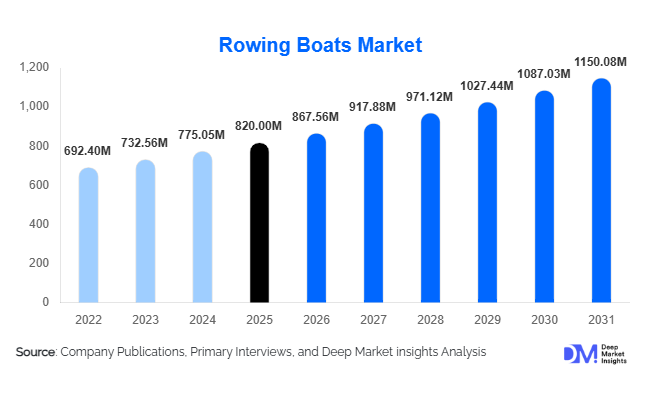
According to Deep Market Insights, the global rowing boats market size was valued at USD 820 million in 2025 and is projected to grow from USD 867.56 million in 2026 to reach USD 1,150.08 million by 2031, expanding at a CAGR of 5.8% during the forecast period (2026–2031). The market growth is primarily driven by increasing participation in water-based recreational activities, rising investments in competitive rowing infrastructure, and the growing demand for eco-friendly, non-motorized watercraft. The shift toward sustainable tourism and fitness-oriented outdoor activities is further supporting market expansion globally.
Key Market Insights
- Recreational rowing boats dominate the market, driven by rising tourism and leisure boating activities worldwide.
- Fiberglass materials lead production, offering durability, cost efficiency, and low maintenance compared to traditional wood.
- Europe holds the largest market share, supported by a strong rowing culture and established sports infrastructure.
- Asia-Pacific is the fastest-growing region, driven by increasing investments in sports and marine tourism.
- Technological advancements in composite materials are improving boat performance and attracting professional users.
- Eco-friendly boating trends are boosting demand for non-motorized watercraft across tourism hubs.
What are the latest trends in the rowing boats market?
Shift Toward Eco-Friendly and Sustainable Boating
The rowing boats market is increasingly aligned with global sustainability goals. As governments and tourism operators emphasize low-carbon recreational activities, rowing boats are gaining popularity due to their zero-emission nature. Eco-tourism destinations are incorporating rowing experiences into their offerings, particularly in coastal and inland water regions. Manufacturers are also adopting sustainable materials and eco-friendly production techniques, further strengthening the environmental positioning of rowing boats. This trend is particularly prominent in Europe and the Asia-Pacific region, where regulatory support for sustainable tourism is strong.
Adoption of Advanced Materials and Performance Enhancements
Technological innovation is transforming rowing boat design and manufacturing. The adoption of lightweight materials such as carbon fiber and advanced composites is enhancing speed, durability, and maneuverability. Professional rowing teams and sports institutions are increasingly investing in high-performance boats equipped with ergonomic designs and improved hydrodynamics. Additionally, integration of digital tools such as performance tracking systems and GPS-enabled navigation is emerging, especially in competitive rowing. These advancements are creating premium product segments and driving higher margins for manufacturers.
What are the key drivers in the rowing boats market?
Growth in Recreational and Fitness Activities
The increasing popularity of outdoor fitness and water-based recreation is a major driver of the rowing boats market. Rowing is widely recognized as a full-body workout, leading to higher adoption among health-conscious consumers. Fitness clubs, resorts, and waterfront developments are incorporating rowing activities, boosting demand for recreational boats. The growing trend of active lifestyles is expected to sustain long-term market growth.
Expansion of Marine and Inland Tourism
The rapid expansion of tourism in coastal and inland water destinations is significantly contributing to market growth. Tourism operators are investing in rowing boat fleets to offer unique and immersive experiences to travelers. This trend is particularly strong in Southeast Asia, Southern Europe, and parts of North America, where water tourism is a key economic driver. The increasing preference for experiential travel is further accelerating demand.
Technological Advancements in Boat Manufacturing
Innovations in materials and design are improving the performance and affordability of rowing boats. Fiberglass and composite materials have reduced maintenance costs while enhancing durability, making rowing boats more accessible to a wider audience. These advancements are encouraging adoption across both recreational and professional segments.
What are the restraints for the global market?
High Cost of Advanced Rowing Boats
High-performance rowing boats made from carbon fiber and advanced composites are expensive, limiting adoption among individual consumers and smaller institutions. This cost barrier is particularly significant in emerging markets, where price sensitivity is higher.
Limited Infrastructure and Accessibility
The availability of suitable water bodies and supporting infrastructure, such as docking, storage, and maintenance facilities, remains limited in many regions. This restricts the widespread adoption of rowing boats, especially in developing economies where investment in water sports infrastructure is still evolving.
What are the key opportunities in the rowing boats industry?
Expansion of Eco-Tourism and Waterfront Development
The growing emphasis on eco-tourism presents significant opportunities for rowing boat manufacturers. Governments and private developers are investing in waterfront projects that integrate recreational activities, including rowing. These developments are creating new demand for rental fleets and leisure boats, particularly in urban and resort destinations.
Integration of Smart Technologies
The incorporation of IoT-enabled systems, performance analytics, and GPS navigation into rowing boats is opening new premium market segments. Professional athletes and training institutions are increasingly adopting these technologies to enhance performance and safety, creating opportunities for innovation-driven growth.
Government and Institutional Sports Investments
Increased funding for sports infrastructure and Olympic training programs is driving demand for competitive rowing boats. Emerging economies are investing in sports academies and rowing facilities, providing a stable demand base for manufacturers. These initiatives are expected to boost long-term market growth.
Report Scope
| Report Metric | Details |
|---|---|
| Market Size in 2025 | USD 820 Million |
| Market Size in 2026 | USD 867.56 Million |
| Market Size in 2031 | USD 1150.08 Million |
| CAGR | 5.8% (2026-2031) |
| Base Year for Estimation | 2025 |
| Historical Data | 2022-2024 |
| Forecast Period | 2026-2031 |
| Report Coverage | Revenue Forecast, Competitive Landscape, Supply Chain Disruption, Growth Factors, Environment & Regulatory Landscape and Trends |
| Geographies Covered | North America, Europe, APAC, Middle East and Africa, LATAM |
| Countries Covered | U.S., Canada, U.K., Germany, France, Spain, Italy, Russia, Nordic, Benelux, Rest of Europe, China, Korea, Japan, India, Australia, Singapore, Taiwan, South East Asia, Rest of Asia-Pacific, UAE, Turky, Saudi Arabia, South Africa, Egypt, Nigeria, Rest of MEA, Brazil, Mexico, Argentina, Chile, Colombia, Rest of LATAM |
Explore more data points, trends and opportunities Download Free Sample Report
Product Type Insights
Recreational rowing boats dominate the global market, accounting for approximately 38% of the total market share in 2025. This leadership is primarily driven by the rapid expansion of leisure tourism, increasing participation in outdoor fitness activities, and the rising popularity of water-based recreational experiences in lakes, rivers, and coastal destinations. The affordability and ease of use of recreational rowing boats further enhance their adoption among individual consumers and tourism operators.
Competitive rowing boats represent a significant and strategically important segment, supported by continuous investments in professional sports infrastructure, Olympic training programs, and rowing federations across Europe, North America, and the Asia-Pacific. The growing emphasis on athlete performance optimization and international rowing events continues to strengthen demand in this category. Touring and utility rowing boats are emerging niche segments, gaining traction in coastal exploration, eco-tourism circuits, and small-scale fishing activities. Their growth is particularly driven by sustainable tourism initiatives and the shift toward low-impact marine mobility solutions in developing coastal economies.
Material Type Insights
Fiberglass remains the leading material segment, holding approximately 42% market share in 2025, primarily due to its optimal balance of durability, lightweight structure, and cost-effectiveness. Its low maintenance requirements and high resistance to water damage make it the preferred choice across both recreational and institutional users. Carbon fiber composites are witnessing rapid adoption in the premium and competitive segments, driven by demand for high-speed performance, reduced drag, and enhanced structural efficiency. This trend is particularly strong among professional rowing teams and elite sports institutions.
Traditional wooden rowing boats continue to maintain niche relevance, especially in heritage tourism, artisanal craftsmanship markets, and luxury custom-built boat segments where aesthetic value and tradition play a key role.
Capacity Insights
Two-person rowing boats account for the largest share of approximately 35% in 2025, driven by their versatility in both recreational and training applications. Their popularity stems from balanced usability, shared rowing experience, and suitability for beginner-to-intermediate users. Single-person rowing boats are widely adopted among competitive athletes and fitness enthusiasts, particularly in solo training environments where performance monitoring and technique refinement are essential. Larger capacity boats, including four- and eight-person variants, are primarily utilized in institutional training programs and professional rowing competitions.
Application Insights
Recreational and leisure applications dominate the rowing boats market with nearly 40% share in 2025, driven by rising participation in outdoor lifestyle activities, eco-tourism expansion, and increasing consumer preference for experiential travel. Sports and professional competitions remain a critical segment, supported by global rowing federations, Olympic-level training programs, and increasing investments in athletic infrastructure across developed and emerging economies.
Tourism and rental services represent the fastest-growing application area, fueled by the rapid expansion of eco-tourism, waterfront development projects, and the growing trend of experiential travel. Resorts, urban waterfronts, and adventure tourism operators are increasingly integrating rowing activities into their service offerings.
Distribution Channel Insights
Direct sales account for approximately 45% of the market, as rowing clubs, sports institutions, and government bodies prefer bulk procurement and customized specifications tailored to performance requirements. Specialty marine stores and online retail channels are expanding steadily, particularly for recreational users seeking accessible and affordable purchasing options. Meanwhile, rental and fleet operators are emerging as a high-growth channel, strongly supported by tourism-driven demand and shared-use recreational models.
End-User Insights
Rowing clubs and sports institutions dominate the market with approximately 37% share, driven by continuous demand for training equipment, professional-grade boats, and structured rowing programs. Individual consumers represent a growing segment, supported by increasing interest in fitness-oriented outdoor activities and recreational boating. Tourism operators are the fastest-growing end-user category, leveraging rowing boats for rental services, guided experiences, and eco-tourism packages across waterfront destinations.
Explore more data points, trends and opportunities Download Free Sample Report
Rowing Boats Market Segmentations
By Product Type
- Recreational Rowing Boats
- Competitive Rowing Boats
- Touring Rowing Boats
- Utility Rowing Boats
By Material Type
- Wood
- Aluminum
- Fiberglass (FRP)
- Carbon Fiber Composites
- Polyethylene / Plastic
By Application
- Sports & Professional Competitions
- Recreational & Leisure Activities
- Tourism & Rental Services
- Fishing & Small-scale Commercial Use
- Rescue & Government Services
By Distribution Channel
- Direct Sales
- Specialty Marine Stores
- Online Retail
- Rental & Fleet Operators
By End-User
- Individual Consumers
- Rowing Clubs & Sports Institutions
- Tourism Operators
- Government & Defense Agencies
Regional Insights
Europe
Europe leads the global rowing boats market with approximately 34% share in 2025, supported by a deeply rooted rowing culture and extensive sports infrastructure across countries such as the UK, Germany, Italy, and the Netherlands. Strong collegiate and club-level rowing systems, high participation in competitive rowing events, government-backed sports funding, and well-established waterway infrastructure. The UK alone contributes nearly 10% of global demand, driven by a dense network of rowing clubs and international competitions.
North America
North America accounts for around 28% of the global market share, led by the United States and Canada. Expanding collegiate sports programs, strong recreational boating culture, increasing investments in waterfront redevelopment projects, and rising consumer interest in fitness-based water sports. The U.S. remains the dominant contributor, supported by organized rowing associations and high participation in university-level competitions.
Asia-Pacific
Asia-Pacific is the fastest-growing region, registering a CAGR exceeding 7%, with China, Japan, India, and Australia emerging as key markets. Rising disposable income, rapid expansion of marine and eco-tourism, government investments in sports infrastructure, and increasing participation in international rowing events. Coastal tourism development and urban waterfront projects in China and India are significantly accelerating demand.
Latin America
Latin America holds approximately 6% of the global market, with Brazil, Argentina, and Chile leading regional demand. Expanding adventure tourism sector, gradual development of water sports infrastructure, and rising interest in recreational boating activities among urban populations. Government-led tourism initiatives along coastal and riverfront regions are further supporting growth.
Middle East & Africa
The Middle East & Africa region accounts for nearly 4% market share, with growth concentrated in the UAE, Saudi Arabia, South Africa, and Egypt. Rapid development of luxury waterfront tourism projects, increasing investments in sports and recreational infrastructure, and growing popularity of coastal leisure activities. The UAE, in particular, is emerging as a regional hub for premium marine recreation, supported by strong tourism diversification strategies.
Key Players in the Rowing Boats Market
- Concept2 Inc.
- Filippi Lido Srl
- Empacher GmbH
- Hudson Boat Works
- WinTech Racing
- Resolute Racing Shells
- Swift Racing
- Kanghua Boats
- Janousek & Stampfli Racing Boats
- BBG Bootsmanufaktur
- Salani Boats
- Vega Rowing
- Leo Coastal Rowing
- Baumgarten Bootsbau
- Liteboat