Roller Sports Product Market Size
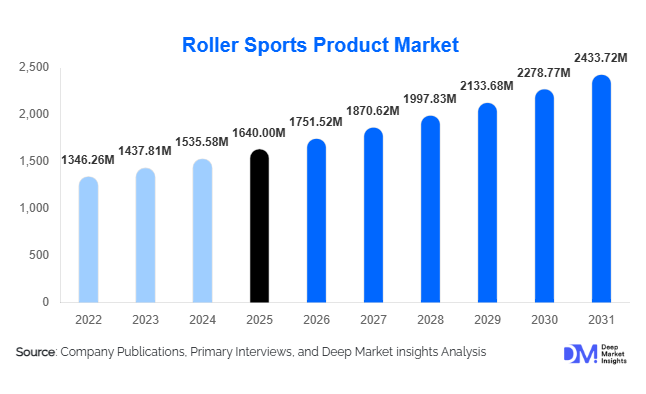
According to Deep Market Insights, the global roller sports product market size was valued at USD 1,640 million in 2025 and is projected to grow from USD 1,751.52 million in 2026 to reach USD 2,433.72 million by 2031, expanding at a CAGR of 6.8% during the forecast period (2026–2031). The roller sports product market growth is primarily driven by increasing participation in recreational skating, the rising popularity of outdoor fitness activities, and expanding youth engagement in urban sports culture. Roller sports equipment, such as roller skates, inline skates, skateboards, and protective gear are increasingly being adopted for both leisure and competitive sports applications.
Growing interest in fitness-oriented recreational activities and the expansion of urban skating infrastructure are accelerating product demand worldwide. Skate parks, roller rinks, and community sports facilities are being developed across major cities to encourage youth participation in physical activities. Additionally, social media and digital communities have played a significant role in reviving roller skating and skateboarding culture among younger demographics.
Technological innovation in product design is also supporting market growth. Manufacturers are introducing lightweight carbon-fiber frames, shock-absorbing wheels, and ergonomic protective gear to enhance safety and performance. Online retail platforms and direct-to-consumer sales channels are further expanding the global reach of roller sports equipment brands, allowing consumers to easily compare products and customize equipment configurations.
Key Market Insights
- Roller skates and inline skates dominate the product landscape, accounting for nearly 45% of total market demand due to their popularity in both recreational and competitive skating.
- Recreational skating is the largest application segment, contributing approximately 60% of overall demand as consumers increasingly adopt skating as a fun fitness activity.
- North America leads the global market, supported by established skating culture, large youth participation, and extensive skate park infrastructure.
- Asia-Pacific is the fastest-growing region, driven by rising youth population, expanding sports infrastructure, and growing middle-class disposable income.
- Online retail channels are rapidly expanding, representing nearly 35% of total sales as consumers increasingly purchase sports equipment through digital platforms.
- Product innovation and customization, including LED-equipped skates, smart performance tracking, and modular skate designs, are reshaping consumer preferences.
What are the latest trends in the roller sports product market?
Revival of Roller Skating Culture and Social Media Influence
Roller skating and skateboarding have experienced a resurgence in popularity due to social media platforms such as Instagram, TikTok, and YouTube. Influencers and skating communities actively share tutorials, trick demonstrations, and lifestyle content that inspire younger audiences to participate in roller sports. Viral skating videos and online challenges have significantly increased product visibility, encouraging first-time buyers to invest in roller skates and protective gear. This cultural revival is particularly strong among Gen-Z and millennials, who view skating as both a fitness activity and a lifestyle expression.
Product Customization and Smart Equipment
Manufacturers are increasingly offering customizable roller sports products that allow users to personalize colors, wheels, frames, and accessories. Modular skate systems enable consumers to replace components easily, extending product life cycles and creating recurring revenue streams for manufacturers. In addition, technological advancements are leading to the development of smart skating equipment featuring LED lighting systems, Bluetooth connectivity, and performance-tracking sensors. These innovations appeal to tech-savvy users seeking interactive experiences and performance analytics while skating.
What are the key drivers in the roller sports product market?
Rising Demand for Outdoor Fitness Activities
Growing health consciousness and the popularity of outdoor recreational activities are major factors driving demand for roller sports equipment. Inline skating and roller skating provide effective cardiovascular workouts that improve endurance, balance, and muscle strength. As consumers look for engaging alternatives to traditional gym workouts, roller sports are gaining popularity as enjoyable and accessible fitness activities. Urban parks, waterfront promenades, and cycling tracks are increasingly being used for skating activities, further encouraging equipment adoption.
Expansion of Organized Roller Sports Competitions
The increasing number of organized competitions and skating leagues is another important driver of market growth. Roller hockey, speed skating, and artistic skating competitions are expanding globally, supported by sports federations and youth training academies. Professional athletes require high-performance equipment such as precision bearings, lightweight frames, and specialized wheels, which contributes to increased demand for premium roller sports products.
What are the restraints for the global market?
Safety Concerns and Injury Risks
One of the primary restraints affecting the roller sports product market is the risk of injuries associated with skating activities. Beginners and children are particularly vulnerable to falls and fractures, which can discourage participation among new users. Although protective gear such as helmets, knee pads, and wrist guards can significantly reduce injury risks, safety concerns remain a barrier for some consumers, particularly parents purchasing equipment for young children.
Seasonal Demand and Weather Dependency
Roller sports activities are largely dependent on favorable weather conditions, particularly in regions with cold winters or heavy rainfall. Outdoor skating participation tends to decline during unfavorable seasons, leading to fluctuations in equipment demand. While indoor skating rinks can mitigate this challenge, the infrastructure required to maintain such facilities is costly, limiting their widespread availability in many regions.
What are the key opportunities in the roller sports industry?
Expansion of Urban Sports Infrastructure
Governments and municipalities across major cities are investing in public skate parks, roller rinks, and recreational sports complexes to encourage physical activity among youth populations. These infrastructure developments create long-term opportunities for roller sports equipment manufacturers by increasing participation in skating activities. Public-private partnerships with sports federations and community organizations can further strengthen brand visibility and product adoption.
E-Commerce and Direct-to-Consumer Distribution
The rapid growth of e-commerce platforms presents a significant opportunity for roller sports product manufacturers to expand their global customer base. Online retail allows brands to reach consumers in regions where specialty sports stores are limited. Direct-to-consumer sales channels also enable manufacturers to provide customized equipment options, strengthen brand engagement, and improve profit margins by eliminating intermediary distribution costs.
Report Scope
| Report Metric | Details |
|---|---|
| Market Size in 2025 | USD 1640 Million |
| Market Size in 2026 | USD 1751.52 Million |
| Market Size in 2031 | USD 2433.72 Million |
| CAGR | 6.8% (2026-2031) |
| Base Year for Estimation | 2025 |
| Historical Data | 2022-2024 |
| Forecast Period | 2026-2031 |
| Report Coverage | Revenue Forecast, Competitive Landscape, Supply Chain Disruption, Growth Factors, Environment & Regulatory Landscape and Trends |
| Geographies Covered | North America, Europe, APAC, Middle East and Africa, LATAM |
| Countries Covered | U.S., Canada, U.K., Germany, France, Spain, Italy, Russia, Nordic, Benelux, Rest of Europe, China, Korea, Japan, India, Australia, Singapore, Taiwan, South East Asia, Rest of Asia-Pacific, UAE, Turky, Saudi Arabia, South Africa, Egypt, Nigeria, Rest of MEA, Brazil, Mexico, Argentina, Chile, Colombia, Rest of LATAM |
Explore more data points, trends and opportunities Download Free Sample Report
Product Type Insights
Roller skates and inline skates represent the largest product category in the roller sports product market, accounting for approximately 45% of global revenue in 2025. The dominance of this segment is primarily driven by the widespread adoption of skating as both a recreational activity and a competitive sport. Inline skating, in particular, has gained popularity as a fitness activity due to its cardiovascular benefits and accessibility in urban environments such as parks, promenades, and dedicated skating tracks. Quad roller skates continue to maintain strong demand among beginners and recreational users due to their stability, balance, and ease of learning. These skates are widely used in roller rinks, entertainment venues, and beginner training programs. Meanwhile, inline skates are favored by fitness enthusiasts and professional athletes due to their speed, maneuverability, and performance advantages in competitive skating disciplines such as speed skating and roller hockey.
Skateboards and longboards represent another important product segment, particularly among younger consumers who view skateboarding not only as a sport but also as part of youth culture and urban lifestyle trends. Demand for longboards is increasing in urban commuting applications due to their smooth riding capabilities and ease of use for short-distance travel. Protective gear such as helmets, knee pads, elbow pads, and wrist guards is also gaining traction within the roller sports product market. Growing safety awareness, particularly among parents purchasing equipment for children, is driving demand for protective accessories. In addition, stricter safety standards in organized sports leagues and recreational facilities are encouraging the use of certified protective gear, further supporting growth in this product category.
Application Insights
Recreational and fitness skating represents the largest application segment in the roller sports product market, contributing nearly 60% of total global demand. The growth of this segment is largely driven by increasing consumer interest in outdoor fitness activities that provide both health benefits and entertainment value. Skating offers a low-impact cardiovascular workout that improves endurance, balance, and coordination, making it an attractive alternative to traditional gym-based exercise routines. Urban parks, waterfront promenades, and dedicated skating tracks are increasingly being used for recreational skating activities, particularly in developed regions such as North America and Europe. Social media trends have also contributed to the popularity of recreational skating by encouraging communities to organize group skating events and lifestyle-focused skating activities.
Professional sports applications represent approximately 25% of the roller sports equipment market. Competitive disciplines such as roller hockey, speed skating, artistic skating, and roller derby require specialized equipment designed for performance, durability, and safety. Increasing investments in youth training academies, sports federations, and international competitions are further driving demand for high-performance roller sports products. Entertainment venues such as roller skating rinks, amusement parks, and family entertainment centers represent a rapidly emerging application segment. These facilities typically purchase roller sports equipment in bulk for rental services, creating consistent demand for durable skates and protective gear. The resurgence of retro-themed roller rinks and entertainment venues in urban areas is expected to further strengthen demand in this segment.
Distribution Channel Insights
Online retail platforms have emerged as one of the most influential distribution channels for roller sports equipment, accounting for approximately 35% of global sales. The rapid growth of e-commerce has enabled consumers to access a wider range of international brands, compare product specifications, and read user reviews before making purchasing decisions. This convenience, combined with competitive pricing and home delivery services, has accelerated online sales of roller sports equipment. Digital marketplaces and brand-owned e-commerce platforms also allow manufacturers to offer customized products and exclusive product launches, which enhances consumer engagement and brand loyalty. Many companies are increasingly adopting direct-to-consumer (DTC) strategies to reduce reliance on intermediaries and improve profit margins.
Specialty sporting goods stores continue to play a crucial role in the roller sports product market by providing expert product guidance, fitting services, and demonstrations. These stores are particularly important for professional athletes and enthusiasts who require high-performance equipment tailored to their specific needs. To maximize market reach, many companies are adopting omnichannel retail strategies that combine online sales platforms with physical retail experiences. This integrated approach allows consumers to research products online while benefiting from in-store support and product trials before finalizing purchases.
User Type Insights
Recreational users represent the largest consumer segment in the roller sports product market, accounting for approximately 55% of total global demand. The dominance of this segment is largely driven by the growing popularity of skating as a leisure and fitness activity among urban populations. Casual skaters typically purchase entry-level or mid-range equipment designed for comfort, safety, and durability.
Enthusiast and amateur riders represent another significant segment within the market. These users actively participate in skating communities, recreational competitions, and advanced training programs. Enthusiasts often upgrade their equipment more frequently, investing in higher-quality wheels, bearings, and performance-oriented skate designs. This segment contributes significantly to aftermarket sales of components and accessories. Professional athletes represent a smaller but highly valuable consumer segment. Competitive skaters require specialized equipment engineered for speed, durability, and precision. Professional-grade roller sports equipment often incorporates advanced materials such as carbon fiber frames and high-performance bearings to enhance skating performance during competitions.
Age Group Insights
Adults aged 19–40 years account for nearly 48% of total demand in the roller sports product market, making them the largest consumer demographic. This segment benefits from relatively high disposable income and a strong interest in fitness-oriented recreational activities. Many adults are rediscovering skating as a nostalgic leisure activity while also adopting it as a convenient form of exercise. Teenagers represent another important demographic group, particularly for skateboarding and freestyle skating disciplines. Youth culture, social media influence, and participation in skateboarding competitions are driving demand for performance-oriented skateboards and inline skates within this segment. The children’s segment continues to generate consistent demand for beginner roller skates and protective gear. Parents increasingly encourage outdoor physical activities for children as a way to promote healthy lifestyles and reduce screen time. As a result, entry-level roller sports products designed specifically for young learners are witnessing steady market growth.
Explore more data points, trends and opportunities Download Free Sample Report
Roller Sports Product Market Segmentations
By Product Type
- Roller Skates
- Inline Skates
- Skateboards & Longboards
- Protective Gear
- Components & Accessories
By Application
- Recreational & Fitness Skating
- Professional Sports Competitions
- Entertainment & Leisure Venues
- Urban Mobility & Commuting
By Distribution Channel
- Online Retail
- Specialty Sporting Goods Stores
- Sporting Goods Chains
- Department Stores & Hypermarkets
- Direct-to-Consumer (Brand Websites)
By User Type
- Recreational Users
- Enthusiast & Amateur Riders
- Professional Athletes
- Kids / Beginner Segment
By Age Group
- Children (Below 12 Years)
- Teenagers (12–18 Years)
- Adults (19–40 Years)
- Senior / Recreational Fitness Users
Regional Insights
North America
North America represents the largest regional market, accounting for approximately 36% of global revenue in 2025. The United States dominates regional demand due to its strong skating culture, widespread skate park infrastructure, and high participation rates in sports such as roller hockey and skateboarding. The presence of established sporting goods brands and strong retail networks further supports market growth. Canada also contributes significantly to regional demand, particularly in recreational skating and youth sports programs. Government initiatives promoting physical activity and community recreation programs are supporting participation in skating activities across both countries. In addition, the rapid adoption of e-commerce platforms and direct-to-consumer brand strategies is further strengthening market expansion across North America.
Europe
Europe accounts for approximately 28% of the global roller sports product market. Countries such as Germany, France, Italy, Spain, and the Netherlands have well-established skating communities supported by organized competitions and strong youth sports programs. Roller derby, artistic skating, and speed skating are particularly popular across Western Europe, contributing to steady demand for specialized equipment. Government investments in urban recreational infrastructure and sustainable mobility initiatives are also encouraging the adoption of inline skating as a short-distance transportation option in several European cities. Additionally, European consumers demonstrate strong interest in eco-friendly and high-quality sporting goods, driving demand for premium roller sports equipment manufactured with advanced materials.
Asia-Pacific
Asia-Pacific represents nearly 25% of the global market and is the fastest-growing regional market for roller sports products. Rapid urbanization, increasing disposable income, and growing interest in sports and recreational activities among younger populations are key drivers of regional growth. China leads regional demand due to significant investments in sports infrastructure and government initiatives promoting youth participation in athletic activities. India is emerging as a promising market due to its large youth population and expanding sports academies. Meanwhile, Japan and South Korea exhibit strong demand for high-performance skating equipment driven by organized competitions and technologically advanced sporting goods markets.
Latin America
Latin America accounts for approximately 7% of global demand, with Brazil and Mexico representing the largest markets in the region. Rapid urbanization, expanding youth populations, and growing interest in action sports are encouraging participation in roller skating and skateboarding activities. Local governments and community organizations are increasingly supporting sports development initiatives aimed at promoting physical activity among young people. The growing popularity of skateboarding competitions and the expansion of skate parks across major cities are expected to further boost demand for roller sports equipment in the region.
Middle East & Africa
The Middle East and Africa represent approximately 4% of global market demand. Countries such as the United Arab Emirates, Saudi Arabia, and South Africa are investing heavily in recreational infrastructure, including sports complexes, entertainment venues, and indoor skating arenas. In the Middle East, government initiatives aimed at promoting active lifestyles and diversifying entertainment sectors are encouraging participation in roller sports. The construction of modern entertainment centers and indoor sports facilities is expected to increase consumer exposure to skating activities. In Africa, rising youth populations and growing interest in urban sports are gradually supporting market expansion, particularly in countries such as South Africa and Kenya.
Key Players in the Roller Sports Product Market
- Decathlon
- Rollerblade
- K2 Sports
- Powerslide
- Roces
- Bauer Hockey
- CCM Hockey
- Riedell Shoes
- Micro-Skate
- Roller Derby Skate Corp
- VNLA
- Sure-Grip International
- Atom Skates
- Chaya Skates
- Seba Skates