Robotic Air Purifier Market Size
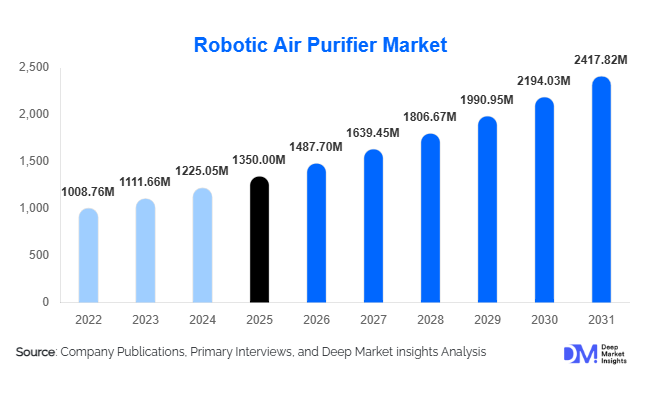
According to Deep Market Insights, the global robotic air purifier market size was valued at USD 1,350 million in 2025 and is projected to grow from USD 1,487.70 million in 2026 to reach USD 2,417.82 million by 2031, expanding at a CAGR of 10.2% during the forecast period (2026–2031). The robotic air purifier market growth is primarily driven by rising concerns about indoor air pollution, increasing adoption of smart home appliances, and advancements in robotics and AI-enabled environmental monitoring technologies.
Robotic air purifiers combine autonomous navigation systems with advanced filtration technologies such as HEPA filters, activated carbon, and UV-C sterilization to deliver continuous indoor air purification across multiple rooms and large commercial spaces. Unlike traditional stationary air purifiers, robotic air purifiers can move dynamically within indoor environments to target pollution hotspots, thereby improving purification efficiency.
Growing urbanization and worsening air quality levels in major cities across Asia-Pacific, North America, and Europe are encouraging consumers and businesses to invest in advanced air purification technologies. Additionally, integration with IoT ecosystems, smartphone applications, and smart building management systems is transforming robotic air purifiers into intelligent indoor environmental management solutions. The increasing deployment of these devices across residential homes, corporate offices, healthcare facilities, and hospitality environments is expected to significantly expand the global robotic air purifier market over the next decade.
Key Market Insights
- Indoor air quality concerns are accelerating demand, particularly in densely populated urban regions experiencing severe pollution levels.
- Smart home integration is transforming robotic air purifiers into connected appliances, enabling remote monitoring, voice assistant control, and AI-driven air quality optimization.
- Asia-Pacific dominates the global market, supported by strong manufacturing ecosystems and high consumer adoption of smart appliances.
- Commercial buildings and healthcare facilities are emerging as key growth sectors, driven by the need for advanced airborne contamination control systems.
- Technological innovations such as LiDAR navigation, SLAM mapping, and AI analytics are improving mobility, coverage, and purification efficiency.
- Online retail platforms are becoming the dominant distribution channel, allowing consumers to compare specifications, reviews, and prices before purchasing robotic air purification devices.
What are the latest trends in the robotic air purifier market?
Integration with Smart Home Ecosystems
One of the most prominent trends in the robotic air purifier market is the integration of these devices into broader smart home ecosystems. Consumers increasingly prefer connected appliances that can communicate with other home automation systems such as thermostats, HVAC units, and environmental sensors. Robotic air purifiers are now being equipped with Wi-Fi connectivity, mobile applications, and voice assistant compatibility to enable real-time monitoring of air quality levels.
This integration allows homeowners to automate purification cycles based on environmental conditions and occupancy levels. For instance, robotic air purifiers can automatically increase purification activity when indoor pollution levels rise or when sensors detect higher concentrations of particulate matter. As smart homes become more prevalent globally, robotic air purifiers are expected to play a central role in automated indoor environmental management.
AI-Driven Air Quality Monitoring and Navigation
Advancements in artificial intelligence and robotics are enabling robotic air purifiers to perform complex environmental analysis and adaptive navigation. Modern devices are equipped with LiDAR sensors, machine learning algorithms, and real-time air quality monitoring systems that allow them to detect pollution hotspots and navigate efficiently within indoor environments.
These AI-driven robots can map indoor spaces, track air quality trends, and optimize purification routes to maximize coverage. In commercial environments such as offices and hospitals, these systems can collect and analyze air quality data over time, helping facility managers improve indoor environmental conditions and energy efficiency.
What are the key drivers in the robotic air purifier market?
Rising Urban Pollution Levels
Air pollution remains a major environmental and health challenge across many urban regions worldwide. High concentrations of particulate matter, industrial emissions, and vehicular pollution significantly impact indoor air quality, even within residential and commercial buildings. As awareness of pollution-related health risks increases, consumers and businesses are investing in advanced air purification systems.
Robotic air purifiers offer a unique advantage compared to traditional stationary purifiers because they can move across rooms and actively target pollution hotspots. This mobility significantly improves purification efficiency, particularly in large indoor spaces where stationary devices may struggle to provide uniform air filtration.
Growth of Smart Appliances and Home Automation
The rapid expansion of the smart home appliance market is another key driver of robotic air purifier adoption. Consumers increasingly seek appliances that offer automation, remote control, and integration with digital ecosystems. Robotic air purifiers meet these requirements by combining robotics technology with intelligent environmental monitoring capabilities.
Manufacturers are also integrating features such as smartphone apps, voice assistant compatibility, predictive maintenance alerts, and real-time air quality dashboards. These capabilities enhance user convenience while improving overall device efficiency.
What are the restraints for the global market?
High Product Cost
Robotic air purifiers are significantly more expensive than conventional air purifiers due to the inclusion of robotic navigation systems, sensors, and artificial intelligence software. The high cost of these devices limits their adoption in price-sensitive markets, particularly in developing countries.
Although technological advancements and economies of scale are gradually reducing manufacturing costs, affordability remains a major challenge for mass adoption.
Battery Life and Maintenance Limitations
Another important restraint is the limited battery life of robotic air purification systems. These devices rely on rechargeable batteries to power both mobility and air filtration operations. In large commercial environments, frequent charging cycles may reduce operational efficiency.
In addition, robotic air purifiers require regular maintenance, including filter replacements, sensor calibration, and software updates. These requirements can increase operational costs and discourage adoption among certain consumer segments.
What are the key opportunities in the robotic air purifier industry?
Healthcare and Infection Control Applications
Healthcare facilities represent a major growth opportunity for robotic air purifier manufacturers. Hospitals and clinics require strict indoor air quality management to reduce airborne pathogens and improve infection control. Robotic air purifiers equipped with HEPA filters and UV-C sterilization systems can move across hospital wards, patient rooms, and corridors to continuously purify indoor air.
The COVID-19 pandemic significantly increased awareness regarding airborne transmission of diseases, prompting healthcare providers to invest in advanced air purification technologies. As a result, robotic air purifiers are increasingly being deployed in hospitals, laboratories, and pharmaceutical manufacturing facilities.
Commercial Building Air Quality Management
Another important opportunity lies in commercial buildings such as offices, shopping malls, airports, and hotels. Corporate organizations are placing greater emphasis on workplace health and productivity, leading to increased investments in indoor environmental management systems.
Robotic air purifiers can patrol large indoor spaces while continuously monitoring air quality indicators such as particulate matter, volatile organic compounds, and humidity levels. This capability makes them particularly valuable for large commercial facilities where maintaining consistent indoor air quality is critical.
Report Scope
| Report Metric | Details |
|---|---|
| Market Size in 2025 | USD 1350 Million |
| Market Size in 2026 | USD 1487.70 Million |
| Market Size in 2031 | USD 2417.82 Million |
| CAGR | 10.2% (2026-2031) |
| Base Year for Estimation | 2025 |
| Historical Data | 2022-2024 |
| Forecast Period | 2026-2031 |
| Report Coverage | Revenue Forecast, Competitive Landscape, Supply Chain Disruption, Growth Factors, Environment & Regulatory Landscape and Trends |
| Geographies Covered | North America, Europe, APAC, Middle East and Africa, LATAM |
| Countries Covered | U.S., Canada, U.K., Germany, France, Spain, Italy, Russia, Nordic, Benelux, Rest of Europe, China, Korea, Japan, India, Australia, Singapore, Taiwan, South East Asia, Rest of Asia-Pacific, UAE, Turky, Saudi Arabia, South Africa, Egypt, Nigeria, Rest of MEA, Brazil, Mexico, Argentina, Chile, Colombia, Rest of LATAM |
Explore more data points, trends and opportunities Download Free Sample Report
Product Type Insights
Autonomous mobile robotic air purifiers dominate the global market, accounting for the largest share due to their ability to move dynamically across indoor environments and target polluted areas more effectively than stationary devices. These systems typically incorporate advanced navigation technologies such as LiDAR sensors and SLAM mapping, allowing them to create digital maps of indoor spaces and optimize purification routes. Hybrid robotic devices that combine floor-cleaning capabilities with air purification functions are also gaining traction among consumers seeking multifunctional smart home appliances. Dock-based robotic air purifiers represent another growing category, designed for continuous purification cycles with automated charging stations.
Application Insights
Residential applications account for the largest share of the robotic air purifier market as households increasingly prioritize indoor air quality and smart home automation. Consumers in highly polluted urban environments are particularly inclined to adopt robotic air purifiers as part of their home health management strategies. Commercial buildings represent the fastest-growing application segment. Offices, co-working spaces, retail stores, and hospitality venues are deploying robotic air purifiers to improve air quality and enhance customer and employee comfort. Healthcare applications are also expanding rapidly as hospitals seek advanced solutions to reduce airborne contamination and improve patient safety.
Distribution Channel Insights
Online retail channels dominate the global robotic air purifier market, accounting for the largest share of pr,oduct sales. E-commerce platforms allow consumers to compare product specifications, read reviews, and access competitive pricing before purchasing robotic air purification devices. Consumer electronics retail chains remain an important distribution channel, particularly for premium products where in-store demonstrations can influence purchasing decisions. Direct-to-consumer sales models are also gaining traction as manufacturers strengthen their digital presence and build brand awareness through online marketing campaigns.
End-Use Industry Insights
The residential sector remains the primary end-use industry for robotic air purifiers, driven by rising pollution concerns and growing adoption of smart home appliances. Urban households are increasingly investing in automated air purification systems to maintain healthier indoor environments. The commercial sector, including offices, retail centers, and hospitality venues, is experiencing the fastest growth as organizations invest in workplace wellness initiatives. Healthcare facilities also represent a key end-use segment due to the need for advanced infection control and airborne contamination reduction systems.
Explore more data points, trends and opportunities Download Free Sample Report
Robotic Air Purifier Market Segmentations
By Product Configuration
- Autonomous Mobile Robotic Air Purifiers
- Dock-Based Robotic Air Purifiers
- Hybrid Cleaning & Air Purification Robots
- Industrial Mobile Air Purification Robots
By Filtration Technology
- HEPA Filtration Systems
- Activated Carbon Filtration Systems
- Electrostatic Precipitator Systems
- UV-C & Photocatalytic Oxidation Systems
- Ionization & Plasma Air Purification Systems
- Multi-Stage Hybrid Filtration Systems
By Navigation Technology
- LiDAR-Based Navigation Robots
- Vision-Based Navigation Robots
- Infrared Sensor Navigation Robots
- SLAM (Simultaneous Localization and Mapping) Robots
- AI-Enabled Adaptive Navigation Robots
By Distribution Channel
- Online Retail / E-commerce Platforms
- Consumer Electronics Retail Chains
- Direct-to-Consumer (D2C) Sales
- Commercial Equipment Distributors
- Institutional Procurement Channels
By End-Use Industry
- Residential Households
- Corporate Offices & Commercial Buildings
- Healthcare Facilities & Hospitals
- Hospitality & Retail Spaces
- Educational Institutions
- Manufacturing & Industrial Facilities
- Cleanrooms & Laboratories
Regional Insights
Asia-Pacific
Asia-Pacific dominates the robotic air purifier market, accounting for approximately 38% of global demand. Countries such as China, Japan, South Korea, and India are major contributors to regional market growth. China represents the largest market due to severe urban air pollution and strong manufacturing capabilities in consumer electronics and robotics. Japan and South Korea also demonstrate high adoption rates due to advanced technology infrastructure and strong consumer demand for smart appliances. In India, rising pollution levels in major metropolitan areas are driving increasing demand for air purification technologies.
North America
North America represents the second-largest regional market, accounting for roughly 27% of global demand. The United States dominates the regional market due to high consumer spending on smart home technologies and increasing awareness about indoor air quality. Corporate offices, healthcare institutions, and smart residential developments are major demand drivers within the region. Regulatory initiatives promoting indoor environmental health are also supporting market expansion.
Europe
Europe holds approximately 21% of the global robotic air purifier market. Germany, the United Kingdom, France, and Italy are the largest markets in the region. Demand is driven by strict environmental regulations, growing adoption of smart home devices, and increased focus on indoor environmental quality.
Latin America
Latin America represents a smaller but steadily growing market for robotic air purifiers. Brazil and Mexico are the largest markets in the region, driven by increasing urbanization and rising consumer awareness about indoor pollution.
Middle East & Africa
The Middle East and Africa region is witnessing increasing adoption of robotic air purification technologies in luxury residential developments, commercial buildings, and healthcare facilities. The United Arab Emirates and Saudi Arabia are key markets due to strong investment in smart infrastructure and advanced building technologies.
Key Players in the Robotic Air Purifier Market
- Dyson Ltd.
- Xiaomi Corporation
- Honeywell International Inc.
- Samsung Electronics Co. Ltd.
- LG Electronics Inc.
- Panasonic Corporation
- ECOVACS Robotics Co., Ltd.
- Sharp Corporation
- Philips N.V.
- Blueair AB
- Coway Co. Ltd.
- Winix Inc.
- Haier Smart Home Co., Ltd.
- Milagrow Business & Knowledge Solutions
- iRobot Corporation