Riding Gear Market Size
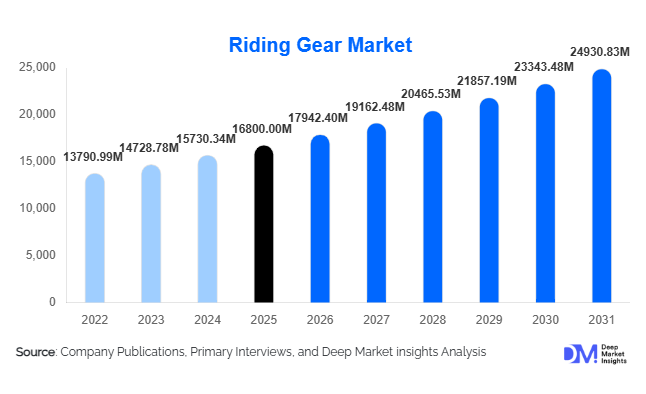
According to Deep Market Insights, the global riding gear market size was valued at USD 16,800 million in 2025 and is projected to grow from USD 17,942.40 million in 2026 to reach USD 24,930.83 million by 2031, expanding at a CAGR of 6.8% during the forecast period (2026–2031). The riding gear market growth is primarily driven by rising global two-wheeler ownership, increasing enforcement of road safety regulations, and growing consumer awareness regarding protective riding equipment. Additionally, the market is benefiting from the increasing popularity of adventure motorcycling and premium lifestyle riding, particularly in developed regions.
Key Market Insights
- Helmets dominate the market, accounting for over 40% share due to regulatory mandates across most countries.
- Asia-Pacific leads the global demand, driven by high motorcycle ownership in India, China, and Southeast Asia.
- Mid-range riding gear is the largest segment, balancing affordability with safety features for mass consumers.
- Online retail channels are rapidly expanding, supported by increasing e-commerce penetration and direct-to-consumer strategies.
- Technological innovation is accelerating, with smart helmets, advanced materials, and lightweight composites gaining traction.
- Adventure and touring riding segments are the fastest growing, fueling demand for premium protective gear globally.
What are the latest trends in the riding gear market?
Shift Toward Smart and Connected Riding Gear
The riding gear market is increasingly witnessing the integration of smart technologies into traditional safety equipment. Smart helmets equipped with Bluetooth connectivity, GPS navigation, heads-up displays (HUDs), and crash detection systems are gaining traction, particularly among premium consumers. These innovations enhance both safety and convenience, appealing to tech-savvy riders. Manufacturers are also exploring AI-powered communication systems and voice-controlled navigation, which allow riders to stay connected without compromising safety. This trend is expected to redefine product differentiation and create new revenue streams through value-added features.
Growing Demand for Multi-Functional and All-Weather Gear
Consumers are increasingly prioritizing versatility and comfort in riding gear, leading to the rise of multi-functional products. Jackets with removable liners, waterproof coatings, and ventilation systems are becoming standard offerings. Textile-based gear is gaining popularity due to its adaptability across different climates, especially in regions with extreme weather variations. Riders are also demanding gear that blends safety with style, pushing manufacturers to focus on ergonomic designs and fashionable aesthetics. This trend is particularly prominent among urban commuters and touring riders who require gear suitable for both daily use and long-distance travel.
What are the key drivers in the riding gear market?
Rising Global Two-Wheeler Ownership
The increasing adoption of motorcycles and scooters, particularly in emerging economies such as India, Indonesia, and Vietnam, is a major driver of the riding gear market. Two-wheelers serve as a primary mode of transportation in these regions, creating consistent demand for helmets and protective apparel. Urbanization, traffic congestion, and cost efficiency are further encouraging two-wheeler usage, thereby supporting long-term market growth.
Increasing Road Safety Awareness and Regulations
Governments and regulatory bodies across the world are enforcing stricter safety laws, including mandatory helmet usage and certification requirements. Public awareness campaigns and insurance incentives are also promoting the use of protective gear. This regulatory push is particularly impactful in emerging markets, where compliance rates are steadily improving, leading to increased adoption of certified riding gear products.
What are the restraints for the global market?
High Cost of Premium Riding Gear
Premium riding gear, including advanced helmets, armored jackets, and specialized boots, often comes at a high price point, limiting accessibility for price-sensitive consumers. This restricts penetration in developing markets where affordability remains a key purchasing factor. As a result, consumers often opt for basic or non-certified products, affecting overall market growth potential.
Proliferation of Counterfeit and Non-Certified Products
The widespread availability of low-cost counterfeit and non-certified riding gear poses a significant challenge to the market. These products undermine safety standards and erode brand trust. In regions with weak regulatory enforcement, such products dominate the market, creating unfair competition for established manufacturers and slowing down the adoption of high-quality gear.
What are the key opportunities in the riding gear industry?
Expansion in Emerging Markets Through Regulatory Enforcement
Emerging economies present substantial growth opportunities as governments strengthen road safety regulations and enforce helmet laws. Countries in the Asia-Pacific and Latin America are witnessing increased compliance, creating a structured demand for certified riding gear. Companies that align with local safety standards and offer affordable yet compliant products can capture significant market share in these regions.
Premiumization and Lifestyle-Oriented Riding Gear
The rising popularity of adventure biking, touring, and motorsports is driving demand for premium riding gear. Consumers are increasingly willing to invest in high-performance products that offer superior safety, comfort, and aesthetics. This trend is particularly strong in North America and Europe, where riding is often associated with lifestyle and recreation rather than just commuting. Premium brands can leverage this shift to enhance margins and expand their product portfolios.
Report Scope
| Report Metric | Details |
|---|---|
| Market Size in 2025 | USD 16800 Million |
| Market Size in 2026 | USD 17942.40 Million |
| Market Size in 2031 | USD 24930.83 Million |
| CAGR | 6.8% (2026-2031) |
| Base Year for Estimation | 2025 |
| Historical Data | 2022-2024 |
| Forecast Period | 2026-2031 |
| Report Coverage | Revenue Forecast, Competitive Landscape, Supply Chain Disruption, Growth Factors, Environment & Regulatory Landscape and Trends |
| Geographies Covered | North America, Europe, APAC, Middle East and Africa, LATAM |
| Countries Covered | U.S., Canada, U.K., Germany, France, Spain, Italy, Russia, Nordic, Benelux, Rest of Europe, China, Korea, Japan, India, Australia, Singapore, Taiwan, South East Asia, Rest of Asia-Pacific, UAE, Turky, Saudi Arabia, South Africa, Egypt, Nigeria, Rest of MEA, Brazil, Mexico, Argentina, Chile, Colombia, Rest of LATAM |
Explore more data points, trends and opportunities Download Free Sample Report
Product Type Insights
Helmets continue to dominate the riding gear market, accounting for over 42% of total market share in 2025, primarily due to stringent government regulations mandating helmet usage across both developed and emerging economies. This regulatory push, combined with rising accident awareness, makes helmets a non-discretionary purchase, ensuring consistent baseline demand. Within this segment, full-face and modular helmets are gaining traction due to their superior protection and comfort features. Protective apparel, including jackets, pants, and riding suits, is the second-largest segment, driven by increasing consumer preference for full-body protection and growing awareness of abrasion injuries. This segment is particularly benefiting from the rise in adventure touring and long-distance riding trends. Gloves and footwear are witnessing steady growth, supported by their increasing adoption among mid-range and premium consumers, especially in North America and Europe. Meanwhile, body armor and accessories, although smaller in share, are expanding at a faster rate due to heightened focus on comprehensive safety systems. The growing popularity of modular helmets, airbag-equipped jackets, and multi-layered protective apparel is further driving product innovation and segment diversification globally.
Material Insights
Textile-based riding gear leads the market with an estimated 38% share in 2025, primarily driven by its affordability, lightweight nature, and adaptability across diverse climatic conditions. This segment is particularly strong in Asia-Pacific and Latin America, where cost sensitivity and weather variability influence purchasing decisions. Advanced synthetic materials such as Kevlar, carbon fiber, and thermoplastic polyurethane (TPU) are gaining significant traction in the premium segment, offering superior impact resistance, abrasion protection, and durability. These materials are increasingly being used in high-performance gear targeted at professional riders and touring enthusiasts. Leather continues to hold a strong position, especially in motorsports and premium segments, due to its superior abrasion resistance and durability. However, its higher cost and limited breathability restrict its adoption in tropical regions. Hybrid materials, combining leather and textile components, are emerging as a key growth area, offering a balanced value proposition of comfort, safety, and cost efficiency. Continuous innovation in smart textiles, including moisture-wicking and temperature-regulating fabrics, is further enhancing product appeal.
Distribution Channel Insights
Offline retail channels dominate the riding gear market, contributing approximately 60% of total sales in 2025, as consumers prefer physical inspection, proper fitting, and immediate purchase of safety gear. Specialty stores and multi-brand outlets play a crucial role in influencing purchase decisions, especially for high-value products such as helmets and protective apparel. However, online retail is the fastest-growing channel, expanding at over 9% CAGR, driven by increasing internet penetration, competitive pricing, and access to a wider product portfolio. E-commerce platforms and brand-owned websites are enabling manufacturers to directly engage with consumers, offer customization options, and improve profit margins through direct-to-consumer (D2C) strategies. Additionally, digital tools such as virtual fitting technologies, detailed product comparisons, and customer reviews are enhancing buyer confidence in online purchases. The shift toward omnichannel strategies, where brands integrate online and offline experiences, is becoming a key trend in the market.
End-Use Insights
Commuters represent the largest end-use segment, accounting for nearly 58% of global demand in 2025, driven by the widespread use of motorcycles and scooters for daily transportation in densely populated urban regions, particularly in the Asia-Pacific. This segment ensures consistent volume demand, especially for helmets and basic protective gear. However, the fastest-growing segment is adventure and touring riders, expanding at a CAGR of over 8%, fueled by rising disposable incomes, increasing interest in long-distance travel, and the growing popularity of motorcycling as a lifestyle activity. This segment significantly boosts demand for premium and multi-functional gear, including all-weather jackets, advanced helmets, and protective boots. Professional motorsports, although niche, contribute high-value demand due to stringent safety requirements and frequent gear replacement cycles. Additionally, emerging segments such as e-mobility users and cycling enthusiasts are creating new growth avenues, particularly for lightweight, urban-focused protective gear designed for short-distance travel and shared mobility solutions.
Explore more data points, trends and opportunities Download Free Sample Report
Riding Gear Market Segmentations
By Product Type
- Helmets
- Protective Apparel
- Gloves
- Footwear
- Body Armor
- Accessories
By Material Type
- Leather-based Gear
- Textile-based Gear
- Synthetic Materials
- Hybrid Materials
By Distribution Channel
- Offline Retail
- Online Retail
By End-Use
- Commuters
- Adventure & Touring Riders
- Professional Riders
- Off-road Enthusiasts
Regional Insights
Asia-Pacific
Asia-Pacific dominates the riding gear market, accounting for approximately 48% of global demand in 2025, with countries such as India, China, Indonesia, and Vietnam leading consumption. The region’s dominance is primarily driven by high two-wheeler penetration, where motorcycles serve as a primary mode of transportation. Regulatory enforcement of helmet laws, particularly in India and Southeast Asia, is a major growth driver, ensuring steady demand for certified gear. Rapid urbanization, rising disposable incomes, and increasing awareness of road safety are further accelerating adoption. Additionally, the presence of large-scale manufacturing hubs in China and Vietnam supports cost-effective production and export growth, strengthening the region’s market position.
North America
North America holds around 18% of the global market share, driven by strong demand for premium and technologically advanced riding gear. The United States leads the region, supported by a well-established culture of recreational motorcycling and touring. Key growth drivers include high consumer spending power, increasing adoption of smart helmets and advanced protective gear, and strong preference for certified, high-quality products. The rising popularity of adventure biking and long-distance touring is further fueling demand for premium apparel and accessories. Additionally, robust distribution networks and the presence of leading global brands enhance market accessibility and product innovation.
Europe
Europe accounts for approximately 22% of the global market, with major demand coming from Germany, Italy, France, and the UK. The region is characterized by strict safety regulations and high consumer awareness, which drive the adoption of certified riding gear such as ECE-compliant helmets. Premiumization is a key trend, with consumers increasingly opting for high-performance and eco-friendly products. Growth in Europe is also supported by a strong motorsports culture, increasing popularity of touring motorcycles, and rising demand for sustainable and technologically advanced gear. Additionally, government initiatives promoting road safety and environmental sustainability are encouraging the adoption of advanced riding gear.
Latin America
Latin America represents approximately 7% of the global market, with Brazil and Mexico as the primary contributors. The region’s growth is driven by increasing motorcycle usage for both personal and commercial purposes, particularly in urban areas. Improving economic conditions and expanding middle-class populations are supporting demand for affordable riding gear. However, the market faces challenges from the widespread availability of counterfeit and non-certified products. Despite this, government efforts to improve road safety regulations and growing awareness among consumers are expected to drive gradual adoption of certified gear in the coming years.
Middle East & Africa
The Middle East & Africa region accounts for around 5% of the global market, with emerging demand in countries such as the UAE and South Africa. Growth in this region is driven by increasing motorcycle adoption, particularly for delivery and logistics services, as well as rising awareness of rider safety. In the Middle East, high disposable incomes and a growing interest in recreational biking are supporting demand for premium riding gear. In Africa, improving infrastructure and urbanization are contributing to increased motorcycle usage, thereby boosting demand for basic protective gear. Government initiatives to enhance road safety and the gradual enforcement of helmet laws are expected to further support market growth in the region.
Key Players in the Riding Gear Market
- Alpinestars
- Dainese
- Shoei Co., Ltd.
- Arai Helmet Ltd.
- HJC Helmets
- Bell Helmets
- Fox Racing
- Klim
- REV’IT!
- Schuberth GmbH
- LS2 Helmets
- Thor MX
- Fly Racing
- RST
- Scott Sports