Reusable Gloves Market Size
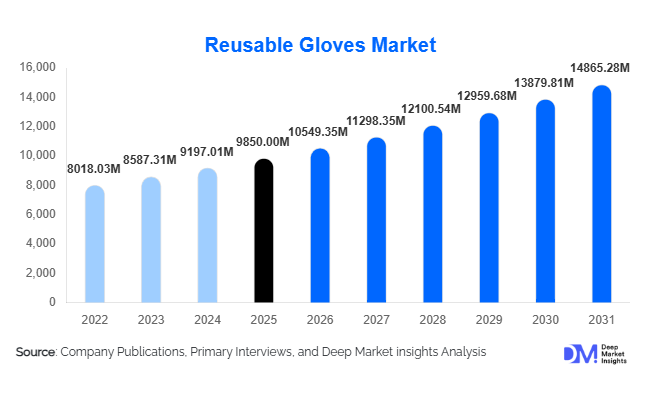
According to Deep Market Insights, the global reusable gloves market size was valued at USD 9,850 million in 2025 and is projected to grow from USD 10,549.35 million in 2026 to reach USD 14,865.28 million by 2031, expanding at a CAGR of 7.1% during the forecast period (2026–2031). The reusable gloves market growth is primarily driven by increasing industrial safety regulations, rising environmental concerns over disposable waste, and the growing demand for cost-effective and durable personal protective equipment (PPE) across multiple industries, including manufacturing, healthcare, and food processing.
Key Market Insights
- Reusable gloves are gaining traction as a sustainable alternative to single-use gloves, aligning with global ESG and waste reduction goals.
- Industrial applications dominate demand, particularly in manufacturing, chemical processing, and automotive sectors.
- Asia-Pacific leads the global market, driven by strong industrial output in China and India.
- Nitrile gloves are the most widely adopted material, owing to their superior durability and chemical resistance.
- Direct B2B sales channels dominate distribution, supported by long-term industrial supply contracts.
- Technological advancements in material science are improving glove performance, longevity, and user comfort.
What are the latest trends in the reusable gloves market?
Sustainability-Driven Product Innovation
The reusable gloves market is increasingly influenced by sustainability initiatives across industries. Companies are focusing on developing gloves made from recyclable and eco-friendly materials, reducing dependency on disposable alternatives. Manufacturers are also investing in lifecycle optimization, ensuring gloves can withstand multiple uses without performance degradation. This trend is particularly prominent in Europe and North America, where regulatory frameworks encourage sustainable procurement practices. Additionally, corporate sustainability targets are pushing organizations to adopt reusable PPE solutions, further accelerating demand.
Advanced Material and Performance Enhancements
Material innovation is reshaping the reusable gloves market. Developments in nitrile, neoprene, and polyurethane materials are enhancing resistance to chemicals, heat, and mechanical stress. Anti-microbial coatings and ergonomic designs are improving user safety and comfort, especially in healthcare and cleanroom applications. Some manufacturers are also exploring smart gloves integrated with sensors for monitoring worker safety in hazardous environments. These innovations are expanding the applicability of reusable gloves into high-value sectors such as electronics and semiconductor manufacturing.
What are the key drivers in the reusable gloves market?
Stringent Workplace Safety Regulations
Governments and regulatory bodies worldwide are enforcing strict occupational safety standards, mandating the use of protective equipment in hazardous environments. Industries such as chemicals, oil & gas, and manufacturing require durable gloves that provide long-term protection, driving the adoption of reusable gloves. Compliance with international standards has become a critical factor influencing procurement decisions.
Cost Efficiency Over Lifecycle Usage
Reusable gloves offer significant cost advantages compared to disposable gloves over extended periods. Although initial costs are higher, their durability reduces the need for frequent replacements, making them economically viable for industries with high glove consumption. This cost-benefit advantage is particularly relevant in large-scale manufacturing and food processing operations.
What are the restraints for the global market?
High Initial Investment and Maintenance Requirements
The upfront cost of reusable gloves is higher than that of disposable alternatives, which can deter small and medium-sized enterprises. Additionally, proper cleaning, storage, and maintenance are required to ensure safety and longevity, adding operational complexity.
Limited Use in High-Contamination Environments
In certain healthcare and hygiene-sensitive applications, disposable gloves remain preferred due to strict contamination control requirements. This limits the penetration of reusable gloves in critical medical procedures and high-risk environments.
What are the key opportunities in the reusable gloves industry?
Expansion in Emerging Economies
Rapid industrialization in countries such as India, China, and Vietnam presents significant growth opportunities. Expanding manufacturing bases and increasing awareness of worker safety are driving demand for reusable gloves. Local production and distribution networks can further enhance market penetration in these regions.
Integration of Smart and Specialized Gloves
The development of smart gloves with embedded sensors for monitoring temperature, pressure, and chemical exposure is opening new avenues for innovation. These advanced products cater to specialized industries such as aerospace, electronics, and hazardous material handling, offering premium pricing opportunities.
Material Type Insights
Nitrile gloves dominate the reusable gloves market, accounting for approximately 34% of the total market share in 2025. Their superior chemical resistance, durability, and hypoallergenic properties make them the preferred choice across industrial and healthcare applications. Latex gloves continue to hold a notable share due to their flexibility and comfort, particularly in household and light industrial uses. Neoprene and PVC gloves are gaining traction in niche applications requiring specific resistance properties, such as heat and chemical exposure.
Report Scope
| Report Metric | Details |
|---|---|
| Market Size in 2025 | USD 9850 Million |
| Market Size in 2026 | USD 10549.35 Million |
| Market Size in 2031 | USD 14865.28 Million |
| CAGR | 7.1% (2026-2031) |
| Base Year for Estimation | 2025 |
| Historical Data | 2022-2024 |
| Forecast Period | 2026-2031 |
| Report Coverage | Revenue Forecast, Competitive Landscape, Supply Chain Disruption, Growth Factors, Environment & Regulatory Landscape and Trends |
| Geographies Covered | North America, Europe, APAC, Middle East and Africa, LATAM |
| Countries Covered | U.S., Canada, U.K., Germany, France, Spain, Italy, Russia, Nordic, Benelux, Rest of Europe, China, Korea, Japan, India, Australia, Singapore, Taiwan, South East Asia, Rest of Asia-Pacific, UAE, Turky, Saudi Arabia, South Africa, Egypt, Nigeria, Rest of MEA, Brazil, Mexico, Argentina, Chile, Colombia, Rest of LATAM |
Explore more data points, trends and opportunities Download Free Sample Report
Product Type Insights
Industrial reusable gloves represent the largest segment, contributing nearly 41% of the global market in 2025. This dominance is primarily driven by the rapid expansion of manufacturing, automotive, and chemical processing industries, where worker safety and compliance with occupational health regulations are critical. Industrial environments require gloves with high durability, chemical resistance, and mechanical strength, making reusable gloves a cost-effective and reliable solution over time. The increasing automation in manufacturing has also led to demand for precision-handling gloves with enhanced grip and flexibility, further strengthening this segment’s leadership.
Household reusable gloves continue to maintain steady demand, supported by their affordability, durability, and growing consumer awareness of sustainability. Meanwhile, medical reusable gloves are gradually expanding in non-critical healthcare applications, particularly in outpatient care and sanitation processes, where cost optimization is essential. Food-grade and cleanroom reusable gloves are emerging as high-growth segments due to stringent hygiene regulations, rising food safety standards, and the expansion of pharmaceutical and semiconductor industries, where contamination control is critical.
Protection Type Insights
Chemical protection gloves lead the market with an estimated 29% share, driven by stringent safety requirements across industries such as petrochemicals, pharmaceuticals, and industrial cleaning. The increasing handling of hazardous substances and regulatory mandates for worker protection are key drivers supporting this segment’s growth. These gloves are designed to withstand exposure to acids, solvents, and other corrosive materials, making them indispensable in high-risk environments.
Mechanical protection gloves are widely used in manufacturing, construction, and automotive industries, where protection against cuts, abrasions, and punctures is essential. Thermal protection gloves cater to industries such as metal processing and glass manufacturing, where workers are exposed to extreme temperatures. Electrical insulation gloves serve specialized applications in power generation and utilities. Multi-purpose gloves are gaining popularity due to their versatility, enabling users to perform multiple tasks with a single product, thereby improving operational efficiency and reducing procurement costs.
Distribution Channel Insights
Direct B2B sales dominate the distribution landscape, accounting for approximately 46% of the market. This is largely driven by large industrial buyers who prefer long-term procurement contracts with manufacturers to ensure consistent quality, compliance with safety standards, and uninterrupted supply. Bulk purchasing agreements and customized product specifications further strengthen this channel’s dominance.
Distributors and wholesalers continue to play a crucial role in regional markets, particularly in emerging economies where fragmented demand and logistical challenges require strong intermediary networks. Retail stores cater primarily to household and small-scale industrial users. Meanwhile, e-commerce platforms are rapidly gaining traction, especially among small and medium enterprises (SMEs), due to convenience, competitive pricing, and access to a wider product range. Digital procurement platforms are also enabling better price transparency and streamlined supply chain management.
End-Use Industry Insights
The manufacturing and automotive sector leads the reusable gloves market with a 27% share in 2025, driven by extensive use in assembly lines, heavy machinery operations, and material handling processes. The growth of global manufacturing output, particularly in the Asia-Pacific region, continues to fuel demand for durable protective gloves. Additionally, increasing automation and precision manufacturing are driving the need for gloves with enhanced dexterity and grip.
The healthcare sector is witnessing the gradual adoption of reusable gloves in non-critical applications such as sanitation, patient handling, and laboratory work, where cost efficiency is a key consideration. The food processing industry is emerging as one of the fastest-growing segments due to stringent hygiene standards, regulatory compliance, and the need to prevent cross-contamination. Cleaning and sanitation services have also seen a surge in demand post-pandemic, with increased focus on hygiene and workplace safety. Emerging industries such as electronics and semiconductor manufacturing are creating new demand avenues, particularly for cleanroom-compatible reusable gloves.
Explore more data points, trends and opportunities Download Free Sample Report
Reusable Gloves Market Segmentations
By Material Type
- Natural Rubber (Latex) Gloves
- Nitrile Gloves
- Neoprene Gloves
- PVC (Vinyl) Gloves
- Polyurethane Gloves
- Butyl & Viton Gloves
By Product Type
- Household Reusable Gloves
- Industrial Reusable Gloves
- Medical Reusable Gloves
- Food-Grade Reusable Gloves
- Cleanroom Reusable Gloves
By Protection Type
- Chemical Protection Gloves
- Mechanical Protection Gloves
- Thermal Protection Gloves
- Electrical Insulation Gloves
- Multi-purpose Protection Gloves
By Distribution Channel
- Direct B2B Sales
- Distributors & Wholesalers
- Retail Stores
- E-commerce Platforms
By End-Use Industry
- Healthcare & Medical
- Food Processing & Hospitality
- Chemical & Petrochemical
- Manufacturing & Automotive
- Cleaning & Sanitation Services
- Agriculture
- Electronics & Semiconductor
Regional Insights
Asia-Pacific
Asia-Pacific dominates the reusable gloves market with a 38% share in 2025, led by major economies such as China, India, and Japan. China’s extensive manufacturing base, spanning automotive, electronics, and chemicals, drives large-scale demand for industrial gloves. India’s rapid industrialization, supported by initiatives such as “Make in India,” is accelerating adoption across manufacturing and infrastructure sectors. Japan contributes through its advanced manufacturing and stringent workplace safety standards. Additional growth drivers include increasing awareness of occupational safety, rising export-oriented production, and the availability of low-cost manufacturing capabilities. The region is also the fastest-growing globally, with a CAGR exceeding 8%, supported by expanding industrial output and rising investments in worker safety.
North America
North America accounts for approximately 24% of the global market, with the United States being the primary contributor. Growth in this region is driven by stringent occupational safety regulations enforced by agencies such as OSHA, which mandate the use of protective equipment in hazardous work environments. The presence of advanced manufacturing, chemical processing, and healthcare industries further supports demand. Additionally, the region’s strong focus on sustainability and waste reduction is encouraging the shift from disposable to reusable gloves. Technological advancements, including high-performance materials and ergonomic designs, are also key drivers enhancing product adoption.
Europe
Europe remains a significant market, with Germany, France, and the UK leading demand. The region’s growth is primarily driven by strict regulatory frameworks related to worker safety and environmental sustainability. The European Union’s emphasis on reducing single-use plastics and promoting circular economy practices is accelerating the adoption of reusable gloves. Industrial sectors such as automotive, chemicals, and food processing contribute significantly to demand. Additionally, strong labor laws and high safety standards compel organizations to invest in high-quality protective equipment, further supporting market growth.
Latin America
Latin America, led by Brazil and Mexico, is experiencing moderate growth due to expanding industrial activities and increasing foreign investments in manufacturing. The region’s growth is supported by rising awareness of workplace safety and the gradual implementation of regulatory standards. Infrastructure development and the expansion of the automotive and food processing industries are key demand drivers. Additionally, improving distribution networks and the growing presence of international PPE manufacturers are enhancing market accessibility in the region.
Middle East & Africa
The Middle East & Africa region is witnessing steady growth, particularly in countries such as the UAE and Saudi Arabia. The oil & gas sector is a major driver, requiring high-performance chemical-resistant gloves for hazardous operations. Additionally, large-scale construction and infrastructure projects are boosting demand for mechanical protection gloves. Governments in the region are increasingly focusing on worker safety regulations, further supporting market expansion. In Africa, growing industrialization and mining activities are contributing to rising demand, while international investments and infrastructure development initiatives are gradually strengthening market growth.
Key Players in the Reusable Gloves Market
- Ansell Limited
- Top Glove Corporation
- Hartalega Holdings
- Kossan Rubber Industries
- Supermax Corporation
- Showa Group
- MAPA Professional
- Honeywell International
- 3M
- Lakeland Industries
- Semperit AG
- Uvex Group
- Delta Plus Group
- Towa Corporation
- Riverstone Holdings