Remodeling Market Size
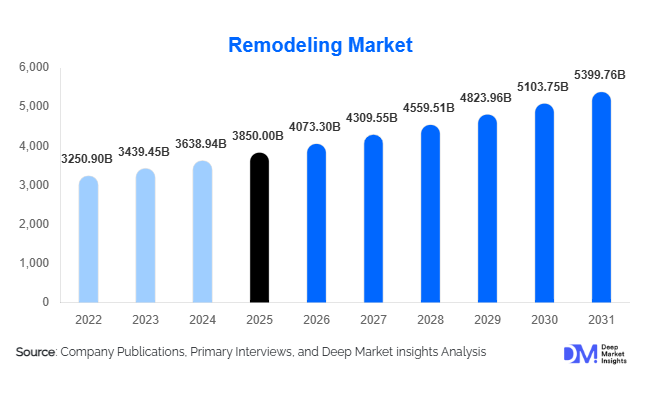
According to Deep Market Insights, the global remodeling market size was valued at USD 3,850 billion in 2025 and is projected to grow from USD 4,073.30 billion in 2026 to reach USD 5,399.76 billion by 2031, expanding at a CAGR of 5.8% during the forecast period (2026–2031). The remodeling market growth is primarily driven by aging building infrastructure, rising disposable incomes, and increasing demand for energy-efficient and customized living and commercial spaces. Additionally, shifting lifestyle preferences, including remote work and hybrid office models, are accelerating renovation activities across both residential and commercial sectors.
Key Market Insights
- Interior remodeling dominates globally, accounting for over 40% of total market demand, driven by kitchen and bathroom upgrades.
- Residential remodeling remains the largest segment, contributing nearly 65% of the global market due to increasing home improvement spending.
- North America leads the market, supported by aging housing stock and high per capita renovation expenditure.
- Asia-Pacific is the fastest-growing region, driven by urbanization and rising middle-class income in countries such as China and India.
- Energy-efficient and sustainable remodeling solutions are gaining traction due to regulatory mandates and consumer awareness.
- Technology integration, including smart home systems and digital project management tools, is transforming remodeling practices.
What are the latest trends in the remodeling market?
Rise of Sustainable and Green Remodeling
Sustainability has become a central theme in the remodeling market, with increasing adoption of eco-friendly materials, energy-efficient appliances, and renewable energy integrations. Homeowners and businesses are prioritizing insulation upgrades, solar panel installations, and water-efficient systems to reduce long-term operational costs and environmental impact. Governments across North America and Europe are supporting this trend through tax incentives and stricter energy regulations. The shift toward green remodeling is also influencing material innovation, with manufacturers introducing low-carbon cement, recycled wood products, and high-performance glass solutions.
Smart Home and Digital Integration
The integration of smart technologies is reshaping remodeling projects globally. Consumers are increasingly incorporating IoT-enabled devices such as smart lighting, automated climate control, and advanced security systems into renovation plans. Digital tools, including 3D design software, virtual walkthroughs, and AI-driven project management platforms, are enhancing planning accuracy and customer experience. This trend is particularly prominent in urban markets, where tech-savvy consumers seek convenience, efficiency, and connectivity in their living and working environments.
What are the key drivers in the remodeling market?
Aging Infrastructure and Renovation Cycles
A significant portion of residential and commercial buildings, especially in developed economies, is over 30 years old, necessitating continuous maintenance and upgrades. This creates a stable demand base for remodeling activities, independent of new construction cycles. Renovation cycles are becoming shorter as consumers increasingly prioritize modern aesthetics and improved functionality, further boosting market growth.
Rising Disposable Income and Lifestyle Changes
Increasing income levels, particularly in emerging markets, are enabling consumers to invest in home improvement projects. The growing emphasis on comfort, personalization, and luxury living is driving demand for high-value remodeling services such as premium kitchens, spa-like bathrooms, and multifunctional living spaces. The shift toward remote work has also increased spending on home office setups and flexible interior designs.
What are the restraints for the global market?
High Costs and Labor Shortages
Remodeling projects often involve high costs, including materials, labor, and design services. The shortage of skilled labor in construction trades has further increased project expenses, making remodeling less accessible for middle-income consumers. Delays caused by workforce constraints can also impact project timelines and customer satisfaction.
Raw Material Price Volatility
Fluctuations in the prices of key construction materials such as steel, wood, and cement pose challenges for contractors and developers. Sudden price increases can disrupt project budgets and reduce profit margins, leading to cautious spending by both consumers and businesses. This volatility remains a critical barrier to consistent market growth.
What are the key opportunities in the remodeling industry?
Energy-Efficient Retrofitting
Retrofitting existing buildings to meet modern energy standards presents a significant growth opportunity. Governments are offering incentives for insulation upgrades, efficient HVAC systems, and renewable energy installations, creating a strong business case for contractors specializing in green remodeling. This segment is expected to grow rapidly, particularly in Europe and North America.
Urban Redevelopment and Emerging Markets
Rapid urbanization in Asia-Pacific, Latin America, and Africa is driving large-scale redevelopment projects. Aging urban infrastructure is being upgraded to accommodate growing populations, creating demand for both residential and commercial remodeling. Rising middle-class income in countries such as India and Indonesia is further expanding the market base.
Project Type Insights
Interior remodeling continues to lead the global remodeling market, accounting for approximately 42% of total demand in 2025. This dominance is primarily driven by the high frequency of renovation cycles in kitchens, bathrooms, and living spaces, which deliver the highest return on investment for homeowners. The growing trend of home personalization, coupled with rising disposable incomes and increased time spent indoors post-pandemic, has significantly accelerated demand for interior upgrades. Additionally, the integration of smart home technologies and modular furniture solutions is further strengthening this segment’s leadership.
Exterior remodeling, including roofing, siding, and façade upgrades, represents a substantial share of the market, particularly in regions exposed to extreme weather conditions such as North America and parts of Europe. Demand in this segment is driven by the need for durability, weather resistance, and improved curb appeal. Structural remodeling, such as room additions and floor expansions, is gaining traction in densely populated urban areas where optimizing existing space is more cost-effective than new construction. Meanwhile, energy-efficiency upgrades are the fastest-growing sub-segment, fueled by government incentives, rising energy costs, and increasing awareness of sustainability. The adoption of insulation systems, energy-efficient windows, and renewable energy integration is expected to further accelerate growth in this category.
Report Scope
| Report Metric | Details |
|---|---|
| Market Size in 2025 | USD 3850 Billion |
| Market Size in 2026 | USD 4073.30 Billion |
| Market Size in 2031 | USD 5399.76 Billion |
| CAGR | 5.8% (2026-2031) |
| Base Year for Estimation | 2025 |
| Historical Data | 2022-2024 |
| Forecast Period | 2026-2031 |
| Report Coverage | Revenue Forecast, Competitive Landscape, Supply Chain Disruption, Growth Factors, Environment & Regulatory Landscape and Trends |
| Geographies Covered | North America, Europe, APAC, Middle East and Africa, LATAM |
| Countries Covered | U.S., Canada, U.K., Germany, France, Spain, Italy, Russia, Nordic, Benelux, Rest of Europe, China, Korea, Japan, India, Australia, Singapore, Taiwan, South East Asia, Rest of Asia-Pacific, UAE, Turky, Saudi Arabia, South Africa, Egypt, Nigeria, Rest of MEA, Brazil, Mexico, Argentina, Chile, Colombia, Rest of LATAM |
Explore more data points, trends and opportunities Download Free Sample Report
Property Type Insights
Residential properties dominate the remodeling market, accounting for nearly 65% of the global market share in 2025. This leadership is driven by increasing homeownership rates, rising renovation spending, and the growing importance of home aesthetics and functionality. The shift toward remote and hybrid work models has also led homeowners to invest in home offices, multifunctional spaces, and comfort-driven upgrades, further strengthening this segment.
Commercial remodeling is witnessing steady growth, particularly in office spaces, retail outlets, and hospitality establishments. The transformation of workplaces to accommodate hybrid work environments, along with the need for enhanced customer experiences in retail and hospitality sectors, is driving demand. Institutional remodeling, including educational and government buildings, is supported by public sector investments and modernization initiatives. Aging infrastructure in schools, hospitals, and administrative buildings is prompting large-scale renovation projects, contributing to consistent demand in this segment.
End-User Insights
Homeowners remain the largest end-user segment, contributing approximately 60% of total market demand. This dominance is driven by increasing consumer preference for personalized living spaces, improved comfort, and long-term property value enhancement. The growing influence of digital platforms and DIY trends has also empowered homeowners to undertake remodeling projects more actively.
Real estate developers and property management companies are significant contributors to the market, focusing on property upgrades to enhance asset value and attract tenants. Renovation activities in rental housing and commercial properties are increasingly being used as a strategy to improve occupancy rates and rental yields. Corporate enterprises are also emerging as a key end-user segment, investing heavily in office redesign and workspace optimization to support flexible and collaborative work environments. Government and public sector entities contribute to demand through infrastructure refurbishment and public building modernization projects.
Material Insights
Wood and engineered wood materials lead the remodeling market, accounting for approximately 30% of total material usage, due to their versatility, aesthetic appeal, and widespread application in flooring, cabinetry, and structural components. The increasing preference for sustainable and eco-friendly materials has further boosted demand for engineered wood products.
Concrete and cement remain essential materials, particularly in structural remodeling and large-scale renovation projects, due to their strength and durability. Metals such as steel and aluminum, along with glass, are gaining popularity in modern architectural designs, especially in commercial and high-end residential projects where contemporary aesthetics are prioritized. Advanced composites are emerging as a high-growth segment, offering benefits such as lightweight construction, durability, and resistance to environmental factors. These materials are increasingly being adopted in energy-efficient and sustainable remodeling projects, aligning with global green building trends.
Explore more data points, trends and opportunities Download Free Sample Report
Remodeling Market Segmentations
By Project Type
- Interior Remodeling
- Exterior Remodeling
- Structural Remodeling
- Energy-Efficiency Upgrades
By Property Type
- Residential
- Commercial
- Institutional
By End-User
- Homeowners
- Real Estate Developers
- Property Management Companies
- Corporate Enterprises
- Government & Public Sector
By Material Type
- Wood & Engineered Wood
- Concrete & Cement
- Metals
- Glass
- Composites & Advanced Materials
Regional Insights
North America
North America holds approximately 35% of the global remodeling market share in 2025, making it the largest regional market. The United States dominates regional demand, driven by an aging housing stock, high per capita renovation expenditure, and a strong culture of home improvement. The presence of well-established contractors and access to advanced construction technologies further support market growth. Canada is also witnessing significant expansion, primarily due to government-backed energy retrofit programs and incentives promoting sustainable building upgrades. Additionally, rising property values and the need to maintain asset quality are key drivers fueling remodeling activity across the region.
Europe
Europe accounts for approximately 25% of the global market, with major contributions from Germany, the United Kingdom, and France. The region’s growth is strongly driven by stringent energy efficiency regulations and carbon reduction targets, which are encouraging large-scale retrofitting of residential and commercial buildings. The presence of a large number of historic structures also necessitates continuous renovation and restoration efforts. Furthermore, government subsidies for green building initiatives and increasing consumer awareness of sustainability are accelerating demand for energy-efficient remodeling solutions across Europe.
Asia-Pacific
Asia-Pacific holds nearly 22% of the market share and is the fastest-growing region, with a CAGR exceeding 7%. China and India are the primary growth engines, driven by rapid urbanization, expanding middle-class populations, and rising disposable incomes. Large-scale infrastructure development and urban redevelopment projects are creating significant opportunities for remodeling activities. Additionally, increasing adoption of modern housing designs and growing awareness of energy efficiency are further boosting demand. Government initiatives supporting housing development and smart city projects are also playing a crucial role in accelerating regional growth.
Latin America
Latin America represents around 10% of the global remodeling market, with Brazil and Mexico leading regional demand. Growth in this region is driven by urban housing shortages, increasing investment in residential construction, and the need to upgrade aging infrastructure. Economic recovery in key countries and rising middle-class income levels are supporting higher spending on home improvement. Additionally, government initiatives aimed at improving housing quality and urban infrastructure are contributing to steady growth in remodeling activities.
Middle East & Africa
The Middle East & Africa region accounts for approximately 8% of the global market, with growth concentrated in countries such as the United Arab Emirates and Saudi Arabia. Rapid urban development, large-scale construction projects, and increasing investments in smart cities are key drivers in this region. In the Middle East, demand is primarily driven by commercial and luxury residential remodeling, supported by high-income populations and tourism infrastructure development. In Africa, urbanization and infrastructure modernization are gradually increasing demand for remodeling services, particularly in major metropolitan areas. Government-led initiatives and foreign investments in infrastructure are expected to further enhance market growth across the region.
Key Players in the Remodeling Market
- Masco Corporation
- Andersen Corporation
- Pella Corporation
- Owens Corning
- Saint-Gobain
- LIXIL Group
- Kohler Co.
- Ferguson plc
- Builders FirstSource
- Beacon Roofing Supply
- Kingspan Group
- Holcim Group
- CRH plc
- Vinci SA
- Skanska AB