REIT Market Size
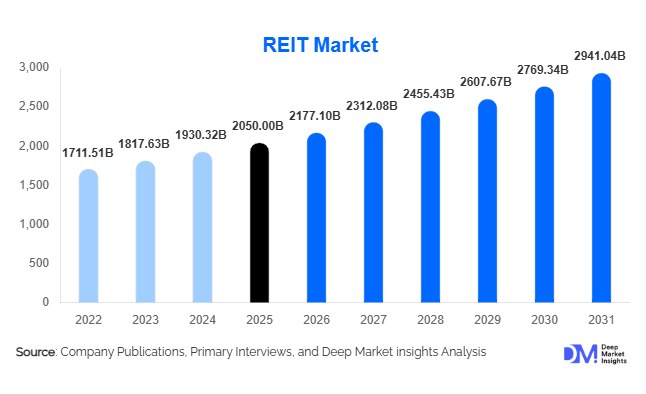
According to Deep Market Insights, the global REIT (Real Estate Investment Trust) market size was valued at USD 2,050 billion in 2025 and is projected to grow from USD 2,177.10 billion in 2026 to reach USD 2,941.04 billion by 2031, expanding at a CAGR of 6.2% during the forecast period (2026–2031). The REIT market growth is primarily driven by increasing institutional participation, rising demand for income-generating real estate assets, and strong expansion in logistics, data centers, and digital infrastructure-backed properties.
Key Market Insights
- Industrial and data center REITs are emerging as the fastest-growing segments, driven by e-commerce and digital transformation trends.
- Equity REITs dominate the market, accounting for over 85% of total market share due to stable income generation.
- North America leads the global market, supported by a mature regulatory ecosystem and high investor participation.
- Asia-Pacific is the fastest-growing region, fueled by urbanization and regulatory reforms in emerging economies.
- Institutional investors are increasing allocations, including pension funds and sovereign wealth funds seeking diversification.
- Technological adoption in PropTech and smart buildings is enhancing operational efficiency and asset valuation.
What are the latest trends in the REIT market?
Shift Toward Specialized and Alternative Asset Classes
The REIT market is witnessing a structural shift from traditional office and retail properties toward specialized assets such as data centers, telecom towers, and logistics facilities. This transition is driven by long-term demand from cloud computing, 5G infrastructure, and global supply chain optimization. Data center REITs, in particular, are experiencing high occupancy rates and premium pricing due to increasing digital storage and processing needs. Investors are actively reallocating capital toward these segments as they offer higher yields and lower vacancy risks compared to traditional property types.
Integration of Technology and Smart Real Estate
Technology adoption is transforming the REIT landscape, with increasing integration of IoT-enabled smart buildings, AI-driven asset management systems, and digital leasing platforms. These innovations enable REIT operators to optimize energy consumption, reduce operational costs, and enhance tenant experience. Smart building technologies also improve sustainability performance, aligning with ESG investment criteria. Additionally, digital platforms are making REIT investments more accessible to retail investors through fractional ownership and online trading, broadening market participation.
What are the key drivers in the REIT market?
Rising Demand for Stable Income Investments
REITs offer consistent dividend yields, making them attractive to investors seeking steady income streams in uncertain economic conditions. Compared to traditional fixed-income securities, REITs provide higher returns and inflation protection, driving increased capital inflows from both institutional and retail investors.
Expansion of E-commerce and Logistics Infrastructure
The rapid growth of e-commerce has significantly increased demand for warehouses and distribution centers. Industrial REITs benefit from high occupancy rates and long-term lease agreements, making them one of the strongest-performing segments within the market.
Growing Institutional Participation
Pension funds, insurance companies, and sovereign wealth funds are increasing their exposure to REITs as part of diversified investment strategies. This trend enhances liquidity and stability while supporting large-scale real estate development projects.
What are the restraints for the global market?
Interest Rate Sensitivity
REIT performance is closely linked to interest rate movements. Rising interest rates increase borrowing costs and reduce the relative attractiveness of dividend yields compared to bonds, potentially impacting investor demand.
Structural Challenges in Office and Retail Segments
Changing work patterns and consumer behavior are negatively affecting office and retail REITs. Remote work trends and the growth of online shopping have reduced demand for physical office spaces and traditional retail outlets, leading to lower occupancy rates in these segments.
What are the key opportunities in the REIT industry?
Expansion in Emerging Markets
Emerging economies such as India, Brazil, and the UAE present significant growth opportunities due to urbanization, infrastructure development, and favorable regulatory frameworks. These markets are witnessing increasing adoption of REIT structures, offering attractive returns for investors.
Growth in Digital Infrastructure Real Estate
The rising demand for cloud computing, artificial intelligence, and data storage is driving investments in data center and telecom infrastructure REITs. These assets provide stable cash flows and long-term growth potential, making them highly attractive to investors.
Adoption of ESG and Sustainable Real Estate Practices
Environmental, Social, and Governance (ESG) considerations are becoming central to investment decisions. REITs that adopt sustainable building practices, energy-efficient operations, and green certifications are gaining a competitive advantage and attracting ESG-focused investors.
Report Scope
| Report Metric | Details |
|---|---|
| Market Size in 2025 | USD 2050 Billion |
| Market Size in 2026 | USD 2177.10 Billion |
| Market Size in 2031 | USD 2941.04 Billion |
| CAGR | 6.2% (2026-2031) |
| Base Year for Estimation | 2025 |
| Historical Data | 2022-2024 |
| Forecast Period | 2026-2031 |
| Report Coverage | Revenue Forecast, Competitive Landscape, Supply Chain Disruption, Growth Factors, Environment & Regulatory Landscape and Trends |
| Geographies Covered | North America, Europe, APAC, Middle East and Africa, LATAM |
| Countries Covered | U.S., Canada, U.K., Germany, France, Spain, Italy, Russia, Nordic, Benelux, Rest of Europe, China, Korea, Japan, India, Australia, Singapore, Taiwan, South East Asia, Rest of Asia-Pacific, UAE, Turky, Saudi Arabia, South Africa, Egypt, Nigeria, Rest of MEA, Brazil, Mexico, Argentina, Chile, Colombia, Rest of LATAM |
Explore more data points, trends and opportunities Download Free Sample Report
Property Type Insights
Industrial REITs lead the global REIT market with approximately 28% share in 2025, primarily driven by the rapid expansion of e-commerce, supply chain optimization, and the need for last-mile delivery infrastructure. The surge in online retail penetration has significantly increased demand for modern warehousing and logistics hubs, particularly in urban peripheries and strategic trade corridors. Long-term lease structures and high occupancy rates further strengthen the revenue stability of this segment, making it highly attractive to institutional investors. Residential REITs represent the second-largest segment, supported by urbanization, population growth, and increasing demand for rental housing across major metropolitan areas. Rising property prices and affordability constraints in key cities are pushing more consumers toward rental housing, thereby strengthening occupancy and rental yields for residential REIT portfolios.
Specialized REITs, including data centers, telecom towers, and healthcare facilities, are the fastest-growing category. Growth is fueled by digital transformation, 5G deployment, and increasing demand for cloud infrastructure. These assets offer long-term contracts with high-credit tenants, resulting in stable and predictable cash flows. Retail and office REITs, while still significant in overall market size, are experiencing relatively slower growth. Structural shifts such as remote working models and the rise of e-commerce have reduced demand for traditional office spaces and brick-and-mortar retail, leading to portfolio repositioning and asset repurposing strategies.
Structure Insights
Equity REITs dominate the market with over 85% share, owing to their direct ownership of income-generating real estate assets. Their dominance is driven by stable rental income, capital appreciation potential, and lower sensitivity to interest rate volatility compared to mortgage REITs. Equity REITs also benefit from strong investor confidence due to transparent asset-backed returns and consistent dividend payouts.
Mortgage REITs (mREITs), which invest in real estate debt instruments, are more sensitive to interest rate fluctuations and credit risk. While they offer higher yields, their performance is closely tied to monetary policy changes, making them relatively volatile. Hybrid REITs, combining both equity and mortgage strategies, hold a smaller share but provide diversification benefits by balancing income generation with financing exposure.
Ownership Model Insights
Publicly traded REITs account for approximately 70% of the market, driven by their high liquidity, regulatory transparency, and accessibility to both retail and institutional investors. Their listing on major stock exchanges enables efficient price discovery and broad capital participation, making them the preferred investment vehicle globally. Public non-traded REITs offer stable returns with reduced market volatility but lack liquidity, making them more suitable for long-term investors seeking predictable income streams. Private REITs, on the other hand, cater primarily to institutional investors and high-net-worth individuals, offering customized investment strategies and exposure to niche or high-growth real estate assets.
Investment Strategy Insights
Core REITs dominate the investment strategy segment with approximately 45% market share, focusing on stabilized, income-generating properties in prime locations. Their leadership is driven by low risk, consistent cash flows, and strong occupancy levels, making them highly attractive in uncertain economic conditions. Core-plus and value-add REITs are gaining traction as investors seek moderate risk-adjusted returns through asset enhancements, redevelopment, and operational improvements. Opportunistic REITs, while smaller in share, are witnessing increased interest due to their potential for high returns through development projects, distressed asset acquisitions, and market repositioning strategies.
End-Use Insights
The logistics and warehousing sector is the fastest-growing end-use segment, expanding at a CAGR of over 8%, driven by global e-commerce growth, cross-border trade, and supply chain reconfiguration. The increasing need for efficient distribution networks and last-mile delivery solutions continues to boost demand for industrial real estate assets. Data center demand is also experiencing exponential growth due to rising cloud computing adoption, artificial intelligence workloads, and digital content consumption. This is significantly boosting the expansion of specialized REITs focused on digital infrastructure.
Healthcare real estate, including hospitals, medical offices, and senior living facilities, is witnessing steady demand growth due to aging populations, particularly in developed economies. Long-term leases and government-backed healthcare spending further enhance the stability of this segment. Export-driven demand plays a crucial role in industrial REIT growth, particularly in major manufacturing economies where global trade flows drive the need for large-scale logistics infrastructure.
Explore more data points, trends and opportunities Download Free Sample Report
REIT Market Segmentations
By Property Type
- Residential REITs
- Commercial REITs
- Industrial REITs
- Specialized REITs
By Structure
- Equity REITs
- Mortgage REITs
- Hybrid REITs
By Ownership Model
- Publicly Traded REITs
- Public Non-Traded REITs
- Private REITs
By Investment Strategy
- Core
- Core-Plus
- Value-Add
- Opportunistic
Regional Insights
North America
North America dominates the REIT market with approximately 42% share in 2025, led by the United States. The region’s growth is driven by a highly developed REIT regulatory framework, deep capital markets, and strong participation from institutional investors such as pension funds and insurance companies. The presence of large-scale industrial, data center, and residential REIT portfolios further strengthens market leadership. Additionally, high e-commerce penetration, advanced logistics infrastructure, and increasing demand for digital assets continue to fuel regional growth. Canada complements this growth with strong residential and retail REIT activity, supported by stable economic conditions and urban housing demand.
Europe
Europe accounts for around 22% of the global market, with key contributors including the UK, Germany, and France. Regional growth is driven by urban redevelopment initiatives, increasing demand for sustainable and energy-efficient buildings, and strong regulatory frameworks supporting real estate investments. The rise of ESG-focused investments is particularly influential in Europe, encouraging REITs to adopt green building standards and sustainable asset management practices. Additionally, logistics demand driven by intra-European trade and e-commerce expansion is accelerating industrial REIT growth across the region.
Asia-Pacific
Asia-Pacific holds approximately 24% market share and is the fastest-growing region, with a CAGR exceeding 9%. Growth is driven by rapid urbanization, expanding middle-class populations, and increasing infrastructure investments in countries such as China, India, Japan, and Australia. Regulatory reforms supporting REIT structures, particularly in emerging markets like India, are significantly boosting investor participation. The region is also witnessing strong demand for office spaces, logistics hubs, and data centers due to industrialization and digital transformation. Rising foreign investments and government initiatives focused on smart cities and infrastructure development further accelerate market expansion.
Latin America
Latin America is an emerging REIT market, led by Brazil and Mexico, where adoption is steadily increasing. Growth in the region is driven by improving regulatory frameworks, rising institutional investment, and expanding real estate development activities. Increasing urbanization and demand for commercial and residential properties are supporting REIT expansion. Additionally, growing participation from foreign investors seeking high-yield opportunities is contributing to market development despite economic volatility in certain countries.
Middle East & Africa
The Middle East and Africa region is witnessing gradual growth, particularly in the UAE and Saudi Arabia. Regional expansion is driven by large-scale infrastructure projects, economic diversification strategies, and government initiatives aimed at reducing dependence on oil revenues. Mega projects, including smart cities and tourism infrastructure developments, are creating significant demand for commercial and residential real estate assets. In Africa, urbanization and increasing foreign direct investment are supporting long-term REIT market potential, although regulatory and market maturity challenges remain.
Key Players in the REIT Market
- Prologis Inc.
- American Tower Corporation
- Equinix Inc.
- Public Storage
- Simon Property Group
- Digital Realty Trust
- Realty Income Corporation
- AvalonBay Communities
- Welltower Inc.
- Crown Castle Inc.
- Extra Space Storage
- VICI Properties
- Invitation Homes
- Segro Plc
- Goodman Group