Recovery Footwear Market Size
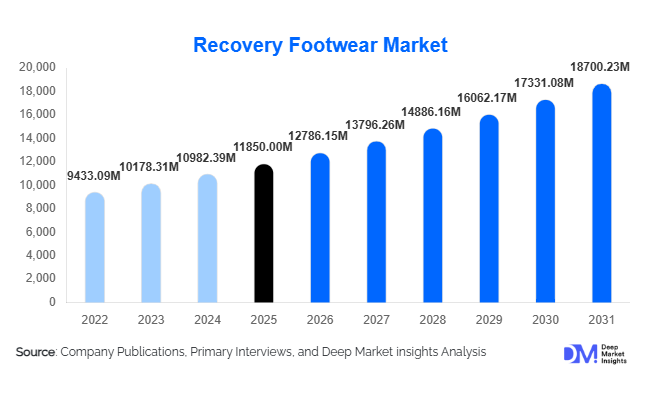
According to Deep Market Insights, the global recovery footwear market size was valued at USD 11,850 million in 2025 and is projected to grow from USD 12,786.15 million in 2026 to reach USD 18,700.23 million by 2031, expanding at a CAGR of 7.9% during the forecast period (2026–2031). The market growth is primarily driven by increasing awareness of post-activity recovery, rising prevalence of foot-related disorders, and the growing adoption of comfort-oriented and athleisure footwear globally.
Key Market Insights
- Recovery footwear is transitioning from a niche athletic product to a mainstream wellness category, driven by increasing focus on foot health and comfort.
- Biomechanical and orthotic technologies are gaining traction, enhancing product functionality and enabling premium pricing.
- North America dominates the global market, supported by a strong athletic culture and high consumer awareness.
- Asia-Pacific is the fastest-growing region, fueled by rising disposable incomes and expanding fitness participation.
- Online retail channels are leading distribution, accounting for nearly half of total global sales.
- Sustainable materials and eco-friendly manufacturing are emerging as key differentiators among leading brands.
What are the latest trends in the recovery footwear market?
Shift Toward Everyday Lifestyle Adoption
Recovery footwear is increasingly being adopted beyond sports recovery into daily lifestyle use. Consumers are prioritizing comfort-driven footwear for extended wear during work, travel, and casual activities. This trend is supported by the broader athleisure movement, where functionality and style converge. Brands are responding by designing aesthetically appealing products that maintain recovery benefits while catering to fashion-conscious consumers. The shift toward all-day usability is expanding the addressable market and driving higher repeat purchases.
Material Innovation and Sustainability Focus
Manufacturers are investing in advanced materials such as high-performance EVA foams, bio-based polymers, and recyclable compounds to enhance cushioning and reduce environmental impact. Sustainability is becoming a core product attribute, particularly in Europe and North America, where consumers are increasingly environmentally conscious. Companies are adopting circular manufacturing practices, reducing carbon footprints, and introducing biodegradable components, which is strengthening brand positioning and regulatory compliance.
What are the key drivers in the recovery footwear market?
Rising Fitness and Sports Participation
The global increase in fitness awareness and sports participation is a major driver of recovery footwear demand. Athletes and fitness enthusiasts are increasingly incorporating recovery products into their routines to reduce fatigue and enhance performance. The rapid growth of gyms, marathons, and recreational sports leagues is further accelerating adoption.
Growing Prevalence of Foot Disorders
The increasing incidence of conditions such as plantar fasciitis, arthritis, and diabetic foot complications is driving demand for recovery footwear with therapeutic benefits. Aging populations in developed regions are particularly contributing to this trend, as they require footwear that supports mobility and reduces discomfort.
What are the restraints for the global market?
High Product Pricing
Advanced recovery footwear products often come with premium pricing due to specialized materials and technology integration. This limits adoption in price-sensitive markets, particularly in developing economies, where affordability remains a key concern.
Limited Awareness in Emerging Markets
Despite growing demand, awareness regarding the benefits of recovery footwear remains limited in several emerging regions. Many consumers still perceive these products as non-essential, which may slow market penetration and adoption rates.
What are the key opportunities in the recovery footwear industry?
Expansion into Medical and Orthopedic Applications
There is a significant opportunity to position recovery footwear within the medical and orthopedic space. Products designed with clinical validation for foot conditions can expand into healthcare channels, including hospitals and clinics, enabling access to a broader consumer base and potential insurance reimbursements.
Growth in Emerging Markets
Rapid urbanization, rising disposable incomes, and increasing fitness awareness in countries such as India, China, and Brazil present strong growth opportunities. Localized product offerings and pricing strategies can help brands penetrate these high-growth markets effectively.
Sustainable Product Innovation
The growing demand for eco-friendly products presents an opportunity for companies to innovate with sustainable materials and processes. Brands that successfully integrate sustainability into their value proposition can enhance customer loyalty and differentiate themselves in a competitive market.
Report Scope
| Report Metric | Details |
|---|---|
| Market Size in 2025 | USD 11850 Million |
| Market Size in 2026 | USD 12786.15 Million |
| Market Size in 2031 | USD 18700.23 Million |
| CAGR | 7.9% (2026-2031) |
| Base Year for Estimation | 2025 |
| Historical Data | 2022-2024 |
| Forecast Period | 2026-2031 |
| Report Coverage | Revenue Forecast, Competitive Landscape, Supply Chain Disruption, Growth Factors, Environment & Regulatory Landscape and Trends |
| Geographies Covered | North America, Europe, APAC, Middle East and Africa, LATAM |
| Countries Covered | U.S., Canada, U.K., Germany, France, Spain, Italy, Russia, Nordic, Benelux, Rest of Europe, China, Korea, Japan, India, Australia, Singapore, Taiwan, South East Asia, Rest of Asia-Pacific, UAE, Turky, Saudi Arabia, South Africa, Egypt, Nigeria, Rest of MEA, Brazil, Mexico, Argentina, Chile, Colombia, Rest of LATAM |
Explore more data points, trends and opportunities Download Free Sample Report
Product Type Insights
Recovery slides continue to dominate the product segment, accounting for approximately 34% of the global market in 2025. Their leadership is primarily driven by their ergonomic slip-on design, superior cushioning, and immediate post-activity usability, making them the preferred choice among athletes and fitness enthusiasts. The increasing frequency of gym workouts, running events, and high-intensity training programs has significantly boosted demand for quick-recovery solutions, further strengthening the position of recovery slides. Additionally, brands are innovating with advanced foam technologies and stylish designs, enabling slides to transition from performance gear to everyday wear.
Recovery sandals and flip-flops hold a substantial share due to their lightweight structure and breathability, particularly in warmer climates across Asia-Pacific and Latin America. Closed-toe recovery shoes are gaining momentum, especially among urban consumers seeking all-day comfort combined with orthopedic benefits. This segment is being driven by rising workplace casualization and demand for hybrid footwear that supports both mobility and recovery. Compression-based footwear, although niche, is expanding steadily due to increasing adoption in medical and rehabilitation settings, particularly for post-surgical recovery and chronic foot conditions.
Application Insights
Sports recovery remains the leading application segment, contributing nearly 41% of total market demand in 2025. This dominance is driven by the global surge in fitness participation, professional sports training, and awareness of muscle recovery techniques. Athletes and fitness enthusiasts increasingly view recovery footwear as an essential component of performance optimization, contributing to consistent demand growth. The expansion of sports leagues, marathons, and fitness communities worldwide continues to reinforce this segment’s leadership.
Medical rehabilitation is the fastest-growing application, supported by the rising prevalence of orthopedic disorders such as plantar fasciitis, arthritis, and diabetic foot conditions. Increasing recommendations from healthcare professionals and integration of orthotic technologies are key growth drivers. Meanwhile, lifestyle and daily comfort applications are expanding rapidly, fueled by the global shift toward comfort-centric fashion and athleisure trends. Consumers are increasingly adopting recovery footwear for prolonged standing, travel, and casual use, significantly broadening the market scope beyond sports.
Distribution Channel Insights
Online retail channels dominate the distribution landscape, accounting for approximately 48% of total market share. This leadership is driven by the rapid expansion of e-commerce platforms, direct-to-consumer (D2C) brand strategies, and increasing digital penetration globally. Consumers benefit from wider product availability, competitive pricing, and convenience, while brands leverage data-driven marketing and personalized recommendations to boost sales. The growing influence of social media and influencer marketing is further accelerating online adoption.
Offline channels, including specialty sports stores and footwear retailers, continue to play a crucial role, particularly for consumers seeking product trials and personalized fitting experiences. Medical distribution channels are also gaining importance, especially for orthopedic and therapeutic footwear, as healthcare providers increasingly recommend recovery products. The integration of omnichannel strategies is becoming a key trend, enabling seamless customer experiences across online and offline platforms.
Consumer Type Insights
Fitness enthusiasts represent the largest consumer segment, holding around 36% of the global market share. This segment’s dominance is driven by the growing global fitness culture, increasing gym memberships, and heightened awareness of recovery practices. Consumers in this category actively seek products that enhance performance, reduce fatigue, and improve overall well-being, making them a primary target for recovery footwear brands.
Athletes remain a core user group, particularly in professional and semi-professional sports, where recovery is critical for performance consistency. The medical user segment is expanding rapidly due to rising incidences of foot-related health conditions and increased adoption of orthopedic solutions. General wellness consumers are also emerging as a significant segment, as recovery footwear becomes integrated into daily lifestyle use, supported by the broader shift toward comfort and preventive healthcare.
Explore more data points, trends and opportunities Download Free Sample Report
Recovery Footwear Market Segmentations
By Product Type
- Recovery Sandals
- Recovery Slides
- Recovery Flip-Flops
- Recovery Shoes
- Compression Recovery Footwear
By Application
- Sports Recovery
- Medical Rehabilitation
- Daily Comfort & Lifestyle Use
By Distribution Channel
- Online Retail
- Specialty Footwear Stores
- Sports Retail Stores
- Medical & Orthopedic Channels
By Consumer Type
- Athletes
- Fitness Enthusiasts
- Medical/Orthopedic Users
- General Wellness Consumers
Regional Insights
North America
North America holds the largest share of approximately 38% of the global market in 2025, with the United States accounting for nearly 30% of total demand. The region’s dominance is driven by high consumer awareness of recovery solutions, a well-established sports culture, and strong participation in fitness activities. The presence of leading global brands and continuous product innovation further supports market growth. Additionally, high disposable incomes and advanced retail infrastructure, including strong e-commerce penetration, enable widespread adoption. The increasing prevalence of lifestyle-related foot disorders and a growing aging population are also key drivers accelerating demand in this region.
Europe
Europe accounts for around 26% of the global market, with major demand coming from Germany, the UK, and France. Growth in this region is driven by a strong emphasis on sustainability and ergonomic product design, with consumers showing a preference for eco-friendly and orthopedic footwear. The aging population and increasing incidence of chronic foot conditions are significant demand drivers. Additionally, stringent regulatory standards related to product quality and sustainability are encouraging innovation among manufacturers. The rising popularity of athleisure and wellness-focused lifestyles is further supporting market expansion across Europe.
Asia-Pacific
Asia-Pacific holds approximately 24% market share and is the fastest-growing region, with a CAGR exceeding 9%. China and India are the primary growth engines, driven by rapid urbanization, rising disposable incomes, and increasing awareness of fitness and health. The expansion of e-commerce platforms and the growing penetration of international brands are significantly boosting market accessibility. Additionally, a large population base and increasing participation in sports and recreational activities are contributing to strong demand. Japan and Australia represent mature markets with steady growth, supported by high health awareness and established consumer spending patterns.
Latin America
Latin America represents about 7% of the global market, with Brazil leading regional demand. Growth in this region is driven by increasing participation in sports, particularly football and fitness activities, and the gradual adoption of premium footwear products. Rising urbanization and improving retail infrastructure are also supporting market expansion. However, price sensitivity remains a key factor, encouraging demand for mid-range products. The growing influence of global brands and expanding e-commerce penetration are expected to further accelerate growth in the coming years.
Middle East & Africa
The Middle East & Africa account for nearly 5% of the market, with demand concentrated in the UAE and South Africa. Growth in this region is supported by rising health awareness, increasing adoption of fitness lifestyles, and expanding retail networks. In the Middle East, high disposable incomes and preference for premium products are key drivers, while in Africa, improving access to international brands and growing urban populations are contributing to demand. Additionally, government initiatives promoting sports and wellness activities are expected to create new growth opportunities in the region.