Razor Market Size
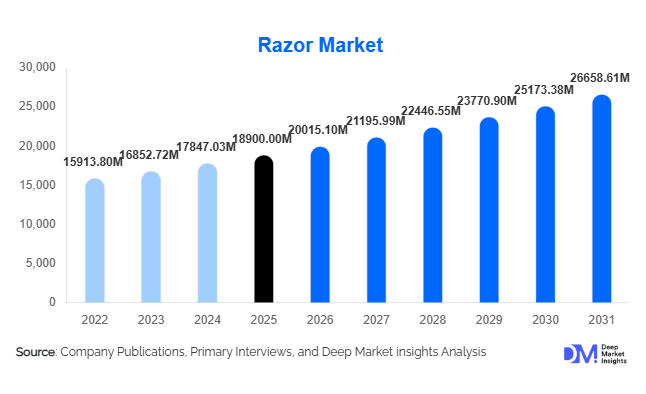
According to Deep Market Insights, the global razor market size was valued at USD 18,900 million in 2025 and is projected to grow from USD 20,015.10 million in 2026 to reach USD 26,658.61 million by 2031, expanding at a CAGR of 5.9% during the forecast period (2026–2031). The razor market growth is primarily driven by increasing grooming awareness, rising disposable incomes, and continuous product innovations across both manual and electric shaving segments. The growing influence of social media, premiumization trends, and expansion of direct-to-consumer (DTC) brands are further reshaping global demand dynamics.
Key Market Insights
- Manual razors dominate the market, accounting for over 60% share due to affordability and accessibility in emerging economies.
- Multi-blade razors are witnessing strong adoption, driven by demand for smoother and faster shaving experiences.
- Asia-Pacific leads the global market, supported by large population bases and rising grooming awareness in countries like China and India.
- Electric razors are the fastest-growing segment, particularly in developed regions, due to convenience and technological advancements.
- Online distribution channels are expanding rapidly, fueled by subscription-based razor models and e-commerce growth.
- Sustainability trends are reshaping product innovation, with increasing demand for recyclable materials and reusable razor systems.
What are the latest trends in the razor market?
Shift Toward Sustainable and Reusable Razors
The razor market is witnessing a significant shift toward sustainability, driven by consumer awareness regarding plastic waste. Manufacturers are introducing reusable handles, recyclable cartridges, and metal safety razors to reduce environmental impact. Regulatory pressure, especially in Europe, is accelerating the adoption of eco-friendly materials and packaging. Brands are also investing in biodegradable components and refill systems to align with global sustainability goals. This trend is particularly strong among younger consumers who prioritize environmentally responsible products.
Rise of Subscription-Based and DTC Models
Subscription-based razor services are transforming the traditional retail landscape. Companies are offering personalized grooming kits delivered at regular intervals, enhancing convenience and customer loyalty. Direct-to-consumer platforms enable brands to gather consumer data, optimize pricing, and offer tailored solutions. This model reduces dependency on intermediaries and improves margins while providing consumers with cost-effective and customized grooming solutions.
What are the key drivers in the razor market?
Increasing Grooming Awareness
Growing emphasis on personal hygiene and appearance is a major driver for the razor market. Social media influence, corporate grooming standards, and lifestyle changes have made regular shaving an essential routine. This trend is particularly prominent among younger demographics and urban populations.
Expansion of the Female Grooming Segment
The increasing adoption of grooming products among women is significantly contributing to market growth. Specialized razors designed for sensitive skin and body grooming are gaining popularity. This segment is witnessing strong innovation in product design and marketing strategies.
What are the restraints for the global market?
Competition from Alternative Hair Removal Methods
Alternatives such as laser hair removal, waxing, and depilatory creams pose a challenge to the razor market. These methods offer longer-lasting results, reducing the frequency of razor usage, particularly in urban and developed markets.
Environmental Concerns Related to Disposable Razors
The widespread use of disposable plastic razors contributes to environmental pollution, leading to increasing regulatory scrutiny. Companies face challenges in balancing cost efficiency with sustainable product development.
What are the key opportunities in the razor industry?
Premiumization and Product Innovation
There is a growing opportunity for premium razor products featuring advanced blade technology, ergonomic designs, and enhanced comfort features. Consumers are willing to pay higher prices for improved shaving experiences, creating scope for innovation-driven growth.
Expansion in Emerging Markets
Emerging economies such as India, Brazil, and Indonesia present significant growth opportunities. Rising disposable incomes, urbanization, and increasing awareness of personal grooming are driving demand for branded razors in these regions.
Report Scope
| Report Metric | Details |
|---|---|
| Market Size in 2025 | USD 18900 Million |
| Market Size in 2026 | USD 20015.10 Million |
| Market Size in 2031 | USD 26658.61 Million |
| CAGR | 5.9% (2026-2031) |
| Base Year for Estimation | 2025 |
| Historical Data | 2022-2024 |
| Forecast Period | 2026-2031 |
| Report Coverage | Revenue Forecast, Competitive Landscape, Supply Chain Disruption, Growth Factors, Environment & Regulatory Landscape and Trends |
| Geographies Covered | North America, Europe, APAC, Middle East and Africa, LATAM |
| Countries Covered | U.S., Canada, U.K., Germany, France, Spain, Italy, Russia, Nordic, Benelux, Rest of Europe, China, Korea, Japan, India, Australia, Singapore, Taiwan, South East Asia, Rest of Asia-Pacific, UAE, Turky, Saudi Arabia, South Africa, Egypt, Nigeria, Rest of MEA, Brazil, Mexico, Argentina, Chile, Colombia, Rest of LATAM |
Explore more data points, trends and opportunities Download Free Sample Report
Product Type Insights
Manual razors continue to dominate the global razor market, accounting for approximately 62% share in 2025. This dominance is primarily driven by their affordability, ease of use, and widespread availability across both developed and emerging markets. Within this segment, cartridge razors lead due to their superior convenience, replaceable heads, and enhanced shaving performance, including lubrication strips and flexible blade systems. The strong penetration of manual razors in price-sensitive markets such as Asia-Pacific and Latin America further reinforces their leadership position. In contrast, electric razors, while holding a smaller share, are experiencing robust growth driven by increasing consumer preference for convenience, time-saving grooming solutions, and skin-friendly technologies. Features such as wet/dry functionality, longer battery life, fast charging, and ergonomic designs are accelerating adoption, particularly in North America and Europe. The rising trend of male grooming and the premiumization of personal care products are also key drivers supporting the growth of electric razors globally.
Application Insights
Household usage dominates the razor market, contributing nearly 85% of total demand, as razors remain an essential component of daily personal grooming routines. The consistent need for shaving products across diverse demographic groups ensures steady demand in this segment. Increasing grooming awareness, especially among younger consumers and women, is further strengthening household consumption patterns. Commercial applications, including salons and barbershops, represent a smaller but stable segment, benefiting from the steady expansion of the professional grooming industry, particularly in urban areas. Additionally, the hospitality sector is emerging as a niche yet growing application segment, with hotels, airlines, and travel accommodations increasingly offering disposable razors as part of their guest service kits. This trend is driven by the rising emphasis on customer convenience and premium service offerings in the global hospitality industry.
Distribution Channel Insights
Offline retail channels continue to dominate the razor market, accounting for approximately 70% of total sales in 2025. Supermarkets, hypermarkets, pharmacies, and specialty stores remain the primary points of purchase due to their accessibility, consumer trust, and ability to offer a wide range of products. However, online distribution channels are witnessing rapid growth, driven by the expansion of e-commerce platforms, digital payment infrastructure, and increasing internet penetration. Subscription-based razor services and direct-to-consumer (DTC) models are significantly reshaping the competitive landscape, allowing brands to establish direct relationships with consumers, offer personalized grooming solutions, and improve customer retention. The convenience of home delivery, competitive pricing, and access to product reviews are key factors accelerating online channel growth globally.
Gender Insights
Men’s razors account for approximately 68% of the global market, largely driven by higher shaving frequency and established grooming habits among male consumers. The segment benefits from continuous product innovation, including multi-blade systems and advanced shaving technologies. However, the women’s razor segment is emerging as the fastest-growing category, supported by increasing awareness of personal grooming, rising disposable incomes, and the introduction of specialized products designed for sensitive skin and body grooming. Marketing strategies targeting female consumers, along with expanding product portfolios, are further driving growth in this segment. The unisex category is also gaining traction, particularly in premium and sustainable product lines.
Explore more data points, trends and opportunities Download Free Sample Report
Razor Market Segmentations
By Product Type
- Manual Razors
- Electric Razors
- Cartridge Razors
- Disposable Razors
- Safety Razors
By Application
- Household/Personal Use
- Commercial Use
- Hospitality & Travel Amenities
By Distribution Channel
- Online Retail
- Supermarkets/Hypermarkets
- Pharmacies & Drug Stores
- Specialty Stores
- Direct-to-Consumer (DTC)
By Gender
- Men
- Women
- Unisex
Regional Insights
Asia-Pacific
Asia-Pacific holds the largest share of the global razor market at approximately 38% in 2025, driven by its large population base and rapidly growing middle class. China and India are the key contributors, supported by increasing grooming awareness, urbanization, and rising disposable incomes. The expansion of modern retail formats and e-commerce platforms is further enhancing product accessibility. India, in particular, is the fastest-growing market in the region, benefiting from favorable demographics, government initiatives supporting manufacturing, and increasing penetration of branded grooming products. Additionally, the growing youth population and rising influence of social media trends are accelerating demand for both manual and electric razors.
North America
North America accounts for around 25% of the global razor market, with the United States leading demand. The region is characterized by high consumer spending power and a strong preference for premium grooming products. The widespread adoption of electric razors, coupled with the success of subscription-based and direct-to-consumer models, is a key growth driver. Technological innovation, including smart grooming devices and skin-sensitive blades, is further enhancing product appeal. Additionally, increasing demand for sustainable and eco-friendly razors is influencing purchasing decisions, prompting manufacturers to introduce recyclable and reusable products.
Europe
Europe represents approximately 22% of the global market, with major contributions from Germany, the United Kingdom, and France. The region’s growth is driven by strong consumer awareness regarding sustainability and environmental impact. Stringent regulations related to plastic usage and waste management are encouraging the adoption of eco-friendly razors and recyclable materials. Premiumization trends and demand for high-quality grooming products are also supporting market expansion. Furthermore, the presence of established brands and a well-developed retail infrastructure contributes to steady market growth across the region.
Latin America
Latin America contributes about 8% of the global razor market, with Brazil and Mexico emerging as key markets. Growth in this region is driven by improving economic conditions, rising urbanization, and increasing awareness of personal grooming. The expanding middle-class population is fueling demand for affordable yet high-quality grooming products. Additionally, the growing influence of international brands and the expansion of retail networks are supporting market development. Promotional pricing strategies and localized product offerings are also playing a crucial role in driving adoption.
Middle East & Africa
The Middle East & Africa region holds approximately 7% share of the global market, with growth primarily driven by increasing urbanization, rising disposable incomes, and expanding retail infrastructure in GCC countries and South Africa. The growing young population and increasing focus on personal grooming are key demand drivers. In the Middle East, premium grooming products are gaining traction due to higher purchasing power, while in Africa, affordability and accessibility remain critical factors influencing market growth. The gradual expansion of e-commerce platforms and international brand presence is expected to further boost market penetration across the region.
Key Players in the Razor Market
- Procter & Gamble
- Edgewell Personal Care
- Philips
- Panasonic
- BIC
- Harry’s Inc.
- Dollar Shave Club
- Feather Safety Razor
- Kai Group
- Super-Max
- Dorco
- Syska
- Wahl Clipper Corporation
- Conair Corporation
- Remington (Spectrum Brands)