Range Hood Market Size
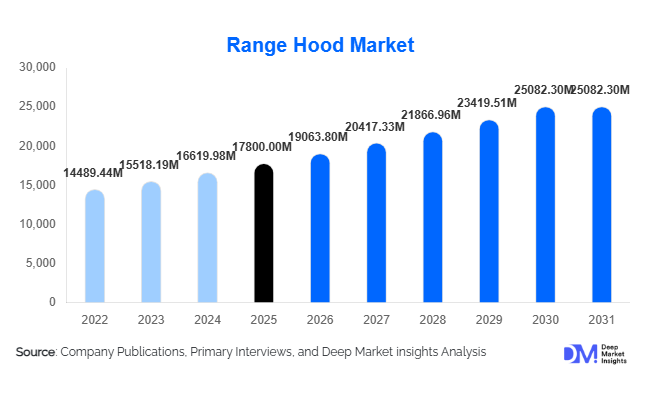
According to Deep Market Insights, the global range hood market size was valued at USD 17,800 million in 2025 and is projected to grow from USD 19,063.80 million in 2026 to reach USD 26,863.14 million by 2031, expanding at a CAGR of 7.1% during the forecast period (2026–2031). The range hood market growth is primarily driven by increasing urbanization, rising awareness of indoor air quality, and the growing adoption of modular kitchen solutions across residential and commercial spaces.
Key Market Insights
- Indoor air quality awareness is significantly driving adoption, as consumers increasingly recognize the health impact of cooking emissions.
- Asia-Pacific dominates the global market, led by strong demand from China and India due to urban expansion and rising middle-class income.
- Residential applications account for the majority share, driven by rapid housing development and kitchen modernization trends.
- Mid-range products lead the market, offering a balance between affordability and performance, especially in emerging economies.
- Smart and connected range hoods are gaining traction, supported by growing smart home ecosystems and IoT integration.
- Commercial demand is accelerating, particularly from cloud kitchens and quick-service restaurants requiring efficient ventilation systems.
What are the latest trends in the range hood market?
Smart and Connected Kitchen Integration
One of the most prominent trends in the range hood market is the rapid adoption of smart and connected appliances. Modern range hoods are increasingly equipped with IoT capabilities, enabling synchronization with cooktops and mobile applications. Features such as automatic suction adjustment, air quality monitoring, and voice control are enhancing user convenience. These advancements are particularly appealing to urban consumers seeking seamless kitchen automation. Additionally, manufacturers are integrating AI-based sensors that detect smoke intensity and adjust performance accordingly, improving energy efficiency and user experience.
Premiumization and Aesthetic Customization
Consumers are increasingly viewing kitchens as lifestyle spaces, leading to rising demand for aesthetically appealing and premium range hoods. Wall-mounted chimney designs, minimalist finishes, and customizable materials such as stainless steel and glass are gaining popularity. Premium products with low-noise operation, touchless controls, and advanced filtration systems are witnessing higher adoption, especially in developed markets. This trend is also supported by the growth of modular kitchens, where design uniformity and appliance integration play a critical role in purchasing decisions.
What are the key drivers in the range hood market?
Growing Awareness of Indoor Air Quality
Rising concerns over indoor air pollution caused by cooking emissions, grease, and smoke are significantly driving demand for range hoods. Regulatory bodies and health organizations are increasingly emphasizing proper ventilation in residential and commercial kitchens. This has led to higher adoption rates, particularly in North America and Europe, where building codes mandate ventilation standards. Consumers are also becoming more proactive in investing in appliances that enhance health and safety within indoor environments.
Rapid Urbanization and Housing Development
Urbanization, particularly in the Asia-Pacific and Latin America, is contributing to large-scale residential construction. The proliferation of apartments and compact urban homes has increased the need for efficient kitchen ventilation solutions. Modular kitchens are becoming standard in new housing developments, and range hoods are increasingly included as essential appliances. This structural shift in housing design is expected to sustain long-term demand growth.
What are the restraints for the global market?
High Installation and Maintenance Costs
Ducted range hood systems often require complex installation, including ductwork and structural modifications. This increases upfront costs and limits adoption in price-sensitive markets. Maintenance costs associated with cleaning and replacing filters further add to the total cost of ownership, discouraging some consumers.
Limited Awareness in Emerging Rural Markets
Despite strong urban demand, awareness and adoption remain low in rural and underdeveloped regions. Traditional cooking methods and lack of infrastructure reduce the perceived need for range hoods, limiting market penetration in these areas.
What are the key opportunities in the range hood industry?
Expansion in Emerging Economies
Emerging markets such as India, Southeast Asia, and parts of Africa present significant growth opportunities due to rising disposable incomes and urban housing development. Manufacturers can tap into these markets by offering cost-effective and compact solutions tailored to local needs.
Growth of Commercial and Cloud Kitchens
The rapid expansion of food delivery platforms has led to a surge in cloud kitchens and small-scale commercial cooking facilities. These setups require efficient ventilation systems, creating strong demand for high-performance range hoods. This segment is expected to grow faster than traditional restaurant applications.
Report Scope
| Report Metric | Details |
|---|---|
| Market Size in 2025 | USD 17800 Million |
| Market Size in 2026 | USD 19063.80 Million |
| Market Size in 2031 | USD 26863.14 Million |
| CAGR | 7.1% (2026-2031) |
| Base Year for Estimation | 2025 |
| Historical Data | 2022-2024 |
| Forecast Period | 2026-2031 |
| Report Coverage | Revenue Forecast, Competitive Landscape, Supply Chain Disruption, Growth Factors, Environment & Regulatory Landscape and Trends |
| Geographies Covered | North America, Europe, APAC, Middle East and Africa, LATAM |
| Countries Covered | U.S., Canada, U.K., Germany, France, Spain, Italy, Russia, Nordic, Benelux, Rest of Europe, China, Korea, Japan, India, Australia, Singapore, Taiwan, South East Asia, Rest of Asia-Pacific, UAE, Turky, Saudi Arabia, South Africa, Egypt, Nigeria, Rest of MEA, Brazil, Mexico, Argentina, Chile, Colombia, Rest of LATAM |
Explore more data points, trends and opportunities Download Free Sample Report
Product Type Insights
Wall-mounted (chimney) range hoods dominate the global market, accounting for approximately 32% of the total market share in 2025. The leadership of this segment is primarily driven by its strong alignment with modern modular kitchen designs, particularly in urban households where aesthetics and performance are equally important. These range hoods offer higher suction capacity, efficient smoke extraction, and enhanced visual appeal, making them the preferred choice in mid-range and premium residential segments. Additionally, increasing consumer inclination toward open kitchen layouts has further accelerated demand for visually appealing chimney-style hoods.
Under-cabinet range hoods continue to hold a significant share due to their compact design and affordability, making them suitable for smaller kitchens and price-sensitive markets. Meanwhile, island and ceiling-mounted range hoods are witnessing rising adoption in luxury residential and high-end commercial spaces, driven by premium kitchen layouts and the growing trend of open-plan cooking areas. The expansion of premium real estate and high-end hospitality infrastructure is further supporting growth in these advanced product categories.
Application Insights
The residential segment remains the dominant application area, contributing nearly 68% of the global market share in 2025. This dominance is largely driven by rapid urbanization, increasing disposable incomes, and the widespread adoption of modular kitchens across both developed and emerging economies. The growing awareness of indoor air quality and the need to manage cooking emissions have further reinforced the importance of range hoods as essential kitchen appliances rather than optional additions.
On the other hand, the commercial segment is emerging as the fastest-growing application, supported by the rapid expansion of the global food service industry. Restaurants, hotels, and particularly cloud kitchens are increasingly investing in high-performance ventilation systems to comply with hygiene regulations and improve operational efficiency. The proliferation of food delivery platforms and quick-service restaurants is significantly boosting demand for durable and high-capacity range hoods in commercial environments, making this segment a key growth driver for the overall market.
Distribution Channel Insights
Offline retail channels continue to dominate the range hood market, accounting for approximately 62% of total sales. This dominance is driven by consumer preference for in-store experiences when purchasing high-value appliances, where they can physically evaluate product quality, design, and functionality. Specialty appliance stores and large-format retail outlets play a crucial role in influencing purchase decisions through demonstrations and expert guidance.
However, online distribution channels are witnessing rapid growth, driven by increasing internet penetration, rising consumer confidence in e-commerce platforms, and the availability of competitive pricing. Online platforms offer a wide range of product comparisons, customer reviews, and promotional discounts, making them particularly attractive to younger and tech-savvy consumers. The shift toward omnichannel retail strategies, where manufacturers integrate both offline and online touchpoints, is further enhancing market accessibility and driving sales growth.
Technology Insights
Conventional range hoods currently dominate the market, holding approximately 75% of the global market share. Their widespread adoption is attributed to cost-effectiveness, reliability, and established consumer familiarity, particularly in developing regions where price sensitivity remains a key factor. These systems continue to be the preferred choice for mass-market consumers due to their functional efficiency and lower upfront costs.
In contrast, smart and connected range hoods represent the fastest-growing technology segment. The growth of this segment is driven by the increasing adoption of smart home ecosystems and the demand for automated, energy-efficient appliances. Features such as IoT connectivity, sensor-based operation, auto-clean technology, and integration with voice assistants are significantly enhancing user convenience. As consumers increasingly prioritize convenience, energy savings, and advanced functionality, smart range hoods are expected to gain substantial market share over the forecast period.
Explore more data points, trends and opportunities Download Free Sample Report
Range Hood Market Segmentations
By Product Type
- Under-Cabinet Range Hoods
- Wall-Mounted (Chimney) Range Hoods
- Island Range Hoods
- Downdraft Range Hoods
- Ceiling-Mounted/Integrated Range Hoods
By Application
- Residential
- Commercial
By Distribution Channel
- Offline Retail
- Online Retail
By Technology
- Conventional Range Hoods
- Smart/Connected Range Hoods
By Ventilation Type
- Ducted Range Hoods
- Ductless Range Hoods
Regional Insights
Asia-Pacific
Asia-Pacific dominates the global range hood market, accounting for approximately 42% of the total market share in 2025. The region’s leadership is driven by strong demand from China, which benefits from a large population base, extensive manufacturing capabilities, and high penetration of kitchen appliances in urban households. India is emerging as the fastest-growing market in the region, supported by rapid urbanization, increasing middle-class income, and expanding residential construction activities.
Key growth drivers in Asia-Pacific include the rising adoption of modular kitchens, government initiatives supporting housing development, and increasing awareness of indoor air quality. Additionally, the presence of low-cost manufacturing hubs enables competitive pricing, further accelerating product adoption across both urban and semi-urban areas.
North America
North America holds approximately 24% of the global market share, with the United States being the primary contributor. The region’s growth is driven by high consumer awareness regarding indoor air quality, strong demand for premium and technologically advanced appliances, and stringent building codes that mandate effective kitchen ventilation systems. Another key driver is the robust home renovation and remodeling market, where consumers are upgrading kitchens with modern appliances, including high-performance range hoods. Canada also contributes to regional growth through steady residential construction and increasing adoption of energy-efficient appliances. The strong presence of established manufacturers and continuous product innovation further supports market expansion in this region.
Europe
Europe accounts for approximately 22% of the global market, with major contributions from Germany, the UK, France, and Italy. The region’s growth is strongly influenced by stringent energy efficiency regulations and environmental standards, which are encouraging the adoption of advanced and eco-friendly range hood systems. In addition, the high penetration of modular kitchens and consumer preference for premium, aesthetically designed appliances are driving demand. Technological innovation, particularly in low-noise and energy-efficient systems, is also a key growth driver. The presence of leading appliance manufacturers in Europe further strengthens the region’s competitive landscape and supports continuous product development.
Latin America
Latin America contributes approximately 6–7% of the global market, with Brazil and Mexico leading regional demand. Market growth in this region is primarily driven by increasing urbanization, rising disposable incomes, and gradual improvements in living standards. The expansion of residential construction and the growing adoption of modern kitchen appliances are key factors supporting demand. However, price sensitivity and lower awareness levels compared to developed regions limit faster adoption. Despite these challenges, improving retail infrastructure and increasing availability of affordable products are expected to drive steady growth in the coming years.
Middle East & Africa
The Middle East & Africa region is an emerging market for range hoods, with growing demand from countries such as the UAE and Saudi Arabia. The region’s growth is driven by rapid infrastructure development, expansion of the hospitality and tourism sectors, and increasing investments in residential real estate. Additionally, rising disposable incomes and the growing influence of modern lifestyle trends are encouraging the adoption of modular kitchens and advanced appliances. Government initiatives focused on urban development and smart city projects are further supporting market expansion. Although the market is still in its early stages compared to other regions, it offers significant long-term growth potential due to increasing consumer awareness and infrastructure investments.
Key Players in the Range Hood Market
- Whirlpool Corporation
- Electrolux AB
- BSH Home Appliances
- Samsung Electronics
- LG Electronics
- Haier Group
- Panasonic Corporation
- Midea Group
- Elica S.p.A.
- Faber S.p.A.
- Broan-NuTone
- Arçelik A.Ş.
- Bosch
- Siemens
- Viking Range