Raincoats and Rain Jackets Market Size
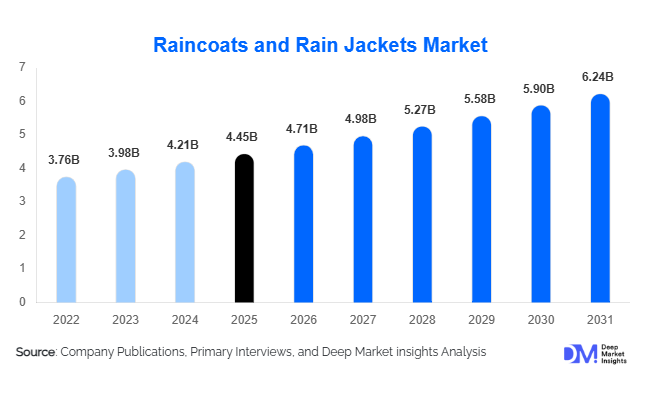
According to Deep Market Insights, the global raincoats and rain jackets market size was valued at USD 4.45 billion in 2025 and is projected to grow from USD 4.71 billion in 2026 to reach USD 6.24 billion by 2031, expanding at a CAGR of 5.8% during the forecast period (2026–2031). The raincoats and rain jackets market growth is primarily driven by increasing climate variability, rising demand for outdoor recreation apparel, growing urban commuting requirements, and expanding adoption of waterproof protective clothing across industrial and commercial sectors. Rising consumer preference for lightweight, breathable, and sustainable rainwear products is also accelerating global market expansion.
Key Market Insights
- Sustainable waterproof apparel is becoming a major market trend, with increasing adoption of recycled polyester fabrics and PFAS-free waterproof coatings.
- Technical rain jackets dominate premium demand globally, particularly among outdoor recreation enthusiasts and urban commuters seeking breathable waterproof performance.
- Asia-Pacific dominates the global market, supported by strong monsoon-driven demand, large textile manufacturing capacity, and growing middle-class spending.
- North America remains a leading premium market, driven by strong outdoor recreation participation and demand for high-performance waterproof outerwear.
- Online retail channels are rapidly expanding, enabling global brands to improve direct-to-consumer sales and strengthen digital engagement.
- Industrial and occupational rainwear demand is increasing, supported by infrastructure development, logistics expansion, and worker safety regulations.
What are the latest trends in the raincoats and rain jackets market?
Sustainable and Eco-Friendly Waterproof Apparel Adoption
The global raincoats and rain jackets market is witnessing a strong transition toward sustainable waterproof apparel solutions. Consumers are increasingly demanding rainwear products manufactured using recycled polyester, biodegradable coatings, and environmentally compliant waterproofing technologies. Major outdoor apparel brands are actively replacing fluorocarbon-based coatings with PFAS-free alternatives to comply with tightening environmental regulations across North America and Europe. Sustainability certifications, low-carbon textile manufacturing, and circular apparel initiatives are becoming key purchasing considerations for younger consumers. Brands are also introducing recyclable rainwear collections and repair-focused programs to improve product lifecycle management and reduce textile waste generation.
Growing Demand for Technical Performance Rainwear
Technical rainwear products featuring breathable membranes, lightweight fabrics, and advanced seam-sealing technologies are experiencing significant global demand growth. Outdoor activities such as trekking, hiking, cycling, mountaineering, fishing, and camping continue to drive demand for multifunctional waterproof jackets that combine comfort, durability, and weather protection. Urban consumers are also increasingly purchasing technical rain jackets for daily commuting and travel applications. Manufacturers are integrating moisture management systems, reflective safety elements, ergonomic fits, and packable designs to enhance user convenience. Smart textile technologies and hybrid weather-adaptive materials are also emerging as innovation areas within the premium rainwear segment.
What are the key drivers in the raincoats and rain jackets market?
Rising Climate Variability and Unpredictable Weather Conditions
Increasing frequency of heavy rainfall events and changing climatic patterns globally are significantly driving demand for waterproof outerwear products. Consumers across Asia-Pacific, Europe, and North America are increasingly purchasing rainwear products as essential everyday apparel rather than seasonal accessories. Urban flooding, prolonged monsoon seasons, and rising outdoor mobility requirements have strengthened year-round demand for lightweight and durable rain jackets. Governments and employers are also emphasizing worker safety for outdoor occupations, further supporting industrial rainwear consumption.
Growth of Outdoor Recreation and Adventure Tourism
The expansion of global outdoor recreation activities is another major growth driver for the raincoats and rain jackets market. Hiking, trekking, camping, cycling, fishing, and mountaineering activities have gained substantial popularity among younger and fitness-oriented consumers. Technical waterproof apparel has become essential for outdoor enthusiasts seeking breathable and high-performance weather protection. Premium outdoor apparel brands are increasingly launching specialized rain jackets designed for specific sports and weather conditions. Adventure tourism growth across North America, Europe, and the Asia-Pacific continues to create sustained demand for premium waterproof outerwear.
What are the restraints for the global market?
Raw Material Price Volatility
Fluctuating prices of polyester, nylon, polyurethane coatings, and advanced waterproof membrane materials continue to challenge rainwear manufacturers globally. Most waterproof fabrics rely heavily on petrochemical-based feedstocks, making production costs vulnerable to energy price volatility and global supply chain disruptions. Sudden increases in raw material costs can directly impact profit margins and retail pricing, particularly in price-sensitive emerging markets. Smaller manufacturers often face difficulties in absorbing these cost fluctuations while maintaining product competitiveness.
Environmental Compliance and Sustainability Challenges
The rainwear industry faces increasing regulatory scrutiny regarding synthetic waterproof coatings, textile waste, and chemical emissions. Traditional waterproof technologies frequently depend on fluorinated compounds that are now subject to stricter environmental regulations across Europe and North America. Manufacturers must invest heavily in sustainable R&D, compliance testing, and cleaner manufacturing technologies to remain competitive. Additionally, the growing prevalence of counterfeit and low-quality rainwear products in unorganized markets creates pricing pressure for established premium brands.
What are the key opportunities in the raincoats and rain jackets industry?
Expansion of Sustainable Waterproof Technologies
The increasing consumer preference for sustainable apparel creates major opportunities for manufacturers investing in eco-friendly waterproof technologies. Demand for recycled synthetic fabrics, biodegradable waterproof coatings, and low-emission textile manufacturing processes is accelerating globally. Brands introducing PFAS-free water-repellent systems and recyclable rainwear collections are gaining competitive advantages in premium consumer segments. Sustainability-driven innovation is expected to create new revenue opportunities across both outdoor recreation and fashion-oriented rainwear categories.
Growth in Urban Mobility and Gig-Economy Demand
Rapid expansion of delivery services, bike commuting, and app-based mobility ecosystems is creating strong demand for functional commuter rainwear products. Food delivery workers, logistics operators, cyclists, and urban commuters increasingly require lightweight waterproof outerwear integrated with reflective safety elements and ergonomic designs. Emerging economies in the Asia-Pacific, particularly India, Indonesia, Vietnam, and China, are witnessing rapid growth in commuter rainwear adoption due to rising urbanization and two-wheeler transportation usage. Manufacturers targeting these mobility-focused applications are expected to experience strong long-term growth opportunities.
Report Scope
| Report Metric | Details |
|---|---|
| Market Size in 2025 | USD 4.45 Billion |
| Market Size in 2026 | USD 4.71 Billion |
| Market Size in 2031 | USD 6.24 Billion |
| CAGR | 5.8% (2026-2031) |
| Base Year for Estimation | 2025 |
| Historical Data | 2022-2024 |
| Forecast Period | 2026-2031 |
| Report Coverage | Revenue Forecast, Competitive Landscape, Supply Chain Disruption, Growth Factors, Environment & Regulatory Landscape and Trends |
| Geographies Covered | North America, Europe, APAC, Middle East and Africa, LATAM |
| Countries Covered | U.S., Canada, U.K., Germany, France, Spain, Italy, Russia, Nordic, Benelux, Rest of Europe, China, Korea, Japan, India, Australia, Singapore, Taiwan, South East Asia, Rest of Asia-Pacific, UAE, Turky, Saudi Arabia, South Africa, Egypt, Nigeria, Rest of MEA, Brazil, Mexico, Argentina, Chile, Colombia, Rest of LATAM |
Explore more data points, trends and opportunities Download Free Sample Report
Product Type Insights
Rain jackets dominate the global raincoat and rain jackets market, accounting for nearly 38% of total market revenue in 2025. The segment’s leadership is primarily driven by rising consumer preference for lightweight, multifunctional, and performance-oriented waterproof outerwear suitable for daily commuting, outdoor recreation, and travel applications. Technical rain jackets featuring breathable waterproof membranes, seam-sealed construction, moisture-management systems, and packable lightweight designs have gained substantial popularity among urban consumers, cyclists, trekkers, and adventure sports participants. The increasing adoption of premium outdoor apparel globally has further strengthened demand for insulated waterproof jackets and shell jackets designed for extreme weather conditions.
The growth of the rain jacket segment is also being fueled by rapid expansion in outdoor tourism and adventure recreation activities such as hiking, mountaineering, camping, and cycling. Consumers increasingly prefer versatile rain jackets that combine weather protection, comfort, and fashion appeal, encouraging manufacturers to launch hybrid products suitable for both urban and recreational use. In developed markets such as North America and Europe, demand for premium waterproof jackets continues to rise due to high consumer spending on technical outdoor apparel and increasing awareness regarding sustainable waterproof technologies.
Raincoats continue to witness strong demand across emerging economies, particularly in monsoon-prone regions of the Asia-Pacific, including India, China, Indonesia, Bangladesh, and Vietnam, where prolonged rainy seasons significantly support seasonal and year-round consumption. Affordable PVC- and polyester-based raincoats remain popular among mass-market consumers and commuters. Meanwhile, ponchos and industrial rain suits maintain steady institutional demand from construction, logistics, agriculture, mining, marine, and public safety sectors due to their durability and large-area weather protection capabilities. Industrial rainwear products integrated with reflective materials and safety-certified waterproof fabrics are increasingly being adopted across occupational safety applications globally.
Application Insights
Urban commuting remains the leading application segment in the global raincoats and rain jackets market, accounting for approximately 27% of total market demand in 2025. The dominance of this segment is driven by rapid urbanization, increasing motorcycle and bicycle commuting, and growing reliance on public transportation systems in densely populated cities. Rising demand from office commuters, gig-economy workers, delivery personnel, and urban mobility users has significantly increased the consumption of lightweight, ergonomic, and breathable waterproof apparel products. Reflective rain jackets and compact foldable rainwear products are becoming increasingly popular among consumers seeking convenience and visibility during adverse weather conditions.
The outdoor recreation segment represents one of the fastest-growing applications globally due to the rising popularity of trekking, hiking, camping, fishing, mountaineering, and adventure tourism. Technical waterproof apparel is increasingly viewed as an essential product category among outdoor enthusiasts, particularly in North America, Europe, Japan, Australia, and selected Southeast Asian markets. Growth in wellness tourism and eco-tourism is further supporting demand for high-performance waterproof jackets designed for multi-climate outdoor activities.
Industrial and construction applications are also expanding steadily as governments and private employers strengthen worker safety standards for outdoor labor environments. Construction workers, warehouse operators, utility personnel, transportation workers, and logistics employees increasingly require certified waterproof protective apparel to ensure operational continuity during extreme weather conditions. Marine, fisheries, mining, and agricultural sectors continue to generate stable institutional demand for durable industrial rainwear due to long working hours in outdoor and wet-weather environments. The increasing frequency of climate-related disruptions globally is also encouraging companies to invest more heavily in occupational waterproof protective clothing.
Distribution Channel Insights
Offline retail channels continue to dominate the global raincoats and rain jackets market, accounting for athe pproximately 61% of global sales in 2025. The leadership of offline retail is largely driven by consumer preference for physically evaluating fabric quality, fitting, waterproof capability, comfort, and durability before purchasing rainwear products. Specialty outdoor equipment stores and branded apparel outlets remain highly influential in premium waterproof jacket sales, particularly in North America, Europe, Japan, and Australia. Consumers purchasing technical outdoor rainwear often seek expert guidance regarding waterproof ratings, breathability levels, seam construction, and weather suitability, further strengthening the role of physical retail stores. Department stores, sportswear retailers, and hypermarkets also contribute significantly to volume sales in the economy and mid-range rainwear categories, particularly in Asia-Pacific and Latin America. Seasonal in-store promotions during monsoon and winter periods continue to support strong offline demand across emerging economies.
However, online retail channels are rapidly gaining market share due to rising digital penetration, smartphone usage, and e-commerce adoption globally. Online platforms allow consumers to compare product specifications, customer reviews, waterproof technologies, and pricing benchmarks more efficiently. Brand-owned websites and online marketplaces are enabling manufacturers to strengthen direct-to-consumer engagement, improve profitability, and expand geographic reach without major investments in physical retail infrastructure. AI-driven product recommendations, virtual fitting technologies, influencer marketing, and social commerce strategies are increasingly shaping purchasing behavior, particularly among younger consumers. The online segment is expected to witness the fastest growth during the forecast period as digital apparel shopping continues to expand across both developed and emerging markets.
Consumer Category Insights
Men represent the largest consumer category in the global raincoats and rain jackets market, accounting for nearly 46% of overall market demand in 2025. The segment’s dominance is primarily supported by strong participation in outdoor sports, commuting activities, industrial occupations, logistics operations, and recreational tourism. Male consumers continue to account for a significant share of premium technical waterproof jacket purchases, particularly across hiking, cycling, mountaineering, and fishing applications. Demand for durable, multifunctional, and weather-resistant rainwear products remains particularly strong among urban professionals and outdoor enthusiasts. Women’s rainwear is emerging as one of the fastest-growing segments globally due to increasing participation of women in outdoor recreation, fitness activities, adventure tourism, and urban mobility ecosystems. Manufacturers are increasingly introducing fashion-oriented waterproof apparel collections that combine aesthetics with technical performance, encouraging broader adoption among female consumers. Lightweight silhouettes, ergonomic tailoring, and sustainable fabrics are becoming important purchasing criteria within this segment.
Kids’ rainwear continues to generate stable demand, particularly in regions experiencing prolonged rainy seasons and colder climates. Parents increasingly prioritize waterproof apparel with improved comfort, flexibility, and safety features for school commuting and outdoor activities. Reflective elements, vibrant colors, and eco-friendly materials are becoming more common within children’s rainwear collections. In response to evolving consumer preferences, manufacturers are also expanding gender-neutral and unisex waterproof apparel offerings to improve inclusivity and product versatility.
Material Type Insights
Polyester-based rainwear dominates the global market with approximately 34% share in 2025 due to its affordability, durability, lightweight properties, moisture resistance, and compatibility with multiple waterproof coating technologies. Polyester fabrics are extensively used across the economy, mid-range, and premium rainwear categories because they offer an effective balance between performance and cost efficiency. The increasing adoption of recycled polyester materials is further strengthening the segment’s position as manufacturers seek to align with sustainability goals and environmentally conscious consumer preferences. Nylon-based rainwear remains highly popular within premium technical outdoor apparel categories because of its superior abrasion resistance, flexibility, and lightweight construction. Nylon fabrics are widely used in high-performance mountaineering jackets, shell jackets, and expedition-grade waterproof outerwear products where durability under extreme weather conditions is critical.
Advanced waterproof membrane technologies such as Gore-Tex and ePTFE laminates continue to dominate the premium waterproof jacket segment due to their exceptional breathability, long-term waterproof performance, and thermal regulation capabilities. These materials are increasingly preferred by professional athletes, trekkers, cyclists, and outdoor recreation enthusiasts. Simultaneously, sustainable waterproof materials, including recycled synthetic fabrics, bio-based coatings, and fluorocarbon-free water repellents, are witnessing rapid growth as environmental regulations tighten across Europe and North America. Manufacturers are increasingly investing in eco-friendly textile innovation to reduce carbon emissions and improve compliance with global sustainability standards.
Explore more data points, trends and opportunities Download Free Sample Report
Raincoats and Rain Jackets Market Segmentations
By Product Type
- Raincoats
- Rain Jackets
- Ponchos
- Rain Suits
- Protective Waterproof Outerwear
By Material Type
- Polyester-Based Rainwear
- Nylon-Based Rainwear
- Polyurethane (PU)-Coated Fabrics
- PVC-Based Rainwear
- Gore-Tex and ePTFE Membranes
- Recycled Waterproof Fabrics
By Application
- Urban Commuting
- Outdoor Recreation
- Sports & Adventure Activities
- Industrial & Construction Use
- Agricultural Use
- Marine & Offshore Applications
- Motorcycle & Cycling Applications
By Consumer Category
- Men
- Women
- Kids
- Unisex
By Distribution Channel
- Offline Retail
- Online Retail
- Specialty Outdoor Stores
- Department Stores
- Brand-Owned Websites
- E-Commerce Marketplaces
Regional Insights
North America
North America accounted for nearly 26% of the global raincoats and rain jackets market in 2025, driven by strong outdoor recreation participation, premium consumer spending, and high adoption of technical waterproof apparel. The United States remains the largest regional market due to growing participation in hiking, camping, cycling, fishing, mountaineering, and adventure tourism activities. The region has a highly developed outdoor apparel ecosystem supported by established premium brands, strong retail infrastructure, and rising demand for sustainable waterproof products. Increasing climate variability and extreme weather events across several U.S. states are also contributing to year-round rainwear consumption.
Canada contributes significantly to regional demand due to harsh climatic conditions, long winters, and rising adoption of insulated waterproof outerwear products. Growth in commuter cycling and outdoor mobility trends across major urban centers such as New York, Toronto, Vancouver, and Seattle is further supporting demand for lightweight technical rain jackets. Additionally, increasing consumer awareness regarding sustainable apparel and breathable waterproof membrane technologies continues to drive premium market expansion across North America.
Europe
Europe represented approximately 24% of the global market in 2025, supported by strong consumer awareness regarding outdoor performance apparel, sustainability, and eco-friendly textile adoption. Germany, the United Kingdom, France, Italy, and Nordic countries remain major regional demand centers due to active outdoor lifestyles and high participation in trekking, cycling, hiking, and winter sports. Northern and Western Europe continue to exhibit particularly strong demand for technical waterproof outerwear because of prolonged rainy seasons and colder climatic conditions.
The region is also leading the transition toward PFAS-free waterproof technologies and sustainable textile manufacturing practices due to strict environmental regulations and rising eco-conscious consumer behavior. European consumers increasingly prefer premium waterproof jackets manufactured using recycled materials and low-emission production processes. The growing popularity of cycling infrastructure, urban mobility initiatives, and adventure tourism across countries such as Germany, the Netherlands, Norway, and Sweden is further driving demand for lightweight commuter rainwear and high-performance outdoor jackets.
Asia-Pacific
Asia-Pacific dominates the global raincoats and rain jackets market with approximately 39% share in 2025 and is expected to remain the fastest-growing regional market during the forecast period. China remains both the largest consumer market and the leading global manufacturing hub for waterproof apparel products due to extensive textile manufacturing capacity, low-cost production ecosystems, and strong export capabilities. Rapid urbanization, rising disposable incomes, and increasing outdoor recreation participation continue to support robust regional demand growth.
India is emerging as one of the fastest-growing country-level markets globally due to strong monsoon-driven demand, increasing motorcycle ownership, rapid urban commuting expansion, and rising penetration of organized retail and e-commerce platforms. Southeast Asian countries, including Indonesia, Vietnam, Thailand, and the Philippines, continue to witness high rainwear consumption because of year-round rainfall patterns and growing urban populations. Japan and South Korea remain key premium markets supported by technologically advanced consumers, active outdoor lifestyles, and strong demand for high-performance waterproof apparel. Rising middle-class spending, expanding domestic tourism industries, and increasing awareness regarding branded outdoor apparel continue to accelerate long-term market growth across the Asia-Pacific.
Latin America
Latin America accounted for nearly 6% of the global raincoats and rain jackets market in 2025. Brazil remains the largest regional market due to increasing urban commuting demand, industrial rainwear consumption, and the expansion of logistics and transportation sectors. Rising motorcycle commuting across densely populated urban areas is significantly contributing to the demand for affordable waterproof apparel products. Infrastructure development activities and public transportation expansion are also supporting institutional demand for industrial rainwear.
Chile and Argentina are witnessing rising adoption of technical outdoor rainwear linked to growing trekking, mountaineering, and eco-tourism activities across Patagonia and other adventure tourism destinations. Increasing weather variability and expanding construction activities are also supporting growth in industrial waterproof apparel consumption. Regional e-commerce expansion is further improving accessibility to branded rainwear products across Latin American markets.
Middle East & Africa
The Middle East & Africa region represented approximately 5% of global market demand in 2025 and is projected to register one of the fastest growth rates during the forecast period. Large-scale infrastructure development projects, industrial expansion, and increasing occupational safety awareness are driving strong demand for waterproof protective apparel across the UAE, Saudi Arabia, South Africa, and selected African economies. Construction workers, logistics operators, utility personnel, and industrial laborers increasingly require certified waterproof clothing to ensure workplace safety and operational efficiency.
Tourism development initiatives across the Middle East and Africa are also supporting demand for lightweight travel-oriented rainwear products. Several African countries are witnessing rising adoption of rainwear due to increasing climate variability and longer rainy seasons. Urbanization and expansion of organized retail channels are further improving product accessibility across the region. In addition, growing investment in transportation, mining, oil & gas, and marine industries continues to support stable institutional demand for industrial-grade waterproof apparel.
Key Players in the Raincoats and Rain Jackets Market
- Columbia Sportswear Company
- VF Corporation
- Patagonia
- Helly Hansen
- Arc’teryx
- Marmot
- Outdoor Research
- Jack Wolfskin
- Berghaus
- Rab
- Fjallraven
- Canada Goose
- K-Way
- Rains
- Didriksons