Puffer Jacket Market Size
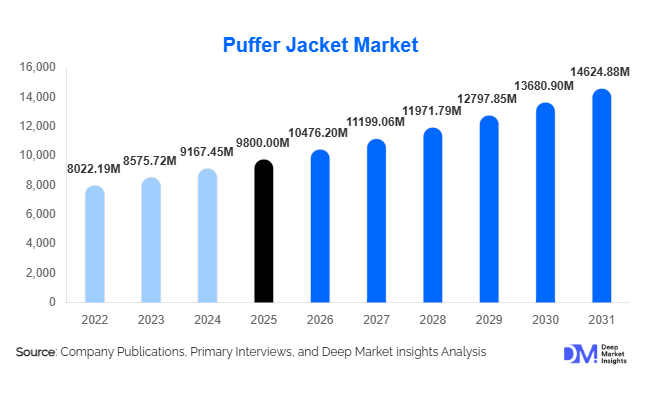
According to Deep Market Insights, the global puffer jacket market size was valued at USD 9,800 million in 2025 and is projected to grow from USD 10,476.20 million in 2026 to reach USD 14,624.88 million by 2031, expanding at a CAGR of 6.9% during the forecast period (2026–2031). The market growth is primarily driven by increasing adoption of outdoor lifestyles, rising demand for athleisure and winter fashion, and continuous innovation in insulation technologies. Puffer jackets have evolved from purely functional winter garments to fashion-forward outerwear, gaining popularity across diverse consumer segments globally.
Key Market Insights
- Puffer jackets are transitioning into everyday fashion wear, driven by the rise of athleisure and streetwear trends globally.
- Synthetic insulation is gaining dominance, supported by affordability, durability, and growing demand for animal-free products.
- North America dominates the market, accounting for over 30% share due to strong outdoor culture and high consumer spending.
- Asia-Pacific is the fastest-growing region, driven by rising disposable income and urban fashion adoption in China and India.
- E-commerce channels are expanding rapidly, reshaping distribution with direct-to-consumer and digital-first brand strategies.
- Sustainability trends are influencing product development, with increased use of recycled materials and ethical sourcing practices.
What are the latest trends in the puffer jacket market?
Sustainable and Eco-Friendly Materials Gaining Momentum
Environmental consciousness is significantly reshaping the puffer jacket market. Consumers are increasingly favoring jackets made from recycled polyester, biodegradable insulation, and responsibly sourced down. Brands are responding by integrating circular fashion models, offering repair services, and enhancing transparency in their supply chains. Certifications related to animal welfare and sustainability are becoming critical differentiators, particularly in developed markets. This trend is not only improving brand perception but also enabling companies to tap into premium pricing segments where consumers are willing to pay more for eco-friendly products.
Technology-Driven Product Innovation
Technological advancements are enhancing the functionality and appeal of puffer jackets. Innovations such as ultra-lightweight insulation, water-resistant coatings, and temperature-regulating fabrics are expanding their usability across seasons. Smart textiles and packable designs are also gaining traction, allowing consumers to carry jackets conveniently for travel and outdoor activities. These innovations are particularly appealing to younger, tech-savvy consumers who seek performance-oriented apparel with added convenience and style.
What are the key drivers in the puffer jacket market?
Growing Popularity of Outdoor and Adventure Activities
The increasing participation in outdoor activities such as hiking, skiing, and trekking is a major growth driver. Consumers require durable and insulated apparel for such activities, positioning puffer jackets as a preferred choice. This trend is particularly strong in North America and Europe, where outdoor recreation is deeply embedded in lifestyle patterns.
Rise of Athleisure and Fashion Integration
Puffer jackets have become a staple in modern fashion, blending functionality with aesthetics. Collaborations between luxury fashion houses and sportswear brands have elevated their appeal, making them suitable for both casual and premium segments. This shift has expanded the consumer base beyond traditional winter wear buyers.
What are the restraints for the global market?
Volatility in Raw Material Prices
Fluctuations in the cost of down feathers and synthetic fibers pose challenges for manufacturers. Price instability affects production costs and can impact profit margins, particularly for mid-range and budget brands.
Seasonal Dependency and Climate Variability
The demand for puffer jackets is highly seasonal and dependent on winter conditions. Warmer winters in certain regions due to climate change can reduce sales volumes and create inventory management challenges for retailers.
What are the key opportunities in the puffer jacket industry?
Expansion in Emerging Markets
Rapid urbanization and rising disposable incomes in countries such as China, India, and Brazil present significant growth opportunities. Consumers in these markets are increasingly adopting global fashion trends, including winter outerwear as a style statement.
Innovation in Sustainable and Hybrid Insulation
The development of hybrid insulation combining synthetic and natural materials offers improved performance and sustainability. Companies investing in such innovations can differentiate their products and capture environmentally conscious consumers.
Report Scope
| Report Metric | Details |
|---|---|
| Market Size in 2025 | USD 9800 Million |
| Market Size in 2026 | USD 10476.20 Million |
| Market Size in 2031 | USD 14624.88 Million |
| CAGR | 6.9% (2026-2031) |
| Base Year for Estimation | 2025 |
| Historical Data | 2022-2024 |
| Forecast Period | 2026-2031 |
| Report Coverage | Revenue Forecast, Competitive Landscape, Supply Chain Disruption, Growth Factors, Environment & Regulatory Landscape and Trends |
| Geographies Covered | North America, Europe, APAC, Middle East and Africa, LATAM |
| Countries Covered | U.S., Canada, U.K., Germany, France, Spain, Italy, Russia, Nordic, Benelux, Rest of Europe, China, Korea, Japan, India, Australia, Singapore, Taiwan, South East Asia, Rest of Asia-Pacific, UAE, Turky, Saudi Arabia, South Africa, Egypt, Nigeria, Rest of MEA, Brazil, Mexico, Argentina, Chile, Colombia, Rest of LATAM |
Explore more data points, trends and opportunities Download Free Sample Report
Product Type Insights
Midweight puffer jackets dominate the global market, accounting for approximately 38% of the total market share in 2025. The leadership of this segment is primarily driven by its optimal balance between insulation, comfort, and versatility. Unlike heavyweight jackets, which are limited to extreme winter conditions, and lightweight variants, which are seasonal, midweight jackets cater to a wide range of climates and use cases. This adaptability makes them highly attractive to both urban consumers and outdoor enthusiasts. Additionally, brands are increasingly focusing on stylish midweight designs, integrating them into fashion collections, which further boosts demand. Lightweight jackets are witnessing growing adoption, particularly in transitional seasons such as autumn and spring, due to their portability and layering capability. Meanwhile, heavyweight puffer jackets continue to serve niche markets, including mountaineering and extreme weather applications, where high thermal insulation is critical.
Application Insights
Casual wear remains the leading application segment, contributing nearly 47% of the global market share. This dominance is largely driven by the transformation of puffer jackets into everyday fashion essentials. Consumers increasingly prefer functional apparel that combines comfort with style, and puffer jackets meet this demand effectively. The rise of streetwear culture, celebrity endorsements, and designer collaborations has further embedded these jackets into daily wardrobes. In contrast, the sports and outdoor segment is emerging as the fastest-growing application, fueled by increasing participation in activities such as hiking, skiing, and trekking. This segment is benefiting from advancements in performance fabrics and insulation technologies that enhance durability, breathability, and weather resistance. Fashion and luxury applications are also gaining traction, particularly in premium markets, where high-end brands are positioning puffer jackets as statement pieces.
Distribution Channel Insights
Offline retail channels dominate the market with around 58% market share in 2025, primarily due to the tactile nature of apparel shopping. Consumers often prefer to physically try on jackets to assess fit, comfort, and insulation quality before making a purchase. Brand outlets and specialty stores also provide personalized experiences, which are particularly important in premium and luxury segments. However, online retail is the fastest-growing distribution channel, driven by the rapid expansion of e-commerce platforms and direct-to-consumer (DTC) strategies adopted by major brands. Online channels offer advantages such as wider product selection, competitive pricing, and convenience, making them increasingly popular among younger consumers. The integration of virtual fitting tools, easy return policies, and digital marketing strategies is further accelerating the shift toward online sales.
End-Use Insights
The women’s segment leads the market with approximately 45% share, driven by higher fashion engagement, frequent product replacement cycles, and a wider variety of design offerings. Women consumers tend to prioritize both aesthetics and functionality, prompting brands to continuously innovate in terms of colors, cuts, and materials. The men’s segment also holds a substantial share, supported by growing demand for performance-oriented outerwear and increasing interest in fashion-forward apparel. The kids’ segment is steadily expanding due to rising parental spending on high-quality winter wear. Among end-use categories, the sports and outdoor segment is the fastest-growing, registering an estimated CAGR of 7–8%, driven by global fitness trends and increasing adventure tourism. Additionally, demand from workwear applications is emerging, particularly in cold-climate industries such as construction, logistics, and mining, where insulated clothing is essential for worker safety and productivity.
Explore more data points, trends and opportunities Download Free Sample Report
Puffer Jacket Market Segmentations
By Product Type
- Lightweight Puffer Jackets
- Midweight Puffer Jackets
- Heavyweight/Expedition Puffer Jackets
By Insulation Type
- Down Insulated
- Synthetic Insulated
- Hybrid Insulation
By Price Range
- Economy (Below USD 50)
- Mid-Range (USD 50–150)
- Premium (USD 150–400)
- Luxury (Above USD 400)
By Application
- Casual Wear
- Sports & Outdoor Activities
- Fashion/Luxury Wear
- Workwear/Functional Apparel
By Distribution Channel
- Online Retail
- Offline Retail
Regional Insights
North America
North America holds approximately 32% of the global market share, with the United States contributing nearly 25%. The region’s dominance is driven by a combination of high disposable income levels, strong consumer spending on apparel, and a deeply rooted outdoor lifestyle culture. Activities such as skiing, hiking, and camping are highly popular, creating consistent demand for functional outerwear. Additionally, the presence of leading global brands and well-established retail infrastructure supports market growth. In Canada, extreme winter conditions act as a key demand driver, ensuring steady consumption of insulated jackets. The increasing trend of athleisure and casual winter fashion further strengthens regional growth.
Europe
Europe accounts for around 29% of the global market, with major demand originating from Germany, the UK, France, and Italy. The region’s growth is strongly influenced by its cold climate and high adoption of winter apparel. A key driver in Europe is the increasing consumer preference for sustainable and ethically produced clothing, prompting brands to invest in eco-friendly materials and transparent supply chains. Additionally, Europe’s strong fashion industry plays a crucial role, with puffer jackets frequently featured in seasonal collections by luxury and fast-fashion brands alike. Government regulations promoting sustainability and circular fashion practices are also shaping market dynamics in this region.
Asia-Pacific
Asia-Pacific is the fastest-growing region, with a CAGR exceeding 8%, driven by rapid urbanization, rising disposable incomes, and expanding middle-class populations. China leads the region with nearly 18% global market share, supported by strong domestic manufacturing capabilities and increasing demand for both functional and fashion-oriented outerwear. Japan and South Korea are mature markets where winter fashion trends and premium product demand drive sales. India is emerging as a high-potential market due to growing urban fashion consciousness and increased penetration of global apparel brands. Additionally, the expansion of e-commerce platforms and digital retail ecosystems is significantly accelerating market growth across the region.
Latin America
Latin America is experiencing moderate growth, led by Brazil and Chile. The region’s expansion is driven by improving retail infrastructure, increasing urbanization, and a growing middle-class population with rising purchasing power. While climatic conditions limit demand in certain areas, colder regions and seasonal demand support market growth. The adoption of global fashion trends and the increasing presence of international brands are also contributing to the region’s development. Furthermore, the growth of online retail channels is enhancing product accessibility and boosting sales.
Middle East & Africa
The Middle East & Africa region holds a relatively smaller share but is gradually expanding. Growth is primarily driven by increasing tourism, expatriate populations, and demand in colder regions such as South Africa and mountainous areas in the Middle East. In addition, rising disposable incomes in Gulf countries and the growing popularity of international fashion brands are supporting market expansion. The development of modern retail infrastructure, including shopping malls and luxury outlets, is further facilitating market growth. Seasonal demand from tourists visiting colder destinations within the region also contributes to overall sales.
Key Players in the Puffer Jacket Market
- Nike Inc.
- Adidas AG
- VF Corporation
- Columbia Sportswear Company
- Patagonia Inc.
- Moncler S.p.A.
- Canada Goose Holdings Inc.
- Puma SE
- Fast Retailing Co., Ltd. (Uniqlo)
- Decathlon S.A.
- Amer Sports (Arc'teryx)
- Mammut Sports Group AG
- Hugo Boss AG
- Ralph Lauren Corporation
- Under Armour Inc.