Property Maintenance Market Size
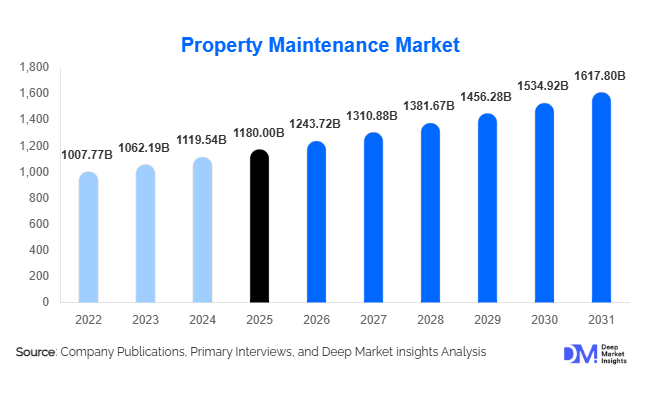
According to Deep Market Insights, the global property maintenance market size was valued at USD 1,180 billion in 2025 and is projected to grow from USD 1,243.72 billion in 2026 to reach USD 1,617.80 billion by 2031, expanding at a CAGR of 5.4% during the forecast period (2026-2031). The market growth is primarily driven by rapid urbanization, increasing outsourcing of facility management services, and rising demand for preventive and predictive maintenance solutions across residential, commercial, and industrial properties.
Key Market Insights
- Outsourced facility management services dominate the market, accounting for nearly 65% of total demand due to cost efficiency and operational flexibility.
- Commercial properties lead global demand, driven by high maintenance intensity in office spaces, retail complexes, and hospitality infrastructure.
- North America holds the largest market share, supported by mature real estate markets and high adoption of integrated facility management solutions.
- Asia-Pacific is the fastest-growing region, fueled by rapid urban development and infrastructure expansion in China and India.
- Technology integration is transforming service delivery, with IoT-enabled predictive maintenance gaining traction globally.
- Sustainability-focused maintenance services are expanding, driven by green building regulations and energy efficiency mandates.
What are the latest trends in the property maintenance market?
Shift Toward Predictive and Smart Maintenance
The market is witnessing a strong transition from reactive to predictive maintenance models, enabled by IoT sensors, AI-driven analytics, and cloud-based facility management platforms. These technologies allow real-time monitoring of building systems, reducing downtime and improving operational efficiency. Predictive maintenance is particularly gaining adoption in commercial and industrial facilities where equipment uptime is critical. Companies are increasingly investing in smart building ecosystems, integrating HVAC, lighting, and security systems into centralized digital platforms for better control and optimization.
Rising Demand for Integrated Facility Management (IFM)
Integrated Facility Management services are becoming the preferred model globally, combining multiple maintenance functions such as cleaning, security, and technical services under a single contract. This approach improves cost efficiency, service consistency, and operational transparency. Large corporations and institutional clients are increasingly opting for IFM providers to streamline vendor management and enhance service quality. The trend is also supported by digital dashboards and analytics tools that provide real-time insights into maintenance performance and costs.
What are the key drivers in the property maintenance market?
Rapid Urbanization and Infrastructure Expansion
Global urban population growth is driving significant demand for property maintenance services. The expansion of residential complexes, commercial hubs, and industrial parks requires continuous upkeep and lifecycle management. Emerging economies, particularly in the Asia-Pacific and the Middle East, are witnessing large-scale infrastructure projects that are fueling long-term maintenance demand.
Increasing Outsourcing of Maintenance Services
Organizations are increasingly outsourcing maintenance operations to specialized service providers to reduce costs and improve efficiency. Outsourcing allows companies to focus on core activities while leveraging expertise in facility management. This trend is particularly strong in sectors such as retail, healthcare, and manufacturing, where operational efficiency is critical.
Advancements in Maintenance Technologies
Technological advancements such as automation, IoT, and AI are enhancing maintenance efficiency and reducing operational costs. These innovations enable predictive analytics, automated scheduling, and remote monitoring, making maintenance services more proactive and data-driven. As technology adoption increases, service providers are able to offer differentiated and value-added solutions.
What are the restraints for the global market?
Highly Fragmented Market Structure
The property maintenance market remains highly fragmented, with numerous small and local service providers competing alongside global players. This leads to inconsistent service quality, pricing pressures, and challenges in standardization. Large companies often face difficulties in scaling operations while maintaining service consistency across regions.
High Initial Investment in Smart Technologies
The adoption of advanced maintenance technologies requires significant upfront investment in infrastructure, software, and training. Small and medium-sized service providers may find it challenging to adopt these technologies, limiting the pace of digital transformation across the market.
What are the key opportunities in the property maintenance industry?
Expansion in Emerging Markets
Emerging economies such as India, Indonesia, and Brazil present significant growth opportunities due to rapid urbanization and increasing property ownership. Governments are investing heavily in housing and infrastructure, creating demand for organized maintenance services. Companies entering these markets with scalable and cost-effective solutions can capture substantial growth.
Sustainability and Green Maintenance Services
The growing focus on sustainability is creating opportunities for eco-friendly maintenance services. Energy-efficient HVAC systems, water conservation solutions, and waste management services are gaining popularity. Regulatory mandates for green buildings are further driving demand for sustainable maintenance practices.
Technology-Driven Service Innovation
The integration of digital technologies into maintenance services offers opportunities for innovation and differentiation. Service providers can leverage AI, IoT, and cloud platforms to offer predictive maintenance, real-time monitoring, and data-driven insights, enhancing customer value and operational efficiency.
Report Scope
| Report Metric | Details |
|---|---|
| Market Size in 2025 | USD 1180 Billion |
| Market Size in 2026 | USD 1243.72 Billion |
| Market Size in 2031 | USD 1617.80 Billion |
| CAGR | 5.4% (2026-2031) |
| Base Year for Estimation | 2025 |
| Historical Data | 2022-2024 |
| Forecast Period | 2026-2031 |
| Report Coverage | Revenue Forecast, Competitive Landscape, Supply Chain Disruption, Growth Factors, Environment & Regulatory Landscape and Trends |
| Geographies Covered | North America, Europe, APAC, Middle East and Africa, LATAM |
| Countries Covered | U.S., Canada, U.K., Germany, France, Spain, Italy, Russia, Nordic, Benelux, Rest of Europe, China, Korea, Japan, India, Australia, Singapore, Taiwan, South East Asia, Rest of Asia-Pacific, UAE, Turky, Saudi Arabia, South Africa, Egypt, Nigeria, Rest of MEA, Brazil, Mexico, Argentina, Chile, Colombia, Rest of LATAM |
Explore more data points, trends and opportunities Download Free Sample Report
Service Type Insights
Building maintenance services continue to dominate the global property maintenance market, accounting for approximately 32% of total demand in 2025. This leadership is primarily driven by the critical nature of core infrastructure systems such as HVAC, plumbing, electrical networks, and structural components, which require regular servicing to ensure operational continuity and safety compliance. The increasing complexity of modern buildings, particularly smart buildings equipped with automated systems, has further amplified the need for specialized and technically skilled maintenance services. Additionally, stricter regulatory frameworks related to fire safety, energy efficiency, and workplace safety standards are compelling property owners to invest consistently in professional building maintenance.
Cleaning and janitorial services form the second-largest segment, supported by rising hygiene awareness, especially in healthcare, commercial offices, and hospitality environments. Post-pandemic behavioral shifts have institutionalized frequent sanitation practices, driving recurring demand. Meanwhile, landscape and outdoor maintenance services are gaining prominence, particularly in residential communities, commercial complexes, and institutional campuses, where aesthetic appeal and environmental sustainability are key value drivers. The growing emphasis on green spaces, water-efficient landscaping, and climate-resilient outdoor infrastructure is further accelerating this segment’s growth globally.
Property Type Insights
Commercial properties lead the market with approximately 38% share in 2025, driven by the high intensity and frequency of maintenance requirements across office buildings, retail centers, and hospitality establishments. These properties operate in highly competitive environments where customer experience, safety, and operational uptime are critical, necessitating continuous and high-quality maintenance services. The expansion of flexible workspaces, shopping malls, and mixed-use developments is further strengthening demand in this segment.
Residential properties represent a large and stable segment, supported by rapid urban housing development, particularly in emerging economies. Increasing apartment complexes and gated communities are adopting organized maintenance services, including annual maintenance contracts. Industrial properties are also experiencing rising demand, especially in manufacturing plants and logistics hubs, where equipment reliability and infrastructure uptime directly impact productivity and supply chain efficiency. The growth of e-commerce and warehousing infrastructure is further reinforcing maintenance demand in this segment.
Delivery Model Insights
Outsourced maintenance services dominate the market, accounting for approximately 65% of total demand, and remain the fastest-growing delivery model globally. The primary driver for this dominance is the increasing preference among organizations to focus on core competencies while delegating non-core operations such as maintenance to specialized service providers. Outsourcing offers cost efficiencies, access to skilled labor, and improved service quality through standardized processes.
Integrated Facility Management (IFM) contracts are gaining significant traction among large enterprises, as they consolidate multiple services, such as technical maintenance, cleaning, and security, under a single vendor. This integrated approach enhances operational efficiency, reduces vendor management complexity, and provides better cost visibility. In contrast, in-house maintenance is gradually declining, particularly in commercial and industrial sectors, though it remains relevant in smaller residential setups due to cost considerations.
Maintenance Type Insights
Preventive maintenance leads the market with approximately 45% share, driven by its ability to reduce long-term repair costs and extend asset lifespan. Organizations are increasingly adopting scheduled maintenance programs to minimize unexpected breakdowns and ensure regulatory compliance. This approach is particularly critical in sectors such as healthcare, manufacturing, and commercial real estate, where downtime can result in significant financial losses.
Predictive maintenance is emerging as the fastest-growing segment, supported by advancements in IoT and AI technologies that enable real-time monitoring and early fault detection. This model is gaining adoption in high-value assets and complex infrastructure. Meanwhile, corrective maintenance, though still necessary, is gradually declining in importance as businesses shift toward proactive maintenance strategies to enhance efficiency and reliability.
Technology Integration Insights
Traditional maintenance services continue to account for approximately 70% of the market, particularly in developing regions where digital adoption is still evolving. However, the market is undergoing a significant transformation with the rapid adoption of smart maintenance solutions. Technologies such as IoT sensors, AI-driven analytics, and cloud-based facility management platforms are enabling predictive maintenance, automated workflows, and real-time performance tracking.
The primary driver for this shift is the need for operational efficiency, cost optimization, and enhanced asset performance. Smart maintenance solutions are particularly gaining traction in commercial real estate, industrial facilities, and smart city projects. As digital infrastructure improves globally, the share of technology-enabled maintenance services is expected to increase substantially over the forecast period.
End-Use Industry Insights
The real estate and construction sector dominates the market, accounting for approximately 30% of total demand, driven by continuous property development and the need for lifecycle maintenance. The expansion of urban infrastructure, including residential complexes and commercial hubs, is sustaining long-term demand for maintenance services.
The healthcare sector is among the fastest-growing end users, driven by stringent hygiene standards, regulatory compliance, and the need for uninterrupted operation of critical equipment and facilities. Similarly, the hospitality industry is witnessing strong demand due to the global recovery in travel and tourism, which necessitates high standards of cleanliness and facility upkeep. Emerging end-use segments such as data centers and logistics hubs are also gaining importance, as they require highly specialized maintenance to ensure operational uptime and efficiency.
Explore more data points, trends and opportunities Download Free Sample Report
Property Maintenance Market Segmentations
By Service Type
- Building Maintenance Services
- Cleaning & Janitorial Services
- Landscape & Outdoor Maintenance
- Security & Safety Maintenance
- Pest Control Services
- Waste Management Services
By Property Type
- Residential Properties
- Commercial Properties
- Industrial Properties
- Institutional Properties
By Delivery Model
- In-house Maintenance
- Outsourced/Contracted Services
By Maintenance Type
- Preventive Maintenance
- Corrective Maintenance
- Predictive Maintenance
By End-Use Industry
- Real Estate & Construction
- Retail & Hospitality
- Healthcare
- Manufacturing
- Government & Public Infrastructure
- Education
Regional Insights
North America
North America remains the largest regional market, accounting for approximately 35% share in 2025. The United States dominates due to its mature real estate sector, high penetration of outsourced facility management services, and strong presence of global service providers. A key growth driver in this region is the increasing adoption of smart building technologies and sustainability initiatives, including energy-efficient retrofits and green building certifications. Canada also contributes significantly, particularly in institutional and commercial sectors, supported by government regulations on building safety and environmental standards.
Europe
Europe holds around 28% of the global market share, led by countries such as Germany, the United Kingdom, and France. The region’s growth is primarily driven by stringent regulatory frameworks related to energy efficiency, environmental sustainability, and building safety. The need to retrofit and maintain aging infrastructure across Western Europe is a major demand driver. Additionally, the strong adoption of green building practices and circular economy principles is encouraging investment in sustainable maintenance services, further boosting market growth.
Asia-Pacific
Asia-Pacific is the fastest-growing region, expanding at a CAGR of approximately 7%. China and India are the key growth engines, driven by rapid urbanization, large-scale infrastructure development, and increasing property ownership. Government initiatives such as smart cities and urban housing programs are significantly boosting demand for organized maintenance services. Japan and South Korea are leading in technology-driven maintenance solutions, with high adoption of automation and IoT-based systems. The region’s expanding middle class and rising disposable incomes are also contributing to increased demand for professional maintenance services.
Middle East & Africa
The Middle East and Africa region is experiencing robust growth, driven by large-scale infrastructure and real estate projects in countries such as the UAE and Saudi Arabia. Government-led initiatives such as smart city developments, tourism expansion, and economic diversification programs are key growth drivers. The region’s extreme climatic conditions also necessitate frequent maintenance of HVAC and building systems, further supporting market demand. In Africa, urbanization and gradual infrastructure development are contributing to steady growth, although at a slower pace compared to the Middle East.
Latin America
Latin America is an emerging market, with Brazil and Mexico leading demand. The primary growth drivers include increasing urbanization, expansion of commercial real estate, and rising adoption of outsourced maintenance services. The growth of the retail and hospitality sectors is also contributing to demand. However, economic volatility and budget constraints in some countries pose challenges to consistent market expansion. Despite these challenges, the region presents long-term growth opportunities as infrastructure development and urbanization continue to progress.