Pressure Coffee Machines Market Size
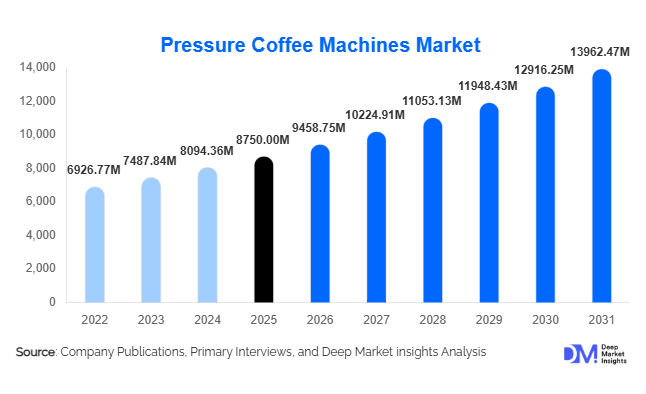
According to Deep Market Insights, the global pressure coffee machines market size was valued at USD 8,750 million in 2025 and is projected to grow from USD 9,458.75 million in 2026 to reach USD 13,962.47 million by 2031, expanding at a CAGR of 8.1% during the forecast period (2026–2031). The market growth is primarily driven by increasing consumer preference for premium café-style beverages at home, the expansion of specialty cafés and coffee chains, and the rising adoption of smart and fully automatic coffee machines across residential and commercial segments.
Key Market Insights
- Consumer preference is shifting toward convenience and premium quality at home, resulting in strong adoption of fully automatic and capsule-based pressure coffee machines.
- Smart, IoT-enabled coffee machines are gaining traction, allowing app-based brewing, personalization, and maintenance alerts that cater to tech-savvy consumers.
- Commercial demand dominates the market, driven by cafés, restaurants, hotels, and offices seeking consistent, high-quality coffee solutions.
- North America and Europe remain key markets, with the U.S., Germany, and Italy leading demand for high-performance machines.
- Asia-Pacific is the fastest-growing region, led by China and India, due to rising urbanization, middle-class income growth, and the adoption of café culture.
- Technological innovation, including energy-efficient designs, smart features, and capsule systems, is reshaping product offerings and driving recurring revenue streams.
What are the latest trends in the pressure coffee machines market?
Smart and Connected Coffee Machines
IoT-enabled and app-controlled pressure coffee machines are increasingly popular, particularly in urban and tech-savvy consumer segments. Users can now customize brewing parameters, schedule automatic preparation, and receive maintenance notifications remotely. Smart machines also integrate with home automation systems, enhancing convenience and allowing households and offices to optimize energy usage and operational efficiency. These machines appeal strongly to millennials and younger consumers who prioritize personalization, automation, and connected experiences in home appliances.
Premiumization and Specialty Coffee Culture
There is a growing demand for premium beverages and specialty coffee experiences at home and in commercial outlets. Consumers are willing to invest in fully automatic and super-automatic espresso machines to replicate café-style beverages. This trend is further supported by the rise of specialty cafés, boutique coffee shops, and office coffee culture, where machine performance, consistency, and design are critical decision factors. Premiumization is also driving the integration of milk frothing systems, pressure control, and high-quality brewing technology in machines targeted at both residential and commercial users.
What are the key drivers in the pressure coffee machines market?
Increasing Global Coffee Consumption
The global rise in coffee consumption, particularly specialty and espresso-based beverages, is a key growth driver. Urbanization, changing lifestyles, and rising disposable incomes are prompting households and businesses to adopt high-quality pressure coffee machines. Millennials and Gen Z consumers are increasingly seeking café-quality experiences at home, which has encouraged manufacturers to innovate and offer easy-to-use yet premium machines.
Technological Innovation and Product Advancements
Advancements such as energy-efficient components, automated milk frothing, programmable brewing, and capsule-based systems have simplified coffee preparation and expanded market accessibility. Technology has also enabled smart machines that connect to mobile apps, offering consumers convenience and personalization, which in turn supports higher adoption in both residential and commercial markets.
Growth of Commercial Coffee Outlets
The proliferation of cafés, restaurants, hotels, and office spaces globally has fueled demand for commercial-grade pressure coffee machines. These establishments prioritize consistency, efficiency, and durability, creating a robust market for high-capacity and professional-grade machines. The expansion of specialty coffee chains is particularly driving demand for fully automatic and super-automatic machines capable of high-volume production without compromising quality.
What are the restraints for the global market?
High Initial Investment Costs
Premium pressure coffee machines remain expensive, limiting their adoption in price-sensitive markets. While entry-level machines exist, the cost barrier for high-performance, fully automatic, and smart machines restricts growth among small businesses and residential users in developing regions.
Maintenance and Operational Complexity
Pressure coffee machines require regular cleaning, descaling, and technical servicing. Commercial establishments must manage downtime, while households may face challenges in maintenance, limiting broader adoption. Complexity in operation, especially for semi-automatic and manual machines, acts as a deterrent for first-time users.
What are the key opportunities in the pressure coffee machines industry?
Expansion into Emerging Markets
Countries in the Asia-Pacific and Latin America, including China, India, Brazil, and Indonesia, are witnessing rapid urbanization and rising disposable income. Coffee consumption is increasing in these regions, creating opportunities for entry-level, mid-range, and premium machines. Localized pricing strategies and distribution partnerships offer significant growth potential for new and established players.
Integration of Smart Technologies
IoT-enabled, app-controlled, and smart pressure coffee machines provide personalization, remote operation, and maintenance alerts. Manufacturers can differentiate offerings by integrating software features, providing recurring revenue models through consumables, and tapping tech-savvy consumers seeking convenience. This presents strong opportunities in the premium residential segment.
Growth of Commercial and Office Coffee Culture
The expansion of specialty cafés, boutique coffee shops, hotels, and modern offices has increased demand for commercial-grade machines. Hybrid work models have accelerated investments in office coffee solutions. Government incentives for the foodservice industry further support market growth in commercial segments.
Report Scope
| Report Metric | Details |
|---|---|
| Market Size in 2025 | USD 8750 Million |
| Market Size in 2026 | USD 9458.75 Million |
| Market Size in 2031 | USD 13962.47 Million |
| CAGR | 8.1% (2026-2031) |
| Base Year for Estimation | 2025 |
| Historical Data | 2022-2024 |
| Forecast Period | 2026-2031 |
| Report Coverage | Revenue Forecast, Competitive Landscape, Supply Chain Disruption, Growth Factors, Environment & Regulatory Landscape and Trends |
| Geographies Covered | North America, Europe, APAC, Middle East and Africa, LATAM |
| Countries Covered | U.S., Canada, U.K., Germany, France, Spain, Italy, Russia, Nordic, Benelux, Rest of Europe, China, Korea, Japan, India, Australia, Singapore, Taiwan, South East Asia, Rest of Asia-Pacific, UAE, Turky, Saudi Arabia, South Africa, Egypt, Nigeria, Rest of MEA, Brazil, Mexico, Argentina, Chile, Colombia, Rest of LATAM |
Explore more data points, trends and opportunities Download Free Sample Report
Product Type Insights
Fully automatic espresso machines dominate the pressure coffee machines market, capturing around 32% of the 2025 market share. This leadership is primarily driven by increasing consumer preference for convenience, consistency, and minimal manual intervention in coffee preparation. These machines integrate grinding, brewing, and milk frothing into a single automated process, making them highly attractive for both residential users and commercial establishments seeking operational efficiency and standardized beverage quality. The growing adoption of smart and connected appliances further strengthens this segment, as fully automatic machines increasingly feature IoT-enabled controls, personalization settings, and maintenance alerts.
Semi-automatic machines continue to maintain steady demand, particularly among small cafés and cost-conscious households, as they offer a balance between control and affordability. Capsule-based systems are witnessing rapid growth in the premium residential segment, driven by their convenience, speed, and ability to deliver consistent flavor profiles with minimal effort. Meanwhile, manual machines cater to niche segments of coffee enthusiasts and specialty cafés that prioritize customization and artisanal brewing techniques. Overall, the trend is shifting toward automation and convenience, positioning fully automatic machines as the long-term growth leader in this segment.
End-Use Insights
The commercial segment leads the market, accounting for approximately 58% of global demand, driven by widespread adoption across cafés, restaurants, hotels, and office spaces. The expansion of global coffee chains, increasing penetration of specialty cafés, and rising demand for premium beverages in foodservice establishments are key drivers supporting this dominance. Commercial users prioritize high-capacity, durable, and consistent-performance machines, which has led to increased investments in fully automatic and super-automatic systems.
The residential segment is experiencing steady growth, fueled by urbanization, rising disposable incomes, and the growing trend of home-based coffee consumption. Consumers are increasingly investing in premium coffee machines to replicate café-style experiences at home, particularly in developed markets. Emerging applications such as boutique home cafés, co-working spaces, and premium office environments are also contributing to demand expansion. Additionally, export-driven demand from manufacturing hubs such as Italy, Germany, and China continues to support global supply, enabling wider accessibility and competitive pricing across regions.
Distribution Channel Insights
Online retail dominates the distribution landscape with approximately 38% market share, driven by the rapid growth of e-commerce platforms, increasing digital penetration, and consumer preference for convenience. Online channels provide access to a wide range of products, competitive pricing, customer reviews, and doorstep delivery, making them particularly attractive for residential buyers. The rise of direct-to-consumer (D2C) strategies has further strengthened this channel, with manufacturers leveraging brand websites to offer personalized recommendations, subscription-based services for coffee pods, and exclusive product launches.
Offline retail channels, including specialty stores, supermarkets, and department stores, remain relevant, especially for premium and commercial-grade machines where consumers prefer in-person demonstrations and expert guidance. Specialty appliance stores play a crucial role in influencing purchase decisions for high-value products. Additionally, hybrid distribution models combining online discovery with offline experience centers are emerging, enabling brands to enhance customer engagement and improve conversion rates.
Explore more data points, trends and opportunities Download Free Sample Report
Pressure Coffee Machines Market Segmentations
By Product Type
- Manual Espresso Machines
- Semi-Automatic Espresso Machines
- Fully Automatic Espresso Machines
- Super-Automatic Espresso Machines
- Capsule/Pod Pressure Coffee Machines
By Pressure Level
- Low Pressure (Up to 9 Bars)
- Standard Pressure (9–15 Bars)
- High Pressure (Above 15 Bars)
By End-Use
- Residential/Household
- Cafés & Coffee Shops
- Restaurants & Hotels
- Offices & Co-working Spaces
By Distribution Channel
- Online Retail
- Specialty Stores
- Supermarkets/Hypermarkets
- Department Stores
- Direct-to-Consumer
By Technology Integration
- Conventional Machines
- Smart/Connected Machines
Regional Insights
North America
North America accounts for approximately 28% of the global market, with the United States representing the largest contributor. The region’s growth is driven by high per capita coffee consumption, strong purchasing power, and a well-established café culture. Increasing demand for premium and specialty coffee beverages has led to widespread adoption of fully automatic and smart coffee machines in both residential and commercial settings. The expansion of office coffee solutions, driven by hybrid work environments, is further boosting demand. Additionally, technological adoption and consumer inclination toward connected home appliances are accelerating the uptake of IoT-enabled machines in this region.
Europe
Europe leads the global market with around 34% share, supported by deeply rooted coffee traditions in countries such as Germany, Italy, and France. The region benefits from a mature consumer base that values quality, authenticity, and premium brewing methods. Strong domestic manufacturing capabilities, particularly in Italy and Germany, ensure continuous innovation and product availability. Growth in Europe is further driven by increasing demand for energy-efficient appliances, sustainability-focused designs, and smart coffee machines. The widespread presence of cafés and specialty coffee shops, along with high household penetration of espresso machines, reinforces the region’s leadership.
Asia-Pacific
Asia-Pacific is the fastest-growing region, with countries such as China, India, Japan, and South Korea driving demand. Rapid urbanization, rising middle-class incomes, and the growing influence of Western lifestyles are significantly boosting coffee consumption. The proliferation of international and domestic café chains is creating strong commercial demand, while increasing awareness of premium coffee experiences is supporting residential adoption. Additionally, the expansion of e-commerce platforms and the improvement of distribution networks are enhancing product accessibility. Government initiatives promoting domestic manufacturing and rising investments in the foodservice sector are further accelerating regional market growth.
Latin America
Latin America, led by Brazil, Mexico, and Argentina, is experiencing steady growth, supported by its strong position as a global coffee producer. Domestic consumption is increasing as urban populations adopt café culture and premium coffee experiences. Export-driven demand plays a significant role in this region, with locally manufactured machines being supplied to international markets. The emergence of boutique cafés and specialty coffee outlets is further driving demand for commercial machines. Additionally, improving economic conditions and rising consumer awareness are supporting the gradual adoption of residential coffee machines.
Middle East & Africa
The Middle East & Africa region is witnessing notable growth, driven by contrasting yet complementary factors. In the Middle East, countries such as the UAE, Saudi Arabia, and Qatar are experiencing rising demand due to high disposable incomes, luxury lifestyle trends, and increasing investments in hospitality and tourism infrastructure. The proliferation of premium cafés and high-end office spaces is boosting demand for advanced coffee machines.
In Africa, while coffee production remains a key economic activity, domestic consumption of premium coffee machines is gradually increasing in urban centers. Growth is supported by expanding tourism, improving retail infrastructure, and rising interest in specialty coffee. Government initiatives promoting tourism and hospitality development across regions such as the Gulf Cooperation Council (GCC) countries and parts of Africa are further contributing to market expansion.
Key Players in the Pressure Coffee Machines Market
- De’Longhi S.p.A.
- Breville Group Limited
- Koninklijke Philips N.V.
- Nestlé Nespresso S.A.
- Jura Elektroapparate AG
- Electrolux AB
- Panasonic Corporation
- Krups (Groupe SEB)
- Melitta Group
- Hamilton Beach Brands Holding Company
- La Marzocco
- Rancilio Group
- Gaggia (Evoca Group)
- Bosch (BSH Hausgeräte GmbH)
- SMEG S.p.A.