Premium Outdoor Apparel Market Size
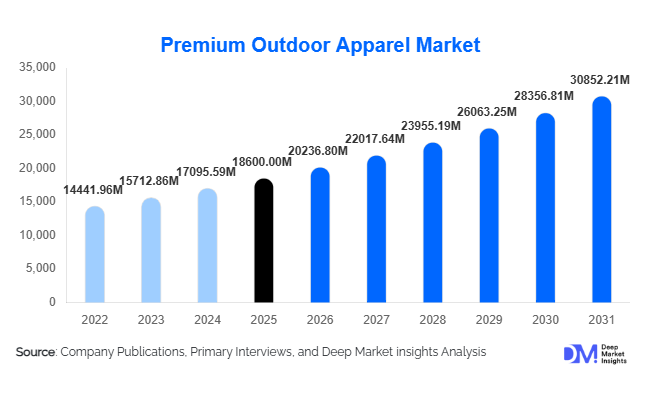
According to Deep Market Insights, the global premium outdoor apparel market size was valued at USD 18,600 million in 2025 and is projected to grow from USD 20,236.80 million in 2026 to reach USD 30,852.21 million by 2031, expanding at a CAGR of 8.8% during the forecast period (2026–2031). The premium outdoor apparel market growth is primarily driven by the increasing participation in outdoor recreation activities, rising demand for technologically advanced performance clothing, and the growing consumer preference for sustainable and durable apparel products. Premium outdoor clothing, including technical jackets, base layers, fleece garments, and performance accessories, is increasingly adopted not only for outdoor sports but also for everyday lifestyle wear. The expansion of adventure tourism, growth of winter sports industries, and the rising awareness of environmental sustainability are further strengthening global demand for premium outdoor apparel products.
Key Market Insights
- Outdoor recreation participation is rising globally, driving strong demand for high-performance apparel designed for hiking, trekking, skiing, and mountaineering.
- Sustainable and recycled materials are becoming a major industry focus, with brands investing in eco-friendly fabrics and circular production models.
- North America dominates the premium outdoor apparel market, supported by high consumer spending and a strong outdoor recreation culture.
- Asia-Pacific is the fastest-growing region, driven by rising middle-class income and expanding adventure tourism activities in China, Japan, and South Korea.
- Urban outdoor lifestyle fashion is expanding the consumer base, as technical apparel is increasingly worn in daily urban environments.
- Technological innovation in textile engineering, including waterproof breathable membranes and lightweight insulation materials, is transforming product performance and market competitiveness.
What are the latest trends in the premium outdoor apparel market?
Sustainability and Circular Apparel Production
Sustainability has emerged as one of the most influential trends in the premium outdoor apparel industry. Consumers, particularly outdoor enthusiasts, are increasingly concerned about environmental impact and are prioritizing products manufactured using recycled or responsibly sourced materials. Leading brands are incorporating recycled polyester, biodegradable insulation materials, and organic natural fibers such as merino wool into their product lines. Additionally, many companies are implementing circular production systems that allow consumers to repair, reuse, or recycle garments. These initiatives help reduce textile waste and improve brand loyalty among environmentally conscious consumers. The trend is further reinforced by stricter environmental regulations and certification programs across North America and Europe that encourage sustainable manufacturing practices.
Expansion of Outdoor Lifestyle Fashion
Outdoor apparel is increasingly crossing over into mainstream fashion, creating a rapidly growing urban outdoor lifestyle segment. Consumers are purchasing premium jackets, fleece layers, and technical hoodies not only for outdoor activities but also for daily wear in urban environments. This shift has broadened the target market beyond traditional outdoor enthusiasts and introduced premium outdoor apparel to new demographics. The blending of performance functionality with modern design aesthetics has enabled brands to appeal to fashion-conscious consumers who value comfort, durability, and weather protection. As a result, companies are launching lifestyle-oriented product lines that combine technical fabrics with minimalist design, expanding revenue opportunities across metropolitan markets.
What are the key drivers in the premium outdoor apparel market?
Growth of Outdoor Recreation Activities
The growing popularity of outdoor recreation activities such as hiking, trekking, camping, skiing, and trail running is a major driver of the premium outdoor apparel market. Participation rates in outdoor sports have increased significantly in recent years as consumers seek healthier lifestyles and nature-based experiences. Governments and tourism organizations are also promoting outdoor activities through investments in national parks, adventure tourism infrastructure, and recreational facilities. As participation grows, consumers increasingly demand specialized clothing that provides weather protection, durability, and mobility, leading to strong demand for premium outdoor apparel.
Technological Advancements in Performance Fabrics
Continuous advancements in textile engineering have significantly enhanced the functionality of outdoor apparel. Modern performance fabrics offer features such as moisture management, breathability, thermal insulation, and waterproof protection while maintaining lightweight construction. These innovations allow manufacturers to develop garments that perform effectively in extreme environmental conditions. As consumers become more knowledgeable about technical apparel features, demand for premium products incorporating advanced fabric technologies continues to rise. High-performance fabrics also enable brands to command higher price points, strengthening profitability within the premium segment.
What are the restraints for the global market?
High Product Prices
Premium outdoor apparel products are often significantly more expensive than conventional sportswear due to advanced materials, specialized manufacturing processes, and strong brand positioning. Technical jackets and insulated garments can cost several hundred dollars, making them less accessible for price-sensitive consumers. During economic downturns or periods of reduced consumer spending, high product prices can limit market expansion and delay purchasing decisions.
Complex Global Supply Chains
The production of premium outdoor apparel relies on specialized fabrics and components sourced from multiple international suppliers. Supply chain disruptions, fluctuations in raw material prices, and transportation challenges can impact production timelines and increase costs. Managing complex global supply chains while maintaining consistent product quality remains a significant challenge for manufacturers operating in this industry.
What are the key opportunities in the premium outdoor apparel industry?
Expansion of Adventure Tourism Markets
The rapid growth of adventure tourism presents a significant opportunity for premium outdoor apparel manufacturers. Countries across North America, Europe, and Asia-Pacific are investing heavily in outdoor recreation infrastructure, including hiking trails, ski resorts, mountain parks, and camping facilities. These developments attract both domestic and international tourists who require specialized outdoor clothing for their activities. As more travelers participate in trekking, mountaineering, and winter sports, the demand for durable and performance-oriented apparel is expected to rise substantially. Collaborations between apparel brands and tourism operators can further strengthen market visibility and drive product adoption among adventure travelers.
Urban Outdoor Lifestyle Expansion
The increasing popularity of outdoor-inspired fashion in urban environments provides another major growth opportunity. Consumers living in metropolitan areas are adopting premium outdoor clothing for everyday wear due to its comfort, durability, and weather resistance. This shift enables brands to reach a wider audience beyond traditional outdoor enthusiasts. By designing versatile apparel that blends performance features with modern fashion aesthetics, companies can tap into a broader lifestyle market while maintaining their core outdoor identity.
Report Scope
| Report Metric | Details |
|---|---|
| Market Size in 2025 | USD 18600 Million |
| Market Size in 2026 | USD 20236.80 Million |
| Market Size in 2031 | USD 30852.21 Million |
| CAGR | 8.8% (2026-2031) |
| Base Year for Estimation | 2025 |
| Historical Data | 2022-2024 |
| Forecast Period | 2026-2031 |
| Report Coverage | Revenue Forecast, Competitive Landscape, Supply Chain Disruption, Growth Factors, Environment & Regulatory Landscape and Trends |
| Geographies Covered | North America, Europe, APAC, Middle East and Africa, LATAM |
| Countries Covered | U.S., Canada, U.K., Germany, France, Spain, Italy, Russia, Nordic, Benelux, Rest of Europe, China, Korea, Japan, India, Australia, Singapore, Taiwan, South East Asia, Rest of Asia-Pacific, UAE, Turky, Saudi Arabia, South Africa, Egypt, Nigeria, Rest of MEA, Brazil, Mexico, Argentina, Chile, Colombia, Rest of LATAM |
Explore more data points, trends and opportunities Download Free Sample Report
Product Type Insights
Jackets and shells dominate the premium outdoor apparel market, accounting for the largest share of global revenue. These products incorporate advanced insulation materials, waterproof membranes, and durable fabrics that protect against extreme weather conditions. High-performance jackets often command premium price points, contributing significantly to overall market value. Base layers and mid-layers, including fleece jackets and thermal garments, represent another important segment as they are essential components of layered outdoor clothing systems. Technical outdoor pants and performance shirts are also gaining popularity due to their versatility and suitability for multiple activities such as trekking and camping. Accessories such as gloves, hats, and gaiters complement apparel purchases and contribute additional revenue streams for outdoor brands.
Application Insights
Hiking and trekking represent the largest application segment within the premium outdoor apparel market due to their widespread popularity and accessibility. These activities require versatile apparel that provides comfort and protection in diverse weather conditions. Winter sports applications, including skiing and snowboarding, also generate strong demand for insulated jackets, thermal base layers, and snow pants. Trail running and mountaineering are emerging as high-growth segments, driven by increasing participation in endurance sports and adventure competitions. Additionally, the urban outdoor lifestyle segment is expanding rapidly as consumers integrate technical outdoor apparel into everyday wardrobes. This trend significantly broadens the application scope for premium outdoor apparel beyond traditional sports activities.
Distribution Channel Insights
Specialty outdoor retailers remain the dominant distribution channel for premium outdoor apparel, as these stores provide expert product guidance and curated selections tailored to outdoor enthusiasts. Brand-owned retail outlets are also expanding globally, allowing companies to maintain stronger control over customer experiences and brand identity. E-commerce platforms have witnessed rapid growth in recent years as consumers increasingly prefer online shopping for convenience and wider product availability. Direct-to-consumer digital channels enable brands to offer personalized marketing, competitive pricing, and exclusive product launches. Department stores and sports equipment chains continue to play an important role in expanding brand visibility, particularly in urban markets where consumers may discover outdoor apparel for lifestyle use.
Consumer Insights
Men represent the largest consumer segment in the premium outdoor apparel market, accounting for more than half of global demand. Historically, participation in outdoor adventure sports has been higher among male consumers, which has contributed to strong product demand in this segment. However, women’s participation in outdoor recreation is increasing rapidly, making the women’s segment one of the fastest-growing categories. Brands are expanding female-focused product lines with improved fit, performance fabrics, and stylish designs to capture this growing demand. The youth and kids segment also represents an emerging opportunity as families increasingly engage in outdoor activities together, driving demand for durable and weather-resistant apparel for younger participants.
Explore more data points, trends and opportunities Download Free Sample Report
Premium Outdoor Apparel Market Segmentations
By Product Type
- Jackets & Shells
- Base Layers
- Mid Layers
- Outdoor Pants & Bottomwear
- Technical Shirts & Tops
- Accessories
By Material Technology
- Synthetic Performance Fabrics
- Natural Technical Fabrics
- Waterproof Breathable Membranes
- Hybrid Fabric Constructions
- Recycled & Sustainable Materials
By Application / Activity Type
- Mountaineering & Alpine Climbing
- Hiking & Trekking
- Skiing & Snow Sports
- Trail Running
- Camping & Adventure Travel
- Urban Outdoor Lifestyle
By Distribution Channel
- Brand-Owned Retail Stores
- Specialty Outdoor Retailers
- E-commerce Platforms
- Department Stores
- Sports Equipment Chains
By Consumer Demographics
- Men
- Women
- Kids & Youth
Regional Insights
North America
North America dominates the premium outdoor apparel market, accounting for approximately 36% of global revenue in 2025. The United States represents the largest national market due to its strong outdoor recreation culture and high consumer spending on performance apparel. Popular activities such as hiking, camping, skiing, and trail running drive consistent demand for premium outdoor clothing. Canada also contributes significantly to regional demand due to its cold climate and widespread participation in winter sports. The presence of several leading outdoor apparel brands and well-developed retail infrastructure further strengthens North America's position as the largest market.
Europe
Europe accounts for around 31% of global market demand and represents one of the most mature markets for premium outdoor apparel. Countries such as Germany, the United Kingdom, France, Switzerland, and Norway have strong outdoor sports cultures and well-established alpine tourism industries. Ski resorts and mountain tourism across the Alps generate significant demand for insulated jackets, base layers, and technical snow apparel. European consumers are also highly receptive to sustainable apparel products, which has encouraged brands to introduce environmentally friendly product lines within the region.
Asia-Pacific
Asia-Pacific is the fastest-growing regional market for premium outdoor apparel, driven by rising disposable incomes and increasing interest in outdoor recreation. China, Japan, South Korea, and Australia are major contributors to regional demand. Government initiatives promoting winter sports and adventure tourism have stimulated market growth, particularly in China. Growing middle-class populations and expanding urban consumer markets are expected to further accelerate demand for premium outdoor apparel in the coming years.
Latin America
Latin America represents a smaller but steadily growing market for premium outdoor apparel. Brazil, Chile, and Argentina are key markets where adventure tourism and mountain sports activities are driving product demand. The region’s growing middle-class population and increasing interest in outdoor recreation are gradually expanding the consumer base for premium outdoor clothing.
Middle East & Africa
The Middle East and Africa region is emerging as a developing market for premium outdoor apparel. Countries such as the United Arab Emirates and South Africa are witnessing growing demand due to rising tourism and participation in adventure travel activities. Additionally, affluent consumers in the Middle East are increasingly purchasing premium outdoor apparel for international travel and winter sports tourism.
Key Players in the Premium Outdoor Apparel Market
- Patagonia
- The North Face
- Columbia Sportswear
- Arc'teryx
- Mammut
- Fjällräven
- Helly Hansen
- Mountain Hardwear
- Jack Wolfskin
- Rab
- Montbell
- Black Diamond Equipment
- Haglöfs
- Norrøna
- Outdoor Research