Potty Training and Step Stools Market Size
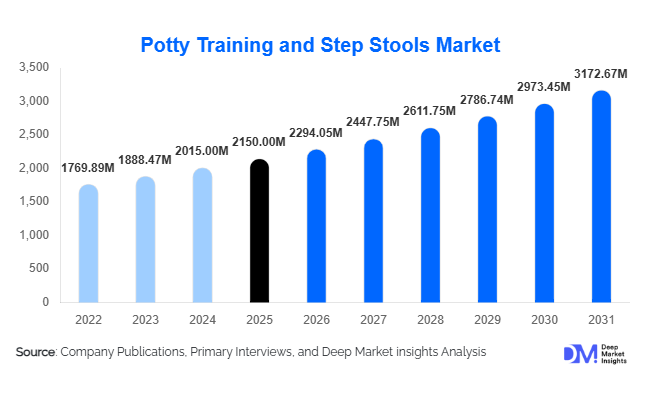
According to Deep Market Insights, the global potty training and step stools market size was valued at USD 2,150 million in 2025 and is projected to grow from USD 2294.05 million in 2026 to reach USD 3172.67 million by 2031, expanding at a CAGR of 6.7% during the forecast period (2026–2031). Market growth is primarily driven by increasing parental awareness of early childhood hygiene, rising demand for child-safe household accessibility products, and the growing adoption of specialized toddler development tools. As parents increasingly prioritize independence training and safety for toddlers, potty chairs, toilet training seats, and step stools are becoming essential products in modern households.
The market is witnessing a steady shift toward multifunctional designs that combine potty training seats with step stool functionality. Manufacturers are also introducing ergonomic designs, anti-slip bases, antimicrobial surfaces, and lightweight portable products to improve safety and convenience. In addition, the expansion of e-commerce baby product platforms and direct-to-consumer brands is improving product accessibility worldwide.
Key Market Insights
- Plastic-based potty training products dominate the market, accounting for more than 60% of total product demand due to affordability, durability, and ease of cleaning.
- Household applications represent the largest demand segment, contributing nearly 78% of global product consumption.
- North America leads the global market, supported by high consumer spending on childcare products and strong retail distribution networks.
- Asia-Pacific is the fastest-growing regional market, driven by rising birth rates, urbanization, and increasing disposable incomes in countries such as China and India.
- E-commerce platforms are becoming the dominant distribution channel, accounting for nearly 38% of global product sales.
- Product innovation is accelerating, with manufacturers introducing foldable travel potty seats, adjustable step stools, and smart potty training devices designed to improve toddler engagement.
What are the latest trends in the potty training and step stools market?
Rise of Multifunctional Toddler Training Products
One of the most notable trends in the market is the development of multifunctional products that combine several toddler utility functions within a single product. Manufacturers are increasingly launching potty chairs that can transform into step stools or toilet seat reducers, extending product usability beyond the initial potty training stage. This approach addresses one of the key market challenges, short product lifecycle, while providing better value for parents.
Multifunctional designs are particularly popular in urban households where living spaces are smaller and parents prefer compact solutions. Products that combine step stools with sink access for handwashing and teeth brushing are gaining popularity in Montessori-inspired parenting environments, which emphasize child independence.
Eco-Friendly and Sustainable Materials
Sustainability is becoming an important purchasing factor among modern parents. Eco-conscious consumers are increasingly seeking potty training products made from recyclable plastics, bamboo, or sustainably sourced wood. Several manufacturers are introducing biodegradable materials and non-toxic finishes to address growing environmental concerns.
European and North American markets are leading the shift toward sustainable baby products. Retailers are also expanding dedicated product categories for environmentally friendly toddler products, encouraging manufacturers to adopt greener production methods. Sustainable packaging and reduced plastic usage are also emerging as competitive differentiators.
What are the key drivers in the potty training and step stools market?
Growing Awareness of Early Childhood Hygiene and Independence
Parents are increasingly focusing on early independence training for toddlers, which has significantly increased the demand for specialized potty training products. Pediatric healthcare professionals and parenting experts emphasize structured potty training routines, encouraging parents to adopt potty chairs and toilet training seats during early childhood stages.
Educational parenting content across digital platforms has further strengthened awareness regarding proper toilet training practices. This trend is particularly evident among millennial and Gen-Z parents who actively research child development products before making purchases.
Rapid Expansion of Online Baby Product Retail
The rapid expansion of online retail platforms has transformed the distribution landscape for potty training and step stool products. E-commerce platforms allow parents to easily compare product features, read reviews, and access international brands that may not be available in local retail stores.
Direct-to-consumer baby product brands are also gaining traction by offering personalized product recommendations, bundled parenting solutions, and subscription-based childcare products. This digital retail transformation has significantly expanded the global reach of potty training product manufacturers.
What are the restraints for the global market?
Short Product Lifecycle
Potty training products generally have a limited usage period of approximately one to two years, as toddlers quickly transition to standard toilets. This short lifecycle reduces the frequency of repeat purchases, limiting long-term revenue growth for manufacturers.
To overcome this challenge, companies are increasingly designing convertible potty chairs and adjustable step stools that can be used across multiple developmental stages.
Price Sensitivity in Emerging Markets
In many developing countries, parents continue to rely on improvised solutions such as basic stools or household furniture instead of purchasing specialized potty training products. Price sensitivity remains a major barrier to adoption, particularly in rural and lower-income communities.
Manufacturers must balance affordability with product safety and durability in order to expand adoption within emerging markets.
What are the key opportunities in the potty training and step stools industry?
Smart and Interactive Potty Training Devices
Technological innovation is opening new growth opportunities within the market. Smart potty training chairs that incorporate music, lights, sensors, and mobile app connectivity are gaining popularity among tech-savvy parents. These products encourage toddlers to engage with toilet training playfully while also allowing parents to track training progress.
Interactive potty training products are expected to capture premium consumer segments, particularly in developed markets where parents are willing to invest in technologically advanced child development tools.
Expansion in Emerging Economies
Emerging economies such as India, Indonesia, Brazil, and Mexico represent major untapped opportunities for market expansion. These countries are experiencing rapid urbanization and growing middle-class populations, which are increasing demand for specialized childcare products.
Companies that develop affordable and durable products tailored to the needs of price-sensitive markets are expected to benefit significantly from this expanding consumer base.
Report Scope
| Report Metric | Details |
|---|---|
| Market Size in 2025 | USD 2150 Million |
| Market Size in 2026 | USD 2294.05 Million |
| Market Size in 2031 | USD 3172.67 Million |
| CAGR | 6.7% (2026-2031) |
| Base Year for Estimation | 2025 |
| Historical Data | 2022-2024 |
| Forecast Period | 2026-2031 |
| Report Coverage | Revenue Forecast, Competitive Landscape, Supply Chain Disruption, Growth Factors, Environment & Regulatory Landscape and Trends |
| Geographies Covered | North America, Europe, APAC, Middle East and Africa, LATAM |
| Countries Covered | U.S., Canada, U.K., Germany, France, Spain, Italy, Russia, Nordic, Benelux, Rest of Europe, China, Korea, Japan, India, Australia, Singapore, Taiwan, South East Asia, Rest of Asia-Pacific, UAE, Turky, Saudi Arabia, South Africa, Egypt, Nigeria, Rest of MEA, Brazil, Mexico, Argentina, Chile, Colombia, Rest of LATAM |
Explore more data points, trends and opportunities Download Free Sample Report
Product Type Insights
Potty training chairs represent the largest product segment, accounting for approximately 34% of the global potty training and step stools market in 2025. These products are widely preferred during the early stages of toilet training because they provide toddlers with a comfortable, stable, and child-sized alternative to standard toilets. The presence of ergonomic designs, splash guards, non-slip bases, and removable bowls for easy cleaning has made potty chairs highly convenient for parents. In addition, pediatricians and child development experts often recommend standalone potty chairs as the most effective starting point for toilet training, which further supports their widespread adoption globally. Training seats designed to fit standard toilets also represent a significant product category, particularly in developed markets where parents prefer space-saving and transition-friendly solutions. These products help toddlers gradually adapt to adult toilets while maintaining safety and comfort. Their popularity is particularly high in urban households and apartments where bathroom space is limited. Manufacturers are increasingly integrating padded seating, adjustable fittings, and antimicrobial materials to enhance product hygiene and usability.
Step stools constitute another major product segment and serve a broader function beyond toilet training. These products assist children in reaching sinks, toilets, and other elevated household surfaces independently. Step stools are widely used for activities such as handwashing, brushing teeth, and accessing kitchen counters under parental supervision. The growing emphasis on child independence and self-care skills is driving the demand for step stools in households and early childhood education settings. Adjustable and foldable step stools are gaining popularity due to their versatility, portability, and ability to adapt to multiple developmental stages. Manufacturers are also introducing multi-functional products that combine potty chairs with step stool functionality, enabling longer product usage and improving value for parents. These innovations are expected to further accelerate product adoption, particularly in markets where consumers seek durable and multifunctional toddler products.
Application Insights
Household use remains the dominant application segment, representing more than 78% of global demand for potty training and step stool products. Toilet training is primarily conducted within the home environment, where parents can establish consistent routines and maintain hygiene standards. Parents increasingly prefer specialized potty training equipment that ensures safety, comfort, and convenience for toddlers, replacing traditional improvised solutions such as small chairs or household stools. The rising awareness of early childhood hygiene, combined with growing parental investment in developmental products, continues to strengthen household demand. Urban households, in particular, are adopting compact potty training products and step stools designed for smaller living spaces. In addition, the growing popularity of Montessori-inspired parenting approaches, which emphasize independence and self-care skills, has significantly increased the adoption of step stools that allow children to access sinks and bathrooms independently.
Institutional applications, including daycare centers, preschools, and early childhood education facilities, are also contributing to market growth. These institutions require multiple potty training units to accommodate groups of toddlers, creating consistent demand for durable and easy-to-clean products. As the global childcare services industry continues to expand due to increasing workforce participation among parents, institutional procurement of toddler hygiene products is expected to rise steadily. Hospitals and pediatric clinics represent a smaller but stable application segment. Healthcare facilities often use specialized hygienic potty training equipment designed to meet strict sanitation standards. Pediatric rehabilitation centers and child development clinics also utilize training seats and step stools to support developmental therapy and early childhood independence training.
Distribution Channel Insights
Online retail channels dominate the distribution landscape, accounting for approximately 38% of global market sales. The rapid growth of e-commerce has significantly transformed the way parents purchase baby products. Online platforms allow consumers to compare features, read verified customer reviews, and access a wide variety of international brands that may not be available in physical retail stores. Direct-to-consumer brand websites and large online marketplaces have become the preferred purchasing channels for millennial and Gen-Z parents who rely heavily on digital research before making purchasing decisions. In addition, social media marketing, parenting blogs, and influencer recommendations play a critical role in shaping consumer preferences for toddler products.
Supermarkets and hypermarkets remain important retail outlets, particularly for mid-range and economy product segments. These stores offer convenience and immediate product availability, making them popular among parents seeking affordable potty training solutions. Retail chains often stock private-label brands that provide cost-effective alternatives to premium products. Specialty baby stores continue to serve premium customers seeking expert guidance and curated product selections. These stores often focus on high-quality brands and ergonomic designs with enhanced safety features. Pharmacies and drugstores also sell toddler hygiene products in several developed markets, particularly in Europe and North America, where healthcare retailers frequently stock child safety and hygiene equipment.
End-Use Insights
Household consumers represent the primary end-user segment in the potty training and step stools market. Parents increasingly recognize the importance of structured toilet training and are investing in specialized equipment that ensures both safety and convenience. Products such as potty chairs and step stools are becoming essential household items during toddler developmental stages. Rising parental awareness regarding hygiene practices, coupled with increased spending on childcare products, is driving household adoption globally. In developed economies, parents are increasingly opting for premium products that offer ergonomic comfort, antimicrobial materials, and durable designs.
Childcare institutions are emerging as a fast-growing end-use segment. The global childcare services industry is expanding rapidly as dual-income households become more common. Daycare centers, preschools, and early learning institutions require multiple potty training seats and step stools to support toddler hygiene routines within shared facilities. Institutional buyers often prioritize durable materials, easy cleaning features, and bulk procurement options when purchasing potty training equipment. As early childhood education infrastructure expands worldwide, institutional demand is expected to play an increasingly important role in supporting market growth.
Explore more data points, trends and opportunities Download Free Sample Report
Potty Training and Step Stools Market Segmentations
By Product Type
- Standalone Potty Chairs
- Potty Training Seats / Toilet Seat Reducers
- Travel Potty Seats
- Single-Step Stools
- Two-Step / Adjustable Step Stools
- Multifunctional Potty Chair & Step Stool Combinations
By Application
- Household / Residential Use
- Daycare Centers and Preschools
- Hospitals and Pediatric Clinics
- Early Childhood Learning Centers
By Distribution Channel
- Online Retail Platforms
- Supermarkets and Hypermarkets
- Specialty Baby Product Stores
- Pharmacies and Drugstores
- Direct-to-Consumer Brand Websites
By Material Type
- Plastic
- Wood and Bamboo
- Metal
- Hybrid Materials
- Eco-Friendly / Recyclable Materials
Regional Insights
North America
North America holds the largest share of the potty training and step stools market, accounting for approximately 32% of global demand in 2025. The United States represents the dominant national market due to high consumer spending on childcare products, strong retail infrastructure, and widespread adoption of specialized toddler development tools. Parents in the U.S. often prefer premium ergonomic designs with advanced safety features such as anti-slip bases, splash guards, and antimicrobial surfaces.
High awareness of early childhood development and structured potty training practices is a major driver of regional demand. Additionally, the strong presence of leading baby product brands and highly developed e-commerce platforms further supports market growth. Canada also contributes steady demand due to high disposable incomes and well-established childcare retail networks.
Europe
Europe accounts for approximately 27% of the global market, with major consumer markets including Germany, the United Kingdom, France, and Italy. European consumers place strong emphasis on product safety certifications and environmentally responsible manufacturing practices. Strict regulatory standards governing child safety products encourage manufacturers to produce high-quality potty training equipment. Sustainability trends are also driving the adoption of eco-friendly materials such as bamboo and recyclable plastics. Additionally, Europe’s strong childcare infrastructure and government support for early childhood education continue to create steady institutional demand for toddler hygiene products.
Asia-Pacific
Asia-Pacific represents around 29% of global demand and is the fastest-growing regional market. Rapid population growth, rising birth rates, and expanding middle-class populations are major factors driving demand for potty training and step stool products across the region. China remains the largest market in Asia-Pacific due to its large population and growing urban middle class. Increasing parental spending on childcare products and strong e-commerce penetration are accelerating product adoption. India is also emerging as a significant growth market due to rising disposable incomes, increasing urbanization, and expanding baby care retail networks. Southeast Asian countries such as Indonesia, Vietnam, and Thailand are witnessing similar demand trends as young urban families adopt modern parenting practices.
Latin America
Latin America contributes approximately 6% of global demand, with Brazil and Mexico representing the largest consumer markets. Growing urban populations and rising middle-class incomes are supporting demand for specialized childcare products across the region. The expansion of modern retail chains and e-commerce platforms is also improving product accessibility. Increasing awareness of child hygiene and development among young parents is encouraging the adoption of potty training products, particularly in urban centers.
Middle East & Africa
The Middle East and Africa collectively account for nearly 6% of global demand. Countries such as the United Arab Emirates and Saudi Arabia are experiencing increasing demand for premium childcare products due to rising disposable incomes, expanding retail infrastructure, and a growing expatriate population. Urbanization and improving healthcare awareness are key drivers of market growth in the region. In addition, government investments in childcare infrastructure and early childhood education programs are gradually increasing institutional demand for toddler hygiene equipment. While adoption rates remain lower in several African countries due to affordability constraints, long-term growth potential remains significant as urban populations and retail networks expand.