Portable UV Sanitizing Boxes Market Size
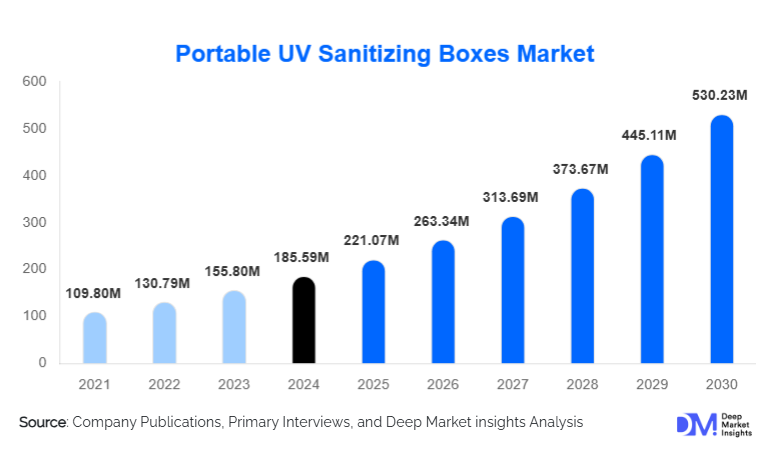
According to Deep Market Insights, the global portable UV sanitizing boxes market size was valued at USD 185.59 million in 2025 and is projected to grow from USD 221.07 million in 2026 to reach USD 530.23 million by 2031, expanding at a CAGR of 19.12% during the forecast period (2026–2031). Market growth is primarily driven by sustained hygiene awareness, rising adoption of chemical-free disinfection technologies, and increasing use of portable UV solutions across residential, healthcare, and travel-related applications.
Key Market Insights
- UV-C LED technology dominates the market, accounting for over two-thirds of global demand due to safety, energy efficiency, and mercury-free operation.
- Consumer electronics sanitization remains the leading application, supported by high-frequency use of smartphones, earbuds, and wearables.
- North America leads global demand, driven by strong consumer awareness and institutional hygiene adoption.
- Asia-Pacific is the fastest-growing region, supported by rising middle-class income, expanding healthcare infrastructure, and large-scale manufacturing capacity.
- Online and direct-to-consumer channels dominate distribution, contributing to more than half of global sales.
- Technological innovation, including smart sensors, safety interlocks, and app-enabled cycle monitoring, is reshaping product differentiation.
Portable UV Sanitizing Boxes Market Trends
Shift Toward UV-C LED and Mercury-Free Designs
The market is witnessing a strong shift away from mercury-based UV lamps toward UV-C LED technology. LED-based systems offer longer lifespans, compact designs, lower power consumption, and improved safety. This trend aligns with tightening environmental regulations and growing consumer preference for sustainable products. Manufacturers are increasingly investing in LED efficiency improvements, enabling faster sanitization cycles and consistent UV dosage delivery.
Integration of Smart and Safety Features
Smart UV sanitizing boxes with automated timers, object detection sensors, child-lock mechanisms, and mobile app connectivity are gaining traction. These features enhance user confidence and enable premium pricing, particularly in healthcare and hospitality environments. IoT-enabled usage tracking is also emerging as a value-added feature for institutional buyers seeking compliance and operational transparency.
Portable UV Sanitizing Boxes Market Drivers
Rising Hygiene Awareness and Preventive Health Behavior
Global hygiene awareness has structurally shifted toward preventive sanitization of everyday objects. Smartphones and personal accessories are increasingly recognized as high-contact surfaces, driving routine usage of portable UV sanitizing boxes in residential and travel settings.
Demand for Chemical-Free Disinfection
UV-based sanitization eliminates the need for chemical wipes and liquids, reducing residue, allergies, and environmental impact. This advantage is particularly important for baby products, medical instruments, and personal care items, supporting adoption across sensitive end-use segments.
Portable UV Sanitizing Boxes Market Restraints
Lack of Standardized Performance Regulations
Inconsistent UV dosage standards and variability in product efficacy across brands can undermine consumer trust. Limited global harmonization of certification frameworks remains a challenge for market credibility and long-term adoption.
Price Sensitivity in Emerging Markets
Despite long-term cost efficiency, upfront pricing of UV sanitizing boxes can be restrictive in price-sensitive regions where chemical cleaning alternatives remain dominant.
Portable UV Sanitizing Boxes Market Opportunities
Institutional and Public Infrastructure Adoption
Hospitals, airports, hotels, schools, and public transport systems are increasingly adopting portable UV sanitization solutions to meet infection prevention protocols. Government-backed hygiene mandates and public procurement programs represent scalable revenue opportunities.
Expansion in Emerging Economies
Rapid urbanization, expanding healthcare access, and rising disposable income in Asia-Pacific, Latin America, and the Middle East present strong growth potential. Localized manufacturing and affordable product variants are expected to accelerate penetration.
Report Scope
| Report Metric | Details |
|---|---|
| Market Size in 2025 | USD 185.59 Million |
| Market Size in 2026 | USD 221.07 Million |
| Market Size in 2031 | USD 530.23 Million |
| CAGR | 19.12% (2026-2031) |
| Base Year for Estimation | 2025 |
| Historical Data | 2022-2024 |
| Forecast Period | 2026-2031 |
| Report Coverage | Revenue Forecast, Competitive Landscape, Supply Chain Disruption, Growth Factors, Environment & Regulatory Landscape and Trends |
| Geographies Covered | North America, Europe, APAC, Middle East and Africa, LATAM |
| Countries Covered | U.S., Canada, U.K., Germany, France, Spain, Italy, Russia, Nordic, Benelux, Rest of Europe, China, Korea, Japan, India, Australia, Singapore, Taiwan, South East Asia, Rest of Asia-Pacific, UAE, Turky, Saudi Arabia, South Africa, Egypt, Nigeria, Rest of MEA, Brazil, Mexico, Argentina, Chile, Colombia, Rest of LATAM |
Explore more data points, trends and opportunities Download Free Sample Report
Product Type Insights
UV-C LED-based sanitizing boxes dominate the global market, accounting for the majority of installed units, due to their superior safety profile, compact form factor, and strong regulatory acceptance. Unlike traditional mercury-based UV lamps, UV-C LEDs are mercury-free, energy-efficient, and capable of delivering consistent irradiance levels with longer operational lifespans. These advantages make them particularly suitable for consumer-facing applications and portable use cases. The rapid decline in LED costs, coupled with improvements in UV-C wavelength efficiency, has accelerated adoption across both residential and institutional segments. Regulatory restrictions on mercury-containing products in North America and Europe further reinforce the leadership of LED-based systems.
Mercury-lamp-based sanitizing boxes are gradually declining in market share due to environmental concerns, disposal challenges, and bulkier designs. Meanwhile, hybrid UV-C LED plus ozone systems remain a niche segment, primarily used in controlled institutional environments such as laboratories and specialized healthcare settings where deeper disinfection of complex tools is required. However, safety concerns related to ozone exposure limit widespread adoption in consumer markets.
Application Insights
Consumer electronics sanitization represents the largest application segment, accounting for approximately 45% of total market demand in 2025. The dominance of this segment is driven by the high frequency of smartphone usage, increased awareness of surface-borne pathogens, and the convenience of sanitizing high-touch personal devices such as phones, earbuds, smartwatches, and accessories.
Medical instrument sanitization is the fastest-growing application, supported by the expansion of outpatient care centers, diagnostic clinics, and ambulatory surgical facilities. Portable UV sanitizing boxes are increasingly used for non-critical instruments, PPE, and reusable tools, offering a chemical-free and time-efficient alternative to traditional disinfection methods. Baby products and travel accessories are emerging as high-value niche applications. Parents increasingly prefer chemical-free sanitization for pacifiers, bottles, and toys, while travelers use UV boxes to disinfect passports, personal items, and hotel-room accessories. These segments benefit from premium pricing and contribute to higher average selling values.
Distribution Channel Insights
Online retail and direct-to-consumer (D2C) platforms dominate global distribution, accounting for more than half of total sales. Growth in this channel is driven by digital-first purchasing behavior, influencer marketing, and the ability to showcase product efficacy through video demonstrations and customer reviews. D2C models also allow manufacturers to capture higher margins and strengthen brand loyalty.
Offline retail channels, including pharmacies, electronics stores, and specialty health retailers, remain relevant, particularly for first-time buyers seeking physical product validation. These channels play a critical role in building trust in emerging markets. Institutional and B2B sales, while lower in volume, generate higher order values and recurring contracts. Hospitals, hotels, schools, and transportation hubs increasingly procure UV sanitizing boxes in bulk as part of standardized hygiene protocols.
End-User Insights
Residential consumers account for the largest share of demand, driven by frequent personal use, ease of operation, and growing awareness of everyday hygiene. High replacement cycles for consumer electronics further support recurring demand in this segment. Healthcare facilities represent the fastest-growing end-user segment, supported by stricter infection control protocols, increased patient throughput, and the need for rapid turnaround of reusable tools. Portable UV sanitizing boxes are increasingly deployed in outpatient clinics, dental practices, and diagnostic centers.
Hospitality, travel, and education sectors are emerging as important secondary adopters. Hotels, airlines, and schools use portable UV boxes to enhance visible hygiene measures, improve customer confidence, and comply with post-pandemic safety expectations.
Explore more data points, trends and opportunities Download Free Sample Report
Portable UV Sanitizing Boxes Market Segmentations
By Product Type
- UV-C LED-Based Sanitizing Boxes
- UV-C Mercury Lamp-Based Sanitizing Boxes
- Pulsed Xenon UV Sanitizing Boxes
- Hybrid UV-C LED + Ozone Sanitizing Boxes
By Application
- Consumer Electronics Sanitization
- Medical Instruments & Healthcare Tools
- Baby Products Sanitization
- Personal Items & Accessories
- Travel & Hospitality Accessories
By Distribution Channel
- Online Retail & Direct-to-Consumer Platforms
- Electronics & Specialty Stores
- Pharmacies & Healthcare Retail Stores
- Institutional & B2B Sales Channels
Regional Insights
North America
North America accounted for approximately 32% of global revenue in 2025, led by the United States. Regional leadership is driven by high consumer awareness of preventive hygiene, strong purchasing power, and early adoption of premium UV-C LED technologies. The healthcare sector plays a major role, with hospitals and outpatient facilities increasingly integrating UV-based disinfection solutions into infection control workflows. Stringent product safety standards and environmental regulations further favor mercury-free UV-C LED systems, reinforcing market growth.
Europe
Europe represents a mature yet stable market, supported by sustainability-driven regulations, healthcare hygiene standards, and strong consumer preference for eco-friendly products. Germany, the UK, and France are key contributors, with demand driven by institutional adoption in the healthcare and education sectors. The European Union’s restrictions on hazardous substances and emphasis on green technologies accelerate the transition toward UV-C LED-based sanitizing boxes, sustaining steady regional growth.
Asia-Pacific
Asia-Pacific is the fastest-growing regional market, driven by China, India, Japan, and South Korea. China dominates global manufacturing due to cost-efficient production, strong electronics supply chains, and export-oriented capacity. India records the highest growth rate in the region, supported by rising urban hygiene awareness, expanding middle-class income, and increasing healthcare investments. Government initiatives promoting domestic manufacturing and public health infrastructure further accelerate regional adoption.
Latin America
Latin America shows moderate but improving growth, with Brazil and Mexico leading demand. Expansion of private healthcare facilities, growing middle-income populations, and rising penetration of e-commerce platforms support market development. Increased awareness of infection prevention in urban centers and gradual adoption of consumer hygiene products are key regional growth drivers.
Middle East & Africa
The Middle East, led by the UAE and Saudi Arabia, benefits from strong demand in hospitality, travel, and premium residential segments. High tourism activity, luxury hotel investments, and government-led hygiene initiatives support adoption. In Africa, market growth remains gradual and is primarily driven by healthcare infrastructure development, donor-funded medical programs, and increasing focus on infection control in urban hospitals.
Key Players in the Portable UV Sanitizing Boxes Market
- Philips
- Panasonic Corporation
- Xiaomi Corporation
- PhoneSoap LLC
- Verilux Inc.
- HoMedics, Inc.
- Halma plc
- Atlantic Ultraviolet Corporation
- Violight Ltd.
- Shenzhen Sunpower Technology Co., Ltd.