Portable Swimming Pool Market Size
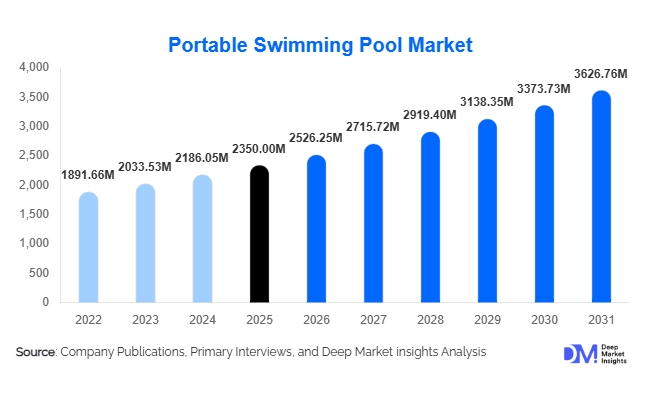
According to Deep Market Insights, the global portable swimming pool market size was valued at USD 2,350 million in 2025 and is projected to grow from USD 2,526.25 million in 2026 to reach USD 3,626.76 million by 2031, expanding at a CAGR of 7.5% during the forecast period (2026–2031). The portable swimming pool market growth is primarily driven by increasing consumer spending on home recreation, rising popularity of backyard leisure infrastructure, and the affordability of portable pools compared to permanent swimming installations.
Portable swimming pools offer an accessible solution for households seeking seasonal water recreation without the cost and installation complexities of in-ground or fixed above-ground pools. These pools are designed for easy setup, portability, and compact storage, making them highly appealing for urban households with limited outdoor space. With advancements in reinforced PVC materials, modular metal frame structures, and improved filtration systems, portable pools have become more durable and user-friendly.
Growing interest in home entertainment and outdoor family activities is accelerating adoption globally. E-commerce platforms have also expanded product accessibility, enabling consumers to compare models, prices, and installation features before purchasing. The market is witnessing increased innovation, including integrated filtration systems, UV-resistant materials, and quick-assembly pool kits designed for convenience.
Key Market Insights
- Inflatable portable pools dominate the market, accounting for the largest product share due to affordability and ease of installation.
- Residential applications represent the majority of demand, with homeowners investing in backyard recreation solutions.
- North America leads the global market, driven by strong consumer spending on outdoor leisure products.
- Asia-Pacific is the fastest-growing region, supported by rising disposable incomes and expanding middle-class populations.
- Online retail channels account for a significant share of global sales, driven by e-commerce platforms and direct-to-consumer brand strategies.
- Product innovation in durable materials and modular designs is improving lifespan and boosting consumer confidence.
What are the latest trends in the portable swimming pool market?
Rising Backyard Leisure Culture
Backyard recreation has become a major lifestyle trend across many developed and emerging economies. Consumers increasingly view outdoor spaces as extensions of their homes, investing in amenities such as portable swimming pools, outdoor furniture, and entertainment zones. Portable pools provide an affordable way for families to enjoy summer recreation without undertaking expensive construction projects.
The growing popularity of “staycations” and home-based leisure activities has further strengthened this trend. Many households now prefer to create entertainment spaces within their own properties rather than traveling frequently. Portable pools allow homeowners to transform small gardens or patios into recreational areas, making them particularly attractive for suburban households and urban families.
Technology-Enhanced Pool Systems
Manufacturers are introducing advanced features that improve the user experience and extend product durability. Modern portable pools increasingly include integrated filtration systems, automated pumps, LED lighting, and digital water-quality monitoring tools. These innovations make pool maintenance easier while enhancing safety and convenience.
Smart pool technologies are also gaining traction in premium segments. Some portable pool models now feature app-controlled pumps and automated filtration schedules, enabling users to manage pool conditions remotely. These technological upgrades appeal particularly to younger consumers who value smart home integration and convenience.
What are the key drivers in the portable swimming pool market?
Growing Demand for Home Recreation
The increasing focus on home-based entertainment is one of the most important drivers of the portable swimming pool market. Consumers are investing more in leisure infrastructure that enhances comfort and recreation within residential spaces. Portable pools provide an affordable alternative to traditional swimming pools, which require extensive construction, plumbing, and maintenance.
Families with children represent a particularly strong consumer segment, as portable pools provide a safe and convenient environment for outdoor play during warm seasons. As disposable incomes rise globally, households are allocating greater budgets to home improvement and leisure products, directly supporting market growth.
Increasing Health and Fitness Awareness
Swimming is widely recognized as a low-impact, full-body exercise that supports cardiovascular health, muscle strength, and stress reduction. As awareness of the health benefits of swimming grows, more consumers are exploring ways to incorporate water-based exercise into their daily routines.
Portable pools allow individuals to practice swimming and water-based workouts at home, making them an attractive option for consumers seeking convenient fitness solutions. Fitness-focused pools designed for resistance training and aquatic exercise are also emerging within the market.
What are the restraints for the global market?
Durability and Product Lifespan Concerns
One of the key restraints affecting the portable swimming pool market is the perceived durability of low-cost inflatable products. Some entry-level pools may be susceptible to punctures, UV degradation, or leakage after repeated use. Consumers often replace these products frequently, which may reduce long-term brand loyalty.
Manufacturers are responding to this challenge by investing in reinforced PVC materials, multi-layer liners, and stronger structural frames to improve product longevity and reliability.
Seasonal Demand Fluctuations
Portable swimming pool sales are highly seasonal, particularly in regions with distinct summer climates. Demand typically peaks during warmer months and declines significantly during colder seasons. This creates supply chain and inventory management challenges for manufacturers and retailers.
Companies are attempting to mitigate seasonality by expanding sales into warmer regions, promoting indoor portable pools, and diversifying product offerings to include pool accessories and maintenance equipment.
What are the key opportunities in the portable swimming pool industry?
Expansion into Emerging Consumer Markets
Emerging economies present substantial opportunities for portable swimming pool manufacturers. Rising disposable incomes, expanding middle-class populations, and increasing interest in recreational products are driving demand across regions such as Asia-Pacific, Latin America, and the Middle East.
Countries including India, Brazil, Indonesia, and Mexico are witnessing growing consumer adoption of affordable outdoor leisure equipment. By establishing localized manufacturing and distribution networks, companies can significantly expand their presence in these markets.
Integration of Smart Pool Technologies
The integration of smart technologies into portable pools represents another major opportunity. Innovations such as automated filtration systems, water quality sensors, and app-controlled maintenance tools are enhancing the overall consumer experience.
Premium portable pools equipped with smart monitoring capabilities are gaining traction among tech-savvy consumers who value convenience and digital connectivity. These products allow manufacturers to target higher-value consumer segments while differentiating themselves in a competitive marketplace.
Report Scope
| Report Metric | Details |
|---|---|
| Market Size in 2025 | USD 2350 Million |
| Market Size in 2026 | USD 2526.25 Million |
| Market Size in 2031 | USD 3626.76 Million |
| CAGR | 7.5% (2026-2031) |
| Base Year for Estimation | 2025 |
| Historical Data | 2022-2024 |
| Forecast Period | 2026-2031 |
| Report Coverage | Revenue Forecast, Competitive Landscape, Supply Chain Disruption, Growth Factors, Environment & Regulatory Landscape and Trends |
| Geographies Covered | North America, Europe, APAC, Middle East and Africa, LATAM |
| Countries Covered | U.S., Canada, U.K., Germany, France, Spain, Italy, Russia, Nordic, Benelux, Rest of Europe, China, Korea, Japan, India, Australia, Singapore, Taiwan, South East Asia, Rest of Asia-Pacific, UAE, Turky, Saudi Arabia, South Africa, Egypt, Nigeria, Rest of MEA, Brazil, Mexico, Argentina, Chile, Colombia, Rest of LATAM |
Explore more data points, trends and opportunities Download Free Sample Report
Product Type Insights
Inflatable portable pools dominate the global portable swimming pool market, accounting for approximately 38% of total market share in 2025. The leading position of inflatable pools is primarily driven by their affordability, ease of installation, lightweight construction, and high portability. These pools can be assembled quickly without the need for specialized tools or professional installation, making them highly convenient for households seeking temporary summer recreation solutions. Additionally, inflatable pools are easy to deflate, fold, and store during off-season periods, which significantly reduces storage constraints for consumers living in apartments or homes with limited outdoor space.
The growing trend of backyard leisure activities and family-oriented outdoor recreation has further strengthened demand for inflatable pools globally. Manufacturers have also introduced multi-layer PVC reinforced inflatable pools with integrated filtration systems, improving durability and safety compared to earlier product generations. As a result, inflatable pools continue to attract both first-time buyers and budget-conscious consumers. Soft-sided fabric pools and rigid plastic models cater to consumers seeking improved durability and enhanced safety features. Soft-sided pools offer greater flexibility and comfort, while rigid plastic pools provide sturdy construction suitable for repeated seasonal use. Additionally, hybrid modular portable pools that combine reinforced PVC liners with metal frame structures are gaining popularity due to their improved structural integrity and ability to hold larger volumes of water. These hybrid systems appeal particularly to consumers looking for semi-permanent backyard recreational installations without committing to expensive permanent pool construction.
Material Insights
PVC remains the most widely used material in portable swimming pools, accounting for nearly 42% of global demand in 2025. The dominance of PVC is attributed to its flexibility, water resistance, durability, and cost efficiency, making it highly suitable for inflatable and frame-supported pool structures. PVC materials can be easily reinforced with multiple layers to improve puncture resistance and structural strength, which enhances product lifespan and consumer confidence. Additionally, PVC offers excellent UV resistance, allowing portable pools to withstand prolonged exposure to sunlight without significant degradation.
The increasing availability of reinforced PVC composites has further improved product performance, enabling manufacturers to produce pools capable of holding larger volumes of water while maintaining structural stability. As a result, PVC-based portable pools continue to dominate the entry-level and mid-range product segments globally. Vinyl liner materials also account for a notable share of the market due to their smooth surface, strong water-retention capabilities, and resistance to tearing. Vinyl liners are commonly used in frame-supported pools where durability and water containment are essential. Polyethylene and polypropylene materials are gaining traction in rigid pool structures due to their high strength-to-weight ratio and resistance to corrosion. These materials are particularly suitable for molded plastic pool designs that offer improved stability and longevity. In the premium segment, manufacturers are increasingly exploring composite reinforced materials that combine multiple polymer layers with structural reinforcements. These advanced materials provide improved durability, enhanced UV protection, and longer product lifespans, making them attractive for consumers seeking higher-quality portable pool solutions.
Distribution Channel Insights
Online retail platforms dominate the global portable swimming pool distribution landscape, accounting for approximately 45% of total global sales. The rapid growth of e-commerce marketplaces has significantly expanded product accessibility, allowing consumers to browse and compare multiple pool models, specifications, and price ranges before making purchasing decisions. Online platforms provide extensive product information, user reviews, installation guides, and competitive pricing, which enhance consumer confidence and simplify the purchasing process. The increasing penetration of smartphones and digital payment systems has further accelerated the shift toward online retail channels. Major e-commerce platforms, along with brand-owned websites and direct-to-consumer (D2C) platforms, enable manufacturers to reach a broader global customer base while reducing dependency on traditional retail intermediaries.
Direct-to-consumer channels are also gaining popularity as manufacturers invest in digital marketing, influencer partnerships, and social media promotions to build stronger brand recognition. These strategies allow companies to engage directly with customers and provide customized product recommendations. Despite the rapid growth of online channels, offline retail stores remain an important distribution channel for portable swimming pools. Sporting goods retailers, specialty pool stores, and large hypermarkets continue to attract consumers who prefer to physically inspect product quality before purchasing. Seasonal retail promotions, in-store product displays, and bundled offers during peak summer periods significantly contribute to offline sales growth.
End-Use Insights
The residential sector dominates the portable swimming pool market, accounting for nearly 68% of global demand in 2025. The leading position of the residential segment is primarily driven by the growing popularity of backyard leisure infrastructure, family-oriented recreational activities, and affordable home entertainment solutions. Portable pools provide homeowners with a convenient alternative to permanent swimming pools, which typically require significant investment in construction, plumbing, and maintenance. Rising consumer spending on home improvement and outdoor lifestyle products has further accelerated residential demand for portable swimming pools. Families with children represent a major consumer segment, as portable pools offer a safe and enjoyable outdoor activity during warm seasons.
The hospitality and tourism sector is emerging as a fast-growing application segment. Hotels, resorts, and holiday parks frequently install portable pools for temporary recreational activities, particularly in seasonal tourist destinations and outdoor event venues. Portable pools offer hospitality operators flexibility, as they can be installed or relocated based on seasonal demand and guest preferences. Educational institutions and sports training centers are also increasingly adopting portable pools for beginner swimming lessons and temporary aquatic training facilities. These pools allow schools and sports academies to introduce water-based training programs without investing in permanent aquatic infrastructure, thereby expanding the potential applications of portable swimming pool products.
Explore more data points, trends and opportunities Download Free Sample Report
Portable Swimming Pool Market Segmentations
By Product Type
- Inflatable Portable Pools
- Metal Frame Portable Pools
- Soft-Sided Fabric Pools
- Rigid Plastic Portable Pools
- Hybrid Modular Portable Pools
By Material Type
- PVC Pools
- Vinyl Liner Pools
- Polyethylene Pools
- Polypropylene Pools
- Composite Reinforced Pools
By Capacity
- Small Capacity Pools
- Medium Capacity Pools
- Large Capacity Pools
- Extra-Large Pools
By Distribution Channel
- Online Retail
- Hypermarkets and Supermarkets
- Specialty Pool and Outdoor Equipment Stores
- Sporting Goods Retailers
- Direct-to-Consumer Brand Websites
By End-Use
- Residential
- Hospitality & Tourism
- Educational & Institutional
- Commercial Recreation Centers
Regional Insights
North America
North America represents the largest regional market for portable swimming pools, accounting for approximately 34% of global demand in 2025. The United States alone contributes nearly 28% of total global market revenue, driven by strong consumer spending on outdoor recreational equipment and home leisure infrastructure. The region’s market leadership is supported by several key growth drivers, including the widespread popularity of backyard entertainment culture, rising investments in home improvement projects, and the availability of spacious suburban housing with outdoor living spaces. Additionally, seasonal climate conditions across the United States and Canada create strong summer demand for portable pools, particularly in residential neighborhoods. Retail giants and e-commerce platforms in North America also play a crucial role in expanding product accessibility. The presence of established manufacturers and strong distribution networks further strengthens the regional market.
Europe
Europe accounts for roughly 26% of the global portable swimming pool market, with major demand originating from countries such as Germany, France, the United Kingdom, Italy, and Spain. The growing trend of home-based leisure activities and outdoor living has significantly increased consumer spending on recreational products across the region. Key growth drivers in Europe include rising disposable incomes, increasing urbanization, and the growing popularity of staycations. European consumers are increasingly investing in backyard recreation infrastructure to enhance family entertainment and relaxation during warm summer months. Additionally, strict building regulations and limited space for permanent swimming pools in many urban areas make portable pools an attractive alternative for homeowners seeking affordable and flexible recreational solutions.
Asia-Pacific
The Asia-Pacific region is the fastest-growing market for portable swimming pools and is expected to expand at a CAGR of approximately 9% through 2031. Rapid urbanization, rising disposable incomes, and the expansion of middle-class populations are key drivers supporting market growth across the region. Countries such as China, India, Japan, South Korea, and Australia are witnessing increasing consumer adoption of portable recreational products. In densely populated urban areas where permanent swimming pools are impractical or costly, portable pools provide an accessible alternative for families seeking seasonal water recreation. In addition, strong manufacturing capabilities in China have helped lower product costs and improve global supply chain efficiency, enabling portable pools to reach broader consumer markets worldwide.
Latin America
Latin America is experiencing gradual growth in the portable swimming pool market, particularly in Brazil and Mexico. The region’s warm climate and growing tourism infrastructure support demand for outdoor recreational equipment. Rising middle-class incomes and increasing consumer interest in home entertainment products are encouraging households to invest in portable leisure equipment. Additionally, tourism-driven developments such as resorts, vacation rentals, and recreational parks are adopting portable pools to enhance guest experiences. The expansion of e-commerce platforms across Latin America is also improving product accessibility and supporting market growth in the region.
Middle East & Africa
The Middle East and Africa region is witnessing increasing adoption of portable swimming pools due to its hot climate and expanding residential and tourism infrastructure. Countries such as the United Arab Emirates, Saudi Arabia, and South Africa are emerging as key markets for outdoor recreational equipment. High temperatures throughout the year make water-based recreation highly desirable in many parts of the region. As a result, portable pools are becoming popular among households seeking convenient cooling and leisure solutions. The rapid expansion of luxury residential developments, private villas, and hospitality resorts across the Middle East is also driving demand for portable swimming pools. In Africa, rising urbanization and tourism investments are gradually supporting market expansion as portable pools become more accessible through retail and online distribution channels.