Portable Ladder Market Size
According to Deep Market Insights, the global portable ladder market size was valued at USD 1.32 billion in 2025 and is projected to grow from USD 1.39 billion in 2026 to reach USD 1.78 billion by 2031, expanding at a CAGR of 5.1% during the forecast period (2026–2031). The portable ladder market growth is primarily driven by rising global construction activity, increasing home improvement spending, and the growing need for safe and efficient access equipment across residential, commercial, and industrial environments.
Portable ladders remain one of the most widely used access tools across maintenance, construction, and facility management operations. These ladders provide a lightweight, mobile solution for working at height and are commonly manufactured from materials such as aluminum, fiberglass, steel, and wood. Their portability and relatively low cost make them indispensable tools across multiple industries, including utilities, telecommunications, warehousing, and residential maintenance.
The market is also benefiting from product innovations, including telescopic ladders, multi-position folding ladders, and ladders equipped with improved safety features such as anti-slip rungs, stabilizing bars, and load-indicator mechanisms. In addition, increasing urbanization in emerging economies and the expansion of large-scale infrastructure projects are expected to support long-term demand for portable ladders. While North America currently represents the largest regional market due to strong DIY culture and high construction activity, Asia-Pacific is emerging as the fastest-growing region driven by rapid urban development and industrial expansion.
Key Market Insights
- Step ladders dominate global demand due to their versatility, stability, and suitability for both residential and professional applications.
- Aluminum ladders represent the leading material category, accounting for nearly half of global demand because of their lightweight structure and corrosion resistance.
- North America remains the largest regional market, supported by strong construction activity and a large DIY home improvement culture.
- Asia-Pacific is the fastest-growing regional market, driven by infrastructure development and increasing industrial maintenance requirements.
- Multi-functional and telescopic ladder designs are gaining popularity among professional contractors due to improved portability and adaptability.
- Safety innovations such as anti-slip steps, stabilizers, and reinforced frames are becoming standard features as workplace safety regulations tighten globally.
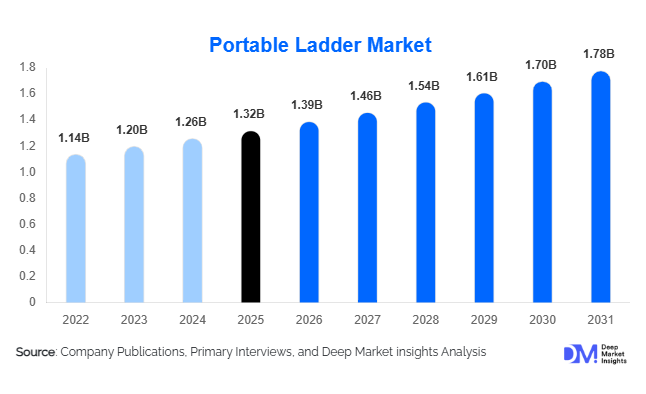
What are the latest trends in the portable ladder market?
Growing Demand for Multi-Position and Telescopic Ladders
One of the most prominent trends in the portable ladder industry is the rising demand for multi-functional ladder designs. Telescopic ladders and folding multi-position ladders allow users to adjust ladder height and configuration depending on the task being performed. These products are particularly attractive to professional contractors, maintenance technicians, and DIY consumers who require flexibility across different working environments. Multi-position ladders can function as step ladders, extension ladders, or scaffolding supports, reducing the need for multiple pieces of equipment. As contractors increasingly seek tools that maximize efficiency and portability, manufacturers are investing heavily in product innovation within this category.
Advanced Safety Features Becoming Standard
Safety is becoming a critical differentiator in the portable ladder market. Manufacturers are incorporating features such as non-slip steps, stabilizing bars, wide bases, automatic locking hinges, and reinforced frames to reduce workplace accidents. Fiberglass ladders with non-conductive properties are also gaining popularity in electrical and utility applications. These innovations are being driven by stricter occupational safety regulations in developed markets such as the United States and Europe. Many companies are now offering ladders with enhanced ergonomic design and improved weight distribution to ensure better balance and stability during use.
What are the key drivers in the portable ladder market?
Expansion of Global Construction Activity
The construction industry remains the primary driver of portable ladder demand worldwide. Workers involved in building construction, electrical installation, painting, and interior finishing frequently rely on ladders to access elevated work areas. Rapid urbanization in developing countries such as India, China, and Indonesia is fueling large infrastructure and housing development projects, which in turn increases demand for construction tools and equipment including portable ladders. The global construction industry continues to expand steadily, creating consistent demand for safe and portable access solutions.
Growth in DIY Home Improvement
Another key driver is the rising popularity of DIY home improvement projects. Homeowners increasingly undertake maintenance activities such as painting, cleaning, gardening, and storage installation themselves rather than hiring professionals. Portable ladders provide a convenient and affordable tool for performing these tasks. The growth of large home improvement retail chains and e-commerce platforms has made consumer-grade ladders widely accessible, further accelerating adoption among residential users.
What are the restraints for the global market?
Competition from Alternative Access Equipment
Although portable ladders remain widely used, alternative access solutions such as scaffolding systems, aerial work platforms, and hydraulic lifts are increasingly being adopted in large construction projects and industrial environments. These systems provide greater stability and safety for workers performing tasks at significant heights. As a result, some large contractors are shifting toward mechanized access equipment, which may limit the growth potential of ladders in certain applications.
Volatility in Raw Material Prices
Fluctuating raw material prices, particularly for aluminum and steel, present another challenge for ladder manufacturers. Aluminum is the most widely used material in portable ladder production due to its lightweight and corrosion-resistant properties. However, global metal price fluctuations can significantly impact manufacturing costs and profit margins. Companies must manage these risks through efficient supply chains and long-term supplier partnerships.
What are the key opportunities in the portable ladder industry?
Infrastructure Modernization Projects
Large-scale infrastructure investments across emerging economies represent a major opportunity for ladder manufacturers. Governments are investing heavily in transportation networks, power plants, commercial buildings, and urban housing projects. These projects require significant construction and maintenance activities that rely on portable access tools. Companies capable of supplying high-durability ladders to construction contractors and infrastructure developers can benefit from long-term demand.
Integration of Smart Safety Technologies
The integration of smart technologies into ladder design is another emerging opportunity. Manufacturers are exploring the incorporation of load sensors, digital leveling indicators, and safety monitoring systems that help prevent accidents during ladder use. These advanced safety features are particularly attractive to industrial customers who must comply with strict workplace safety regulations. Smart ladders may also command premium pricing, improving profitability for manufacturers.
Report Scope
| Report Metric | Details |
|---|---|
| Market Size in 2025 | USD 1.32 Billion |
| Market Size in 2026 | USD 1.39 Billion |
| Market Size in 2031 | USD 1.78 Billion |
| CAGR | 5.1% (2026-2031) |
| Base Year for Estimation | 2025 |
| Historical Data | 2022-2024 |
| Forecast Period | 2026-2031 |
| Report Coverage | Revenue Forecast, Competitive Landscape, Supply Chain Disruption, Growth Factors, Environment & Regulatory Landscape and Trends |
| Geographies Covered | North America, Europe, APAC, Middle East and Africa, LATAM |
| Countries Covered | U.S., Canada, U.K., Germany, France, Spain, Italy, Russia, Nordic, Benelux, Rest of Europe, China, Korea, Japan, India, Australia, Singapore, Taiwan, South East Asia, Rest of Asia-Pacific, UAE, Turky, Saudi Arabia, South Africa, Egypt, Nigeria, Rest of MEA, Brazil, Mexico, Argentina, Chile, Colombia, Rest of LATAM |
Explore more data points, trends and opportunities Download Free Sample Report
Product Type Insights
Step ladders represent the largest product segment in the portable ladder market, accounting for approximately 34% of global demand in 2025. Their popularity is largely due to their self-supporting structure, which eliminates the need for wall support during operation. Step ladders are widely used for indoor maintenance tasks such as painting, installing lighting fixtures, and accessing shelves or storage spaces. Extension ladders also hold a significant share of the market, particularly in construction and exterior maintenance applications where greater working height is required. Telescopic and folding ladders are emerging as fast-growing segments because of their compact design and portability, making them ideal for contractors and DIY consumers with limited storage space.
Material Insights
Aluminum ladders dominate the global market, accounting for roughly 46% of total revenue in 2025. Aluminum offers a strong combination of durability, corrosion resistance, and lightweight structure, making it ideal for both residential and professional applications. Fiberglass ladders represent another important segment, particularly in electrical and utility applications where non-conductive properties are required. Steel ladders are typically used in industrial environments where heavy load capacity is required, while wooden ladders continue to be used in niche traditional applications.
Distribution Channel Insights
Offline retail channels continue to dominate ladder sales, accounting for approximately 70% of global market share. Hardware stores, construction supply retailers, and industrial equipment distributors remain the primary sales channels, as many customers prefer to physically inspect ladder stability and material quality before purchasing. However, e-commerce platforms are gaining popularity, particularly among residential consumers seeking convenience and price comparisons. Online marketplaces allow manufacturers to reach a wider consumer base and provide detailed product information, reviews, and safety certifications.
End-Use Insights
The construction sector represents the largest end-use segment for portable ladders globally. Construction workers rely heavily on ladders for structural assembly, electrical installation, roofing work, and interior finishing. The residential sector is one of the fastest-growing segments, supported by increasing DIY home maintenance activities. Industrial and manufacturing facilities also contribute significant demand as technicians frequently require portable ladders to access machinery, overhead systems, and storage racks. Utilities and telecommunications companies use specialized ladders for maintenance and installation of electrical lines, communication towers, and network equipment.
Explore more data points, trends and opportunities Download Free Sample Report
Portable Ladder Market Segmentations
By Product Type
- Step Ladders
- Extension Ladders
- Platform Ladders
- Telescopic Ladders
- Folding / Multi-Position Ladders
- Combination Ladders
- Attic Ladders
- Step Stools
By Material Type
- Aluminum Ladders
- Fiberglass Ladders
- Steel Ladders
- Wood Ladders
- Composite / Hybrid Material Ladders
By Application
- Construction & Building Maintenance
- Electrical & Utility Maintenance
- Painting & Interior Work
- Warehouse & Logistics Operations
- Household / DIY Applications
- Telecommunications Infrastructure Maintenance
By Distribution Channel
- Hardware & Home Improvement Retail Stores
- Industrial Equipment Distributors
- E-commerce Platforms
- Direct Sales / OEM Supply Contracts
Regional Insights
North America
North America accounts for approximately 39% of the global portable ladder market, making it the largest regional market. The United States represents the majority of demand due to strong construction activity and a large DIY home improvement culture. Major home improvement retailers play a significant role in ladder distribution across the region. Canada also contributes to regional growth through commercial construction projects and infrastructure maintenance activities.
Europe
Europe holds around 27% of the global market share, with strong demand coming from countries such as Germany, the United Kingdom, France, and Italy. Strict occupational safety regulations in the region encourage businesses to invest in high-quality ladders that meet regulatory standards. Industrial maintenance and commercial building management also drive consistent demand.
Asia-Pacific
Asia-Pacific is the fastest-growing regional market with a CAGR exceeding 5.8%. China represents the largest market in the region due to its massive construction industry and manufacturing sector. India is also experiencing rapid growth as infrastructure development and housing construction continue to expand. Japan and South Korea maintain steady demand driven by industrial maintenance and advanced manufacturing operations.
Latin America
Latin America represents a smaller but steadily growing market for portable ladders. Brazil and Mexico account for the majority of regional demand due to industrial development and residential construction activities. As urbanization continues to accelerate across the region, demand for maintenance equipment and construction tools is expected to rise.
Middle East & Africa
The Middle East and Africa region is witnessing moderate growth driven by increasing infrastructure development and construction projects in countries such as the United Arab Emirates, Saudi Arabia, and South Africa. Government investments in tourism infrastructure, commercial buildings, and transportation networks are supporting demand for portable ladders used in construction and facility maintenance operations.
Key Players in the Portable Ladder Market
- WernerCo
- Louisville Ladder Inc.
- Little Giant Ladder Systems
- ZARGES GmbH
- Hasegawa Kogyo Co., Ltd.
- TB Davies Ltd.
- Ballymore Company
- Alaco Ladder Company
- Featherlite Ladders
- Lynn Ladder & Scaffolding Co.
- P.W. Platforms Inc.
- Gorilla Ladders
- LockNClimb LLC
- Krause-Werk GmbH & Co. KG
- WAKÜ Group