Portable Cannabis Vaporizer Market Size
According to Deep Market Insights, the global portable cannabis vaporizer market size was valued at USD 4,750 million in 2025 and is projected to grow from USD 5,177.50 million in 2026 to reach USD 7,966.23 million by 2031, expanding at a CAGR of 9.0% during the forecast period (2026–2031). The market growth is primarily driven by the rising legalization of medical and recreational cannabis, growing consumer preference for health-conscious consumption methods, and advancements in portable and smart vaporizer technologies.
Key Market Insights
- Portable cannabis vaporizers are increasingly favored for health-conscious consumption, offering a cleaner, combustion-free alternative to traditional smoking methods.
- Smart and hybrid vaporizers are gaining traction, integrating IoT-enabled temperature control, mobile apps, and precise dosing features for both medical and recreational users.
- North America dominates the market, with the U.S. and Canada leading demand due to mature cannabis legalization frameworks and high per capita consumption.
- Europe is the fastest-growing region, with Germany, the U.K., and the Netherlands driving medical and recreational adoption.
- Asia-Pacific is emerging as a promising growth region, supported by increasing medical cannabis adoption in Australia, Japan, and India.
- Online retail channels, including e-commerce platforms and D2C websites, are reshaping the distribution landscape, offering convenience, discreet purchasing, and wider accessibility.
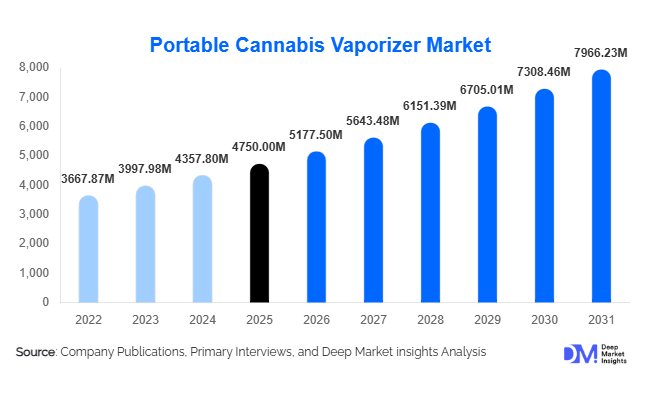
What are the latest trends in the portable cannabis vaporizer market?
Technological Innovation and Smart Devices
Vaporizer manufacturers are increasingly integrating smart technology to enhance user experience. Devices now feature IoT connectivity, smartphone-controlled temperature settings, and usage tracking, enabling consumers to customize vaporization for flavor and potency. Smart vaporizers improve patient compliance in medical applications and offer precise dosing for recreational users. Innovations in hybrid heating technology, combining convection and conduction, have improved efficiency, taste retention, and vapor quality. Premium models incorporating app-based controls and battery management systems are driving market growth in North America and Europe, appealing to tech-savvy consumers who prioritize performance and safety.
Rising Preference for Health-Conscious Consumption
Consumers increasingly prefer vaporization over smoking due to lower exposure to harmful byproducts such as tar and carcinogens. This trend is particularly prominent in medical applications, where patients seek controlled and safe methods for administering cannabis. The shift toward healthier consumption methods has encouraged manufacturers to innovate in ergonomic, portable, and discreet designs, further expanding adoption across both recreational and medical segments. Additionally, educational campaigns highlighting vaporization as a safer alternative have reinforced consumer trust, boosting demand in regulated markets.
What are the key drivers in the portable cannabis vaporizer market?
Legalization of Cannabis
The expanding legalization of recreational and medical cannabis in North America, Europe, and parts of LATAM has directly boosted vaporizer adoption. Legal frameworks promote safer consumption methods and encourage manufacturers to introduce innovative products that comply with local regulations. The resulting increase in consumer accessibility and awareness has made portable vaporizers a preferred choice among both medical patients and recreational users, establishing a strong foundation for market expansion.
Technological Advancements in Vaporizers
Advancements such as hybrid heating systems, convection technology, and smart IoT-enabled devices have improved vapor quality, flavor, and user convenience. These innovations attract premium and tech-savvy consumers, driving adoption in both established and emerging markets. Integration of app-based temperature control, dosing reminders, and battery management features enhances user experience and encourages repeat purchases, supporting market growth.
Rising Health Awareness
Health-conscious consumers increasingly favor vaporizers over traditional smoking methods due to reduced exposure to harmful compounds. The medical cannabis segment, in particular, has driven demand for precise, controlled, and combustion-free consumption. Educational initiatives promoting vaporization as a safer alternative have contributed to the growing market share of portable devices, especially in North America and Europe.
What are the restraints for the global market?
Regulatory Challenges in Certain Regions
Strict cannabis regulations in countries such as Japan, China, and several Middle Eastern nations limit vaporizer adoption and restrict market expansion. Manufacturers must navigate complex licensing requirements, import restrictions, and regional compliance standards, which can slow growth and delay entry into emerging markets.
High Product Costs
Premium portable vaporizers often come with a high price tag, limiting adoption in price-sensitive markets. Manufacturing advanced devices with hybrid heating, battery management, and smart technology increases production costs, which may constrain growth, particularly among recreational users in emerging regions.
What are the key opportunities in the portable cannabis vaporizer market?
Expansion into Emerging Markets
Regions such as Latin America, Asia-Pacific, and Africa are witnessing the gradual legalization of medical cannabis, presenting opportunities for market entrants to establish early presence. Countries like Colombia, Brazil, and South Africa are seeing rising awareness of medical cannabis benefits, providing a favorable environment for portable vaporizer adoption. Strategic entry in these markets can enable companies to capture market share ahead of competitors and set up localized distribution networks.
Integration of Smart and IoT-Enabled Technology
The adoption of smart vaporizers is accelerating as consumers seek precision and convenience. IoT-enabled devices with app-controlled temperature, dosing tracking, and usage analytics are differentiating brands in both medical and recreational segments. Smart technology adoption offers opportunities to build brand loyalty, attract tech-savvy users, and expand into premium market segments, particularly in North America and Europe.
Growth in Cannabis Tourism and Hospitality
With the rise of cannabis-friendly tourism, including lounges, cafes, and recreational facilities, portable vaporizers offer discreet and hygienic consumption options. Premium devices are increasingly integrated into hospitality experiences, creating niche yet high-margin segments. Expanding cannabis tourism in North America and Europe presents lucrative opportunities for specialized products targeting tourists and recreational users seeking safe and portable consumption methods.
Report Scope
| Report Metric | Details |
|---|---|
| Market Size in 2025 | USD 4750 Million |
| Market Size in 2026 | USD 5177.50 Million |
| Market Size in 2031 | USD 7966.23 Million |
| CAGR | 9.0% (2026-2031) |
| Base Year for Estimation | 2025 |
| Historical Data | 2022-2024 |
| Forecast Period | 2026-2031 |
| Report Coverage | Revenue Forecast, Competitive Landscape, Supply Chain Disruption, Growth Factors, Environment & Regulatory Landscape and Trends |
| Geographies Covered | North America, Europe, APAC, Middle East and Africa, LATAM |
| Countries Covered | U.S., Canada, U.K., Germany, France, Spain, Italy, Russia, Nordic, Benelux, Rest of Europe, China, Korea, Japan, India, Australia, Singapore, Taiwan, South East Asia, Rest of Asia-Pacific, UAE, Turky, Saudi Arabia, South Africa, Egypt, Nigeria, Rest of MEA, Brazil, Mexico, Argentina, Chile, Colombia, Rest of LATAM |
Explore more data points, trends and opportunities Download Free Sample Report
Product Type Insights
Dry herb vaporizers dominate the portable cannabis vaporizer market, accounting for approximately 45% of global revenue in 2025. This segment leads primarily due to its strong compatibility with natural cannabis flower products, which remain the most widely consumed form of cannabis worldwide. Dry herb vaporizers are preferred by both recreational users and medical patients because they offer superior flavor preservation, efficient cannabinoid extraction, and relatively simple device design compared with concentrate-based systems. In addition, dry herb devices typically offer adjustable temperature control, enabling users to customize the vaporization experience and optimize terpene and cannabinoid release. Their affordability compared with advanced hybrid systems also contributes to their widespread adoption among first-time consumers.
The growth of this segment is further supported by increasing legalization of recreational cannabis in North America and parts of Europe, where flower-based cannabis products continue to dominate retail sales in dispensaries. Medical cannabis programs in countries such as Canada, Germany, and Australia also encourage vaporization of dry cannabis flower as a safer alternative to smoking. Meanwhile, concentrate vaporizers are gaining traction among experienced users seeking higher potency and rapid effects. Hybrid vaporizers, capable of supporting both dry herb and concentrates, are emerging as premium devices and are witnessing rising adoption among technologically inclined consumers. As vaporizer manufacturers continue integrating smart features such as mobile app connectivity, temperature presets, and precision heating technologies, the product landscape is gradually shifting toward multifunctional devices that combine portability, efficiency, and advanced user control.
Application Insights
Recreational use represents the largest application segment, accounting for roughly 60% of global market share in 2025. The segment’s leadership is largely driven by the rapid expansion of legalized recreational cannabis markets, particularly in the United States and Canada, where consumer awareness of vaporization as a cleaner alternative to smoking has significantly increased. Vaporization reduces the inhalation of combustion-related toxins such as tar and carbon monoxide, making it an attractive consumption method for users seeking a smoother and less harmful experience. Additionally, portable vaporizers provide discreet usage, minimal odor, and improved portability, which has further encouraged adoption among recreational users.
Beyond traditional applications, new use cases are emerging that further expand the market. Cannabis lounges, hospitality venues, and tourism-focused cannabis experiences are increasingly incorporating vaporizers as a hygienic and discreet consumption solution. Additionally, smart vaporizer technologies are being integrated into medical monitoring systems to track dosage and patient compliance, particularly in regulated medical cannabis programs. These evolving applications are broadening the consumer base and strengthening the long-term growth outlook for portable cannabis vaporizers.
Distribution Channel Insights
Online retail channels dominate the portable cannabis vaporizer market, accounting for approximately 35% of total revenue in 2025. The rapid growth of e-commerce platforms has transformed how consumers purchase vaporizer devices, providing convenient access to a wide variety of products, competitive pricing, and discreet purchasing options. Consumers often prefer online channels because they can easily compare product specifications, read reviews, and access educational content regarding vaporizer usage and cannabis consumption methods. The expansion of direct-to-consumer (D2C) sales strategies by leading vaporizer brands has further strengthened the role of online channels in the market.
General retail outlets, including electronics stores and lifestyle retailers, are gradually entering the vaporizer market as legalization expands and regulatory clarity improves. However, their market share remains relatively limited due to regulatory restrictions in several jurisdictions. Looking ahead, e-commerce platforms are expected to integrate subscription-based services, loyalty programs, and bundled product offerings that combine vaporizers with cannabis accessories. These strategies are likely to enhance customer retention and drive recurring revenue for manufacturers.
End-User Insights
Individual consumers represent the largest end-user segment in the portable cannabis vaporizer market, accounting for nearly 70% of global market share in 2025. The widespread adoption among individual users is driven by the increasing acceptance of cannabis consumption and the growing popularity of discreet, portable devices that allow users to consume cannabis conveniently in private settings. Consumers are increasingly prioritizing devices that offer portability, user-friendly design, and advanced heating technologies, which has fueled demand for compact and technologically advanced vaporizers.
Another rapidly growing end-use segment is cannabis tourism and hospitality. Cannabis-friendly hotels, lounges, and tourism operators are incorporating portable vaporizers as part of curated consumption experiences for travelers. These venues often prefer vaporizers because they produce minimal odor and smoke, allowing them to comply with indoor air regulations while offering premium cannabis experiences. As cannabis tourism continues to expand in destinations such as Canada, the Netherlands, and parts of the United States, this end-user segment is expected to contribute significantly to market growth over the next five years.
Explore more data points, trends and opportunities Download Free Sample Report
Portable Cannabis Vaporizer Market Segmentations
By Product Type
- Dry Herb Vaporizers
- Oil Vaporizers
- Wax & Concentrate Vaporizers
- Hybrid Vaporizers
By Heating Method
- Conduction Vaporizers
- Convection Vaporizers
- Induction Vaporizers
- Hybrid Heating Systems
By Distribution Channel
- Online Retail
- Specialty Vape Stores
- Dispensaries
- Electronics & Lifestyle Stores
- Direct-to-Consumer Brand Websites
Regional Insights
North America
North America dominates the global portable cannabis vaporizer market, accounting for approximately 55% of the total market share in 2025. The United States is the largest market in the region, representing roughly 35% of global demand, driven by the widespread legalization of recreational cannabis across numerous states and a well-established cannabis retail ecosystem. Consumers in the U.S. are highly receptive to vaporization technologies due to strong awareness regarding health-conscious consumption methods and increasing demand for discreet cannabis products.
Canada contributes nearly 15% of the global market, supported by its fully legalized cannabis industry and strong regulatory framework that promotes safer consumption methods. The country has also become a hub for vaporizer innovation, with many companies investing in advanced heating technologies and smart vaporizer devices. Growth across North America is further supported by a high level of disposable income, widespread adoption of e-commerce platforms, and a robust network of licensed dispensaries and specialty vape retailers. Additionally, continuous product innovation and brand competition are encouraging consumers to upgrade to premium vaporizer models, strengthening market expansion in the region.
Europe
Europe accounts for approximately 25% of the global portable cannabis vaporizer market in 2025. Germany leads the region with around 10% market share, driven by the rapid expansion of medical cannabis prescriptions and recent policy reforms supporting regulated cannabis consumption. The Netherlands also holds a significant share of the market due to its long-standing tolerance of cannabis use and established cannabis tourism industry.
The United Kingdom is emerging as one of the fastest-growing markets in Europe, recording a projected CAGR of around 11%. Rising consumer awareness regarding vaporization as a safer alternative to smoking, combined with growing demand for medical cannabis therapies, is driving vaporizer adoption in the country. Across the broader European region, increasing regulatory acceptance of medical cannabis programs, expanding e-commerce distribution channels, and rising interest in discreet cannabis consumption devices are key factors supporting market growth.
Asia-Pacific
Asia-Pacific currently represents approximately 10% of the global market but is expected to experience the fastest growth with a projected CAGR of nearly 12% during the forecast period. Australia is the leading market in the region due to its regulated medical cannabis framework and increasing patient enrollment in cannabis treatment programs. The country’s medical cannabis industry has expanded significantly in recent years, which has stimulated demand for vaporization devices designed for controlled dosing.
Japan and India are also emerging as potential growth markets, particularly within medical and research-based cannabis segments. Rising middle-class income levels, increasing health awareness, and growing exposure to global cannabis consumption trends through social media are gradually driving consumer curiosity about vaporization devices. Although regulatory restrictions remain strict in many parts of Asia, gradual policy reforms and growing acceptance of medical cannabis could unlock substantial market potential in the coming decade.
Latin America
Latin America accounts for roughly 5% of the global portable cannabis vaporizer market. Brazil and Colombia are the largest contributors in the region, representing approximately 3% and 2% of the global market, respectively. Both countries have implemented medical cannabis frameworks that allow regulated distribution of cannabis-based therapies, creating early demand for vaporization devices used in therapeutic applications.
The region is witnessing growing interest in cannabis vaporization due to increasing patient awareness, expanding cannabis research initiatives, and government support for domestic cannabis cultivation. In addition, Latin America is becoming an important export hub for cannabis products, which is encouraging the development of related consumption technologies such as vaporizers. While regulatory progress remains gradual, the combination of expanding medical programs and improving economic conditions is expected to support steady market growth across the region.
Middle East & Africa
The Middle East and Africa region accounts for approximately 5% of the global portable cannabis vaporizer market. South Africa is the largest market in the region, contributing nearly 2% of global demand. The country’s progressive stance toward medical cannabis and personal cannabis cultivation has created opportunities for vaporizer adoption among both recreational and medical users. Israel represents another key market due to its well-developed medical cannabis research ecosystem and strong government support for cannabis-based therapies. The country has become a global leader in medical cannabis innovation, which has encouraged the adoption of advanced vaporization devices among patients.
In the Middle East, high-income countries such as the United Arab Emirates, Saudi Arabia, and Qatar are witnessing niche demand for premium vaporizer devices, particularly among affluent consumers and international tourists. Although cannabis regulations remain restrictive across most of the region, increasing global exposure to vaporization technologies and rising interest in alternative wellness products could gradually stimulate market growth in select markets.
Key Players in the Portable Cannabis Vaporizer Market
- Pax Labs
- Storz & Bickel
- DaVinci Vaporizer
- G Pen (Grenco Science)
- Firefly Vapor
- IQOS (Cannabis variant)
- Arizer
- Mighty Vaporizer
- Boundless Technology
- KandyPens
- Vapium
- AtmosRX
- Linx Vapor
- XVape
- Yocan