Polygraph Equipment Market Size
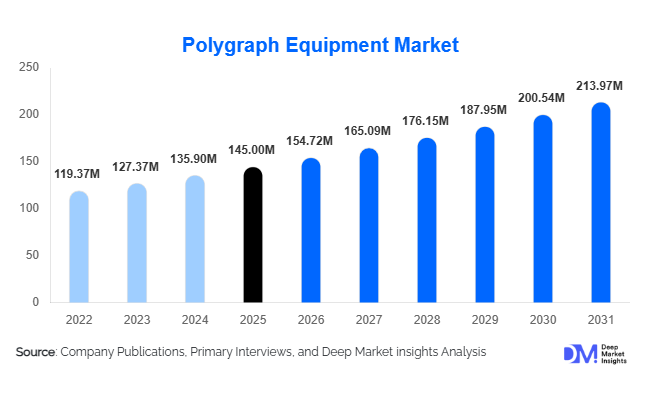
According to Deep Market Insights, the global polygraph equipment market size was valued at USD 145 million in 2025 and is projected to grow from USD 154.72 million in 2026 to reach USD 213.97 million by 2031, expanding at a CAGR of 6.7% during the forecast period (2026–2031). The polygraph equipment market growth is primarily driven by increasing demand for security screening, criminal investigations, and counterintelligence operations across government and defense sectors. The market is also witnessing a gradual expansion into corporate and private security applications, supported by rising concerns over fraud, insider threats, and compliance monitoring.
Key Market Insights
- Government and law enforcement agencies dominate demand, accounting for over 55% of global market share due to widespread use in criminal investigations and security screening.
- Computerized and AI-integrated polygraph systems are gaining traction, improving accuracy, data analytics, and operational efficiency.
- North America leads the global market, supported by strong defense spending and advanced forensic infrastructure.
- Asia-Pacific is the fastest-growing region, driven by increasing investments in law enforcement modernization and internal security.
- Portable polygraph systems are emerging as a key trend, enabling field-based operations and flexible deployment.
- Integration with biometric and behavioral analytics technologies is reshaping the future of deception detection systems.
What are the latest trends in the polygraph equipment market?
AI-Driven Polygraph Analysis and Automation
The integration of artificial intelligence and machine learning into polygraph systems is transforming traditional lie detection methods. Modern systems are increasingly equipped with automated data interpretation tools that reduce reliance on human examiners and minimize subjectivity. AI-driven algorithms analyze physiological signals such as heart rate, respiration, and skin conductivity with greater precision, enabling faster and more consistent results. This trend is particularly prominent in developed markets where law enforcement agencies are investing in advanced interrogation technologies. Additionally, cloud-based data storage and analytics platforms are enabling centralized monitoring and real-time insights, improving operational efficiency and scalability.
Shift Toward Portable and Field-Deployable Systems
There is a growing demand for compact, portable polygraph systems that can be deployed in field environments. These systems are designed for ease of transport and rapid setup, making them suitable for military operations, border security, and remote investigations. Advances in miniaturization and wireless connectivity have enhanced the functionality of portable devices without compromising accuracy. This trend is expanding the application scope of polygraph equipment beyond traditional interrogation rooms, allowing for real-time assessments in dynamic environments.
What are the key drivers in the polygraph equipment market?
Rising National Security and Counterintelligence Needs
Increasing geopolitical tensions and security concerns are driving demand for polygraph equipment in defense and intelligence agencies. Governments are investing heavily in screening personnel, preventing espionage, and strengthening internal security frameworks. Polygraph systems are widely used in pre-employment screening and ongoing monitoring of sensitive roles, making them a critical component of national security infrastructure.
Growth in Criminal Investigations and Law Enforcement Applications
The rising incidence of criminal activities and cybercrime is prompting law enforcement agencies to adopt advanced investigative tools. Polygraph systems are used as supplementary tools to enhance interrogation processes and gather behavioral insights. Their continued use in forensic investigations, despite legal limitations, is supporting steady market growth.
What are the restraints for the global market?
Concerns Over Accuracy and Legal Admissibility
One of the major challenges facing the polygraph equipment market is the ongoing debate over the reliability of polygraph results. In many countries, polygraph evidence is not admissible in court, limiting its application scope. This skepticism affects adoption rates, particularly in regions with strict legal frameworks.
Dependence on Skilled Examiners
Polygraph testing requires trained professionals to administer tests and interpret results accurately. The shortage of certified examiners, especially in developing regions, poses a barrier to market expansion. Training and certification costs further add to operational challenges for end-users.
What are the key opportunities in the polygraph equipment industry?
Expansion into Emerging Markets
Emerging economies in the Asia-Pacific and the Middle East present significant growth opportunities due to increasing investments in law enforcement modernization and internal security. Governments in countries such as India, China, and the UAE are adopting advanced technologies to enhance investigative capabilities, creating demand for cost-effective polygraph systems.
Integration with Multi-Modal Biometric Systems
The convergence of polygraph systems with other biometric technologies such as facial recognition, voice analysis, and eye tracking is creating new opportunities for innovation. These integrated systems provide more comprehensive deception detection solutions, enhancing accuracy and expanding use cases across various industries.
Report Scope
| Report Metric | Details |
|---|---|
| Market Size in 2025 | USD 145 Million |
| Market Size in 2026 | USD 154.72 Million |
| Market Size in 2031 | USD 213.97 Million |
| CAGR | 6.7% (2026-2031) |
| Base Year for Estimation | 2025 |
| Historical Data | 2022-2024 |
| Forecast Period | 2026-2031 |
| Report Coverage | Revenue Forecast, Competitive Landscape, Supply Chain Disruption, Growth Factors, Environment & Regulatory Landscape and Trends |
| Geographies Covered | North America, Europe, APAC, Middle East and Africa, LATAM |
| Countries Covered | U.S., Canada, U.K., Germany, France, Spain, Italy, Russia, Nordic, Benelux, Rest of Europe, China, Korea, Japan, India, Australia, Singapore, Taiwan, South East Asia, Rest of Asia-Pacific, UAE, Turky, Saudi Arabia, South Africa, Egypt, Nigeria, Rest of MEA, Brazil, Mexico, Argentina, Chile, Colombia, Rest of LATAM |
Explore more data points, trends and opportunities Download Free Sample Report
Component Insights
Hardware continues to dominate the polygraph equipment market, accounting for approximately 52% of the global market in 2025. This leadership is primarily driven by the indispensable role of core polygraph instruments, sensors, and data acquisition systems in conducting physiological measurements such as respiration, cardiovascular activity, and galvanic skin response. Government agencies and defense organizations continue to invest heavily in upgrading legacy analog systems to advanced digital hardware, further strengthening this segment’s position. Additionally, hardware replacement cycles and the need for high-precision sensors in critical investigations sustain consistent demand. Meanwhile, software solutions are rapidly gaining traction as organizations transition toward computerized systems that offer enhanced data visualization, automated interpretation, and secure storage capabilities. Service offerings, including examiner training, certification, calibration, and maintenance, are also expanding, as accurate polygraph testing remains highly dependent on system reliability and skilled operation, thereby creating a recurring revenue stream for vendors.
Technology Insights
Computerized polygraph systems lead the technology segment with nearly 48% market share, driven by their superior accuracy, real-time data processing capabilities, and seamless integration with digital platforms. These systems enable efficient data storage, advanced analytics, and standardized reporting, making them the preferred choice for modern law enforcement and intelligence agencies. The transition from analog to digital technologies has significantly improved test consistency and operational efficiency, further reinforcing this segment’s dominance. A key driver behind this shift is the growing need for data-backed decision-making and audit trails in investigations. Additionally, AI-integrated polygraph systems are emerging as a high-growth segment, offering automated pattern recognition, reduced examiner bias, and predictive analytics. These next-generation systems are particularly attractive in developed markets, where agencies are prioritizing technological modernization and scalability.
Application Insights
Criminal investigations remain the largest application segment, contributing approximately 40% of the global market. The dominance of this segment is attributed to the extensive use of polygraph tests in interrogation processes, suspect verification, and forensic investigations. Law enforcement agencies rely on polygraph systems as supplementary tools to enhance investigative accuracy and uncover concealed information. The increasing complexity of crimes, including cybercrime and organized criminal activities, is further driving demand in this segment. Additionally, pre-employment screening and counterintelligence applications are gaining importance, particularly in defense and intelligence sectors, where background verification and personnel reliability are critical. The expansion of these applications into corporate environments, especially in high-risk industries such as banking and cybersecurity, is also contributing to incremental growth.
End-User Insights
Government and law enforcement agencies dominate the market, accounting for approximately 55% of total demand. This segment’s leadership is driven by the critical role polygraph systems play in national security, criminal justice, and intelligence operations. Continuous investments in defense and internal security infrastructure, particularly in developed economies, are sustaining strong demand. Additionally, mandatory screening protocols for sensitive positions in government institutions further reinforce adoption. Private security firms and corporate enterprises are emerging as fast-growing end-user segments, fueled by increasing concerns over fraud detection, insider threats, and regulatory compliance. Organizations in sectors such as finance, IT, and critical infrastructure are gradually incorporating polygraph testing into risk management frameworks, thereby expanding the market beyond its traditional public-sector base.
Portability Insights
Fixed polygraph systems hold the largest share at around 60% of the market, primarily due to their widespread use in controlled environments such as interrogation rooms, forensic laboratories, and government facilities. These systems offer higher stability, accuracy, and integration with advanced software tools, making them the preferred choice for formal investigations. The dominance of this segment is also supported by established infrastructure in law enforcement agencies, where fixed setups are standard. However, portable polygraph systems are gaining significant momentum, driven by the need for flexibility and rapid deployment in field operations. Military units, border security agencies, and private investigators are increasingly adopting portable solutions for on-site assessments, which is expected to drive faster growth in this segment over the forecast period.
Explore more data points, trends and opportunities Download Free Sample Report
Polygraph Equipment Market Segmentations
By Component
- Hardware
- Software
- Services
By Technology Type
- Conventional Polygraph Systems
- Computerized Polygraph Systems
- Voice Stress Analysis Systems
- AI-Integrated Lie Detection Systems
By Application
- Criminal Investigations
- Pre-Employment Screening
- Counterintelligence & National Security
- Private Investigations
- Research & Academic Use
By End-User
- Government & Law Enforcement
- Defense & Military
- Private Security Firms
- Corporate Enterprises
- Academic & Research Institutions
By Portability
- Fixed/Stationary Systems
- Portable/Field-Based Systems
Regional Insights
North America
North America dominates the polygraph equipment market with approximately 38% share in 2025, led by the United States, which accounts for over 30% of global demand. The region’s leadership is driven by high defense and homeland security spending, well-established law enforcement infrastructure, and early adoption of advanced technologies. Federal agencies extensively use polygraph testing for pre-employment screening, counterintelligence, and criminal investigations. Additionally, continuous investments in upgrading digital and AI-enabled systems, along with the strong presence of key market players, further support regional growth. The increasing focus on cybersecurity and insider threat detection is also expanding application areas in both public and private sectors.
Europe
Europe holds around 25% market share, with major contributions from countries such as the UK, Germany, and France. The region exhibits steady demand, primarily driven by defense, intelligence, and border security applications. Growth is supported by increasing focus on counterterrorism measures and cross-border crime prevention within the European Union. However, stringent regulatory frameworks and legal limitations regarding the admissibility of polygraph evidence moderate market expansion. Despite this, investments in forensic science modernization and the rising adoption of digital investigation tools are gradually strengthening demand across the region.
Asia-Pacific
Asia-Pacific accounts for approximately 20% of the market and is the fastest-growing region, with a CAGR exceeding 8%. Rapid growth in this region is driven by increasing government investments in internal security, law enforcement modernization, and defense capabilities. Countries such as China, India, and Japan are actively upgrading their investigative infrastructure to address rising crime rates, terrorism threats, and cybercrime. Additionally, expanding private security sectors and growing adoption of advanced technologies are contributing to demand. Favorable government initiatives supporting domestic manufacturing and technology adoption further accelerate market growth in the region.
Latin America
Latin America represents about 7% of the market, with Brazil and Mexico leading demand. Growth in this region is primarily driven by rising crime rates, drug trafficking activities, and increasing government focus on strengthening law enforcement capabilities. Investments in police modernization programs and forensic infrastructure are supporting the adoption of polygraph systems. However, budget constraints and limited availability of skilled examiners remain key challenges. Despite these limitations, gradual improvements in security policies and international collaborations are expected to drive steady market expansion.
Middle East & Africa
The Middle East & Africa region accounts for nearly 10% of global market share, with significant demand from countries such as the UAE, Saudi Arabia, and South Africa. Growth in this region is driven by increasing security concerns, geopolitical tensions, and rising investments in surveillance and intelligence systems. Governments are focusing on enhancing border security, counterterrorism capabilities, and internal surveillance, which is boosting demand for polygraph equipment. Additionally, the expansion of private security services and infrastructure development projects in the Middle East is creating new opportunities for market growth. In Africa, improving law enforcement frameworks and international aid for security enhancement are contributing to the gradual adoption.
Key Players in the Polygraph Equipment Market
- Lafayette Instrument Company
- Axciton Systems Inc.
- Stoelting Co.
- Limestone Technologies Inc.
- NMS Labs
- Peak Credibility Assessment
- Omega Intelligence
- CPS Pro
- Paragon Systems
- Forensic Research & Supply
- Behavioral Measures Inc.
- Diogenes Polygraph
- Global Polygraph Network
- Polygraph Institute
- International Polygraph Services