Point-of-Sale (POS) Receipt Printer Market Size
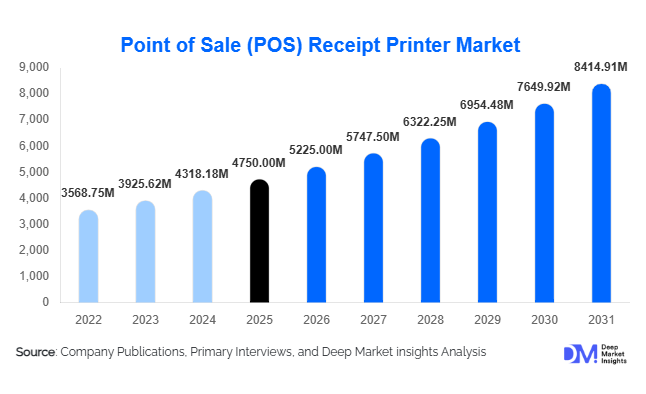
According to Deep Market Insights, the global point-of-sale (POS) receipt printer market size was valued at USD 4,750 million in 2025 and is projected to grow from USD 5,225.00 million in 2026 to reach USD 8,414.91 million by 2031, expanding at a CAGR of 10.0% during the forecast period (2026–2031). The POS receipt printer market growth is primarily driven by the rapid expansion of digital payment ecosystems, increasing deployment of POS terminals across retail and hospitality industries, and the transition toward cloud-connected and mobile POS infrastructure. Businesses worldwide are modernizing transaction systems to improve billing accuracy, transaction speed, and customer service efficiency.
POS receipt printers play a critical role in retail and service environments by generating transaction receipts, invoices, kitchen order tickets, and logistics documentation. Thermal printing technology has emerged as the dominant solution due to its low maintenance requirements, high printing speed, and cost efficiency compared to traditional impact printers. Additionally, the proliferation of mobile POS (mPOS) systems, self-checkout kiosks, and automated retail stores is creating new demand for compact and wireless receipt printers.
The growing formalization of retail sectors in emerging economies, combined with the expansion of quick-service restaurants (QSRs), supermarkets, and e-commerce fulfillment centers, is further accelerating market demand. Businesses are increasingly investing in POS infrastructure that integrates with cloud software, digital payment systems, and inventory management platforms. As retail automation continues to advance globally, the POS receipt printer market is expected to experience sustained growth across both developed and emerging markets.
Key Market Insights
- Thermal POS receipt printers dominate the market, accounting for more than 60% of global deployments due to high printing speed and low operational costs.
- Retail remains the largest end-use industry, driven by high transaction volumes in supermarkets, department stores, and convenience stores.
- North America holds the largest market share, supported by advanced retail infrastructure and widespread adoption of digital payment systems.
- Asia-Pacific is the fastest-growing region, driven by expanding retail networks, rising digital payments, and growing hospitality sectors in China, India, and Southeast Asia.
- Mobile POS and portable printers are gaining traction, particularly in restaurants, delivery services, and event ticketing applications.
- Cloud-integrated POS systems are increasingly driving demand for wireless receipt printers with IoT connectivity and remote management capabilities.
What are the latest trends in the POS receipt printer market?
Adoption of Cloud-Connected POS Printing Systems
The increasing adoption of cloud-based POS systems is transforming the POS receipt printer ecosystem. Businesses are shifting toward centralized retail management platforms where transaction data, billing operations, and printer management are handled remotely through cloud software. Modern POS printers are now designed with Ethernet, Wi-Fi, and Bluetooth connectivity that allows seamless integration with cloud POS platforms.
This shift enables retailers and restaurant chains to manage multiple outlets from a centralized dashboard while monitoring printer performance and maintenance requirements. Cloud-connected printers can also receive remote firmware updates and diagnostics, reducing downtime and operational costs. As cloud-based retail technology continues to gain traction, POS printer manufacturers are focusing on developing IoT-enabled devices that support remote monitoring and predictive maintenance.
Growth of Mobile POS and Portable Printing Solutions
Mobile POS systems are rapidly gaining popularity across industries such as hospitality, field services, transportation, and event management. Portable POS receipt printers equipped with Bluetooth and Wi-Fi connectivity allow businesses to process transactions anywhere without relying on fixed checkout counters.
Restaurants increasingly deploy mobile printers for tableside billing and order processing, improving service efficiency and reducing customer waiting time. Similarly, delivery personnel and field technicians use portable printers to issue receipts and invoices instantly. The growing popularity of mobile commerce and pop-up retail formats is expected to drive strong demand for lightweight, battery-powered receipt printers that provide flexibility and operational mobility.
What are the key drivers in the POS receipt printer market?
Expansion of Organized Retail and Supermarket Chains
The rapid expansion of organized retail infrastructure worldwide is a major driver of the POS receipt printer market. Supermarkets, hypermarkets, convenience stores, and department stores rely heavily on POS printers to process large volumes of transactions. As retail chains expand store networks globally, each new outlet requires multiple POS terminals and receipt printers.
Emerging markets in Asia-Pacific and Latin America are witnessing significant retail infrastructure growth, driven by rising urbanization and consumer spending. Governments in many developing countries are also promoting digital payments and electronic billing, which further increases the adoption of POS hardware systems including receipt printers.
Transition Toward Thermal Printing Technology
Thermal printing technology has become the preferred solution for POS receipt printing due to its operational advantages. Thermal printers eliminate the need for ink cartridges or ribbons, significantly reducing maintenance costs and operational downtime. They also deliver faster printing speeds and produce clear, durable receipts suitable for high-volume transaction environments.
Retailers and hospitality operators are increasingly replacing traditional dot-matrix printers with direct thermal printers to improve efficiency and reduce noise in service environments. The continued adoption of thermal printing technology is expected to remain a key growth driver for the POS receipt printer market.
What are the restraints for the global market?
Rising Adoption of Digital Receipts
One of the key restraints impacting the POS receipt printer market is the growing adoption of digital receipts delivered through email or mobile applications. Retailers aiming to reduce paper usage and support sustainability initiatives are encouraging customers to opt for electronic receipts rather than printed ones.
Digital receipts provide advantages such as easy record storage, improved customer engagement through loyalty programs, and reduced operational costs for retailers. Although printed receipts remain necessary for regulatory compliance in many countries, the gradual shift toward paperless transactions could moderate long-term demand for receipt printers in certain retail environments.
Supply Chain and Component Cost Volatility
POS receipt printers rely on electronic components such as print heads, semiconductors, and connectivity modules. Fluctuations in semiconductor supply and raw material prices can affect manufacturing costs and product availability. Supply chain disruptions experienced during recent global events highlighted the vulnerability of electronics manufacturing industries.
Manufacturers must manage component sourcing risks and maintain cost-efficient production strategies to remain competitive. Companies that establish diversified supply chains and invest in local manufacturing capabilities are better positioned to mitigate these risks.
What are the key opportunities in the POS receipt printer industry?
Expansion of Digital Payment Infrastructure in Emerging Markets
Rapid expansion of digital payment ecosystems across emerging economies presents significant opportunities for POS receipt printer manufacturers. Governments in countries such as India, Indonesia, Brazil, and Vietnam are promoting electronic payments to improve financial transparency and tax compliance. This has led to a surge in POS terminal installations across small retail outlets, restaurants, and service businesses.
As millions of small merchants adopt POS terminals to support digital transactions, demand for compact and affordable receipt printers is expected to increase significantly. Manufacturers that provide cost-effective printers tailored for small and medium enterprises (SMEs) can capture substantial market opportunities in these regions.
Integration with Automated Retail and Self-Checkout Systems
The global retail industry is increasingly adopting automation technologies such as self-checkout kiosks and unattended retail stores. These systems rely on integrated receipt printing modules to provide customers with transaction documentation. The deployment of automated checkout counters is particularly prominent in supermarkets, airports, and convenience stores.
POS printer manufacturers have an opportunity to design compact embedded printing modules optimized for kiosk integration. As retailers continue to invest in automation to improve operational efficiency and reduce labor costs, demand for kiosk-compatible POS printers is expected to rise steadily.
Report Scope
| Report Metric | Details |
|---|---|
| Market Size in 2025 | USD 4750 Million |
| Market Size in 2026 | USD 5225 Million |
| Market Size in 2031 | USD 8414.91 Million |
| CAGR | 10.0% (2026-2031) |
| Base Year for Estimation | 2025 |
| Historical Data | 2022-2024 |
| Forecast Period | 2026-2031 |
| Report Coverage | Revenue Forecast, Competitive Landscape, Supply Chain Disruption, Growth Factors, Environment & Regulatory Landscape and Trends |
| Geographies Covered | North America, Europe, APAC, Middle East and Africa, LATAM |
| Countries Covered | U.S., Canada, U.K., Germany, France, Spain, Italy, Russia, Nordic, Benelux, Rest of Europe, China, Korea, Japan, India, Australia, Singapore, Taiwan, South East Asia, Rest of Asia-Pacific, UAE, Turky, Saudi Arabia, South Africa, Egypt, Nigeria, Rest of MEA, Brazil, Mexico, Argentina, Chile, Colombia, Rest of LATAM |
Explore more data points, trends and opportunities Download Free Sample Report
Product Type Insights
Thermal receipt printers dominate the POS receipt printer market due to their superior performance and cost efficiency. Direct thermal printers are widely used in retail checkout counters and restaurant billing systems because they deliver high-speed printing without requiring ink or ribbons. Thermal transfer printers, though less common in POS environments, are used in applications where longer receipt durability is required.
Impact printers, particularly dot-matrix printers, continue to be used in specialized environments such as banking and transportation where multi-copy receipts are required. However, their market share has declined as businesses shift toward quieter and more efficient thermal printing technologies. Inkjet receipt printers represent a niche segment used in applications that require high-resolution printing or color graphics, though they remain less common due to higher operating costs.
Application Insights
Transaction receipt printing remains the primary application for POS printers, accounting for more than half of global demand. Every retail or service transaction typically requires a printed receipt for accounting, tax compliance, and customer record purposes. This application dominates across supermarkets, convenience stores, restaurants, and pharmacies.
Order processing in restaurants and cafés represents another important application segment. Kitchen order tickets printed through POS systems enable restaurants to streamline operations and ensure accurate order preparation. Ticket and coupon printing is also gaining traction in entertainment venues, transportation hubs, and event management applications.
Distribution Channel Insights
Direct enterprise sales and system integrators dominate the distribution landscape for POS receipt printers. Large retail chains and hospitality groups typically procure POS hardware through enterprise procurement contracts with manufacturers or authorized distributors. System integrators play an important role by providing complete POS solutions that include printers, payment terminals, and retail management software.
Online distribution channels are becoming increasingly important, particularly for small businesses and independent retailers purchasing POS equipment. E-commerce platforms and B2B marketplaces allow businesses to compare product features and pricing while enabling manufacturers to reach a broader customer base.
End-Use Industry Insights
The retail sector represents the largest end-use industry for POS receipt printers, accounting for nearly 30% of total market demand. Supermarkets, department stores, and convenience stores rely heavily on POS printers to process high volumes of transactions efficiently. The expansion of organized retail infrastructure across emerging markets is further driving demand for POS hardware systems.
The hospitality and food service industry is among the fastest-growing segments. Restaurants, cafés, and quick-service restaurants use POS printers for order processing, billing, and kitchen ticket printing. The growing global restaurant industry and expansion of food delivery services are increasing the adoption of mobile POS printers in this sector.
Healthcare institutions, including pharmacies and hospitals, also utilize POS printers for billing and prescription documentation. Additionally, transportation, logistics, and entertainment industries rely on POS printers for ticketing and transaction documentation.
Explore more data points, trends and opportunities Download Free Sample Report
Point of Sale (POS) Receipt Printer Market Segmentations
By Printing Technology
- Direct Thermal Receipt Printers
- Thermal Transfer Receipt Printers
- Dot-Matrix / Impact POS Receipt Printers
- Inkjet POS Receipt Printers
By Printer Form Factor
- Desktop POS Receipt Printers
- Mobile / Portable POS Receipt Printers
- Kiosk / Embedded POS Receipt Printers
- Hybrid Receipt Printers (Receipt + Slip/Check)
By Application
- Transaction Receipt Printing
- Kitchen Order / Restaurant Ticket Printing
- Ticket and Coupon Printing
- Invoice and Billing Documentation
By End-Use Industry
- Retail & Supermarkets
- Hospitality & Food Service
- Healthcare (Hospitals, Pharmacies, Labs)
- Banking & Financial Services
- Transportation & Logistics
- Entertainment & Event Management
- Government Services & Public Utilities
By Distribution Channel
- Direct Enterprise Sales
- System Integrators
- Value-Added Resellers (VARs)
- Online Retail / E-commerce
Regional Insights
North America
North America holds the largest share of the global POS receipt printer market, accounting for approximately 35% of total revenue in 2025. The United States represents the dominant market in the region due to widespread adoption of advanced retail technologies and digital payment infrastructure. Large supermarket chains, quick-service restaurants, and entertainment venues rely heavily on POS systems integrated with high-speed receipt printers.
Canada also contributes to regional demand through the modernization of retail infrastructure and the growing adoption of automated checkout systems. Retailers in North America are increasingly investing in cloud-based POS platforms, which require wireless printers capable of seamless integration with digital retail ecosystems.
Europe
Europe represents nearly 27% of the global POS receipt printer market. Countries such as Germany, the United Kingdom, France, and Italy have well-established retail sectors and strict fiscal regulations that require printed receipts for transactions. These regulations support sustained demand for POS printers across retail and hospitality businesses.
European retailers are also adopting advanced POS technologies such as self-checkout kiosks and automated billing systems, which integrate embedded receipt printers. The region is witnessing strong adoption of energy-efficient thermal printers designed to reduce operational costs and environmental impact.
Asia-Pacific
Asia-Pacific accounts for around 29% of the global market and is the fastest-growing region. China is the largest market in the region due to its extensive retail infrastructure and large-scale manufacturing capabilities. India is also experiencing rapid growth as digital payment adoption expands and retail businesses increasingly deploy POS terminals.
Japan and South Korea represent technologically advanced markets with high adoption of automated retail systems and mobile POS solutions. Southeast Asian countries such as Indonesia, Thailand, and Vietnam are emerging markets where retail modernization and growing tourism industries are driving POS printer demand.
Latin America
Latin America holds approximately 6% of the global market. Brazil and Mexico are the largest markets in the region due to government tax regulations that require printed receipts for transactions. Retail expansion and growing hospitality sectors are also supporting demand for POS printers.
Middle East & Africa
The Middle East and Africa region accounts for around 3% of global demand but is gradually expanding. Countries such as the UAE, Saudi Arabia, and South Africa are investing heavily in retail infrastructure and tourism development. As digital payments and modern retail formats expand across the region, the demand for POS hardware systems including receipt printers is expected to grow steadily.
Key Players in the POS Receipt Printer Market
- Seiko Epson Corporation
- Star Micronics Co., Ltd.
- Bixolon Co., Ltd.
- Zebra Technologies Corporation
- Toshiba Tec Corporation
- Honeywell International Inc.
- NCR Voyix Corporation
- HP Inc.
- Citizen Systems Japan Co., Ltd.
- Posiflex Technology Inc.
- Fujitsu Limited
- Custom S.p.A.
- SATO Holdings Corporation
- Diebold Nixdorf Inc.
- SNBC (Shandong New Beiyang Information Technology)