Plotter Printer Market Size
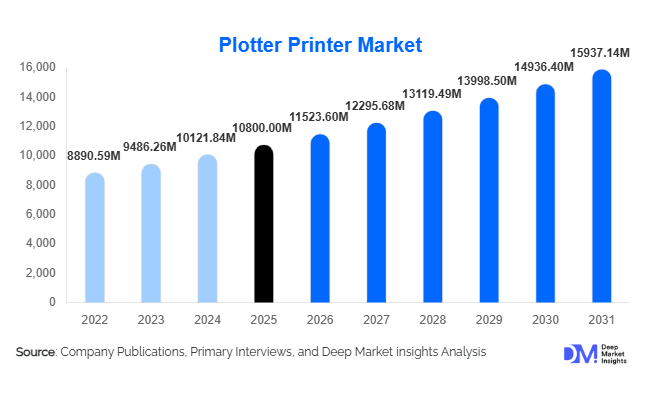
According to Deep Market Insights, the global plotter printer market size was valued at USD 10,800 million in 2025 and is projected to grow from USD 11,523.60 million in 2026 to reach USD 15,937.14 million by 2031, expanding at a CAGR of 6.7% during the forecast period (2026–2031). The plotter printer market growth is primarily driven by increasing demand for high-precision large-format printing across industries such as architecture, engineering, textiles, and advertising, along with the rapid shift toward digital printing technologies and automated workflows.
Key Market Insights
- Inkjet-based large-format plotters dominate the market, driven by superior color quality, cost efficiency, and versatility across applications.
- Architecture, engineering, and construction (AEC) remains the largest end-use sector, supported by global infrastructure expansion and smart city initiatives.
- Asia-Pacific leads the global market, fueled by strong manufacturing, textile printing demand, and rapid urbanization in China and India.
- Digital textile printing is emerging as a high-growth segment, driven by demand for customization and sustainable production processes.
- Cloud connectivity and IoT integration are transforming plotter operations through predictive maintenance and workflow optimization.
- Mid-range and network-enabled plotters are witnessing the fastest adoption, balancing performance, cost, and scalability.
What are the latest trends in the plotter printer market?
Adoption of Smart and Connected Plotters
The integration of IoT and cloud-based technologies is significantly transforming the plotter printer market. Modern plotters now feature real-time monitoring, predictive maintenance alerts, and remote operation capabilities, enabling businesses to streamline workflows and reduce downtime. These smart systems allow enterprises to manage large-scale printing operations more efficiently, particularly in industries such as construction and manufacturing, where time-sensitive outputs are critical. Additionally, cloud-enabled collaboration tools are facilitating seamless sharing of large-format files across distributed teams, supporting the growing trend of remote and hybrid work environments.
Growth of Digital Textile Printing
Digital textile printing is rapidly gaining traction as a sustainable and flexible alternative to traditional printing methods. Plotter printers are increasingly being used for fabric printing, offering advantages such as reduced water consumption, minimal waste, and the ability to produce customized designs at scale. This trend is particularly prominent in fast fashion and home décor industries, where quick turnaround times and design flexibility are essential. As sustainability becomes a core focus, manufacturers are developing eco-friendly inks and energy-efficient machines, further accelerating adoption in the textile sector.
What are the key drivers in the plotter printer market?
Rising Demand for CAD and Technical Printing
The widespread adoption of computer-aided design (CAD) tools across architecture, engineering, and industrial design is a major growth driver. Plotter printers are essential for producing precise technical drawings, blueprints, and schematics, ensuring accuracy in large-scale projects. With global infrastructure investments increasing, the demand for high-quality technical printing continues to rise steadily.
Expansion of the Advertising and Signage Industry
The advertising and media industry is increasingly relying on large-format printing for high-impact visual communication. Plotter printers enable businesses to produce banners, billboards, and promotional materials with superior resolution and faster turnaround times. The growing emphasis on brand visibility and customization is driving continuous demand from this segment.
What are the restraints for the global market?
High Initial Investment and Maintenance Costs
Advanced plotter printers require significant upfront investment, along with ongoing maintenance and consumable costs. This poses a barrier for small and medium enterprises, limiting widespread adoption despite the long-term efficiency benefits offered by these systems.
Competition from Digital Display Alternatives
The increasing adoption of digital signage, LED displays, and other non-print advertising technologies is reducing reliance on printed materials in certain applications. This shift poses a challenge to the growth of the plotter printer market, particularly in urban advertising environments.
What are the key opportunities in the plotter printer industry?
Expansion in Textile and Apparel Printing
The growing shift toward digital textile printing presents a significant opportunity for plotter printer manufacturers. As fashion brands move toward on-demand production and mass customization, the demand for advanced fabric printing solutions is increasing. This trend is particularly strong in emerging markets, where textile manufacturing is a key economic driver.
Infrastructure Development and Smart Cities
Large-scale infrastructure projects and smart city initiatives across developing economies are creating sustained demand for technical drawings and GIS mapping. Plotter printers play a crucial role in these applications, providing consistent revenue opportunities for market participants.
Report Scope
| Report Metric | Details |
|---|---|
| Market Size in 2025 | USD 10800 Million |
| Market Size in 2026 | USD 11523.60 Million |
| Market Size in 2031 | USD 15937.14 Million |
| CAGR | 6.7% (2026-2031) |
| Base Year for Estimation | 2025 |
| Historical Data | 2022-2024 |
| Forecast Period | 2026-2031 |
| Report Coverage | Revenue Forecast, Competitive Landscape, Supply Chain Disruption, Growth Factors, Environment & Regulatory Landscape and Trends |
| Geographies Covered | North America, Europe, APAC, Middle East and Africa, LATAM |
| Countries Covered | U.S., Canada, U.K., Germany, France, Spain, Italy, Russia, Nordic, Benelux, Rest of Europe, China, Korea, Japan, India, Australia, Singapore, Taiwan, South East Asia, Rest of Asia-Pacific, UAE, Turky, Saudi Arabia, South Africa, Egypt, Nigeria, Rest of MEA, Brazil, Mexico, Argentina, Chile, Colombia, Rest of LATAM |
Explore more data points, trends and opportunities Download Free Sample Report
Product Type Insights
Inkjet plotter printers dominate the global market, accounting for approximately 62% of the market share in 2025, and continue to expand their lead due to strong underlying technological and economic advantages. The primary growth driver for this segment is the increasing demand for high-resolution, color-accurate large-format printing across industries such as advertising, textiles, and architecture. Inkjet technology offers superior versatility, enabling printing on diverse substrates, including paper, fabric, vinyl, and films, which significantly broadens its application scope. Additionally, continuous advancements in printhead technology, pigment-based inks, and faster drying systems have improved productivity while reducing operational costs, making inkjet plotters highly attractive for both high-volume and customized printing needs.
Laser and electrostatic plotters, although critical in certain industrial and high-precision monochrome applications, hold comparatively smaller shares due to higher capital costs and limited flexibility. However, they continue to serve niche markets such as defense mapping and specialized engineering documentation where durability and precision are paramount. Overall, the shift toward digital, on-demand, and cost-efficient printing solutions is expected to further strengthen the dominance of inkjet plotters over the forecast period.
Application Insights
CAD and technical drawing applications remain the largest segment, contributing nearly 35% of total market demand in 2025. The key driver behind this dominance is the rapid expansion of global infrastructure and construction activities, which require highly accurate and scalable technical drawings. Plotter printers are indispensable in producing blueprints, engineering schematics, and GIS maps, particularly in large-scale urban development and industrial projects. The integration of CAD software with advanced plotter systems has further streamlined workflows, enhancing efficiency and precision.
Advertising and signage printing represents another major application segment, driven by the increasing need for high-impact visual communication in retail, events, and outdoor advertising. Businesses are investing heavily in customized and large-format promotional materials, which plotter printers can deliver with speed and quality. Meanwhile, textile printing is emerging as the fastest-growing application, supported by the shift toward digital textile manufacturing and sustainable production processes. The ability to produce short-run, customized designs with reduced waste is accelerating adoption in the fashion and home décor industries, making this segment a key future growth driver.
End-Use Industry Insights
The architecture, engineering, and construction (AEC) sector leads the market, accounting for approximately 32% of the total market share in 2025. This dominance is primarily driven by global investments in infrastructure, urbanization, and smart city development. Plotter printers play a critical role in delivering precise and large-scale technical documentation required for planning, design, and execution phases of construction projects. The increasing adoption of digital construction technologies, including Building Information Modeling (BIM), further reinforces the demand for advanced plotting solutions.
The textile and apparel industry is the fastest-growing end-use segment, fueled by the rising adoption of digital printing technologies and the growing demand for customization in fashion. Digital plotters enable faster production cycles and environmentally sustainable practices, aligning with evolving consumer preferences. The advertising and media sector continues to contribute significantly, supported by ongoing demand for high-quality signage and promotional materials. Additionally, education and research institutions are emerging as a steady demand base, particularly in design, engineering, and technical training applications, where large-format visualization tools are essential.
Explore more data points, trends and opportunities Download Free Sample Report
Plotter Printer Market Segmentations
By Product Type
- Flatbed Plotter Printers
- Drum Plotter Printers
- Inkjet Plotter Printers
- Electrostatic Plotter Printers
- Laser Plotter Printers
By Application
- CAD & Technical Drawings
- GIS Mapping
- Advertising & Signage Printing
- Textile & Apparel Printing
- Packaging Design & Prototyping
- Photography & Fine Art Printing
By End-Use Industry
- Architecture, Engineering & Construction (AEC)
- Manufacturing & Industrial Design
- Advertising & Media
- Textile & Fashion Industry
- Government & Public Sector
- Education & Research Institutes
By Connectivity
- Standalone Plotters
- Networked Plotters
- Cloud-Integrated Plotters
Regional Insights
Asia-Pacific
Asia-Pacific dominates the global plotter printer market, accounting for approximately 38% of the total market share in 2025, and is also the fastest-growing region. The region’s growth is primarily driven by rapid industrialization, expanding textile manufacturing, and large-scale infrastructure development. China leads the market due to its strong manufacturing ecosystem and dominance in textile production, which heavily relies on digital printing technologies. India is witnessing accelerated demand due to government initiatives such as infrastructure expansion and “Make in India,” which are boosting the construction and manufacturing sectors. Japan contributes significantly through its advanced technological capabilities and high adoption of precision printing equipment. Additionally, increasing urbanization and rising investments in smart cities across Southeast Asia are further propelling regional growth.
North America
North America holds around 26% of the global market share, with the United States as the primary contributor. Growth in this region is driven by high adoption of advanced printing technologies, strong presence of AEC firms, and a mature advertising industry. The demand for high-quality, large-format printing solutions in construction, design, and media sectors remains robust. Furthermore, the region benefits from continuous technological innovation, including cloud-enabled and IoT-integrated plotters, which enhance operational efficiency. Investments in infrastructure modernization and the presence of key market players also support sustained growth.
Europe
Europe accounts for approximately 22% of the global market, led by Germany, the United Kingdom, and France. The region’s growth is supported by strong engineering and design industries, an emphasis on sustainability, and the adoption of advanced manufacturing technologies. Germany’s industrial base and precision engineering sector drive demand for high-performance plotters, while the UK and France contribute through construction and creative industries. Additionally, strict environmental regulations are encouraging the adoption of eco-friendly inks and energy-efficient printing solutions, further shaping market dynamics in the region.
Middle East & Africa
The Middle East & Africa region is experiencing steady growth, driven by large-scale infrastructure projects, smart city initiatives, and increasing investments in construction. Countries such as the UAE and Saudi Arabia are at the forefront, with mega-projects and urban development plans generating strong demand for technical printing solutions. The region is also witnessing growing adoption of digital advertising, particularly in urban centers, which is supporting demand for large-format printers. Additionally, government-led diversification efforts away from oil-based economies are encouraging investments in industrial and commercial sectors, indirectly boosting the plotter printer market.
Latin America
Latin America represents approximately 8% of the global market, with Brazil and Mexico as the key contributors. Market growth in this region is driven by expanding industrial activities, increasing urbanization, and rising adoption of digital advertising solutions. Brazil’s construction and manufacturing sectors are major demand drivers, while Mexico benefits from its strong export-oriented industrial base. The growing penetration of digital printing technologies and increasing investments in retail and outdoor advertising are further supporting market expansion. Although growth is moderate compared to other regions, improving economic conditions and infrastructure investments are expected to create new opportunities in the coming years.
Key Players in the Plotter Printer Market
- HP Inc.
- Canon Inc.
- Seiko Epson Corporation
- Roland DG Corporation
- Mimaki Engineering Co., Ltd.
- Ricoh Company, Ltd.
- Xerox Holdings Corporation
- Konica Minolta, Inc.
- Mutoh Holdings Co., Ltd.
- Brother Industries, Ltd.
- Kyocera Corporation
- Agfa-Gevaert Group
- Fujifilm Holdings Corporation
- Durst Group
- Electronics For Imaging (EFI)