Photo Sharing Market Size
According to Deep Market Insights, the global photo sharing market size was valued at USD 5,800 million in 2025 and is projected to grow from USD 6,430 million in 2026 to reach USD 10,900 million by 2031, expanding at a CAGR of 11.1% during the forecast period (2026–2031). The market growth is primarily driven by the rapid proliferation of smartphones, increasing consumption of visual content across digital platforms, and the growing integration of cloud-based storage and AI-powered image management tools. The expansion of creator economies and monetization avenues for digital content further supports the sustained growth of the photo-sharing ecosystem.
Key Market Insights
- Mobile-first platforms dominate the ecosystem, accounting for nearly 70% of total usage due to smartphone penetration and app-based accessibility.
- Social media-based photo-sharing platforms lead the market, contributing over 50% share driven by large user bases and integrated content ecosystems.
- Cloud-based deployment models account for approximately 78% of the market, supported by scalability and secure storage capabilities.
- North America remains the largest regional market, while Asia-Pacific is the fastest-growing due to rising digital adoption.
- Short-form visual content is rapidly gaining traction, driven by user preference for engaging and ephemeral media formats.
- AI-powered features such as image recognition and tagging are transforming user experience and content discoverability.
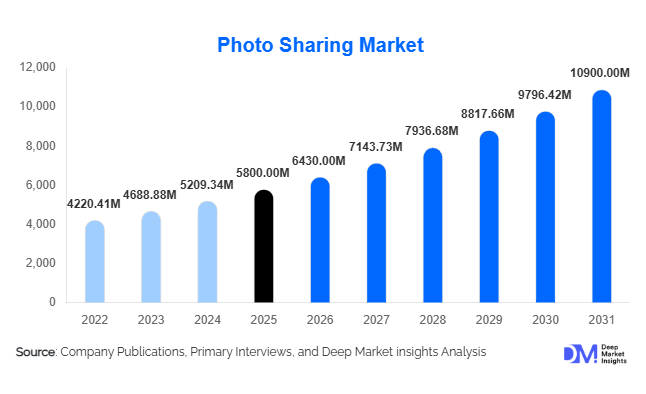
What are the latest trends in the photo-sharing market?
AI-Driven Content Personalization and Automation
Artificial intelligence is playing a transformative role in the photo-sharing market by enabling automated tagging, facial recognition, and intelligent categorization of images. Platforms are increasingly leveraging AI algorithms to deliver personalized content feeds, improving user engagement and retention. Advanced editing tools powered by AI are also simplifying content creation, allowing users to enhance images with minimal effort. This trend is particularly relevant for both individual users and enterprises managing large image databases, as it reduces manual effort and enhances operational efficiency.
Rise of Short-Form and Ephemeral Visual Content
User preferences are shifting toward short-form and temporary visual content such as stories and reels. These formats drive higher engagement due to their immediacy and interactive nature. Platforms are prioritizing features that enable quick sharing, real-time updates, and seamless integration with other social functionalities. This trend is also influencing advertising strategies, as brands increasingly adopt short-form content for marketing campaigns, thereby expanding monetization opportunities within the ecosystem.
What are the key drivers in the photo-sharing market?
Smartphone Penetration and High-Resolution Cameras
The widespread adoption of smartphones equipped with high-quality cameras has significantly increased the volume of photos captured and shared globally. With billions of users generating content daily, photo sharing has become a core digital activity, driving sustained demand for platforms offering seamless upload, storage, and sharing capabilities.
Growth of Visual Communication and Social Media Engagement
Visual content has become a preferred mode of communication across social media platforms. Images and videos generate higher engagement compared to text-based content, encouraging users and brands to prioritize visual storytelling. This shift is driving continuous innovation in photo-sharing features and platform capabilities.
What are the restraints for the global market?
Data Privacy and Security Concerns
Rising concerns around data breaches, unauthorized use of images, and privacy violations are significant challenges for the market. Regulatory frameworks such as data protection laws are becoming stricter, requiring platforms to invest heavily in security infrastructure and compliance measures.
Market Saturation and Intense Competition
The presence of established global players creates high entry barriers for new participants. Market saturation in developed regions limits user acquisition, while intense competition drives continuous innovation and pricing pressure, impacting profitability for smaller players.
What are the key opportunities in the photo-sharing industry?
Expansion into Emerging Markets
Emerging economies in Asia-Pacific, Africa, and Latin America present significant growth opportunities due to increasing internet penetration and smartphone adoption. Localized platforms and region-specific content strategies can help companies capture untapped user bases and expand market share.
Creator Monetization and Digital Content Economy
The rise of creator-driven platforms is enabling users to monetize their content through subscriptions, licensing, and brand collaborations. This shift is attracting professional photographers and influencers, expanding the market beyond traditional social sharing and creating new revenue streams.
Report Scope
| Report Metric | Details |
|---|---|
| Market Size in 2025 | USD 5800 Million |
| Market Size in 2026 | USD 6430 Million |
| Market Size in 2031 | USD 10900 Million |
| CAGR | 11.1% (2026-2031) |
| Base Year for Estimation | 2025 |
| Historical Data | 2022-2024 |
| Forecast Period | 2026-2031 |
| Report Coverage | Revenue Forecast, Competitive Landscape, Supply Chain Disruption, Growth Factors, Environment & Regulatory Landscape and Trends |
| Geographies Covered | North America, Europe, APAC, Middle East and Africa, LATAM |
| Countries Covered | U.S., Canada, U.K., Germany, France, Spain, Italy, Russia, Nordic, Benelux, Rest of Europe, China, Korea, Japan, India, Australia, Singapore, Taiwan, South East Asia, Rest of Asia-Pacific, UAE, Turky, Saudi Arabia, South Africa, Egypt, Nigeria, Rest of MEA, Brazil, Mexico, Argentina, Chile, Colombia, Rest of LATAM |
Explore more data points, trends and opportunities Download Free Sample Report
Platform Type Insights
Social media-based platforms dominate the photo-sharing market, accounting for approximately 52% of the total share in 2025. This leadership is primarily driven by their ability to integrate multiple functionalities such as messaging, short-form video, live streaming, and community engagement within a single ecosystem. The network effect created by large user bases further strengthens their dominance, as users prefer platforms where their social circles are already active. Additionally, continuous feature innovation, such as AI-driven feeds, filters, and creator tools, has significantly enhanced user retention and monetization potential.
Dedicated photo-sharing and storage platforms are gaining traction, particularly among professional photographers and content creators who require high-resolution storage, RAW file support, and advanced editing capabilities. These platforms are increasingly differentiating themselves through subscription-based premium services and enhanced data security features. Meanwhile, enterprise photo management platforms are witnessing strong growth, especially in sectors like e-commerce, real estate, and travel, where visual content is mission-critical. The rising need for digital asset management (DAM), workflow automation, and collaborative content sharing is driving enterprise adoption globally.
Revenue Model Insights
Advertisement-based revenue models lead the market with an estimated 46% share in 2025, primarily due to the widespread adoption of free-to-use platforms supported by targeted digital advertising. The ability to leverage user data for personalized ad delivery significantly enhances revenue generation for platform providers. This model remains dominant due to its scalability and ability to attract large user bases without upfront costs.
Freemium and subscription-based models are steadily gaining momentum, driven by increasing demand for premium features such as ad-free experiences, enhanced storage capacity, and advanced editing tools. These models are particularly लोकप्रिय among professional users and privacy-conscious consumers. Additionally, licensing and content monetization models are emerging as high-growth segments, fueled by the expansion of the creator economy. Platforms enabling users to monetize their content through brand partnerships, stock image licensing, and subscription-based access are creating diversified revenue streams and increasing platform stickiness.
User Type Insights
Individual consumers continue to dominate the market, accounting for approximately 61% of total usage in 2025, driven by the widespread adoption of social media and the growing importance of visual communication in everyday interactions. The increasing use of images for storytelling, social engagement, and personal branding is sustaining demand within this segment.
Professional photographers and content creators represent a rapidly expanding segment, leveraging photo-sharing platforms for portfolio development, audience engagement, and monetization. The rise of influencer marketing and digital content creation has further accelerated growth in this category. Enterprise users are also emerging as a key segment, adopting photo-sharing solutions for marketing, internal collaboration, and digital asset management. Industries such as retail, real estate, and media are particularly driving enterprise demand, as high-quality visual content directly impacts customer engagement and conversion rates.
Device Ecosystem Insights
Mobile-based platforms dominate the ecosystem with nearly 70% market share, reflecting the central role of smartphones in content creation, editing, and sharing. The increasing availability of high-resolution smartphone cameras, coupled with user-friendly mobile applications, has made mobile devices the primary medium for photo sharing. The convenience of real-time capture and instant sharing continues to reinforce this segment’s leadership.
Desktop and web-based platforms remain relevant, particularly among professional users who require advanced editing software, large-screen interfaces, and higher processing capabilities. Hybrid ecosystems offering seamless cross-device synchronization are gaining popularity, enabling users to capture content on mobile devices and edit or manage it on desktops. This convergence is enhancing user experience and supporting multi-device workflows.
Content Format Insights
Short-form visual content is the fastest-growing segment, contributing approximately 34% of the market, driven by the increasing popularity of ephemeral content formats such as stories and reels. These formats encourage frequent user engagement and align with changing consumer preferences for quick, visually appealing content.
Static images continue to hold a significant share, particularly in professional and archival applications where quality and permanence are critical. High-resolution and RAW image sharing is gaining traction among photographers, creative professionals, and enterprises requiring superior image quality for commercial use. The growing demand for high-quality visual assets in industries such as advertising, media, and e-commerce is further supporting this segment.
End-Use Insights
Consumer applications remain the primary end-use segment, driven by social media engagement and personal content sharing. However, enterprise applications are witnessing faster growth, as businesses increasingly rely on visual content for branding, marketing, and customer engagement. The media and entertainment industry, valued at over USD 1,200 million in 2025, is a major contributor, leveraging photo-sharing platforms for content distribution and audience interaction.
The e-commerce sector, exceeding USD 900 million in related services, is another key growth driver, as high-quality product imagery plays a crucial role in influencing purchasing decisions. Emerging applications in real estate (virtual property showcases), travel (destination marketing), and digital marketing (campaign visuals) are further expanding the market. Additionally, the rise of user-generated content in brand marketing is creating new opportunities for platform providers.
Explore more data points, trends and opportunities Download Free Sample Report
Photo Sharing Market Segmentations
By Platform Type
- Social Media-Based Photo Sharing Platforms
- Dedicated Photo Sharing & Storage Platforms
- Professional Photography Platforms
- Enterprise Photo Management Platforms
By Revenue Model
- Advertisement-Based
- Subscription-Based
- Freemium Model
- Licensing & Content Monetization
By User Type
- Individual Consumers
- Professional Photographers & Creators
- Enterprise Users
By Device Ecosystem
- Mobile-Based Platforms
- Desktop/Web-Based Platforms
- Hybrid Cross-Device Platforms
By End-Use Industry
- Consumer & Social Media
- Media & Entertainment
- E-commerce
- Real Estate
- Travel & Hospitality
- Digital Marketing & Advertising
Regional Insights
North America
North America holds approximately 34% of the global market share, with the United States contributing over 75% of regional demand. The region’s dominance is driven by high digital maturity, widespread adoption of advanced technologies, and the strong presence of leading global platform providers. High disposable income levels and early adoption of premium subscription services further support market growth. Additionally, the region benefits from robust cloud infrastructure, strong data center networks, and continuous innovation in AI-driven content management, which collectively enhance platform capabilities and user experience.
Asia-Pacific
Asia-Pacific accounts for around 29% of the market and is the fastest-growing region, with countries such as China, India, and Japan leading demand. India, in particular, is witnessing rapid growth with a CAGR exceeding 14%, driven by affordable mobile data, increasing smartphone penetration, and a large young population actively engaged in social media. China’s growth is supported by a strong domestic ecosystem of digital platforms and high user engagement, while Japan contributes through advanced technology adoption and premium service demand. The expansion of 5G networks and rising digital literacy are further accelerating regional growth.
Europe
Europe represents approximately 20% of the market, with key contributions from Germany, the UK, and France. Growth in this region is driven by high internet penetration, strong demand for secure and privacy-focused platforms, and increasing adoption of subscription-based services. Strict data protection regulations, such as GDPR, are shaping platform strategies and encouraging investments in data security and compliance. Additionally, the growing creator economy and digital marketing industry in Europe are supporting sustained demand for photo-sharing solutions.
Latin America
Latin America holds around 8% of the market share, with Brazil and Mexico as major contributors. The region is experiencing steady growth due to increasing social media adoption, expanding internet connectivity, and rising smartphone usage. Younger demographics and the growing popularity of influencer culture are key drivers of demand. Furthermore, improving digital infrastructure and affordable mobile data plans are enabling broader access to photo-sharing platforms, supporting long-term market expansion.
Middle East & Africa
The Middle East & Africa region accounts for approximately 9% of the global market, with growth driven by increasing internet penetration and investments in digital infrastructure. Countries such as the UAE and South Africa are leading adoption due to high smartphone usage and government-led digital transformation initiatives. The rise of social media influencers and digital marketing in the region is also contributing to increased platform usage. Additionally, expanding youth populations and growing urbanization are creating new opportunities for market growth across emerging economies in this region.
Key Players in the Photo Sharing Market
- Meta Platforms Inc.
- Alphabet Inc.
- Apple Inc.
- Snap Inc.
- Pinterest Inc.
- Adobe Inc.
- Dropbox Inc.
- SmugMug Inc.
- Shutterfly Inc.
- Amazon.com Inc.
- Tencent Holdings Ltd.
- ByteDance Ltd.
- Microsoft Corporation
- 500px (Visual China Group)
- Flickr (SmugMug)