Pet Grooming Market Size
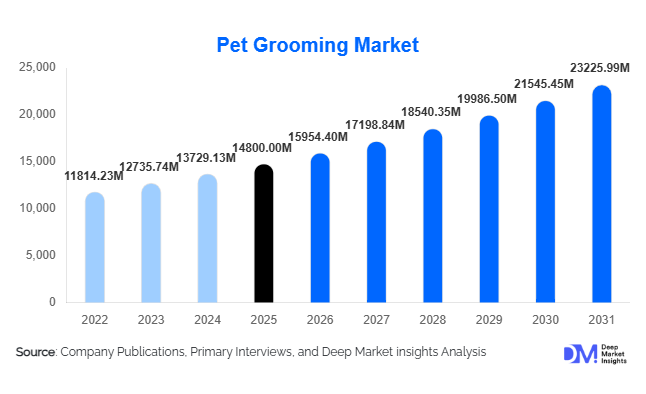
According to Deep Market Insights, the global pet grooming market size was valued at USD 14,800 million in 2025 and is projected to grow from USD 15,954.40 million in 2026 to reach USD 23,225.99 million by 2031, expanding at a CAGR of 7.8% during the forecast period (2026–2031). The pet grooming market growth is primarily driven by increasing pet ownership, rising pet humanization trends, and growing awareness regarding pet hygiene and wellness. The expanding availability of premium grooming products, along with the rapid growth of mobile and on-demand grooming services, is further accelerating market expansion globally.
Key Market Insights
- Pet humanization is driving higher spending on grooming products and services, particularly in premium and organic categories.
- Mobile and on-demand grooming services are rapidly expanding, offering convenience and personalized care for urban pet owners.
- North America dominates the global pet grooming market due to high pet ownership and premium spending patterns.
- Asia-Pacific is the fastest-growing region, fueled by rising disposable incomes and increasing pet adoption rates.
- E-commerce channels are transforming distribution, with over 25% of grooming product sales occurring online.
- Technological advancements, including smart grooming devices and AI-based skin analysis tools, are enhancing product innovation.
What are the latest trends in the pet grooming market?
Shift Toward Natural and Organic Grooming Products
Consumers are increasingly prioritizing natural, organic, and hypoallergenic grooming products for their pets. This shift is driven by concerns over chemical exposure and a growing preference for sustainable and eco-friendly solutions. Manufacturers are responding by introducing plant-based formulations, cruelty-free certifications, and biodegradable packaging. Premiumization within this segment is also enabling higher profit margins, as pet owners are willing to pay more for safe and high-quality products tailored to specific skin and coat conditions.
Rise of Mobile and Subscription-Based Grooming Services
Convenience-driven consumer behavior is fueling the adoption of mobile grooming services and subscription-based models. Mobile grooming vans provide at-home services, reducing stress for pets and saving time for owners. Subscription grooming kits, delivered periodically, are gaining traction among households preferring DIY grooming. Digital platforms and mobile apps are enabling seamless booking, personalized recommendations, and recurring service models, significantly enhancing customer engagement and retention.
What are the key drivers in the pet grooming market?
Growing Pet Ownership and Urbanization
The global increase in pet ownership, particularly in urban areas, is a major driver of the pet grooming market. Smaller living spaces and indoor pet lifestyles necessitate frequent grooming to maintain hygiene. Post-pandemic trends have further accelerated pet adoption rates, leading to sustained demand for grooming products and services across both developed and emerging markets.
Rising Premiumization and Health Awareness
Pet owners are increasingly investing in premium grooming solutions that offer health benefits such as skin protection, flea control, and coat enhancement. Dermatologically tested and medicated products are gaining popularity, particularly among owners of high-maintenance breeds. This trend is also supported by growing awareness of preventive healthcare, positioning grooming as an essential component of overall pet wellness.
What are the restraints for the global market?
High Cost of Professional Grooming Services
Professional grooming services can be expensive, particularly in developed markets where labor and operational costs are high. This limits adoption among price-sensitive consumers and shifts demand toward DIY grooming solutions in emerging economies.
Lack of Skilled Grooming Professionals
The shortage of trained grooming professionals and the lack of standardized training frameworks, especially in developing regions, can lead to inconsistent service quality. This poses challenges for service providers aiming to scale operations and maintain customer trust.
What are the key opportunities in the pet grooming industry?
Expansion in Emerging Markets
Emerging economies such as India, China, and Brazil present significant growth opportunities due to rising disposable incomes and increasing pet ownership. Market participants can capitalize on relatively low competition and growing awareness of pet care by introducing affordable and localized grooming solutions tailored to regional preferences.
Technology Integration in Grooming Solutions
The integration of technology, including smart grooming devices and AI-enabled diagnostics, is opening new avenues for innovation. These solutions enhance efficiency and provide value-added insights into pet health, enabling companies to differentiate their offerings and create premium segments within the market.
Report Scope
| Report Metric | Details |
|---|---|
| Market Size in 2025 | USD 14800 Million |
| Market Size in 2026 | USD 15954.40 Million |
| Market Size in 2031 | USD 23225.99 Million |
| CAGR | 7.8% (2026-2031) |
| Base Year for Estimation | 2025 |
| Historical Data | 2022-2024 |
| Forecast Period | 2026-2031 |
| Report Coverage | Revenue Forecast, Competitive Landscape, Supply Chain Disruption, Growth Factors, Environment & Regulatory Landscape and Trends |
| Geographies Covered | North America, Europe, APAC, Middle East and Africa, LATAM |
| Countries Covered | U.S., Canada, U.K., Germany, France, Spain, Italy, Russia, Nordic, Benelux, Rest of Europe, China, Korea, Japan, India, Australia, Singapore, Taiwan, South East Asia, Rest of Asia-Pacific, UAE, Turky, Saudi Arabia, South Africa, Egypt, Nigeria, Rest of MEA, Brazil, Mexico, Argentina, Chile, Colombia, Rest of LATAM |
Explore more data points, trends and opportunities Download Free Sample Report
Product Type Insights
Shampoos and conditioners dominate the pet grooming market, accounting for approximately 28% of the global market share in 2025. The leadership of this segment is primarily driven by its high frequency of use and essential nature in routine pet hygiene, making it a recurring purchase category with strong volume stability. Pet owners increasingly view grooming as a preventive healthcare measure, which is boosting demand for specialized formulations such as anti-fungal, anti-bacterial, and flea-control shampoos. Additionally, the rising trend of premiumization and clean-label products has accelerated the growth of medicated and organic variants, particularly in developed markets where consumers prioritize ingredient transparency and safety. Clippers and trimmers represent another key segment, supported by the growing shift toward at-home grooming and cost optimization, especially in emerging markets. Meanwhile, brushes, nail care, and dental care products are expanding steadily as part of holistic pet grooming routines, with increasing awareness around dental hygiene and coat maintenance further strengthening their adoption.
Service Type Insights
In-store grooming services lead the market with around 35% share in 2025, driven by the trust associated with professional expertise and availability of specialized equipment. Consumers often prefer salons for breed-specific grooming, styling, and advanced care services that cannot be easily replicated at home. The segment’s dominance is further supported by strong urban penetration and established retail grooming chains. However, mobile grooming services are emerging as the fastest-growing segment, fueled by convenience, time efficiency, and reduced stress for pets. This model is particularly gaining traction in metropolitan areas where busy lifestyles demand flexible solutions. Subscription-based grooming services are also gaining momentum, offering predictable revenue streams and enhanced customer retention, as consumers increasingly prefer bundled and recurring service models.
Pet Type Insights
Dogs account for the largest share of the pet grooming market, contributing approximately 65% of total demand in 2025. This dominance is primarily due to higher grooming frequency requirements and breed-specific maintenance needs, including regular hair trimming, bathing, and coat care. Long-haired and specialty breeds significantly drive demand for both grooming products and professional services. Additionally, higher emotional attachment and spending willingness among dog owners further reinforce this segment’s leadership. Cats represent a smaller but steadily growing segment, supported by increasing awareness of feline hygiene and shedding control. Grooming demand for small mammals and exotic pets remains niche but is gradually expanding as pet ownership diversifies and specialized grooming products become more accessible.
Distribution Channel Insights
Pet specialty stores hold the largest share of around 30% in 2025, driven by their ability to offer curated product selections, expert guidance, and premium brands. These stores play a critical role in influencing consumer purchasing decisions, particularly for first-time pet owners and high-value products. However, online retail channels are the fastest-growing distribution segment, supported by increasing digital penetration, competitive pricing, and convenience. E-commerce platforms enable access to a wider range of products, including niche and imported brands, while also supporting subscription models and direct-to-consumer strategies. Veterinary clinics and grooming salons remain important channels, particularly for medicated, prescription-based, and premium grooming products, as they benefit from higher consumer trust and professional recommendations.
End-Use Insights
Household consumers dominate the market with approximately 60% share in 2025, driven by the growing adoption of DIY grooming practices and cost-conscious consumer behavior. The increasing availability of user-friendly grooming tools and instructional content online has empowered pet owners to perform basic grooming tasks at home. However, commercial grooming businesses are the fastest-growing end-use segment, expanding at a CAGR of around 9%, as demand for professional and specialized grooming services continues to rise. Urbanization, higher disposable incomes, and the premiumization trend are key drivers for this segment. Veterinary clinics are also emerging as an integrated end-use channel, combining grooming with healthcare services, thereby enhancing customer convenience and driving bundled service adoption.
Explore more data points, trends and opportunities Download Free Sample Report
Pet Grooming Market Segmentations
By Product Type
- Shampoos & Conditioners
- Clippers & Trimmers
- Brushes & Combs
- Nail Care Products
- Dental Care Products
- Grooming Accessories
By Service Type
- In-store Grooming Services
- Mobile Grooming Services
- At-home Grooming (DIY)
- Subscription Grooming Services
By Pet Type
- Dogs
- Cats
- Small Mammals
- Exotic Pets
By Distribution Channel
- Online Retail
- Pet Specialty Stores
- Supermarkets/Hypermarkets
- Veterinary Clinics
- Grooming Salons
By End-Use
- Household Consumers
- Commercial Grooming Businesses
- Veterinary Clinics
Regional Insights
North America
North America leads the global pet grooming market with approximately 38% share in 2025, with the United States accounting for the majority of regional demand. The region’s dominance is driven by high pet ownership rates, strong consumer spending power, and a well-established pet care ecosystem. The presence of organized grooming service providers, advanced product innovation, and widespread awareness of pet hygiene further support market growth. Additionally, the increasing trend of pet humanization and premium product adoption is boosting demand for high-value grooming solutions. The region also benefits from a strong e-commerce infrastructure, enabling rapid distribution and accessibility of grooming products.
Europe
Europe accounts for around 27% of the global market, with key countries including Germany, the UK, and France. Growth in this region is driven by stringent animal welfare regulations, high awareness of pet health, and strong demand for organic and sustainable grooming products. European consumers are particularly inclined toward eco-friendly and cruelty-free products, which is encouraging manufacturers to innovate in natural formulations and sustainable packaging. Additionally, the presence of established retail networks and increasing penetration of premium grooming services are further strengthening market expansion across the region.
Asia-Pacific
Asia-Pacific is the fastest-growing region, expanding at a CAGR of over 9.5%, led by China, India, and Japan. The growth is primarily driven by rising disposable incomes, rapid urbanization, and increasing pet adoption among younger demographics. Changing lifestyles and growing awareness of pet hygiene are encouraging higher spending on grooming products and services. Additionally, the expansion of e-commerce platforms and entry of international brands are improving product accessibility in the region. The relatively low penetration of professional grooming services also presents significant growth opportunities, particularly in emerging markets such as India and Southeast Asia.
Latin America
Latin America holds approximately 8% of the global market, with Brazil and Mexico leading regional demand. Growth in this region is supported by increasing pet ownership, improving economic conditions, and rising awareness of pet care practices. The expanding middle-class population is driving demand for affordable grooming products, while premium segments are gradually gaining traction in urban areas. Additionally, the growing presence of organized retail and e-commerce platforms is enhancing product availability and supporting market expansion.
Middle East & Africa
The Middle East & Africa region accounts for around 5% share, with growth concentrated in urban centers such as the UAE and South Africa. The market is driven by rising disposable incomes, increasing expatriate populations, and growing adoption of premium pet care services. In the Middle East, luxury pet grooming services are gaining popularity, supported by high-income consumers and a strong preference for premium offerings. In Africa, the market is gradually developing, with growth driven by urbanization and increasing awareness of pet hygiene. The expansion of veterinary infrastructure and specialty pet stores is further supporting market growth across the region.
Key Players in the Pet Grooming Market
- Mars Incorporated
- Nestlé Purina PetCare
- Spectrum Brands Holdings
- Hartz Mountain Corporation
- Central Garden & Pet Company
- Wahl Clipper Corporation
- Andis Company
- PetEdge
- Coastal Pet Products
- Beaphar
- Resco
- Earthbath
- TropiClean
- Chris Christensen Systems
- SynergyLabs