Pet Clothing Market Size
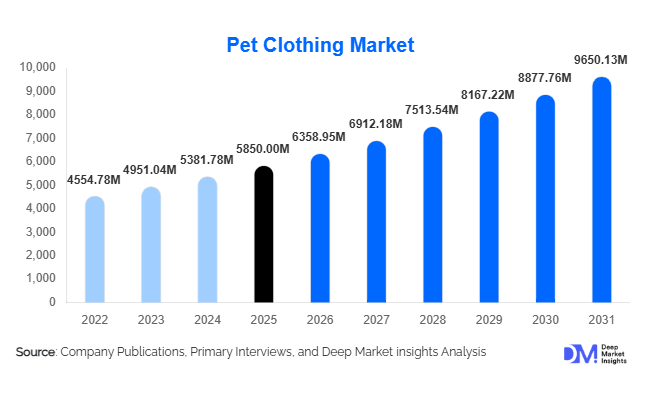
According to Deep Market Insights, the global pet clothing market size was valued at USD 5,850 million in 2025 and is projected to grow from USD 6,358.95 million in 2026 to reach USD 9,650.13 million by 2031, expanding at a CAGR of 8.7% during the forecast period (2026–2031). The pet clothing market growth is primarily driven by rising pet humanization trends, increasing disposable incomes, and growing awareness regarding pet comfort, safety, and seasonal protection. The market has transitioned from a niche luxury segment into a mainstream category within the broader pet care industry, supported by strong demand across North America, Europe, and rapidly expanding Asia-Pacific markets.
Key Market Insights
- Pet humanization continues to drive premium spending, as owners increasingly treat their pets as family members and invest in apparel for both functionality and fashion.
- Online retail dominates distribution, accounting for over 50% of total sales due to convenience, product variety, and influencer-driven demand.
- Dogs represent the largest pet segment, contributing more than 70% of total demand due to higher adoption rates and greater acceptance of clothing.
- North America leads the global market, supported by high disposable income and strong pet care expenditure.
- Asia-Pacific is the fastest-growing region, driven by rising pet ownership and expanding middle-class income levels.
- Functional pet clothing is gaining traction, including thermal wear, cooling vests, and health-support garments.
What are the latest trends in the pet clothing market?
Rise of Functional and Smart Pet Apparel
Pet clothing is increasingly moving beyond aesthetics toward functionality and innovation. Products such as temperature-regulating jackets, waterproof rainwear, and anxiety-relief garments are gaining widespread adoption. Smart textiles integrated with sensors for tracking health indicators or GPS-enabled features are also emerging. These innovations are particularly appealing to urban pet owners who prioritize both safety and wellness. Manufacturers are investing in breathable, lightweight, and durable materials to enhance comfort, ensuring that pets can wear clothing for extended periods without discomfort.
Growth of Sustainable and Eco-Friendly Materials
Sustainability is becoming a major trend in the pet clothing market, with consumers actively seeking eco-friendly products. Brands are increasingly using organic cotton, recycled polyester, and biodegradable packaging to align with environmentally conscious purchasing behavior. This trend is particularly strong in Europe and North America, where regulatory frameworks and consumer awareness are driving adoption. Companies adopting sustainable practices are also able to command premium pricing, enhancing profitability while strengthening brand loyalty.
What are the key drivers in the pet clothing market?
Increasing Pet Humanization
The growing emotional bond between pet owners and their animals is a major driver of market growth. Pets are increasingly viewed as family members, leading to higher discretionary spending on apparel and accessories. Seasonal clothing, festive wear, and personalized outfits are becoming common purchases, particularly among younger consumers. This shift is significantly expanding the addressable market.
Expansion of E-commerce Platforms
The rapid growth of online retail channels has made pet clothing more accessible globally. E-commerce platforms offer a wide variety of products, competitive pricing, and convenience, enabling consumers to explore global brands. Social media marketing and influencer promotions are further accelerating online sales, making digital channels a key growth driver.
What are the restraints for the global market?
Price Sensitivity in Emerging Markets
Despite strong growth, pet clothing remains a discretionary purchase in many developing regions. Consumers in price-sensitive markets often prioritize essential pet care products over apparel, limiting market penetration. This creates a barrier for premium brands attempting to expand into these regions.
Sizing and Comfort Challenges
The diversity in pet sizes and breeds creates challenges in standardizing clothing sizes. Poor fit can lead to discomfort and reduced product adoption. High return rates due to sizing issues also increase operational costs for manufacturers and retailers, making this a key challenge for market participants.
What are the key opportunities in the pet clothing industry?
Customization and Premiumization
The demand for personalized pet clothing is growing rapidly, presenting a significant opportunity for market players. Customized apparel, including tailored fits and unique designs, allows companies to differentiate themselves and command higher margins. Premiumization is particularly strong in developed markets, where consumers are willing to pay more for quality and exclusivity.
Expansion in Emerging Markets
Asia-Pacific and Latin America offer substantial growth opportunities due to rising pet ownership and increasing disposable incomes. Countries such as China, India, and Brazil are witnessing a surge in demand for affordable yet functional pet clothing. Localized product offerings tailored to climate conditions and cultural preferences can help companies capture these untapped markets.
Report Scope
| Report Metric | Details |
|---|---|
| Market Size in 2025 | USD 5850 Million |
| Market Size in 2026 | USD 6358.95 Million |
| Market Size in 2031 | USD 9650.13 Million |
| CAGR | 8.7% (2026-2031) |
| Base Year for Estimation | 2025 |
| Historical Data | 2022-2024 |
| Forecast Period | 2026-2031 |
| Report Coverage | Revenue Forecast, Competitive Landscape, Supply Chain Disruption, Growth Factors, Environment & Regulatory Landscape and Trends |
| Geographies Covered | North America, Europe, APAC, Middle East and Africa, LATAM |
| Countries Covered | U.S., Canada, U.K., Germany, France, Spain, Italy, Russia, Nordic, Benelux, Rest of Europe, China, Korea, Japan, India, Australia, Singapore, Taiwan, South East Asia, Rest of Asia-Pacific, UAE, Turky, Saudi Arabia, South Africa, Egypt, Nigeria, Rest of MEA, Brazil, Mexico, Argentina, Chile, Colombia, Rest of LATAM |
Explore more data points, trends and opportunities Download Free Sample Report
Product Type Insights
Jackets and coats dominate the pet clothing market, accounting for approximately 28% of the total market share in 2025. This leadership position is primarily driven by their strong functional value in colder climates across North America and Europe, where seasonal demand for insulation and weather protection is high. Additionally, jackets and coats typically command higher average selling prices compared to other apparel categories, contributing significantly to revenue share. The increasing frequency of extreme weather conditions globally has further strengthened demand for protective outerwear, making this segment both necessity-driven and premium-oriented. Sweaters and hoodies follow as the second-largest category, benefiting from their dual appeal as both functional and casual fashion wear. Costumes and occasion wear are witnessing accelerated growth due to rising social media influence, pet events, and seasonal celebrations, particularly in urban markets. Meanwhile, functional wear such as cooling vests and anxiety wraps is emerging as a high-growth niche, supported by increasing awareness of pet health, climate adaptation needs, and veterinary recommendations.
Application Insights
Fashion and decorative applications lead the market, contributing nearly 60% of total demand in 2025. This dominance is largely driven by the growing trend of pet humanization, where owners increasingly seek to express personal style through their pets. Social media platforms and influencer-driven content have significantly amplified demand for aesthetically appealing and seasonal apparel, making fashion the primary purchase driver. Weather protection applications represent the second-largest segment, driven by practical needs such as protection against cold, rain, and heat. This segment is particularly strong in regions experiencing extreme or variable climatic conditions, where functional clothing has become essential rather than discretionary. Health and wellness applications are gaining momentum as a fast-growing segment, supported by rising veterinary awareness and product innovation. Items such as post-surgery garments, mobility-support wear, and anxiety-relief clothing are increasingly being adopted, reflecting a shift toward preventive and therapeutic pet care solutions.
Distribution Channel Insights
Online retail channels dominate the pet clothing market, accounting for approximately 55% share in 2025. The leading position of this segment is driven by the convenience of home delivery, access to a wide assortment of products, competitive pricing, and the ability to compare brands globally. The rise of direct-to-consumer (D2C) brands and the influence of digital marketing, including social media and pet influencers, have further accelerated online sales. Additionally, advancements in AI-driven size recommendation tools and customization features are reducing return rates and improving customer satisfaction. Offline channels, including pet specialty stores, supermarkets, and veterinary clinics, continue to play a crucial role, particularly for premium and functional products where physical inspection and expert guidance are valued. The integration of omnichannel strategies, such as click-and-collect and in-store digital experiences, is enhancing customer engagement and expanding market reach.
Pet Type Insights
Dogs account for the largest share of the pet clothing market, contributing around 72% of total demand in 2025. This dominance is driven by higher global dog ownership rates, greater acceptance of clothing among dog owners, and the wider availability of dog-specific apparel across all price ranges. Dogs are also more likely to require functional clothing for outdoor activities, further boosting demand. Cats represent a smaller but steadily growing segment, particularly in urban areas where indoor pet ownership is increasing. While cats are less commonly dressed compared to dogs, demand is rising for lightweight and comfortable apparel designed specifically for feline use. Other pets, including rabbits and small mammals, form a niche segment with emerging demand, primarily driven by novelty and specialty applications rather than functional necessity.
Explore more data points, trends and opportunities Download Free Sample Report
Pet Clothing Market Segmentations
By Product Type
- Jackets & Coats
- Sweaters & Hoodies
- T-Shirts & Shirts
- Dresses & Skirts
- Rainwear
- Costumes & Occasion Wear
- Functional Wear
By Application
- Fashion & Decorative
- Weather Protection
- Health & Wellness
By Distribution Channel
- Online Retail
- Pet Specialty Stores
- Supermarkets/Hypermarkets
- Veterinary Clinics
By Pet Type
- Dogs
- Cats
- Other Pets
Regional Insights
North America
North America holds the largest share of the pet clothing market, accounting for approximately 38% in 2025, with the United States contributing the majority of regional demand. Growth in this region is driven by high pet ownership rates, high disposable incomes, and a well-established pet care industry. The widespread trend of pet humanization, combined with seasonal climate variations, has significantly boosted demand for both functional and fashion-oriented pet apparel. Additionally, the presence of leading market players, advanced e-commerce infrastructure, and high consumer awareness regarding pet wellness further support regional growth. Canada also contributes significantly, with demand driven by cold weather conditions and increasing adoption of premium pet products.
Europe
Europe represents around 27% of the global market, led by key countries such as the United Kingdom, Germany, and France. Regional growth is driven by strong consumer preference for premium, sustainable, and ethically sourced products. European consumers are highly conscious of environmental impact, which has accelerated the adoption of eco-friendly pet clothing materials. Additionally, colder climates in several parts of Europe drive demand for thermal and protective apparel. Regulatory standards related to textile quality and animal welfare further encourage innovation and product differentiation, strengthening market expansion in this region.
Asia-Pacific
Asia-Pacific is the fastest-growing region, with a CAGR exceeding 10%. China dominates the regional market, accounting for nearly 45% of APAC demand, followed by Japan, South Korea, and India. Growth in this region is driven by rapid urbanization, rising disposable incomes, and increasing pet ownership among younger demographics. The influence of social media and the growing adoption of Western lifestyle trends have significantly boosted demand for pet fashion. Additionally, the expansion of e-commerce platforms and domestic manufacturing capabilities has improved product accessibility and affordability, further accelerating market growth.
Latin America
Latin America is experiencing steady growth, particularly in Brazil and Mexico, supported by increasing urbanization and rising pet adoption rates. The expansion of organized retail and e-commerce platforms is improving product availability across the region. While price sensitivity remains a challenge, the growing middle class and increasing awareness of pet care are driving gradual adoption of pet clothing. Seasonal demand, particularly for lightweight and functional apparel suited to regional climates, is also contributing to market expansion.
Middle East & Africa
The Middle East & Africa region shows emerging potential, with demand concentrated in urban centers such as the UAE and South Africa. Growth in this region is driven by rising disposable incomes, increasing pet ownership among expatriate populations, and evolving lifestyle trends. The demand for premium and luxury pet products is particularly strong in the Middle East, where consumers are willing to spend on high-end pet apparel. In Africa, market growth is more gradual but supported by urbanization and improving retail infrastructure. Climate conditions in parts of the region are also driving demand for functional clothing such as cooling vests and protective wear.