Pet Boarding Market Size
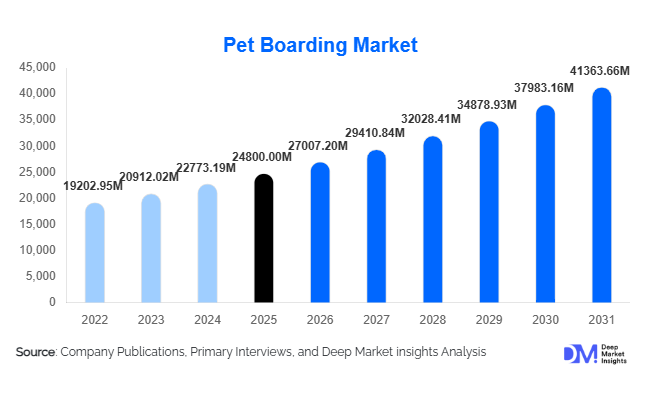
According to Deep Market Insights, the global pet boarding market size was valued at USD 24,800 million in 2025 and is projected to grow from USD 27,007.20 million in 2026 to reach USD 41,363.66 million by 2031, expanding at a CAGR of 8.9% during the forecast period (2026–2031). The pet boarding market growth is primarily driven by increasing pet humanization, rising disposable incomes, and growing demand for professional pet care services during travel and work commitments.
Key Market Insights
- Dog boarding dominates the market, accounting for nearly 65% of global demand due to higher ownership rates and structured care needs.
- Premium and luxury boarding services are expanding rapidly, driven by the increased willingness of pet owners to spend on comfort and personalized care.
- North America leads the global market, supported by high pet ownership rates and strong spending on pet services.
- Asia-Pacific is the fastest-growing region, fueled by rising pet adoption and increasing middle-class income levels.
- Online booking platforms are gaining traction, improving accessibility, transparency, and customer convenience.
- Integration of technology, including live pet monitoring and mobile apps, is reshaping customer expectations.
What are the latest trends in the pet boarding market?
Premiumization and Luxury Pet Hospitality
The pet boarding industry is increasingly shifting toward premium and luxury offerings. Pet owners are seeking high-end services such as private suites, climate-controlled environments, organic meals, grooming packages, and personalized attention. Luxury pet hotels and resorts are expanding globally, particularly in urban centers, offering amenities comparable to human hospitality services. This trend is driven by the growing perception of pets as family members, leading to higher emotional spending. Facilities are also introducing value-added services such as behavioral training, spa treatments, and customized playtime activities, significantly enhancing revenue potential.
Technology-Enabled Boarding Services
Technology adoption is transforming the pet boarding experience. Facilities are integrating mobile apps, online booking systems, and real-time pet monitoring through webcams and IoT devices. These technologies provide transparency and build trust among pet owners, enabling them to stay connected with their pets remotely. Additionally, AI-driven analytics are helping operators optimize occupancy rates, manage pricing, and improve service quality. Digital platforms are also streamlining customer acquisition, making it easier for new entrants to scale operations and compete effectively in the market.
What are the key drivers in the pet boarding market?
Rising Pet Ownership and Humanization
The increasing number of pet-owning households globally is a primary driver of the pet boarding market. Pets are increasingly treated as family members, leading to higher spending on their care and well-being. This shift in consumer behavior has significantly increased demand for professional boarding services, particularly in urban areas where space and time constraints limit in-home care options.
Growth in Travel and Urban Lifestyles
The expansion of global travel and tourism, combined with busy urban lifestyles, is driving demand for pet boarding services. Pet owners frequently require short- and medium-term boarding solutions during vacations, business trips, or extended work hours. The rise of dual-income households further reinforces the need for reliable pet care services, boosting market growth.
What are the restraints for the global market?
High Operational and Service Costs
Pet boarding facilities require significant investment in infrastructure, staffing, and hygiene maintenance. These high operational costs often result in premium pricing, limiting accessibility for cost-sensitive consumers. Maintaining quality standards while managing expenses remains a key challenge for service providers.
Concerns Related to Pet Safety and Health
Pet owners often express concerns regarding the safety, hygiene, and well-being of their pets in boarding facilities. Incidents involving inadequate care or health issues can negatively impact consumer trust and hinder market growth. Ensuring consistent service quality across fragmented providers remains a critical challenge.
What are the key opportunities in the pet boarding industry?
Expansion in Emerging Markets
Emerging economies such as India, China, and Brazil present significant growth opportunities due to rising pet ownership and increasing disposable incomes. The lack of organized pet boarding infrastructure in these regions creates a substantial gap between demand and supply. Market participants can capitalize on this opportunity by establishing structured facilities and introducing standardized services tailored to local preferences.
Integration with Veterinary and Pet Care Services
Combining boarding services with veterinary care, grooming, and training offers strong growth potential. Integrated pet care ecosystems enhance customer convenience and create additional revenue streams for service providers. Partnerships with veterinary clinics and pet insurance companies can further strengthen service offerings and improve customer retention.
Report Scope
| Report Metric | Details |
|---|---|
| Market Size in 2025 | USD 24800 Million |
| Market Size in 2026 | USD 27007.20 Million |
| Market Size in 2031 | USD 41363.66 Million |
| CAGR | 8.9% (2026-2031) |
| Base Year for Estimation | 2025 |
| Historical Data | 2022-2024 |
| Forecast Period | 2026-2031 |
| Report Coverage | Revenue Forecast, Competitive Landscape, Supply Chain Disruption, Growth Factors, Environment & Regulatory Landscape and Trends |
| Geographies Covered | North America, Europe, APAC, Middle East and Africa, LATAM |
| Countries Covered | U.S., Canada, U.K., Germany, France, Spain, Italy, Russia, Nordic, Benelux, Rest of Europe, China, Korea, Japan, India, Australia, Singapore, Taiwan, South East Asia, Rest of Asia-Pacific, UAE, Turky, Saudi Arabia, South Africa, Egypt, Nigeria, Rest of MEA, Brazil, Mexico, Argentina, Chile, Colombia, Rest of LATAM |
Explore more data points, trends and opportunities Download Free Sample Report
Product Type Insights
Mid-range boarding services dominate the global pet boarding market, accounting for approximately 45% of total demand in 2025, primarily due to their ability to strike an optimal balance between affordability and quality of care. This segment is particularly strong in developed markets such as North America and Europe, where consumers seek reliable services without incurring the high costs associated with luxury offerings. The growth of this segment is driven by increasing urbanization, rising dual-income households, and the need for dependable yet cost-effective pet care solutions.
Economy boarding services continue to play a critical role in developing regions, where price sensitivity remains a key factor influencing consumer decisions. These services are widely adopted in Asia-Pacific and Latin America, where pet ownership is rising but spending capacity is comparatively lower. However, the premium and luxury boarding segment is the fastest-growing category, supported by the ongoing trend of pet humanization. Affluent pet owners are increasingly opting for high-end facilities offering personalized services, private suites, grooming, and wellness treatments. This segment is expanding rapidly across metropolitan cities, with operators focusing on differentiated experiences and value-added services to capture higher margins.
Application Insights
Overnight boarding remains the leading application segment, contributing approximately 52% of the global market share in 2025, driven by the fundamental need for pet care during travel and extended absences. The segment’s dominance is supported by increasing domestic and international travel, as well as growing reliance on professional services among working pet owners. Additionally, the availability of structured care environments and trained staff enhances trust among consumers, further strengthening demand.
Daycare services are witnessing steady growth, particularly in urban centers where pet owners require short-term care during working hours. This segment is driven by changing work patterns, including hybrid and office-based jobs, and the rising need for pet socialization and activity. Meanwhile, medical boarding is emerging as a specialized niche, supported by increasing awareness of pet health and the growing prevalence of veterinary-integrated facilities. This segment caters to pets requiring medical supervision, post-surgical care, or special attention, thereby creating additional revenue streams for veterinary clinics and specialized providers.
Distribution Channel Insights
Offline booking channels continue to dominate the pet boarding market, accounting for nearly 60% of total bookings in 2025, as many pet owners prefer direct interaction with service providers to assess facility conditions and ensure trust. Personal recommendations, repeat customers, and local brand loyalty further reinforce the strength of offline channels, particularly in traditional and semi-urban markets.
However, online booking platforms are the fastest-growing distribution channel, driven by increasing digital adoption, convenience, and transparency. Consumers are increasingly relying on mobile apps and websites to compare services, read reviews, and make informed decisions. Digital platforms are also enabling smaller and independent boarding providers to expand their reach and improve visibility, thereby contributing to market formalization. Integration of features such as real-time availability, instant booking, and pet monitoring is further accelerating the shift toward online channels.
End-User Insights
Household pet owners represent the largest end-user segment, accounting for the majority of demand in the pet boarding market. Growth in this segment is driven by rising pet adoption rates, increasing disposable incomes, and a growing emphasis on pet well-being. Urban households, particularly dual-income families, are the primary demand drivers, as their busy lifestyles necessitate external pet care solutions.
The travel and tourism sector plays a significant supporting role, with increased travel frequency directly influencing demand for boarding services. As global travel continues to recover and expand, the need for reliable pet care during trips is expected to rise. Additionally, millennials and younger consumers are emerging as key contributors to market growth, driven by their higher propensity to spend on premium and personalized pet services. This demographic shift is also accelerating demand for technologically advanced and experience-focused boarding solutions.
Explore more data points, trends and opportunities Download Free Sample Report
Pet Boarding Market Segmentations
By Pet Type
- Dogs Boarding Services
- Cats Boarding Services
- Small Mammals
- Birds Boarding Services
- Exotic Pets
By Service Type
- Overnight Boarding
- Luxury Boarding
- Daycare Boarding
- In-Home Pet Boarding
- Medical Boarding
By Facility Type
- Kennels
- Pet Hotels & Resorts
- Veterinary Clinics Offering Boarding
- Home-Based Boarding Providers
- Pet Boarding Chains/Franchises
By Pricing Tier
- Economy Boarding
- Mid-Range Boarding
- Premium/Luxury Boarding
By Booking Mode
- Offline Booking
- Online Booking Platforms
Regional Insights
North America
North America accounts for approximately 40% of the global pet boarding market in 2025, making it the largest regional market. The United States dominates regional demand, supported by one of the highest pet ownership rates globally and strong consumer spending on pet care services. Key growth drivers include the widespread adoption of premium and luxury boarding services, high travel frequency, and the presence of well-established boarding infrastructure. Additionally, technological advancements such as app-based bookings and real-time pet monitoring are highly prevalent in this region, further enhancing customer engagement. The increasing trend of pet humanization and willingness to spend on premium services continues to drive sustained growth.
Europe
Europe holds approximately 25% of the global market share, with major contributions from countries such as the UK, Germany, and France. Growth in this region is driven by strong regulatory frameworks related to pet welfare, which encourage the use of professional boarding services. Increasing urbanization and changing lifestyles are also contributing to higher demand for structured pet care solutions. Additionally, the rising popularity of eco-friendly and sustainable boarding facilities is influencing consumer preferences. The region is witnessing steady growth in premium services, supported by increasing disposable incomes and a growing focus on pet well-being.
Asia-Pacific
Asia-Pacific accounts for around 20% of the global market and is the fastest-growing region, with a CAGR exceeding 10%. Rapid urbanization, rising middle-class incomes, and increasing pet adoption rates are the primary drivers of growth in this region. Countries such as China, India, and Japan are experiencing significant expansion in demand for pet boarding services. India, in particular, is emerging as a high-growth market due to increasing awareness of pet care services and the expansion of organized boarding facilities. The growing influence of Western lifestyles, coupled with the rise of nuclear families, is further accelerating demand for professional pet care solutions.
Latin America
Latin America contributes approximately 8% of the global market, with Brazil and Mexico being the key markets. Growth in this region is driven by increasing pet humanization and rising disposable incomes, which are encouraging spending on pet care services. Urbanization and the gradual expansion of organized pet boarding facilities are also supporting market development. Additionally, increasing awareness of pet health and well-being is driving demand for professional boarding services, particularly in metropolitan areas.
Middle East & Africa
The Middle East & Africa region holds around 7% of the global market share, with growth primarily concentrated in urban centers such as the UAE and South Africa. Rising disposable incomes, increasing expatriate populations, and growing awareness of pet care services are key drivers of demand in this region. The expansion of premium boarding facilities and luxury pet services is particularly notable in the Middle East, where high-income consumers are driving demand for high-end offerings. In Africa, gradual urbanization and improving pet care awareness are supporting steady market growth, although the market remains relatively underpenetrated.
Key Players in the Pet Boarding Market
- PetSmart Inc.
- Petco Health and Wellness Company Inc.
- Rover Group Inc.
- Wag Labs Inc.
- Best Friends Pet Care
- Camp Bow Wow
- Dogtopia Enterprises
- Pets at Home Group Plc
- Paradise 4 Paws
- PetBacker
- Swifto Inc.
- Barking Mad Ltd.
- Paws Pet Resorts
- Urban Tails
- K9 Resorts Luxury Pet Hotel