Paraffin Wax Machine Market Size
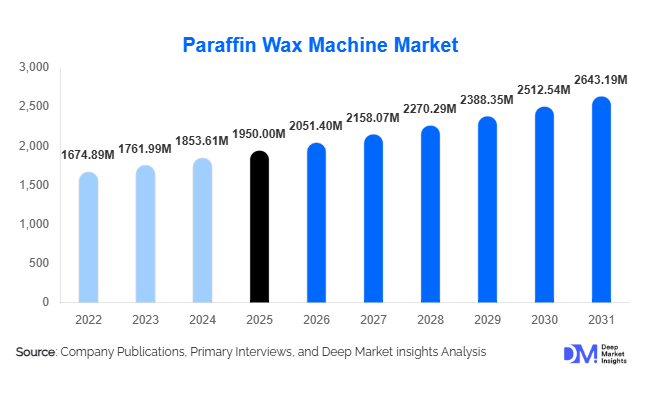
According to Deep Market Insights, the global paraffin wax machine market size was valued at USD 1,950 million in 2025 and is projected to grow from USD 2,051.40 million in 2026 to reach USD 2,643.19 million by 2031, expanding at a CAGR of 5.2% during the forecast period (2026–2031). The paraffin wax machine market growth is primarily driven by the increasing demand for wellness therapies, rising global production of decorative candles, and the growing adoption of automated wax melting equipment across cosmetic and industrial manufacturing sectors.
Paraffin wax machines are widely used in applications ranging from spa treatments and physiotherapy therapies to industrial wax melting processes in candle manufacturing and packaging industries. In recent years, the growing trend of self-care routines and home-based beauty treatments has also accelerated the adoption of compact paraffin wax machines among consumers.
Technological advancements in heating elements, digital temperature controls, and energy-efficient wax melting systems are further improving the safety and efficiency of these machines. As spa services expand globally and candle consumption continues to rise due to aromatherapy and home décor trends, the paraffin wax machine market is expected to experience steady growth over the next decade.
Key Market Insights
- Growing demand for home beauty devices is accelerating sales of compact paraffin wax machines through online retail channels.
- Candle manufacturing expansion across Asia-Pacific is driving industrial demand for automated wax melting and dispensing equipment.
- Beauty salons and spa centers remain the largest end-use segment, accounting for more than one-third of total global demand.
- Asia-Pacific dominates the global market share due to strong manufacturing capacity and growing wellness industries.
- Fully automatic paraffin wax machines are gaining traction due to improved productivity, temperature precision, and safety features.
- Smart temperature monitoring and energy-efficient heating systems are emerging as key technological trends in the market.
What are the latest trends in the paraffin wax machine market?
Growing Adoption of Home Wellness Devices
The increasing popularity of at-home beauty treatments is significantly influencing the paraffin wax machine market. Consumers are increasingly investing in compact wellness devices that allow them to replicate spa treatments at home. Paraffin wax therapy is widely used for moisturizing skin, improving circulation, and relieving joint stiffness, making it particularly popular among individuals with arthritis or dry skin conditions.
Manufacturers are responding to this trend by launching portable machines with fast heating systems, digital temperature controls, and automatic shut-off safety features. E-commerce platforms have also played a major role in expanding access to these products, enabling consumers to purchase affordable devices without visiting professional salons. Social media beauty tutorials and wellness influencers have further contributed to rising consumer awareness and adoption of these machines.
Automation and Smart Temperature Control Technologies
Technological innovation is reshaping the paraffin wax machine industry. Modern machines are increasingly equipped with smart temperature monitoring systems, programmable heating cycles, and digital displays that allow precise control over wax melting conditions. These features are particularly important in professional spa and physiotherapy environments, where consistent wax temperature is critical for treatment safety.
In industrial applications such as candle manufacturing, automation technologies are improving operational efficiency by enabling continuous wax melting, automatic dispensing, and batch temperature monitoring. Some manufacturers are also experimenting with IoT-enabled machines that allow remote monitoring of heating performance and maintenance alerts. These innovations are expected to enhance equipment reliability and reduce energy consumption across industrial and commercial applications.
What are the key drivers in the paraffin wax machine market?
Expansion of the Global Spa and Wellness Industry
The rapid growth of the global wellness industry is one of the primary drivers of the paraffin wax machine market. Beauty salons, spas, and physiotherapy clinics widely use paraffin wax therapy to improve skin hydration and relieve joint pain. As urban populations increase and consumer spending on personal care rises, the number of professional wellness facilities continues to expand worldwide.
Luxury hotels and resorts are also incorporating spa services into their hospitality offerings, further increasing demand for professional-grade paraffin wax machines. In regions such as North America, Europe, and Asia-Pacific, wellness tourism and self-care treatments have become important lifestyle trends, strengthening long-term market growth.
Rising Demand for Decorative and Aromatherapy Candles
The global candle industry has experienced steady growth due to increasing consumer interest in aromatherapy, home décor, and relaxation products. Candles are widely used in households, hospitality venues, religious ceremonies, and wellness environments. As candle production volumes rise globally, manufacturers require efficient wax melting and dispensing equipment to maintain consistent product quality.
Industrial paraffin wax machines enable candle manufacturers to control wax viscosity and temperature with high precision, improving productivity and reducing production waste. Countries such as China, India, Vietnam, and Poland have become major candle manufacturing hubs, creating strong demand for automated wax processing equipment.
What are the restraints for the global market?
Environmental Concerns Over Petroleum-Based Paraffin Wax
Paraffin wax is derived from petroleum, which raises environmental concerns related to sustainability and carbon emissions. As consumers increasingly shift toward natural wax alternatives such as soy wax, beeswax, and palm wax, demand for traditional paraffin wax products may face moderate pressure. Although paraffin wax machines can often process alternative wax materials, differences in melting points and material properties may require equipment adjustments.
Intense Price Competition in Consumer Devices
The consumer segment of the paraffin wax machine market is highly competitive, with numerous manufacturers offering low-cost models through online retail platforms. Price sensitivity among home users often leads to intense competition, particularly from Asian manufacturers producing inexpensive devices. This competitive environment can reduce profit margins for premium brands unless they differentiate through advanced technology, safety features, or superior product design.
What are the key opportunities in the paraffin wax machine industry?
Growth of Home Spa Equipment Market
The expanding home wellness market presents significant opportunities for paraffin wax machine manufacturers. Consumers increasingly prefer convenient beauty treatments that can be performed at home, reducing the need for frequent spa visits. Portable wax machines designed for personal use are gaining popularity due to their affordability and ease of operation.
Companies that develop compact, energy-efficient, and user-friendly devices tailored for home users are likely to benefit from this trend. Integration with mobile applications and smart temperature control systems may further enhance consumer appeal.
Industrial Expansion in Candle Manufacturing
The candle manufacturing industry continues to grow globally due to rising demand for scented and decorative candles. Industrial wax processing equipment is essential for maintaining production efficiency in candle factories. Automated paraffin wax machines capable of handling large wax volumes and continuous melting processes are increasingly preferred by manufacturers seeking to scale operations.
Emerging manufacturing hubs in Asia and Eastern Europe are expected to drive equipment demand, creating opportunities for machinery suppliers to expand their regional presence.
Report Scope
| Report Metric | Details |
|---|---|
| Market Size in 2025 | USD 1950 Million |
| Market Size in 2026 | USD 2051.40 Million |
| Market Size in 2031 | USD 2643.19 Million |
| CAGR | 5.2% (2026-2031) |
| Base Year for Estimation | 2025 |
| Historical Data | 2022-2024 |
| Forecast Period | 2026-2031 |
| Report Coverage | Revenue Forecast, Competitive Landscape, Supply Chain Disruption, Growth Factors, Environment & Regulatory Landscape and Trends |
| Geographies Covered | North America, Europe, APAC, Middle East and Africa, LATAM |
| Countries Covered | U.S., Canada, U.K., Germany, France, Spain, Italy, Russia, Nordic, Benelux, Rest of Europe, China, Korea, Japan, India, Australia, Singapore, Taiwan, South East Asia, Rest of Asia-Pacific, UAE, Turky, Saudi Arabia, South Africa, Egypt, Nigeria, Rest of MEA, Brazil, Mexico, Argentina, Chile, Colombia, Rest of LATAM |
Explore more data points, trends and opportunities Download Free Sample Report
Machine Type Insights
Fully automatic paraffin wax machines dominate the global market, accounting for approximately 42% of total revenue in 2025. The leading position of this segment is primarily driven by the increasing need for operational efficiency, consistent temperature control, and reduced manual intervention across professional and industrial environments. Fully automated machines are widely used in large beauty salons, spa chains, physiotherapy clinics, and candle manufacturing facilities, where precise wax heating and controlled dispensing are essential for maintaining treatment quality and production consistency. In industrial candle production environments, automated systems significantly reduce labor costs while ensuring uniform wax melting and continuous operation, which has further accelerated adoption.
Semi-automatic paraffin wax machines represent a considerable portion of the market and are particularly popular among medium-sized salons, wellness clinics, and small manufacturing units. These machines offer a balance between affordability and automation by incorporating partial automation features such as temperature stabilization and automatic heating cycles while still requiring some manual handling. This makes them attractive to businesses seeking improved productivity without the high capital investment associated with fully automated systems. Manual paraffin wax machines continue to maintain steady demand among small beauty businesses, home users, and entry-level wellness facilities due to their lower cost and simple operational design. These devices typically require manual temperature monitoring and wax handling but remain accessible to budget-conscious buyers. However, the market is gradually shifting toward automation as salons, wellness centers, and manufacturing facilities increasingly invest in advanced equipment to improve operational efficiency, safety, and service quality. As a result, the demand for fully automatic paraffin wax machines is expected to grow steadily over the forecast period.
Application Insights
Cosmetic and spa treatments represent the largest application segment in the paraffin wax machine market, accounting for approximately 41% of global demand. The dominance of this segment is driven by the widespread use of paraffin wax therapy in professional beauty salons and wellness spas for skin hydration, exfoliation, muscle relaxation, and improved blood circulation. Paraffin wax treatments are also widely recommended for therapeutic skincare procedures and arthritis relief, making them a common service offering in dermatology clinics and physiotherapy centers. The rapid expansion of the global wellness industry, particularly in urban areas, has significantly increased the demand for professional paraffin wax machines.
Additional applications of paraffin wax machines include physiotherapy treatments for arthritis and joint stiffness, cosmetic product manufacturing processes, and wax coating operations used in packaging industries. In physiotherapy clinics, paraffin wax therapy is frequently used to treat conditions such as rheumatoid arthritis, muscle stiffness, and sports injuries. Meanwhile, packaging industries use wax melting equipment for protective wax coating of paper and packaging materials. The diversification of applications across healthcare, cosmetics, and industrial sectors continues to support long-term market growth.
Distribution Channel Insights
Direct industrial sales represent the largest distribution channel in the paraffin wax machine market, accounting for approximately 40% of global market revenue. Industrial buyers, including candle manufacturers and cosmetic production companies, often procure machines directly from manufacturers to obtain customized equipment configurations, technical support, and maintenance services. Direct procurement also allows manufacturers to tailor machine capacity, heating systems, and automation features to meet specific production requirements.
Specialized beauty equipment suppliers also play an important role in distributing paraffin wax machines to salons, spas, dermatology clinics, and physiotherapy centers. These distributors often provide training, installation services, and after-sales support, which makes them a preferred purchasing channel for professional users in the wellness industry. Online retail platforms have emerged as one of the fastest-growing distribution channels for consumer-grade paraffin wax machines. E-commerce marketplaces allow manufacturers to reach a global customer base while offering competitive pricing and product variety. Direct-to-consumer websites and online beauty equipment stores have significantly accelerated the adoption of home-use paraffin wax machines, particularly among consumers interested in self-care and DIY spa treatments. The continued growth of digital commerce and global logistics networks is expected to further expand this distribution channel.
End-Use Industry Insights
Beauty salons and spas remain the largest end-use segment in the paraffin wax machine market, accounting for approximately 37% of total global demand. The leading position of this segment is driven by the growing popularity of professional skincare treatments and wellness services worldwide. Paraffin wax therapy is widely offered as part of spa treatment packages due to its ability to hydrate skin, relieve muscle tension, and improve blood circulation. The increasing number of urban beauty salons and luxury spa facilities has significantly strengthened equipment demand within this segment.
Physiotherapy clinics also contribute to substantial demand for paraffin wax machines. In clinical environments, paraffin wax therapy is commonly used as a non-invasive treatment for arthritis, joint stiffness, and chronic musculoskeletal pain. Hospitals and rehabilitation centers frequently incorporate wax therapy equipment into their treatment protocols to improve patient mobility and reduce pain. The candle manufacturing industry represents another important end-use sector, supported by growing global consumption of decorative and aromatherapy candles. Manufacturers rely on industrial wax melting machines to maintain consistent production conditions and improve operational efficiency. Additional demand also comes from cosmetic manufacturing companies that utilize wax melting equipment in skincare product formulation, as well as packaging industries that use wax coating processes to enhance the durability and moisture resistance of paper-based packaging materials.
Explore more data points, trends and opportunities Download Free Sample Report
Paraffin Wax Machine Market Segmentations
By Machine Type
- Manual Paraffin Wax Machines
- Semi-Automatic Paraffin Wax Machines
- Fully Automatic Paraffin Wax Machines
By Application
- Cosmetic & Spa Treatments
- Candle Manufacturing
- Physiotherapy & Medical Therapy
- Cosmetic Manufacturing
- Packaging & Wax Coating
By Distribution Channel
- Direct Industrial Sales
- Beauty Equipment Suppliers
- Online Retail Platforms
- Distributors & Wholesalers
By End-Use Industry
- Beauty Salons & Spas
- Physiotherapy Clinics
- Candle Manufacturing Industry
- Cosmetic Manufacturing Companies
- Packaging Industry
Regional Insights
Asia-Pacific
Asia-Pacific dominates the paraffin wax machine market, accounting for approximately 39% of global demand in 2025. The region’s leadership is driven by its strong manufacturing base, expanding beauty and wellness industries, and increasing candle production capacity. China serves as the largest manufacturing hub for both paraffin wax machines and candle products, supplying equipment to domestic and international markets. The presence of large-scale industrial equipment manufacturers and competitive production costs has positioned China as a key exporter of wax processing machinery.
India is experiencing rapid market growth due to the expansion of urban beauty salons, rising consumer spending on personal care services, and increasing adoption of wellness therapies. Government initiatives supporting domestic manufacturing and small business development have also contributed to equipment demand among local beauty service providers. Japan and South Korea maintain stable demand driven by their advanced skincare industries and strong consumer interest in innovative beauty technologies. The region’s growing middle-class population, rapid urbanization, and expanding wellness tourism sector are expected to continue driving market growth.
North America
North America accounts for roughly 26% of the global paraffin wax machine market, with the United States representing the largest national market in the region. High consumer spending on personal care treatments and widespread adoption of home beauty devices are major drivers of market growth. The region also benefits from a well-established spa and wellness industry, with a large number of professional beauty salons and dermatology clinics offering paraffin wax therapy as part of skincare and treatments.
In addition to professional services, the growing popularity of DIY skincare routines and home wellness devices has increased consumer demand for compact paraffin wax machines. Physiotherapy clinics and rehabilitation centers frequently use wax therapy for joint pain relief and arthritis treatment, further supporting equipment demand. Strong e-commerce infrastructure and the presence of leading beauty device manufacturers also contribute to the region’s steady market expansion.
Europe
Europe holds approximately 22% of the global market share, supported by the region’s well-established spa culture and strong candle manufacturing industry. Countries such as Germany, the United Kingdom, France, and Italy represent major markets due to their large wellness sectors and high consumer awareness of skincare treatments. The candle manufacturing industry is particularly strong in Eastern Europe, where countries such as Poland and Hungary have become important production hubs supplying candles to global markets. This has increased demand for industrial wax melting and dispensing machines in the region. Additionally, the rising popularity of sustainable wellness practices and luxury spa experiences has encouraged investment in advanced spa equipment across Western European countries.
Latin America
Latin America accounts for nearly 6% of global demand, with Brazil and Mexico emerging as the largest regional markets. The expansion of the beauty and personal care industry in these countries has significantly increased the number of beauty salons and wellness centers, thereby driving demand for paraffin wax machines. Growing consumer awareness of skincare treatments and increasing disposable income among urban populations are key growth drivers in the region. Additionally, the rising popularity of aromatherapy candles and decorative home products has supported demand for industrial wax processing equipment among regional manufacturers.
Middle East & Africa
The Middle East and Africa region represents approximately 7% of the global paraffin wax machine market. Demand in this region is largely driven by the rapid growth of the luxury spa tourism and hospitality industries. Countries such as the United Arab Emirates, Saudi Arabia, and South Africa have invested heavily in high-end spa facilities within luxury hotels and wellness resorts, creating demand for professional spa equipment.
The region is also experiencing increased investment in tourism infrastructure and wellness services as part of broader economic diversification strategies. For example, government initiatives aimed at expanding tourism sectors in the Gulf countries are encouraging the development of new spa resorts and wellness centers. These developments, combined with rising consumer interest in skincare and relaxation therapies, are expected to support steady growth in the regional paraffin wax machine market.